

Artificial intelligence has become the defining technology of modern enterprise transformation. It now shapes how corporations forecast demand, automate operations, and make strategic decisions. Yet despite record investment and near-universal awareness, most organizations remain far from realizing the full promise of being “AI-driven.” The challenge is not the technology itself but the organizational readiness to use it effectively. Structural rigidity, cultural inertia, and a persistent talent gap have combined to create what experts increasingly call the enterprise AI maturity divide.
Research confirms the scale of the problem. McKinsey’s State of AI in 2024 report found that while roughly 70 percent of global enterprises have deployed at least one AI capability, fewer than 15 percent have managed to scale these tools across multiple functions. For most, progress stalls after pilot programs, leaving isolated innovation units experimenting while legacy departments continue to rely on traditional processes. The outcome is a patchwork of technological potential—fragmented, underutilized, and often misunderstood.

This gap reflects a deeper cultural misalignment. Traditional corporate structures value predictability, hierarchy, and control, while AI thrives on experimentation, iteration, and data-driven adaptation. As a result, many organizations struggle to reconcile innovation with established business norms. A PwC global study found that 62 percent of executives view cultural resistance—not cost or infrastructure—as the primary obstacle to AI transformation. Employees accustomed to linear decision-making often perceive automation as a threat, particularly in industries where machine learning redefines entire job categories.
Leadership commitment remains the strongest predictor of AI success. Accenture’s AI Maturity Index 2024 identifies executive sponsorship as the most decisive factor separating leaders from laggards. Companies where senior management directly oversees AI strategy are twice as likely to report measurable returns on investment. In contrast, organizations that delegate AI development to technical teams without clear business alignment tend to fragment efforts, resulting in “islands of innovation” disconnected from corporate strategy. True transformation begins when leadership integrates AI into the enterprise’s strategic vision rather than treating it as an experimental add-on.
Talent remains the second structural barrier. Demand for AI expertise far exceeds global supply. The World Economic Forum projects that while automation could displace 85 million jobs by 2030, it will simultaneously create 97 million new ones, primarily in data science, machine learning, and AI governance. Yet educational and corporate training systems have not kept pace. Fewer than 20 percent of data professionals report having access to upskilling programs at work. Many firms compensate by outsourcing projects to consultants or technology partners, but this approach limits the transfer of institutional knowledge. Sustainable AI capability depends on developing internal talent pipelines, cross-functional collaboration, and an understanding of how to translate technical outputs into business impact.

Some of the world’s most successful organizations illustrate what full integration looks like. Microsoft’s internal transformation demonstrates how embedding AI across divisions can reshape both culture and capability. The company shifted from a product-centric model to a data-first operating structure, applying machine learning across engineering, sales, and human resources. Likewise, Unilever uses predictive analytics to forecast demand and optimize production, cutting waste by nearly 15 percent annually. These examples share one trait: AI is treated not as a technology function but as a central nervous system linking data, strategy, and execution.
However, most enterprises remain hindered by legacy technology. Gartner’s Data and Analytics Maturity Model 2025 reports that over half of global firms still manage data in functional silos, preventing unified visibility. Inconsistent taxonomies, incompatible systems, and manual processes prevent organizations from building scalable data pipelines—the foundation of any AI-driven enterprise. Even the most advanced models fail when starved of reliable, integrated data. Modern architecture, including cloud-native data lakes and decentralized “data mesh” frameworks, offers solutions by allowing teams to share information without compromising governance or compliance. Still, technology alone is insufficient. Organizational literacy—training employees to interpret and question data insights—is what transforms infrastructure into intelligence.
Ethical and regulatory readiness forms another critical dimension of AI maturity. As algorithms influence decisions in finance, healthcare, and public policy, transparency and accountability have become indispensable. A 2023 MIT Sloan Management Review study revealed that only 28 percent of global enterprises have formal AI governance structures. The remainder rely on informal oversight, increasing their exposure to ethical risk. Some industries are responding proactively. JPMorgan uses explainable AI to ensure that credit-scoring models can be audited for fairness, while the Mayo Clinic has established an ethics board to evaluate algorithms used in patient diagnostics. These frameworks ensure compliance while maintaining trust—an essential precondition for widespread adoption.
Regulation is also shaping enterprise behavior. The European Union’s Artificial Intelligence Act, expected to be implemented in 2025, will require organizations deploying high-risk AI systems to maintain transparency, risk assessments, and human oversight. In the United States, the National Institute of Standards and Technology’s AI Risk Management Framework provides voluntary guidance emphasizing continuous evaluation and accountability. Meanwhile, emerging economies such as India and Singapore are developing national governance frameworks to balance innovation with local security and economic priorities. Together, these developments indicate a global movement toward responsible AI that aligns commercial incentives with ethical standards.
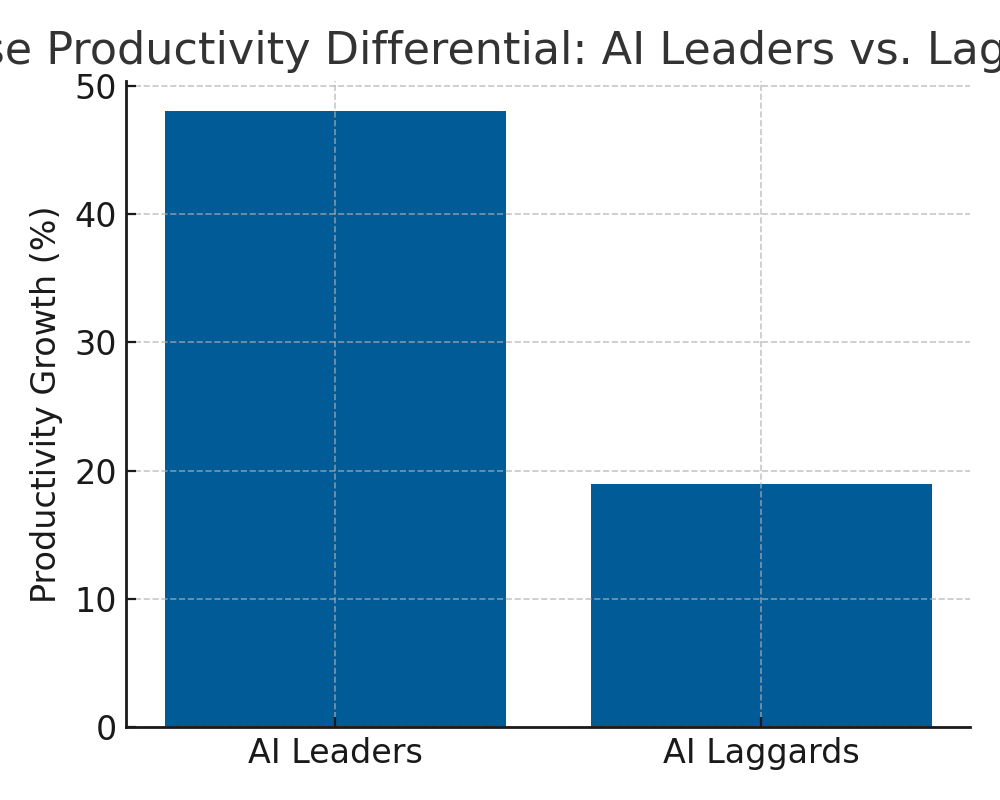
Despite these advances, the divide between AI leaders and laggards continues to widen. Deloitte and the World Bank estimate that mature AI organizations experience productivity growth up to 50 percent higher than peers, driven by predictive analytics, process automation, and faster decision cycles. Those unable to evolve risk competitive marginalization. The pattern echoes earlier digital transformations: early adopters of cloud computing, for instance, now dominate entire sectors, while late movers struggle to modernize legacy operations. The difference today is speed—AI diffusion is happening far faster, compressing the time available for adaptation.
Overcoming this gap demands rethinking organizational incentives. Corporate performance metrics often prioritize short-term financial results, discouraging the kind of sustained experimentation AI requires. Some companies are addressing this by creating internal innovation funds or “AI Centers of Excellence” tasked with developing long-horizon strategies while maintaining alignment with operational priorities. These models protect exploratory work from quarterly performance pressures, creating room for learning and iteration.
A subtler challenge lies in expectation management. Many enterprises experience “AI fatigue” when early enthusiasm fades and returns appear slower than anticipated. Unrealistic projections, often shaped by hype cycles, can lead to disillusionment. The most effective organizations frame AI progress as cumulative—measured not only by profit but by improvements in efficiency, accuracy, and decision velocity. Incremental gains, scaled across departments, compound into measurable competitive advantage.
Looking forward, the next phase of enterprise AI maturity will depend on synthesis rather than specialization. The most advanced organizations will integrate AI into all dimensions of operation—strategy, product development, supply chain, and customer engagement—while maintaining rigorous governance and oversight. The shift from automation to augmentation will redefine how humans and machines collaborate. In manufacturing, predictive maintenance systems will anticipate failures before they occur. In logistics, autonomous optimization will reduce fuel use and emissions. In healthcare, adaptive diagnostic systems will enhance clinician judgment rather than replace it.
The maturity journey is not linear. It requires parallel progress in technology, people, and policy. Technical capability without cultural readiness leads to underutilization. Cultural enthusiasm without data discipline leads to noise. The enterprises that close the gap will align these elements—treating intelligence not as an application but as a design principle.
The enterprise AI maturity gap is, at its core, a question of adaptability. Technology evolves exponentially, but institutions evolve incrementally. The organizations that bridge this divide will not be those with the most algorithms, but those with the most alignment—between data and vision, automation and ethics, innovation and governance. Becoming AI-driven is not a milestone; it is a continuous process of learning, correction, and reinvention. Those who master it will define the architecture of the intelligent economy.
Takeaways
- Cultural alignment and leadership commitment are stronger predictors of AI success than technology alone.
- Enterprises that integrate AI into strategy and governance achieve faster, more sustainable transformation.
- Talent scarcity and fragmented data infrastructure remain key barriers to maturity.
- Ethical governance and regulatory compliance are becoming competitive advantages.
- The maturity gap will define long-term competitiveness—organizations that align culture, data, and oversight will lead the intelligent economy.
Sources
McKinsey & Company — State of AI 2024 Report — Link
PwC — Global AI Adoption and Cultural Barriers Study — Link
Accenture — AI Maturity Index 2024 — Link
World Economic Forum — Future of Jobs Report 2024 — Link
Gartner — Data and Analytics Maturity Model 2025 — Link
MIT Sloan Management Review — AI Governance and Ethical Accountability Study — Link
Deloitte — AI Productivity and Enterprise Transformation Report — Link
World Bank — AI and Economic Competitiveness Study 2024 — Link
Institute of Internet Economics — AI Readiness, Governance, and Maturity Frameworks — Link
Reuters — Corporate AI Investment and Workforce Transformation 2025 — Link