

When the Internet Became Economic Infrastructure
By 2025, internet regulation had moved decisively beyond earlier debates over platform conduct, antitrust enforcement, or content moderation in isolation. Rules governing data flows, artificial intelligence, digital markets, and access to advanced computing increasingly shaped how economic activity itself was organized online. Governments no longer approached the internet primarily as a neutral communications layer or an innovation substrate. Instead, it was treated as economic infrastructure: a system whose design, access conditions, and governance directly structured productivity, opportunity, and risk.
This transition unfolded alongside continued growth in global connectivity. Roughly 6 billion people were online in 2025, up from approximately 5.8 billion the year prior. Yet this expansion masked persistent exclusion. An estimated 2.2 billion people remained offline, concentrated disproportionately in low-income economies, rural regions, fragile states, and among women and older populations. These gaps were not merely technical. They reflected deeper disparities in income, education, institutional capacity, and political stability, demonstrating that connectivity growth alone did not resolve structural inequality.
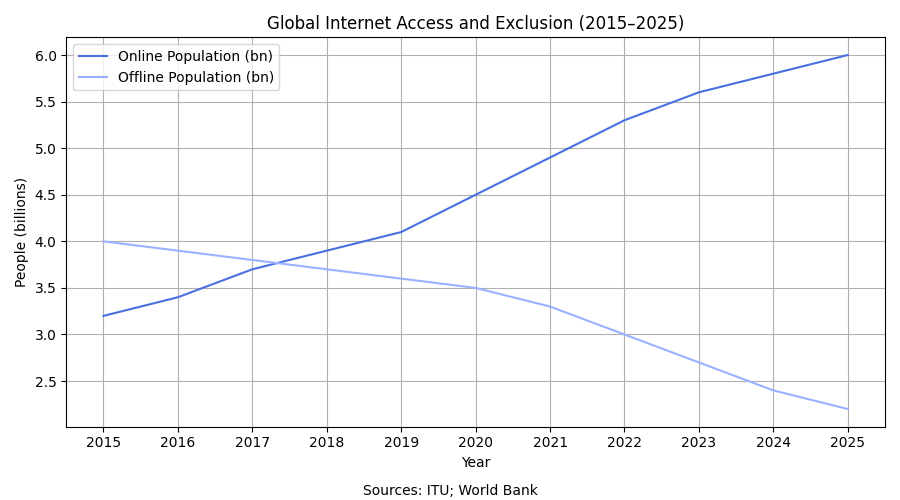
As digital systems increasingly mediated access to employment, finance, education, health care, and government services, regulatory decisions began to shape life chances directly. Digital public infrastructure—such as digital identity systems, interoperable payment rails, and public data exchange platforms—was associated with improved service delivery and financial inclusion where governance capacity and affordability aligned. Where those conditions were absent, regulation often amplified exclusion by raising costs or imposing compliance burdens without corresponding access investment.
Regulatory divergence accelerated through 2024 and 2025. The European Union expanded governance into industrial data and algorithmic systems through the Data Act and the AI Act, extending regulatory oversight well beyond consumer-facing platforms. Other regions pursued narrower or more fragmented approaches, often addressing specific risks without comprehensive frameworks. Fewer than half of UN member states possessed coherent digital regulatory systems, producing uneven participation conditions across the global economy.
Connectivity itself became increasingly political. Nearly 300 internet shutdowns occurred across more than 50 countries in 2024, many linked to elections, protests, or security operations. In highly digitalized economies, nationwide shutdowns were estimated to reduce daily GDP by up to 1 percent. In lower-income contexts, shutdowns disrupted informal commerce, remittances, education access, and basic service delivery. The costs fell disproportionately on those with the least resilience.
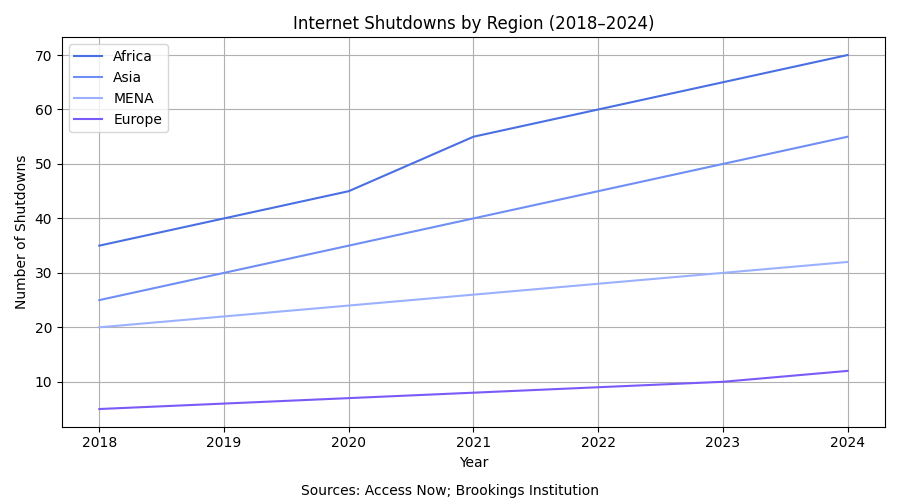
Industrial policy and geopolitics further reshaped the digital environment. Export controls on advanced semiconductors, data localization mandates, and national AI strategies increasingly determined where frontier systems could be developed and deployed. These measures influenced global investment patterns, concentrating advanced capabilities in jurisdictions with capital, energy capacity, and regulatory stability.
What had once been treated as elements of a largely free-flowing global technology system increasingly functioned as instruments of foreign policy. Restrictions on advanced AI chip exports, controls over large-scale data processing capacity, and leverage over critical inputs such as rare earths moved from technical trade administration into the core toolkit of national leaders. Decisions by governments to limit access to compute, manufacturing capacity, or digital infrastructure were no longer framed solely as economic regulation, but as mechanisms to shape strategic alignment, technological advantage, and geopolitical influence.
Policy Instruments Increasingly Used as Digital Foreign Policy Tools
| Policy Instrument | Description | Strategic Purpose |
|---|---|---|
| AI chip export controls | Restrictions on advanced semiconductor sales | Limit rival AI development capacity |
| Compute access controls | Limits on large-scale data processing infrastructure | Shape AI deployment and model training |
| Data localization rules | Requirements to store or process data domestically | Sovereignty, regulatory control |
| Rare earth export restrictions | Control over critical mineral supply chains | Leverage in technology manufacturing |
| Cross-border data restrictions | Limits on international data transfers | Economic security, geopolitical alignment |
Sources: US Department of Commerce; World Trade Organization; Chinese Ministry of Commerce; OECD
Taken together, these developments marked a structural shift. What had once operated as a largely borderless digital economy increasingly functioned through distinct, rule-bound environments shaped by regulation, infrastructure, and enforcement. These environments began to resemble nation-like systems, with defined participation rules, economic policies, and governance norms. The emergence of virtual nations reflected not ideology, but governance necessity.
Regulation as Market Architecture
By 2025, regulation reshaped digital markets less through isolated enforcement actions and more through structural design. In jurisdictions with strong institutions and predictable enforcement, clearer rules reduced uncertainty and enabled long-term planning. Elsewhere, overlapping or inconsistent frameworks increased compliance costs and strategic risk, particularly for firms operating across borders.
European enforcement under the Digital Markets Act and Digital Services Act clarified obligations related to app distribution, advertising transparency, data access, and platform accountability. Large platforms reported substantial compliance investments, reshaping how developers, advertisers, and service providers participated in digital ecosystems. While these measures improved predictability, they also reinforced Europe as a distinct regulatory environment rather than a subset of a unified global market.
Small and medium-sized enterprises faced disproportionate burdens. Although global business-to-business e-commerce reached approximately $27 trillion, SMEs captured only a limited share of cross-border digital trade. Compliance costs, platform access constraints, legal uncertainty, and fragmented standards limited their ability to scale internationally, reinforcing advantages for firms with legal, financial, and technical depth.
Cloud governance illustrated these dynamics clearly. Data portability and localization rules sought to enhance competition, resilience, and sovereignty. In practice, they often required firms to maintain parallel infrastructure and jurisdiction-specific data architectures. While beneficial for certain policy objectives, these requirements fragmented scale efficiencies and raised operating costs, particularly for firms without global infrastructure footprints.
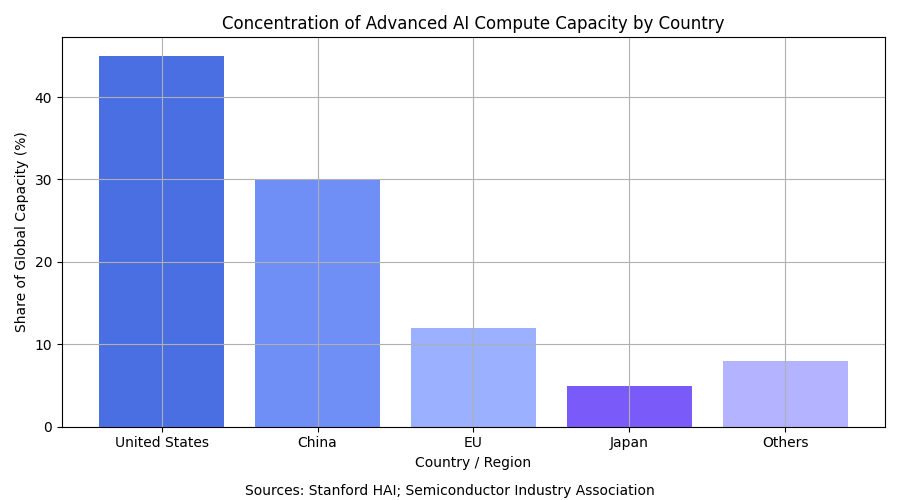
Artificial intelligence intensified concentration pressures. Training frontier models required tens to hundreds of millions of dollars in compute, energy, specialized hardware, and engineering talent. Access to these inputs was unevenly distributed, favoring firms operating within stable regulatory regimes and well-capitalized ecosystems. As a result, companies increasingly aligned strategy around regulatory environments rather than global scale alone, treating market access as jurisdictional participation rather than universal reach.
How Regulation Shapes Daily Life
For individuals, internet regulation was rarely experienced as abstract policy. Its effects were felt through access, affordability, safety, reliability, and trust, with outcomes varying sharply by income, geography, age, gender, and education.
Expanded connectivity enabled mobile payments, online education, telemedicine, digital government services, and remote work. In countries where infrastructure investment was paired with digital skills programs and affordable access, employment outcomes and service delivery improved measurably. Where regulatory costs raised prices or constrained competition without corresponding access expansion, divides widened rather than narrowed.
Key Barriers Facing SMEs in Cross-Border Digital Trade
| Barrier Type | Impact on SMEs |
|---|---|
| Regulatory compliance costs | Disproportionate financial and legal burden |
| Platform dependence | Limited bargaining power and revenue capture |
| Fragmented data rules | Need for jurisdiction-specific systems |
| Infrastructure requirements | Inability to maintain parallel cloud architectures |
| Legal uncertainty | Reduced willingness to expand internationally |
Sources: UNCTAD; World Bank; OECD
Internet shutdowns exposed fragility in stark terms. In regions such as Sub-Saharan Africa and South Asia, shutdowns imposed daily losses in the millions of dollars, disrupting livelihoods dependent on digital tools. Informal workers, small merchants, journalists, students, and migrants relying on remittances were among the most affected. Governance decisions reverberated directly through everyday economic life.
Privacy and security governance shaped autonomy and trust. Strong enforcement correlated with reduced fraud and higher consumer confidence, while weak institutional capacity aligned with rising cybercrime. Global online fraud continued to grow through 2025, disproportionately affecting users with limited digital literacy, weak consumer protections, or constrained access to legal remedies.
AI governance increasingly influenced life chances. Approximately 27 percent of jobs faced high task-level exposure to AI, but outcomes depended less on technology itself than on skills distribution, labor institutions, and social protection systems. Regulation mediated whether automation amplified opportunity or risk, shaping who benefited from productivity gains and who absorbed displacement costs.
A Fragmented World of Internet Governance
Governance models diverged sharply across regions. The United States emphasized innovation, competition, and security through sector-specific regulation, antitrust enforcement, and export controls rather than comprehensive privacy law. This approach supported rapid innovation but created uncertainty for firms and users navigating fragmented legal obligations.
Major Digital Regulatory Frameworks by Region
| Region / Country | Primary Frameworks | Core Focus Areas |
|---|---|---|
| European Union | Digital Markets Act, Digital Services Act, AI Act, Data Act | Competition, platform accountability, AI risk management, industrial data |
| United States | Sectoral regulation, export controls, antitrust enforcement | Innovation, security, competition, strategic technology controls |
| United Kingdom | Online Safety Act, UK AI governance framework | Online safety, child protection, risk-based AI oversight |
| China | Data Security Law, Personal Information Protection Law, algorithm regulation | Content control, data governance, industrial policy |
| India | Digital Public Infrastructure stack, evolving digital regulation | Inclusion, payments, identity, regulatory experimentation |
| Australia | Online Safety Act, social media age restrictions | Platform safety, access control, youth protection |
Sources: European Commission; US Department of Commerce; UK Government; Cyberspace Administration of China; Government of India; Australian Government
Europe and the United Kingdom pursued rights- and risk-based governance through dense regulatory frameworks emphasizing accountability, transparency, and safety. These regimes strengthened user protections while increasing compliance complexity and reinforcing regional regulatory boundaries.
China integrated content governance, data management, algorithm oversight, and industrial policy within a coordinated system designed to support domestic platform growth and strategic capacity building. Interoperability with external systems remained tightly managed, reflecting national priorities around control and resilience.
Elsewhere in Asia, governance varied widely. India combined expansive digital public infrastructure with regulatory volatility, creating both inclusion gains and uncertainty for investors. Japan and South Korea aligned digital governance closely with industrial strategy, emphasizing competitiveness and export capacity.
In the Middle East and North Africa, governance reflected security and stability priorities. Internet shutdowns coexisted with state-led AI investment, producing uneven trust and adoption. Africa experienced rapid mobile adoption alongside frequent disruptions and limited regulatory capacity, disproportionately affecting SMEs and informal workers. Latin America blended rights-based aspirations with uneven enforcement and continued platform dependence.
Across income tiers, high-income economies focused on regulating mature markets, middle-income economies faced coordination gaps, and low-income economies prioritized access over regulatory complexity. The result was not convergence, but layered fragmentation.
Safety, Speech, and the Governance of Information
By 2025, more than 70 countries maintained formal online content governance frameworks, reflecting how rapidly information control had become institutionalized. What began as platform-level moderation debates evolved into state-backed regulatory systems governing speech, visibility, and algorithmic amplification. These frameworks differed sharply in scope and intent, but all signaled a shift away from laissez-faire information flows toward managed digital public spaces.
In the European Union, the Digital Services Act emphasized transparency, systemic risk mitigation, and accountability for large platforms. Early implementation improved response times for illegal content and expanded disclosure around recommender systems. At the same time, uneven outcomes across languages and regions revealed the limits of centralized compliance when applied to diverse cultural and linguistic contexts.
The United Kingdom’s Online Safety Act extended this approach, increasing incentives for automated moderation to address harmful but legal content. While designed to enhance child safety and reduce abuse, early assessments warned of elevated over-removal risks, particularly during politically sensitive periods. Studies documented higher false positives around elections as platforms adopted precautionary moderation strategies to reduce regulatory exposure.
Australia represented a distinct regulatory turn. Mandatory social media age restrictions shifted responsibility for age verification directly onto platforms, effectively regulating access rather than content alone. This approach raised technical, privacy, and enforcement challenges and signaled a willingness to treat social media as a regulated risk environment rather than a neutral forum.
Artificial intelligence regulation increasingly intersected with information governance. Requirements around algorithmic transparency, recommender systems, and generative AI outputs reshaped how information was produced, ranked, and disseminated. AI-powered moderation expanded enforcement capacity but embedded bias and error at scale. As generative systems integrated into search, media, and communication tools, the boundary between speech governance and AI governance blurred.
In more centralized systems, content oversight was integrated into broader information strategies aligned with national objectives. Interoperability diminished as platforms adapted moderation practices to local legal requirements. For users, the experience of the internet increasingly reflected domestic regulatory choices rather than a shared global information space.
Looking Forward
Looking ahead, compliance costs for large digital firms were projected to rise between 15 and 25 percent by 2026 as AI, data, competition, and content rules matured simultaneously. These costs extended beyond legal compliance to include infrastructure redesign, audit systems, localization requirements, and governance staffing. While large firms could absorb these investments, smaller competitors faced higher relative barriers to entry.
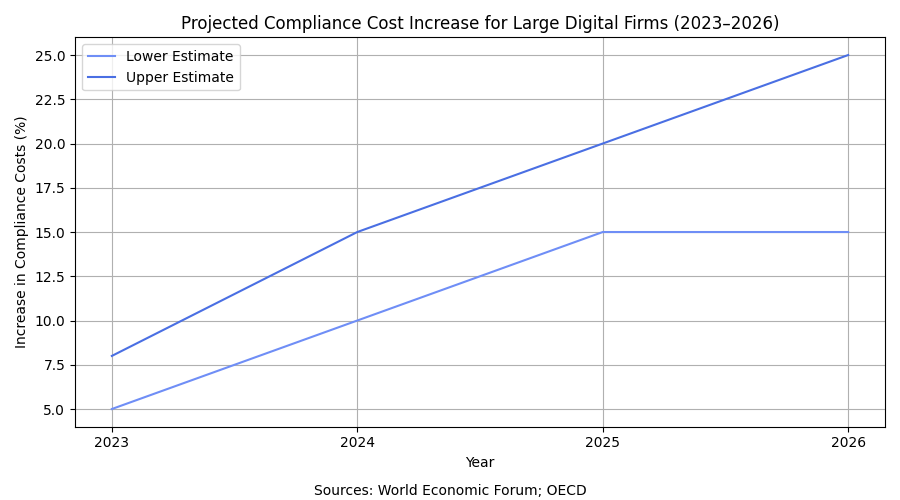
Artificial intelligence governance was poised to intersect more deeply with labor markets, public services, and industrial policy. Risk-based frameworks applied to hiring systems, credit scoring, biometric identification, and generative tools increasingly shaped which applications scaled and which stalled. AI policy became an economic coordination mechanism rather than a narrow ethics exercise.
Advanced AI capacity remained highly concentrated, with fewer than ten countries hosting the majority of frontier model development and high-performance compute infrastructure. Energy availability, semiconductor access, and regulatory predictability reinforced this concentration. Efforts to diffuse AI capacity through international cooperation faced structural constraints tied to capital intensity and geopolitical competition.
As a result, regulatory ecosystems increasingly resembled virtual nations. Participation depended on compliance with jurisdiction-specific rules governing data use, algorithmic design, content standards, and infrastructure location. Firms, developers, and users navigated these environments much as they would national economies, balancing access opportunities against regulatory obligations.
Multilateral coordination continued, but unevenly. Global AI principles, cross-border data initiatives, and digital development compacts advanced shared norms without fully harmonizing enforcement. Capacity gaps, strategic rivalry, and domestic political pressures limited convergence, ensuring fragmentation remained a defining feature of the next phase of internet governance.
Conclusion: Long-Term Implications
The cumulative economic impact of these shifts was substantial. When indirect effects were included, digital sectors accounted for more than 15 percent of global GDP. Digital infrastructure, platforms, and data-driven services increasingly functioned as general-purpose inputs across the economy, amplifying the consequences of regulatory design choices.
Strong data protection enforcement reduced large-scale breaches and improved consumer trust in some regions, demonstrating tangible governance benefits. At the same time, compliance barriers reduced SME digital exports by up to 30 percent in developing economies, reinforcing global asymmetries. Regulation simultaneously enabled trust and constrained participation, depending on institutional capacity and market structure.
Characteristics of Emerging Virtual Nations
| Dimension | Description |
|---|---|
| Data governance | Jurisdiction-specific rules on data collection, storage, and transfer |
| AI regulation | Risk-based or control-oriented oversight of algorithms |
| Content standards | Locally defined speech, safety, and moderation norms |
| Infrastructure control | Regulation of cloud, compute, and connectivity |
| Enforcement capacity | Ability to monitor, audit, and sanction at scale |
| Market access | Participation conditioned on regulatory compliance |
Sources: OECD; World Bank; Institute of Internet Economics
Over time, the internet evolved away from a single integrated system toward multiple rule-bound environments functioning as virtual nations. These environments shaped not only market access but also speech norms, innovation pathways, and individual opportunity. Borders re-emerged in functional form, even where physical infrastructure remained interconnected.
Long-term outcomes will depend less on the volume of regulation than on its coordination and proportionality. Capacity-building, interoperability mechanisms, and regulatory restraint will determine whether virtual nations coexist within a broadly open digital economy or harden into exclusionary blocs. The defining challenge of the next decade will be governing the internet as infrastructure without extinguishing the dynamism that made it transformative.
Key Takeaways
- Internet regulation now functions as economic infrastructure, shaping productivity, participation, and risk allocation across the global economy.
- Regulatory divergence has fragmented the digital economy into jurisdiction-specific environments with nation-like characteristics.
- Compliance costs and infrastructure requirements increasingly determine market access, particularly for SMEs and emerging economies.
- Content, safety, and AI governance are converging, reshaping information flows and user experience across regions.
- Long-term outcomes depend on coordination, institutional capacity, and proportional regulation rather than regulatory expansion alone.
Sources
When the Internet Became Economic Infrastructure
- OECD; OECD Digital Economy Outlook 2024 (Volume 1); – Link
- International Telecommunication Union; Facts and Figures 2025; – Link
- World Bank; Digital Public Infrastructure and Development: A World Bank Group Framework; – Link
- United Nations Department of Economic and Social Affairs; United Nations E-Government Survey 2024; – Link
- Access Now; Internet Shutdowns in 2024: Lives on Hold; – Link
- Access Now; KeepItOn 2024 Internet Shutdowns Annual Report; – Link
- Global Network Initiative; The Economic Costs of Internet Shutdowns; – Link
- U.S. Department of Commerce, Bureau of Industry and Security; Commerce Releases Clarifications of Export Control Rules Restricting PRC Access to Advanced Computing; – Link
- Federal Register; Framework for Artificial Intelligence Diffusion; – Link
Regulation as Market Architecture
- European Commission; Digital Services Act; – Link
- European Commission; How the Digital Services Act Enhances Transparency Online; – Link
- European Commission; Digital Markets Act Annual Reports; – Link
- European Commission; Digital Markets Act Annual Report 2024; – Link
- United Nations Conference on Trade and Development; Digital Economy Report 2024; – Link
- United Nations Conference on Trade and Development; Digital Economy Report 2024 (PDF); – Link
- Organisation for Economic Co-operation and Development; Data Portability, Interoperability and Competition; – Link
- Stanford University Human-Centered Artificial Intelligence; AI Index Report 2025; – Link
- Stanford University Human-Centered Artificial Intelligence; Artificial Intelligence Index Report 2025 (PDF); – Link
How Regulation Shapes Daily Life
- International Telecommunication Union; Facts and Figures 2025; – Link
- Brookings Institution; Internet Shutdowns Cost Countries $2.4 Billion Last Year; – Link
- INTERPOL; Global Financial Fraud Assessment (Public Version); – Link
- INTERPOL; Globalization of Scam Centres: INTERPOL Briefing; – Link
- Organisation for Economic Co-operation and Development; Who Will Be the Workers Most Affected by AI?; – Link
A Fragmented World of Internet Governance
- Congressional Research Service; Data Protection and Privacy Law: An Introduction; – Link
- European Union; Artificial Intelligence Act – Regulation (EU) 2024/1689; – Link
- European Union; Data Act – Regulation (EU) 2023/2854; – Link
- European Commission; Data Act Policy Overview; – Link
- Freedom House; Freedom on the Net 2024; – Link
- GSMA Intelligence; The State of Mobile Internet Connectivity 2024; – Link
- Economic Commission for Latin America and the Caribbean; Digital Agenda for Latin America and the Caribbean 2024; – Link
Safety, Speech, and the Governance of Information
- European Commission; How the Digital Services Act Enhances Transparency Online; – Link
- Pew Research Center; Free Expression Seen as Important Globally; – Link
- UK Government; Online Safety Act 2023; – Link
- Ofcom; Online Safety in 2025: Summary of Industry Response; – Link
- Australian Government eSafety Commissioner; Social Media Age Restrictions; – Link
- Australian Government; Social Media Minimum Age Policy; – Link
Looking Forward
- U.S. Department of Commerce, Bureau of Industry and Security; Export Controls Restricting Access to Advanced Computing; – Link
- Federal Register; Framework for Artificial Intelligence Diffusion; – Link
- Center for Strategic and International Studies; The Consequences of China’s New Rare Earths Export Restrictions; – Link
- Georgetown Center for Security and Emerging Technology; China Rare Earth Export Controls Explained; – Link
- United Nations; Global Digital Compact; – Link
Long-Term Implications
- United Nations Conference on Trade and Development; Digital Economy Report 2024 (PDF); – Link
- United Nations Conference on Trade and Development; Facts and Figures: The Digital Economy; – Link
- European Union Agency for Cybersecurity; ENISA Threat Landscape 2024; – Link
- Organisation for Economic Co-operation and Development; Going Digital to Advance Data Governance for Growth and Well-being; – Link
- United Nations; Global Digital Compact Overview; – Link