
Airlines in the Crosshairs: The AI-Powered Cyber War in the Skies
For decades, commercial aviation has symbolized global connectivity, efficiency, and technological advancement. Yet, in recent months, a new danger has emerged—one that is not visible on radar, cannot be intercepted by air defense systems, and evolves at machine speed. Airlines across continents have been struck by an escalating wave of cyberattacks powered by artificial intelligence. The attacks exploit not just technical vulnerabilities but also the human factor, deploying deepfake audio, synthetic video, and AI-enhanced phishing to dismantle traditional defenses.
The recent breaches at Qantas, WestJet, Hawaiian Airlines, and Aeroflot have served as both warning and proof: cybercriminals have entered a new era of capability, and airlines are on the front lines.
The Evolution of Aviation Cyber Threats
Airlines have always been lucrative targets. The sector handles immense amounts of sensitive data: passenger identities, credit card details, loyalty program information, and even flight operations systems. Until recently, cyberattacks often centered on ransomware or simple phishing attempts. Now, however, attackers wield AI as both weapon and disguise.
AI-generated voice clones can mimic senior executives or customer service staff, tricking employees into revealing access codes. Deepfake video adds another layer of deception, while automated social engineering campaigns can scale to thousands of simultaneous targets. Unlike older techniques, these methods are nearly indistinguishable from authentic interactions.
The threat, as cybersecurity analyst Ricardo Amper put it, is existential: “With only 20 seconds of recorded voice, an AI system can create a flawless impersonation capable of convincing even trained professionals.”
High-Profile Breaches: A Pattern Emerges
Qantas and the Call Center Breach
Australia’s flagship carrier confirmed that nearly six million customer profiles were compromised in a cyberattack linked to AI-powered voice phishing. The attackers bypassed technical defenses not through brute force but through deception, using deepfake impersonations to manipulate call center staff. Exposed details included names, phone numbers, and loyalty program credentials. While passports and financial data were not accessed, the trove of personal information provides fertile ground for identity fraud.
Hawaiian Airlines and Scattered Spider
In June, Hawaiian Airlines reported a breach that disrupted internal IT systems. Flights were not canceled, but operations were strained as staff scrambled to contain the intrusion. Investigators tied the attack to Scattered Spider, a hacking collective infamous for social engineering campaigns. Their methods often involve impersonating IT support staff, persuading employees to surrender login credentials, or bypassing multi-factor authentication systems.
WestJet and Aeroflot: Global Targets
WestJet also fell victim in North America, while Russia’s Aeroflot endured perhaps the most devastating attack to date. Hackers infiltrated its systems for over a year, destroying 7,000 servers and extracting 20 terabytes of data. Over 100 flights were grounded, demonstrating the potential for cyberattacks to cause operational paralysis.
The Aeroflot case illustrates how cybercrime is merging with geopolitics. Responsibility was claimed by hacker groups linked to opposition movements, hinting at how national rivalries and political conflict are increasingly fought in cyberspace.
 Why Airlines Are So Vulnerable
Airlines face a unique combination of risks:
- Legacy systems: Many carriers still operate on outdated IT infrastructure, sometimes decades old, layered with newer platforms that create security gaps.
- Complex ecosystems: Airlines rely on hundreds of suppliers, vendors, and partners, making security a shared responsibility with multiple weak links.
- Data-rich environments: Loyalty programs, biometric travel initiatives, and mobile applications generate valuable personal data.
- Human trust: Call centers, helpdesks, and ticketing staff operate on high-trust models—precisely what AI-powered impersonators exploit.
In many ways, airlines are perfect targets: highly visible, globally interconnected, and dependent on customer trust.
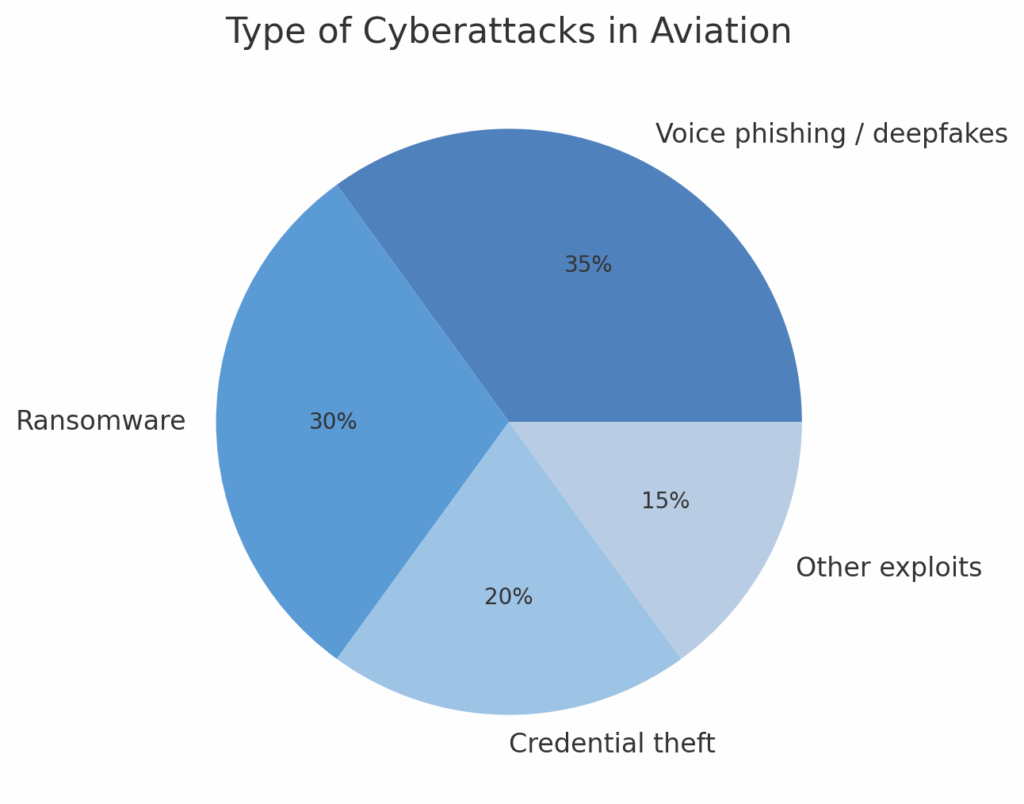

The Rise of AI-Powered Attacks
The aviation sector is not just facing more cyberattacks—it is facing qualitatively different ones.
- Deepfake Voice Phishing (Vishing): Attackers use AI to replicate the voice of executives or IT support staff to manipulate employees.
- Synthetic Video: Video impersonations add credibility to fraudulent instructions or urgent requests.
- Adaptive Malware: AI systems adjust malware signatures in real-time to evade detection by traditional antivirus tools.
- Automated Social Engineering: Bots generate convincing phishing messages tailored to individual employees based on social media and leaked data.
Flying into the Digital Storm
Aviation is one of the most visible battlegrounds for AI-powered cyber warfare. What is unfolding is not just a series of isolated breaches but a structural shift. Airlines, as symbols of global connectivity, have become testbeds for the next generation of cyberattacks.
The industry now faces a reckoning: adapt to a threat landscape that evolves at the speed of algorithms or risk becoming perpetual victims. Just as cockpit crews train for emergencies, digital defense teams must prepare for AI-driven intrusions as a new normal.
The age of analog cybercrime is over. The battleground is algorithmic, and resilience will be measured not by how few breaches occur but by how swiftly and effectively airlines can respond when—not if—they happen.
Key Points
- Airlines have faced a surge of AI-powered cyberattacks, including deepfake impersonations and voice phishing.
- High-profile cases include Qantas, WestJet, Hawaiian Airlines, and Aeroflot.
- Attacks increasingly exploit human trust, bypassing technical defenses.
- Economic costs extend beyond IT repair to customer trust, regulation, and insurance.
- Future resilience requires AI-based defense, zero trust frameworks, and industry collaboration.
Sources
- Fox News: Air France-KLM breach coverage
- Economic Times: Reports on Qantas and WestJet incidents
- Cybersecurity Dive: Analysis of Scattered Spider activity
- Reuters: Hawaiian Airlines cyberattack confirmation
- Financial Times: Aeroflot cyberattack details
- Sangfor Technologies: Aviation cybersecurity analysis
- Adelaide Now: AI deepfake threats in finance and aviation