

The Lifecycle of an AI Prompt
Typing a prompt into an artificial intelligence system feels straightforward. A user writes a question, presses “Send,” and within seconds a response appears on the screen. The exchange resembles a short conversation with a digital assistant, often giving the impression that the interaction is temporary and contained within the chat window. In reality, submitting a prompt initiates a far more complex technical process that extends well beyond the visible response.
The moment a prompt is submitted, the text leaves the user’s device and travels through the internet to servers operated by the AI provider or by cloud infrastructure partners hosting the system. These servers typically reside inside hyperscale data centers operated by companies such as Microsoft, Amazon, or Google. Once the prompt arrives, the system converts the text into tokens—numerical fragments of language that allow neural networks to analyze words mathematically. A single paragraph can become dozens of tokens once translated into the internal representation used by the model.
Those tokens move through a neural network containing tens or hundreds of billions of parameters. Models in the GPT-4 class are believed to operate with parameter counts approaching or exceeding a trillion internal weights across distributed architectures. The system evaluates token sequences and predicts the most probable next token repeatedly until a full response is generated. This process—known as inference—takes place across clusters of specialized processors such as GPUs or AI accelerators designed for large-scale parallel computation.
At global scale, these operations occur continuously. ChatGPT surpassed 100 million users within two months of launch, making it one of the fastest-adopted consumer technologies in history. By 2024, generative AI systems were estimated to have over 900 million users worldwide, and reporting indicates that ChatGPT alone processes roughly 2.5 billion prompts each day. Each of those prompts generates data that can enter logging systems, monitoring infrastructure, analytics pipelines, and model evaluation frameworks used to maintain and improve the system. The prompt that appears to vanish when the answer arrives often continues moving through the technical ecosystem supporting the AI platform.
| Global Adoption of Generative AI Tools | ||
|---|---|---|
| Year | Estimated Global Users | Key Industry Milestone |
| 2019 | ~50 million | Early enterprise AI assistants and research tools |
| 2020 | ~80 million | Growth in cloud-based AI development tools |
| 2021 | ~120 million | Expansion of AI coding assistants |
| 2022 | ~250 million | Public launch of large language model chat interfaces |
| 2023 | ~550 million | Enterprise generative AI deployment accelerates |
| 2024 | ~900 million | AI integrated into major productivity platforms |
| 2030 (Forecast) | ~2.0 billion | Generative AI becomes standard digital infrastructure |
Sources: Stanford HAI AI Index; Microsoft Work Trend Index; IDC Artificial Intelligence Market Forecast
How AI Systems Use Your Data
Once a prompt has been processed, the interaction data can serve multiple operational and strategic functions inside an AI platform. The specific uses vary by company and product configuration, but several common categories have emerged across the industry. Yes, AI shares your information with others when you hit “Send.” It shares it with data partners, advertising and digital marketers, and internal personnel who review and analyze the system. It may also be accessed by auditors and regulators. It goes much farther than most users expect.
The most immediate function of a prompt is generating the response itself. The AI model interprets the text and produces an answer based on patterns learned during training. Many systems maintain conversational context so that earlier prompts within a session influence later responses, enabling extended interactions that resemble natural dialogue. In enterprise deployments, prompts may also interact with external data sources such as corporate documents or proprietary knowledge bases.
| Operational Uses of AI Interaction Data | ||
|---|---|---|
| Use Category | How Data Is Used | Primary Stakeholders |
| Response Generation | Prompts are processed by AI models to generate answers in real time | AI systems and inference infrastructure |
| Model Improvement | Aggregated prompts analyzed to identify errors and improve training | AI research teams |
| Safety and Moderation | Interaction logs used to detect harmful or prohibited content | Trust and safety teams |
| Product Analytics | Usage patterns reveal which features and tasks users rely on | Product development teams |
| Human Review | Annotated interactions help refine reinforcement learning models | Data labeling and evaluation teams |
| Infrastructure Monitoring | Logs help engineers detect failures or optimize performance | Infrastructure and operations teams |
| Compliance and Auditing | Certain interaction records reviewed for regulatory or safety compliance | Regulators, auditors, and legal teams |
Sources: Stanford AI Index; OpenAI Policy Documentation; NIST AI Risk Management Framework
Interaction data also becomes part of system improvement. Engineers analyze prompts and responses to identify where models generate inaccurate information or hallucinated answers. These examples are used to refine safety systems, improve prompt-handling frameworks, and guide the design of training datasets used in future model development. Human reviewers often participate in this process. Investigative reporting and academic research have documented that large AI companies employ thousands of data annotators worldwide who evaluate outputs and label examples used for reinforcement learning systems that guide model behavior.
Prompt data also functions as a large-scale analytics resource. By analyzing millions of interactions, companies gain insight into how users apply AI tools in real-world environments. McKinsey’s global survey of AI adoption reports that 65 percent of organizations now use generative AI in at least one business function, most frequently in marketing, software development, and customer support. The prompts submitted by these users reveal which tasks people attempt to automate and where AI tools provide the greatest value.
Another dimension involves the long-term evolution of the models themselves. Individual prompts do not retrain models immediately, but aggregated patterns across millions of interactions influence how developers design new training datasets and evaluation benchmarks. Over time, this feedback loop allows the behavior of AI systems to evolve in response to how users interact with them.
How Interaction Data Shapes the AI Ecosystem
The rapid adoption of generative AI has created one of the largest new streams of behavioral data in the digital economy. AI tools are now embedded across productivity software, search engines, enterprise platforms, and education systems. Surveys conducted by Microsoft and LinkedIn indicate that 75 percent of knowledge workers have experimented with generative AI, while approximately one in five workers globally uses AI tools regularly in their daily work.
Enterprise adoption has expanded quickly as well. Microsoft reports that more than 70 percent of Fortune 500 companies are experimenting with or deploying AI-powered assistants, and industry forecasts from IDC suggest that enterprise spending on AI software, hardware, and services will exceed $300 billion annually by 2030.
Every deployment produces interaction data describing how humans communicate with machine intelligence. Developers analyze these interactions to understand how users phrase questions, which tasks they attempt to automate, and where AI systems struggle to provide reliable answers. Repeated prompts that trigger incorrect outputs can reveal gaps in training datasets or weaknesses in model reasoning.
Interaction data also reveals new economic use cases for AI technologies. Early generative AI systems were used primarily for writing assistance and programming support. Within a few years, prompts increasingly involve legal document drafting, financial analysis, scientific research, marketing strategy, and data analytics. These patterns illustrate how AI is becoming integrated into professional workflows across multiple industries.
At global scale, billions of prompts submitted each day collectively describe how humans interact with artificial intelligence. Technology companies study this data closely to refine models, build industry-specific AI tools, and identify emerging markets. Each prompt contributes a small fragment of information to a much larger dataset describing the evolving relationship between humans and machine intelligence.

Privacy Risks and Data Sovereignty
The scale of interaction data flowing through AI systems has raised new concerns about privacy and digital governance. Large language models are designed to learn statistical relationships between words rather than store individual conversations. Their parameters encode patterns across training datasets rather than functioning as traditional databases.
However, research has demonstrated that models can sometimes reproduce fragments of text from their training data. Machine learning researchers have shown that carefully designed prompts can occasionally cause language models to emit memorized sequences of training text. While these occurrences are rare, they illustrate the technical challenges involved in preventing sensitive information from appearing in large datasets.
Another concern involves re-identification. Removing direct identifiers such as names or account numbers does not guarantee privacy protection. Research on anonymized datasets has shown that individuals can sometimes be identified through indirect clues such as writing style, geographic references, or contextual information.
User behavior further complicates the issue. Studies examining AI usage patterns have found that individuals frequently disclose personal information while interacting with conversational systems. Health questions, workplace problems, and financial concerns often appear in prompts submitted to AI assistants. The conversational interface encourages users to treat the system as a private advisor, even though the interaction occurs within a large computational platform operated by a technology company.
These dynamics have intensified debates about digital sovereignty. When individuals interact with AI systems, they contribute information that may influence models owned and operated by private firms. Determining who ultimately controls that data—and how it may be used—has become a central question in discussions about AI governance.
The Economics of AI Data
Artificial intelligence systems operate within a rapidly expanding economic ecosystem built on computing infrastructure, data resources, and energy consumption. Training advanced language models requires enormous computational capacity. Analysts estimate that training a frontier AI model can require tens of thousands of GPUs operating for weeks or months, processing datasets containing trillions of tokens.
The cost of training such models can exceed $100 million, largely due to the computing infrastructure required to process these massive datasets. Operating these systems at scale requires even greater investment. With billions of prompts processed daily, AI inference workloads have become one of the fastest-growing segments of global cloud computing.
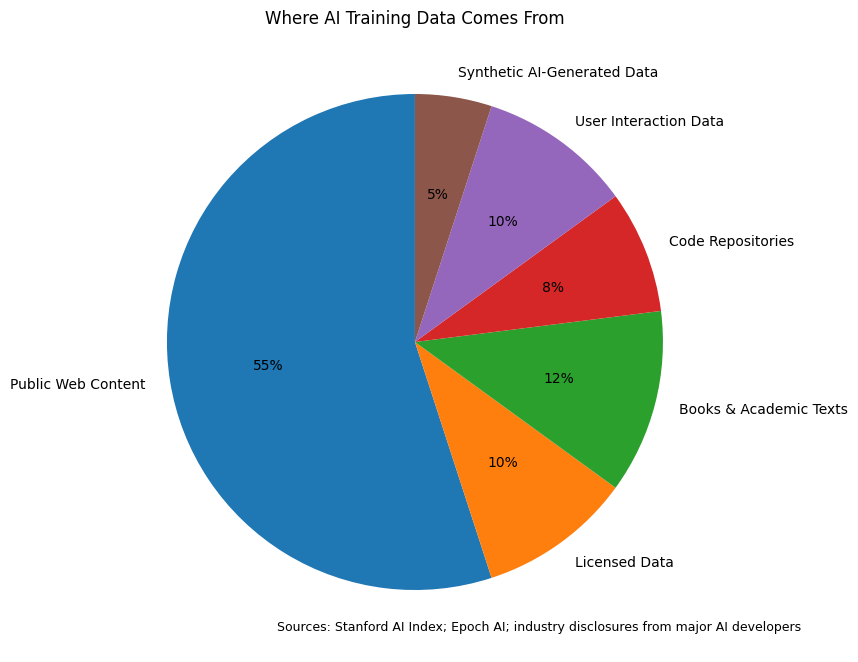
Hyperscale cloud providers are investing heavily in infrastructure to support this demand. Microsoft, Amazon, Google, and Meta collectively spent more than $200 billion on data-center capital expenditures in 2023, much of it related to AI infrastructure and specialized computing hardware. The International Energy Agency estimates that data centers currently consume between 1 and 1.5 percent of global electricity production, and demand is expected to increase as AI workloads expand.
Interaction data plays a central role in this economic system. For AI developers, prompts provide insight into how users apply the technology across industries and professions. This information helps identify new markets, refine product capabilities, and improve model performance. The more people interact with AI systems, the more data developers obtain about real-world usage patterns.
In the emerging AI economy, interaction data has therefore become a strategic resource comparable to computing infrastructure or intellectual property. Companies that operate large AI platforms gain access to continuous streams of behavioral data describing how millions of users interact with machine intelligence.
Governance and the Future of AI Data Rights
As artificial intelligence systems become integrated into economic and social infrastructure, policymakers have begun examining how interaction data is collected and used. Questions about transparency, accountability, and data ownership are becoming central to global digital policy discussions.
Several regulatory initiatives are already emerging. The European Union’s Artificial Intelligence Act introduces transparency requirements and risk classifications for certain AI systems. In the United States, the National Institute of Standards and Technology (NIST) AI Risk Management Framework provides guidelines for responsible AI development and deployment. Other jurisdictions are exploring transparency requirements around AI training datasets and algorithmic accountability.
These developments reflect a broader shift in how digital infrastructure is governed. Artificial intelligence systems increasingly function as information infrastructure supporting research, education, business operations, and public services. Understanding how interaction data flows through these systems is therefore becoming an important issue not only for engineers and technology companies, but also for policymakers and digital citizens.
Submitting a prompt to an AI system may feel like a private conversation. In reality, it represents a data event within a complex technological ecosystem. As AI adoption continues to expand, the governance of that data will shape how societies balance innovation, economic growth, and digital rights in the years ahead.
| Infrastructure Requirements for Modern AI Systems | ||
|---|---|---|
| Category | Typical Scale | Implication for AI Systems |
| Training Compute | Tens of thousands of GPUs | Required to train frontier AI models |
| Training Cost | $100M+ per frontier model | Large financial barrier to entry |
| Training Dataset Size | Trillions of tokens | Large datasets required for model accuracy |
| Daily System Usage | Billions of prompts | Continuous demand for inference computing |
| Global Data Center Electricity | ~1–1.5% of global electricity | Energy demand driven by AI workloads |
| Cloud Infrastructure Investment | $200B+ annual hyperscaler spending | Rapid expansion of AI data centers |
Sources: International Energy Agency; Stanford AI Index; McKinsey Global Institute; Microsoft, Amazon, Google financial filings
Key Takeaways
- AI systems process billions of prompts each day, generating vast amounts of interaction data.
- Each prompt undergoes tokenization and neural network inference before producing a response.
- Interaction data is used for model improvement, analytics, safety monitoring, and regulatory oversight.
- Aggregated prompts influence the development of future AI systems and how models respond to users.
- Privacy risks include potential memorization of training data and re-identification of anonymized datasets.
- AI infrastructure requires massive computing resources and growing energy consumption.
- Interaction data has become a strategic economic resource within the rapidly expanding AI industry.
- Governments are developing governance frameworks addressing transparency, accountability, and digital rights.
Sources
- Stanford University Human-Centered AI; AI Index Report 2024; – Link
- McKinsey & Company; The state of AI in early 2024: Gen AI adoption spikes and starts to generate value; – Link
- IDC; A Deep Dive Into IDC’s Global AI and Generative AI Spending; – Link
- International Energy Agency; Electricity 2024; – Link
- Microsoft; 2024 Work Trend Index Annual Report; – Link
- OpenAI; How your data is used to improve model performance; – Link
- OpenAI; AI and compute; – Link
- University of North Carolina Information Technology Services; AI, data privacy and you; – Link
- Google Developers; Machine Learning; – Link
- IBM; Exploring privacy issues in the age of AI; – Link
- TIME; Exclusive: OpenAI Used Kenyan Workers on Less Than $2 Per Hour to Make ChatGPT Less Toxic; – Link
- The Verge; ChatGPT handles 2.5 billion prompts every day, OpenAI says; – Link
- Carlini et al.; Extracting Training Data from Large Language Models; – Link
- Nasr et al.; Membership Inference Attacks on Machine Learning Models; – Link
- Narayanan and Shmatikov; Robust De-anonymization of Large Sparse Datasets; – Link
- Epoch AI; Training compute of frontier AI models grows by 4–5x per year; – Link
- Electronic Frontier Foundation; Artificial Intelligence; – Link
- European Commission / EU AI Act portal; Artificial Intelligence Act; – Link
- National Institute of Standards and Technology; AI Risk Management Framework; – Link