


For much of the 20th century, consumer spending revolved around ownership. Goods and services were purchased, used, and disposed of in cycles that shaped industries and defined economic growth. Yet in recent years, demand has shifted dramatically. The rise of the subscription economy, underpinned by automation and digital platforms, reflects a fundamental change in what consumers want. Microeconomically, this transformation speaks to evolving utility preferences, a redefinition of value, and new patterns of marginal decision-making. Its effects ripple outward, influencing how businesses compete, how revenue is structured, and ultimately how broader economies adapt.
At its heart, the subscription economy signals a shift in consumer desire away from ownership toward access, convenience, and personalization. In classical microeconomic terms, utility maximization is no longer tied solely to possession of goods but to ongoing services that deliver continuous satisfaction. Streaming platforms like Netflix and Spotify illustrate this shift: instead of owning individual DVDs or albums, consumers pay a monthly fee for unlimited access. For the consumer, the marginal utility of each additional dollar spent is enhanced because it secures not just one item but an entire library. The psychological weight of ownership—storage, obsolescence, maintenance—is lifted, replaced by the frictionless flow of access.
The implications extend beyond entertainment. In replenishment models, such as Amazon Subscribe & Save, automation ensures that necessities arrive before the consumer realizes they are running low. Here, microeconomic efficiency is driven by the minimization of transaction costs. The traditional model required time and energy for repeated purchases, but automated subscriptions reduce both, increasing consumer surplus. The convenience yields measurable gains: surveys show 28 percent of consumers cite ease of use as the primary reason for adopting subscriptions, while 23 percent cite cost savings. This illustrates how demand shifts when transaction friction is reduced—a central theme in microeconomic theory.
Curation models add another dimension. Services like StitchFix and Birchbox leverage algorithms to tailor product selections to individual tastes. In microeconomic terms, this personalization reduces information asymmetry between consumers and producers. By outsourcing discovery to algorithms, consumers experience lower search costs and potentially higher satisfaction. At the same time, businesses enjoy stronger demand stability because curated services heighten switching costs. The unseen effect is a reinforcement of consumer lock-in, where the marginal cost of moving to a competitor feels disproportionately high.
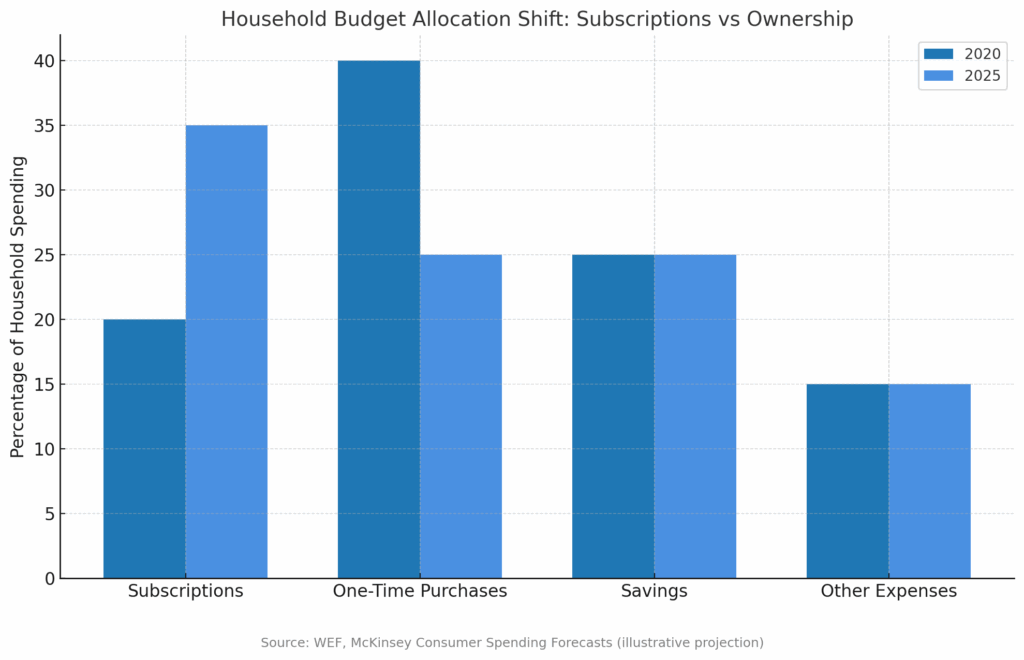 Microeconomics also helps explain the appeal of subscription models from the perspective of consumer budgeting. Subscriptions smooth consumption, spreading costs into predictable increments. This phenomenon, known as consumption smoothing, stabilizes demand across time periods. Adobe’s shift from selling its Creative Suite to offering Creative Cloud subscriptions exemplifies this. High upfront costs were a barrier to many consumers, but by distributing expenses into smaller monthly payments, Adobe expanded its user base by 45 percent. For consumers, the affordability of smaller, repeated payments increased accessibility; for the firm, predictable recurring revenues improved long-term stability.
The subscription model also reconfigures the elasticity of demand. Traditional product purchases often exhibited higher price sensitivity, with consumers delaying or forgoing purchases when prices rose. Subscriptions, however, bundle access into recurring fees, altering perceived elasticity. Research suggests that consumers are less responsive to price changes in subscriptions than in one-off transactions, particularly when services are embedded into daily routines. Amazon Prime illustrates this: its combination of delivery, streaming, and bundled benefits creates multi-faceted value, reducing consumer willingness to cancel even when prices rise. From a microeconomic lens, this demonstrates how bundling alters demand elasticity, protecting firms against revenue volatility.
Yet this shift is not without constraints. Subscription fatigue is a growing microeconomic phenomenon. As households accumulate multiple services, the marginal utility of additional subscriptions declines. Consumers begin to reassess their budget constraints, canceling less-used services in order to reallocate spending. This is consistent with diminishing marginal utility: while the first streaming service may provide significant value, the fifth may feel redundant. Firms face the challenge of positioning their service to maintain its place in the household’s constrained optimization problem.
The rise of the subscription economy also has larger economic implications. On a macro level, it contributes to stable revenue streams for businesses, but at the micro level, it alters household spending patterns in ways that aggregate across economies. Predictable expenses encourage budgeting and allow households to allocate discretionary income differently. At the same time, subscription lock-ins shift consumer surplus into producer surplus, raising questions about long-term welfare impacts. While firms benefit from predictable cash flow, households risk overspending due to automated renewals or underestimating cumulative subscription costs.
This evolution in consumer demand reflects deeper psychological and behavioral underpinnings. Reduced payment friction lowers the salience of individual purchases. Instead of weighing each transaction independently, consumers commit to recurring charges that fade into the background of financial awareness. Behavioral economists argue this “low-visibility spending” reduces price sensitivity, allowing firms to extract more value without overt resistance. In effect, automation not only changes how demand is met but subtly reshapes how it is perceived.
Technological innovation amplifies these shifts. AI and advanced analytics drive personalization, optimize pricing strategies, and minimize churn. From a microeconomic standpoint, these technologies create near-perfect price discrimination environments, where firms can tailor offerings to maximize revenue from each consumer segment. Businesses leveraging AI have reported increases in customer lifetime value by up to 25 percent. While efficient in terms of firm revenue, such models raise equity concerns, as not all consumers benefit equally from personalization.
Environmental sustainability adds another layer. Subscription services that emphasize sharing rather than ownership, such as Rent the Runway, extend product life cycles and reduce waste. Each garment rented replaces an estimated eight to ten purchased items, lowering the overall demand for new production. On a microeconomic scale, this shifts consumer preference curves toward greener alternatives. On the supply side, it incentivizes producers to design durable goods that can withstand multiple users. While the environmental benefits are clear, they hinge on consumer demand continuing to align with values of sustainability and convenience.
The microeconomic dynamics of the subscription economy reveal a world in which consumer desires for convenience, personalization, and flexibility are reshaping broader spending patterns. Firms respond by innovating business models, investing in retention strategies, and leveraging automation to anticipate demand. Consumers, in turn, gain access to more services but face trade-offs in autonomy and cumulative financial costs.
What emerges is an economy where access trumps ownership, where recurring commitments reshape household budgeting, and where automation ensures seamless satisfaction at the cost of consumer visibility. For microeconomists, the lesson is clear: consumer demand is not static. It evolves alongside technology, culture, and behavioral shifts, and its implications extend from the household ledger to the global marketplace.
Key Takeaways
- Microeconomic analysis reveals that demand is shifting from ownership toward access, convenience, and personalization.
- Subscriptions reduce transaction costs, smooth consumption, and alter demand elasticity, benefiting both consumers and firms.
- Case studies like Adobe Creative Cloud and Amazon Prime show how subscription models expand user bases and stabilize revenues.
- Subscription fatigue reflects diminishing marginal utility as households balance multiple recurring services.
- Automation and AI enhance personalization but raise concerns about price discrimination, consumer autonomy, and overspending.
Sources
- Subscription Economy Index (Zuora) — Link
- McKinsey Global Institute on Consumer Behavior — Link
- World Economic Forum Future of Jobs Report — Link
- OECD Digital Economy Outlook — Link
- Financial Times on Consumer Spending Models — Link
- Forbes on Subscription Business Growth — Link
- Federal Trade Commission “Click-to-Cancel” Rule — Link
- MIT Technology Review on Behavioral Economics and AI — Link
Would you like me to also design visuals specifically from a microeconomic angle (like demand curves for ownership vs. subscriptions, marginal utility decline, or household budget allocation shifts)?