

The promise of the internet was once one of liberation. It was supposed to make people smarter, markets fairer, and choices freer. But in the world of algorithmic personalization and behavioral targeting, that promise has inverted. Today, the digital marketplace no longer merely reflects human behavior—it engineers it. Every click, scroll, and hesitation is observed, analyzed, and optimized to influence what comes next. Platforms have evolved from neutral intermediaries into behavioral architects, shaping not only what people buy but how they think and act.
The foundation of this transformation lies in behavioral economics, a field that exposes how human choices often deviate from rational logic. The digital economy has scaled these insights, embedding them into code and design. Anchoring, scarcity, social proof, and loss aversion—once studied in laboratories—now operate as invisible infrastructure across digital life. Platforms test millions of behavioral variants each day, learning what nudges work best and adapting their systems accordingly. The result is a marketplace that feels personal but is structured for persuasion.
At its most basic level, digital persuasion starts with how value is framed. When a streaming service lists a premium subscription first, followed by a cheaper “standard” option, it establishes a reference point that makes the lower tier appear economical. This anchoring effect—where the first number we see skews our perception of value—is one of the most pervasive forms of bias online. Retailers manipulate it constantly, showing inflated “list prices” next to discounted ones or labeling bundles as “best value” to steer decisions. The effect is subtle but powerful; it changes perception long before any conscious decision-making occurs.

Urgency amplifies the pull of emotion. A countdown timer flashing “Only two left!” triggers loss aversion—the fear of missing out. The consumer is not deciding between products; they are reacting to the threat of loss. Digital urgency has become so widespread that regulators have intervened. The European Commission found that several booking platforms overstated scarcity, prompting policy reforms. Yet despite scrutiny, these tactics endure because they work. Studies continue to show double-digit increases in conversions from time-limited prompts. It is not deception in the traditional sense but an engineered form of anxiety that blurs rational choice.
The power of the crowd adds another layer to digital persuasion. Humans tend to look to others for cues when uncertain, and platforms have learned to operationalize this instinct. Product rankings, trending videos, and visible counters like “3,000 bought today” are the digital equivalent of social validation. A recent MIT Sloan Review analysis found that the manipulation of reviews and recommendations can shift consumer preference more effectively than price changes. Visibility becomes a feedback loop: what the algorithm promotes, people see; what people see, they buy; what they buy, the algorithm promotes again. Popularity becomes self-fulfilling.
Even the absence of friction influences behavior. When a subscription defaults to auto-renewal or when “accept all” is the easiest privacy setting, the user’s inaction becomes a predictable asset. Behavioral economists describe this as the power of defaults—our natural tendency to stick with pre-set choices. Many digital firms exploit this inertia, making opting out intentionally inconvenient. The Norwegian Consumer Council’s 2023 study Deceived by Design found that users were 60% more likely to consent to data sharing if declining required extra effort. The industry calls this “seamless experience.” Regulators increasingly call it manipulation.
The consequences are not merely commercial. As behavioral design became industrialized, its influence seeped into broader culture. Platforms that manipulate attention for profit now shape political discourse, emotional climates, and even public trust. Algorithms that learn to maximize engagement often do so by amplifying outrage, exaggerating differences, or feeding users what they already believe. What was once a strategy to sell more goods has become a mechanism that governs perception itself.
This evolution has created what scholars term behavioral capitalism—a system in which human attention, emotion, and predictability are monetized. Every interaction generates data, and every data point improves the model predicting what users will do next. The digital economy no longer depends on information asymmetry between buyers and sellers; it depends on asymmetry between humans and algorithms. Users are predictable; platforms are not.
Yet not all firms use these insights to exploit. Some are beginning to recognize that trust is an asset just as valuable as conversion. Airbnb simplified refund policies after customer frustration peaked during the pandemic, and the result was a rebound in user satisfaction. Apple built an entire brand narrative around privacy, turning design transparency into competitive advantage. These companies understood that the behavioral infrastructure of technology can just as easily reinforce trust as it can erode it. The difference lies in intent.
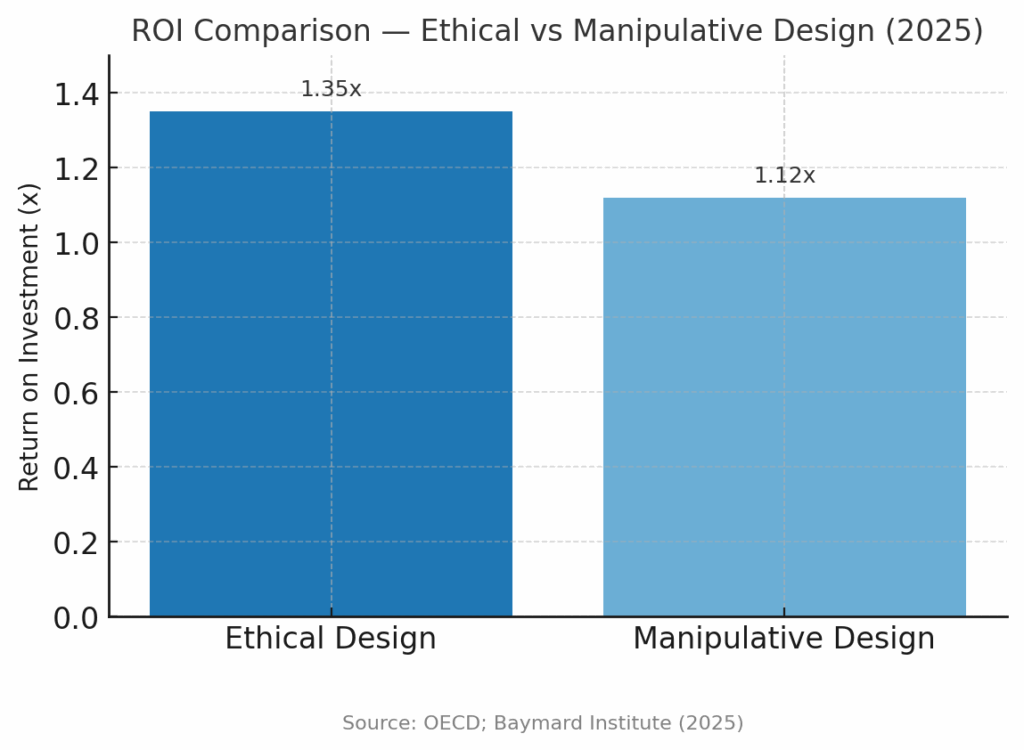
Ethical design is not simply a moral stance—it is emerging as a business model. Firms that emphasize user autonomy see stronger retention and loyalty over time. Transparency builds resilience against regulatory risk and reputational collapse. The lesson is simple: persuasion without accountability is unsustainable. As digital ecosystems mature, profit will increasingly depend on credibility.

Regulators have already begun to close the gap between behavioral science and law. The U.S. Federal Trade Commission, the EU’s Digital Services Act, and the UK Competition and Markets Authority have each launched actions against what they term “dark patterns”—interfaces that mislead, coerce, or exploit users. In this new regulatory landscape, user experience design is no longer just a creative function; it is a governance issue. Companies must now document how their systems influence decision-making, an acknowledgment that behavioral architecture carries ethical weight.
The implications reach far beyond compliance. As interfaces become more intelligent and personalized, they increasingly act as agents—deciding which options to show, which to hide, and which to recommend. This algorithmic mediation shapes everything from consumer markets to democratic participation. The structure of the interface becomes the structure of opportunity. The digital world that feels intuitive and frictionless is, in reality, a carefully managed ecosystem of nudges.
For executives, the question is no longer whether their platforms influence behavior, but how responsibly they do so. Behavioral optimization can increase revenue, but overuse corrodes trust and invites intervention. The future of competitive advantage may depend less on who captures the most data and more on who uses it with the greatest integrity. Transparency, consent, and fairness are becoming economic differentiators.
In many ways, this marks a return to first principles. Markets have always depended on trust. Digital markets, however, have redefined it. Instead of faith in the product, users now must trust the process—the unseen algorithms that determine what they see and when. A company that cannot demonstrate fairness in its digital design risks more than lost sales; it risks irrelevance in a world that prizes credibility over complexity.
The next phase of digital evolution will likely focus on behavioral transparency. Platforms will need to reveal when and how they use persuasive design. Governments will demand explainable algorithms. Investors will begin rating behavioral ethics alongside environmental and governance metrics. A new kind of accountability is emerging—one rooted in the recognition that every digital decision carries psychological consequences.
Technology will always influence human choice; it cannot be neutral. The challenge is to ensure that influence aligns with autonomy rather than undermines it. The same behavioral tools that drive addiction and overspending can promote healthier habits, sustainability, and education when used deliberately. The power of the interface is not inherently manipulative—it is only as ethical as the goals it serves.
The internet was designed to connect people and information. Over time, it began connecting incentives instead—aligning human behavior with corporate objectives. The future of digital platforms will depend on reversing that equation, restoring the primacy of human intention over algorithmic prediction. The architecture of persuasion, refined through decades of data, now faces a choice of its own: whether to deepen dependency or enable autonomy.
If technology can reshape behavior, it can also reshape responsibility. The next era of the internet will not be defined by faster processing or richer content, but by whether its designers and users can build systems that influence without exploiting, that persuade without deceiving, and that empower rather than diminish human choice.
Key Takeaways
- Platforms use psychological design—anchoring, scarcity, defaults, and social proof—to influence billions of decisions daily.
- Behavioral design drives profits but also systemic dependence, public mistrust, and regulatory oversight.
- Ethical persuasion and transparent defaults are emerging as business advantages, not liabilities.
- Regulators increasingly treat manipulative interfaces as governance failures rather than design issues.
- The next stage of the digital economy depends on balancing influence with autonomy in behavioral systems.
Sources
- International Journal of Social Impact — Behavioral Economics and Consumer Decision-Making in the Digital Age (2025) — Link
- OECD — Dark Commercial Patterns and Online Choice Architecture (2024) — Link
- Norwegian Consumer Council — Deceived by Design (2023 Update) — Link
- FTC — Bringing Dark Patterns to Light (2022) — Link
- MIT Sloan Review — The Economics of Social Proof and Market Manipulation (2024) — Link
- Baymard Institute — Checkout UX: Friction, Trust, and Abandonment Benchmarks (2025) — Link
- International Association of Behavioral Design — Digital Influence and Consumer Autonomy (2025) — Link