


Across Europe, small and medium-sized enterprises (SMEs) are leaping into artificial intelligence with enthusiasm but without the technological groundwork needed to sustain it. A recent Reuters report, based on a Qonto and Appinio survey, found that nearly half of European SMEs now use AI tools like ChatGPT on a daily basis. Yet paradoxically, many of these same companies lack basic digital systems such as accounting software, cloud infrastructure, and secure document management. The trend reveals an imbalance at the heart of Europe’s digital transition—an eagerness to adopt AI’s promise of innovation without first laying the digital foundation required to make it reliable, scalable, and safe.
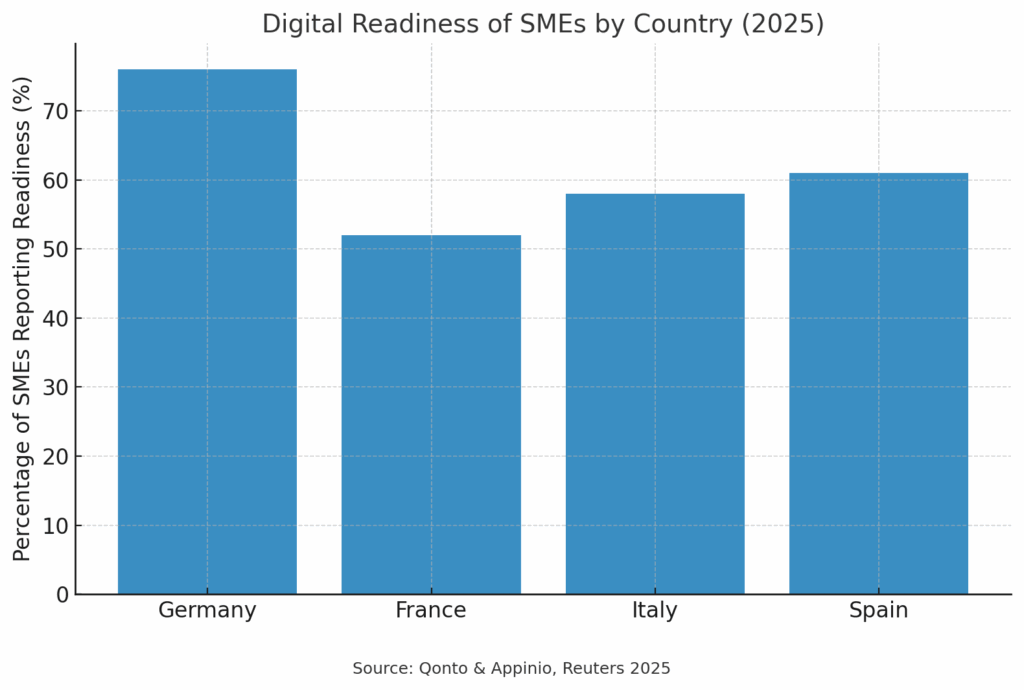
The findings expose a striking contradiction. According to the survey, 46 percent of SMEs across France, Germany, Italy, and Spain use AI regularly, but less than a third employ consistent digital workflows for their financial or operational management. In France, nearly half of respondents admitted their businesses were not digitally prepared, while Germany reported the highest confidence, with three-quarters claiming readiness. The European Union has long framed its SMEs as the backbone of economic activity—accounting for over 99 percent of all enterprises and two-thirds of employment—but this uneven digital maturity threatens to fracture that foundation.
At the root of the problem is a pattern familiar to economists and technology analysts: the allure of frontier innovation often overshadows the unglamorous but vital task of building infrastructure. Artificial intelligence is not plug-and-play—it thrives on structured data, integrated workflows, and skilled operators. Without these, the technology risks creating inefficiencies rather than solving them.
Academic research underscores this concern. A 2024 study of more than 12,000 EU SMEs found that internal capabilities—such as data management, process automation, and employee digital literacy—were far more predictive of AI success than external policy incentives. Another analysis by the Bruegel think tank argued that Europe’s competitiveness depends less on AI adoption rates and more on foundational digital capacity, especially in cloud infrastructure and cybersecurity. In simple terms, Europe’s small firms are trying to fly before they can walk.
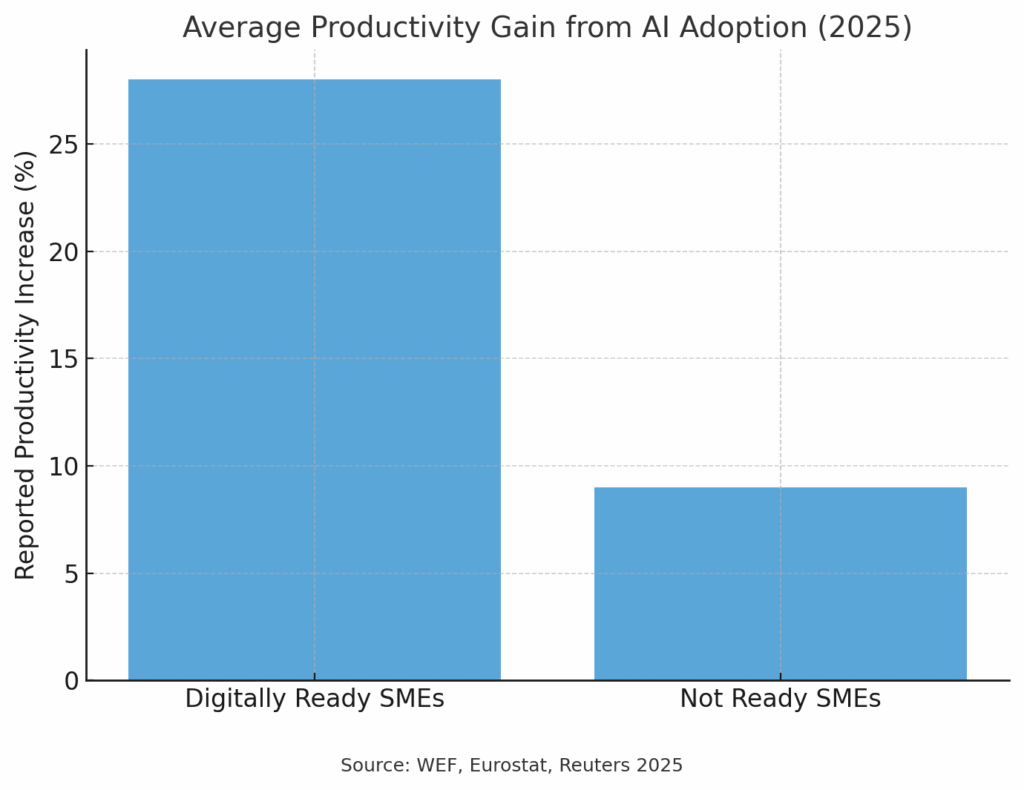
This imbalance has tangible consequences. SMEs adopting AI without core digital systems face three interconnected risks: operational fragility, data unreliability, and governance exposure. Without stable databases, version control, or workflow management, AI-generated outputs are only as accurate as the messy information they rely upon. Errors propagate invisibly, leading to poor business decisions or compliance breaches. In financial operations, for example, unverified expense data can lead AI-powered budgeting tools to suggest faulty spending strategies. In human resources, unstructured employee records can cause bias or misclassification in automated screening tools.
The European Commission’s Digital Economy and Society Index (DESI) repeatedly warns that the majority of EU businesses remain far behind global leaders in digital adoption. Only 18 percent of European SMEs use cloud computing, compared to 40 percent in the United States. Even fewer employ integrated ERP or CRM systems—technologies that form the digital skeleton of modern operations. Without them, AI deployments exist in isolation, unable to draw on real-time, interconnected data streams.
The costs of this imbalance are already evident. An EY survey found that over half of companies deploying AI suffered some financial loss due to risk exposure, often linked to poor implementation, data errors, or cybersecurity breaches. Small businesses are particularly vulnerable because they lack in-house expertise to audit or control AI outputs. The result is a widening digital divide: a minority of tech-savvy firms reap exponential gains while the majority remain stuck at the experimental stage.
Yet there are compelling examples of what can happen when the foundations are built correctly. Nordic countries, for instance, offer a model for balanced digital transformation. In Finland, small health-tech firms have adopted a “threefold readiness” framework—categorizing themselves as AI-curious, AI-embracing, or AI-catering. Those that invested first in digital record systems and standardized data flows advanced much faster toward effective AI integration. By contrast, firms that skipped these preparatory steps remained dependent on ad hoc tools with limited returns. Similarly, in Denmark, SMEs that digitized their accounting and logistics functions before experimenting with AI saw productivity rises of 20–30 percent within two years, according to national business surveys.
The macroeconomic potential of AI, when built on robust digital ground, remains significant. A joint analysis by the World Economic Forum and McKinsey estimates that European AI adoption could unlock up to €600 billion in additional annual economic value by 2030. However, that projection assumes universal readiness—an assumption the current data does not support. Without systemic interventions, that potential will remain concentrated among larger, digitally advanced firms, exacerbating inequality in Europe’s internal market.
The fintech sector illustrates both the promise and pitfalls of Europe’s AI experiment. Qonto, the fintech behind the recent survey, integrates AI to automate invoice categorization and cash flow prediction. For small firms that already use cloud-based accounting, such tools have reduced administrative time by as much as 30 percent. But for those without digital ledgers or standardized transaction data, the same algorithms generate unreliable results. This mismatch demonstrates a broader structural problem: Europe’s AI revolution is not failing from lack of ambition but from inconsistency in its digital foundations.
Bridging this gap requires coordinated action across three fronts: policy reform, business education, and technological standardization. On the policy side, the EU’s digital sovereignty agenda is already shifting toward foundational support. The €1.1 billion European AI Initiative, launched in 2025, includes provisions to expand cloud access, cybersecurity training, and small-business data frameworks. Yet experts argue that incentives should be conditional on demonstrated digital readiness. Grants and AI funding should prioritize firms that have implemented baseline systems such as cloud storage, secure communications, or ERP integration. This approach ensures sustainability and measurable ROI rather than speculative enthusiasm.
Education and workforce training are equally crucial. According to Eurostat, less than 40 percent of European workers feel digitally competent, and only a fraction receive ongoing training. For AI adoption to be productive rather than performative, businesses must invest in digital literacy at all levels—from data entry to executive decision-making. The European Commission’s AI strategy emphasizes “trustworthy AI,” but trust must begin with competence. SMEs that understand the fundamentals of data hygiene, software integration, and risk assessment are better positioned to harness AI responsibly.
Finally, standardization can mitigate fragmentation. By promoting open APIs, interoperable software frameworks, and regional digital hubs, policymakers can lower costs and prevent vendor lock-in. Shared digital infrastructure—particularly in sectors like logistics, manufacturing, and healthcare—allows smaller firms to plug into national or EU-level platforms without having to build everything in-house. This cooperative model mirrors successful initiatives in Scandinavia and the Netherlands, where government-backed digital commons enable SMEs to exchange data securely and access AI services without prohibitive costs.
The path forward demands balance: Europe cannot slow innovation, but it must anchor it in solid ground. Artificial intelligence is not a substitute for digitization; it is its natural extension. A business without digital systems using AI is like a pilot without instruments—capable of taking off but not of navigating safely. By prioritizing foundational readiness, Europe can ensure that the AI revolution is inclusive, productive, and enduring.
The stakes extend beyond economics. Europe’s regulatory and ethical leadership depends on demonstrating that technological advancement can coexist with accountability, privacy, and human-centered values. SMEs are central to that vision. They represent innovation at the grassroots level, job creation across regions, and cultural diversity in enterprise. But to fulfill that role in the AI era, they must be equipped with more than enthusiasm—they need the infrastructure to thrive.
As digital tools evolve, the lesson becomes clear: progress built on shaky foundations risks collapse. The future of European business will depend not on how quickly it adopts AI, but on how well it integrates it into the everyday machinery of work. Only when the basics are secure can intelligence—artificial or otherwise—truly flourish.
Key Takeaways
- Nearly half of European SMEs use AI daily, yet many lack essential digital systems such as accounting or cloud infrastructure.
- Research shows internal digital capability is the strongest predictor of successful AI use.
- AI without foundational systems increases risks of data error, governance failure, and operational instability.
- Countries and firms that build strong digital infrastructure first, such as Finland and Denmark, achieve far higher productivity from AI.
- Europe’s policy focus must shift toward building foundational readiness—through infrastructure, training, and standardization—before scaling AI adoption.
Sources
- Reuters — European Small Businesses Rush into AI Without Basic Digital Tools, Study Shows — Link
- Bruegel — Europe’s AI Competitiveness and SME Digital Foundations — Link
- European Commission — European Approach to Artificial Intelligence — Link
- World Economic Forum — AI’s Economic Impact on Europe — Link
- EY — Global AI Risk and Financial Exposure Report — Link
- Qonto and Appinio — AI Adoption Among European SMEs Survey 2025 — Link
- Eurostat — Digital Economy and Society Index (DESI) 2025 — Link