
From Digital Adoption to Digital Dependence
Imagine an economic system that no one voted for, no legislature debated, and no regulator designed, yet one that quietly became indispensable to daily life. That is how the internet crossed from innovation into utility. The internet cemented itself into ubiquity and became a functional utility. It did not arrive as infrastructure; it became infrastructure through use. What began as a tool for communication and experimentation embedded itself so deeply into social and economic routines that withdrawal gradually ceased to be imaginable. This shift occurred faster than almost any prior general-purpose technology transition, leaving institutions, governance, and cultural norms permanently behind the adoption curve.
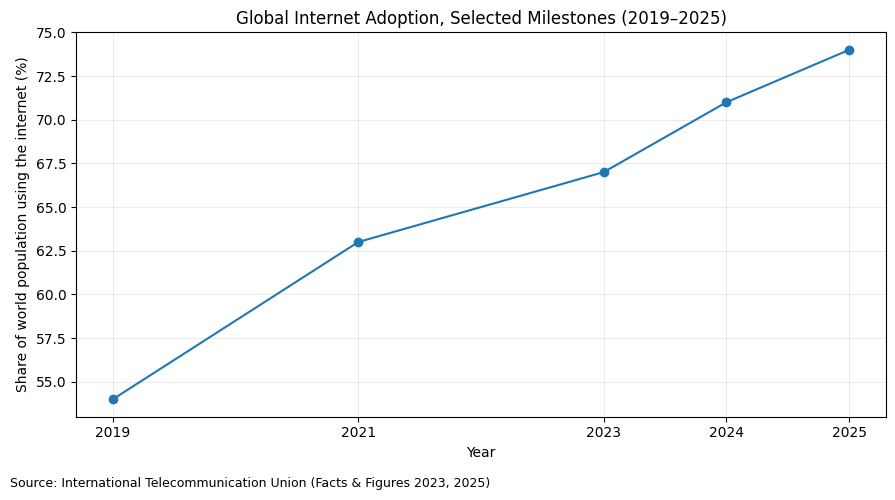
By 2025, the scale of this transformation was visible in global participation data. The International Telecommunication Union estimated that around 6 billion people, roughly three-quarters of the world’s population, were using the internet, while 2.2 billion people remained offline. That split is not merely technological. It marks a structural divide between populations integrated into the digital economy and those excluded from it. Connectivity increasingly functions as a prerequisite for economic participation rather than an optional enhancement.
The enterprise layer reveals how quickly dependence formed. In the European Union, 52.74% of enterprises used paid cloud services in 2025. Among those firms, cloud adoption concentrated overwhelmingly on essential operational functions: email (85.15%), office software (71.69%), and file storage (71.53%). These are not marginal applications. They are the internal nervous system of modern organizations. When core coordination tools migrate to cloud platforms, internet access becomes inseparable from productive capacity.
Cultural normalization followed the same trajectory. Social interaction, news consumption, commerce, entertainment, and work shifted online within a single generation, with digital platforms becoming the default interface for coordination and exchange. The enterprise pattern reinforces this reality. When communications, documentation, financial workflows, and security systems are cloud-based, “going offline” is no longer a lifestyle choice. It is an operational failure. Governments reinforced this dependency by digitizing tax systems, welfare delivery, licensing, healthcare coordination, and identity management. As public services became “digital by default,” participation without connectivity ceased to be realistic.
Generational dynamics accelerated acceptance. Younger populations, raised inside digital environments, displayed higher tolerance for data sharing, platform intermediation, and algorithmic decision-making, with convenience routinely outweighing abstract risk. Pew Research found that 72% of adults under 30 report clicking “agree” to online privacy policies without reading them, compared with 39% of adults aged 65 and older. This divergence did not slow adoption, but it shaped how expectations around governance, protection, and accountability emerged unevenly across society.
| Phase | Defining Logic | Governance Posture |
|---|---|---|
| Frontier Phase | Openness and experimentation | Minimal oversight |
| Platform Phase | Scale and network effects | Reactive regulation |
| Infrastructure Phase | Economic indispensability | Ex ante governance |
| Source: IoIE analytical framework | ||
As dependence deepened, the internet began to resemble a functional utility. It is not physically life-sustaining, but it is operationally imperative. Payments, logistics coordination, scheduling, workforce management, and customer engagement depend on persistent connectivity. When disruptions occur, they increasingly behave like economic shocks rather than service inconveniences. A widely cited econometric approach summarized by the Global Network Initiative, drawing on Deloitte analysis, estimates that in a medium-connectivity country, a full internet shutdown can cost approximately 1% of daily GDP.
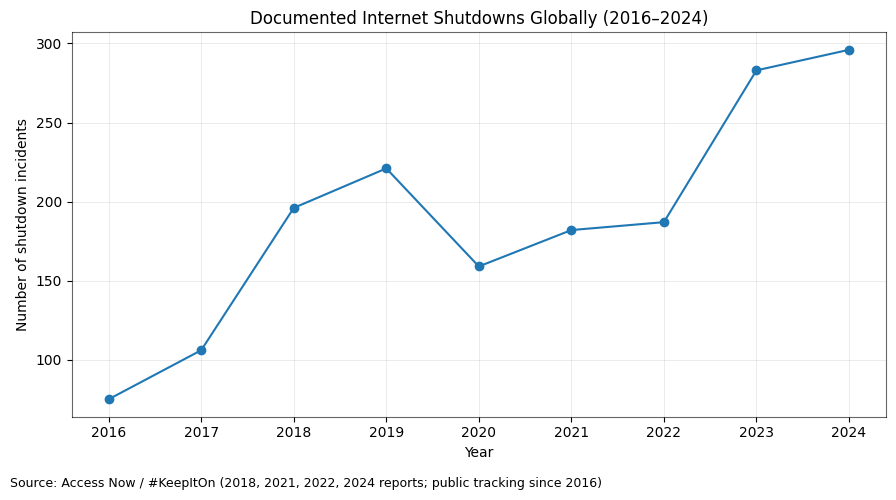
The speed of this transition obscured its fragility. Much of what defines today’s digital economy did not exist five years ago, and many dominant platforms were economically insignificant a decade earlier. That fragility is visible in how frequently connectivity is deliberately disrupted. Access Now and the #KeepItOn coalition documented 296 internet shutdowns across 54 countries in 2024, the highest number ever recorded. Connectivity has become a controllable lever of economic life, exercised with increasing frequency.
Crucially, acceptance preceded understanding. Individuals adopted platforms long before grasping the implications of persistent data extraction. Businesses integrated cloud services before fully pricing jurisdictional exposure and continuity risk. The enterprise adoption curve illustrates this gap directly. In the EU, cloud usage rose by 7.42 percentage points between 2023 and 2025, a pace that routinely outstrips legal, governance, and procurement adaptation cycles. Governments digitized services faster than they developed the capacity to govern the systems they now rely on, creating structural dependence without commensurate control.
Core Domains of Digital Sovereignty
| Domain | What Is Governed | Why It Matters |
|---|---|---|
| Data | Storage, transfer, lawful access | Rights protection and enforcement |
| Cloud Infrastructure | Operational control and resilience | Systemic risk mitigation |
| Compute | Access to advanced processing capacity | Economic and security competitiveness |
| Platforms | Market access and conduct | Economic coordination and trust |
| Source: OECD, WTO, and IoIE synthesisCore Domains of Digital Sovereignty | ||
This imbalance set the stage for digital sovereignty. As personal data accumulated, social behavior migrated online, and economic activity flowed through digital channels, digital issues became societal and national ones. The shutdown record offers a blunt indicator of the new stakes. When states can impose connectivity disruption at scale, and do so hundreds of times in a single year, the internet ceases to function merely as a market. It becomes a governable economic domain. Privacy shifts from consumer preference to political question. Cybersecurity incidents and platform manipulation move from technical concerns to matters of public safety and institutional legitimacy.
The rise of virtual nations begins here. The internet embedded itself into culture, society, and economic life faster than institutions could adapt. Its utility-like dependence is now measurable in cloud reliance, shutdown frequency, and GDP sensitivity to disruption. Once a system becomes indispensable, societies demand that it be governable. That demand forms the economic foundation of digital sovereignty.
From Frontier Economics to Virtual Nations
The internet was not built to be governed. It emerged as a frontier system shaped by experimentation, technical curiosity, and a prevailing belief that openness itself would generate growth. During the 1990s and early 2000s, policymakers largely deferred to engineers and early internet economists who argued that minimal regulation would maximize innovation and global welfare. The logic mirrored historical frontiers: rapid expansion, limited oversight, and delayed institution-building. At the time, global e-commerce volumes were negligible, digital payments were niche, and data held little standalone economic value beyond advertising.
From Internet Frontier to Governable Infrastructure
| Phase | Defining Logic | Governance Posture |
|---|---|---|
| Frontier Phase | Openness and experimentation | Minimal oversight |
| Platform Phase | Scale and network effects | Reactive regulation |
| Infrastructure Phase | Economic indispensability | Ex ante governance |
| Source: IoIE analytical framework | ||
That framework collapsed under scale. The defining features of today’s digital economy emerged faster than regulatory institutions could respond. Social media platforms reached billions of users within a decade. Cross-border e-commerce sales exceeded USD 5 trillion annually by the early 2020s, according to UNCTAD estimates, transforming digital trade from peripheral activity into a core driver of global commerce. Embedded payments, app-based labor platforms, and algorithmic logistics coordination did not simply digitize existing markets. They reorganized how goods, services, and labor moved across borders.
As scale increased, territorial constraints reasserted themselves. Financial regulators confronted unprecedented volumes of cross-border digital payments flowing through privately governed systems. Tax authorities struggled to capture value generated by firms with limited physical presence. Supply-chain regulators faced logistics networks coordinated by algorithms optimized globally rather than nationally. The internet’s abstraction of geography collided directly with governance systems built around territorial accountability.
Data became the first major fault line. As datasets expanded, data evolved into a critical production input across advertising, finance, healthcare, transportation, and public administration. Research from McKinsey and the OECD consistently identifies data as a driver of productivity growth and firm-level competitiveness. Yet governance remained fragmented. Personal and enterprise data were routinely stored, processed, and analyzed under foreign legal regimes, exposing governments to surveillance risk, enforcement gaps, and loss of policy control.
The legal consequences of this mismatch became explicit with the 2020 Schrems II ruling, which invalidated the EU–U.S. Privacy Shield. One of the largest legal frameworks governing transatlantic data transfers disappeared overnight, affecting thousands of firms. Multinationals relying on U.S.-based cloud services were forced to reassess data flows, introduce standard contractual clauses, localize storage, or redesign systems entirely. What had once been treated as a compliance detail became an architectural constraint shaping economic design.
Regional Approaches to Virtual Nation Formation
| Region | Primary Mechanism | Strategic Tradeoff |
|---|---|---|
| European Union | Regulation and enforceability | Control over scale |
| Middle East | State ownership and capital deployment | Speed over openness |
| East Asia | Central coordination | Efficiency over plurality |
| Source: Reuters, OECD, IoIE analysis | ||
Early regulatory responses attempted to correct outcomes without altering structures. Privacy rules, transparency obligations, and monetary penalties improved accountability but left core incentives intact. Even headline fines under GDPR frequently amounted to less than 1% of global platform revenues. Enforcement lagged innovation cycles, and firms internalized penalties as operating costs rather than as signals to change architecture.
The inflection point arrived when governments reframed digital systems as critical infrastructure. Infrastructure-level dependence demanded infrastructure-level governance. This marked the operational emergence of digital sovereignty. Rather than regulating behavior after harm occurred, states began defining the conditions under which digital markets could operate at all.
Data sovereignty was formalized through localization requirements, sector-specific residency mandates, and transfer restrictions. Financial data, health records, government communications, and defense-related information increasingly became jurisdiction-bound. Firms were compelled to re-engineer data pipelines, build in-country processing capacity, and absorb higher fixed costs. Data ceased to function as a globally fungible resource and became a regulated factor of production.
Cloud governance followed. Governments introduced sovereign cloud requirements, certification schemes, and public-sector procurement rules conditioning eligibility on domestic legal control, auditability, and security assurances. Public procurement emerged as a powerful enforcement mechanism. In many economies, public-sector IT spending represents 5–10% of total digital services demand. France’s decision to migrate 2.5 million civil servants away from U.S.-based collaboration platforms by 2027 illustrates how procurement functions as de facto digital border control.
Artificial intelligence extended sovereignty concerns beyond data into industrial and security policy. Advanced AI development depends on scarce inputs: high-performance chips, massive compute clusters, energy-intensive data centers, and specialized expertise. Training frontier AI models now costs tens to hundreds of millions of dollars in compute alone. Export controls and licensing regimes formalized compute capacity as a national asset rather than a market commodity.
Through these mechanisms, virtual nations took shape. They are not isolated digital enclaves, but jurisdictionally enforced internet economies with distinct rules governing data, platforms, compute, and standards. Regulation became economic architecture. Market participation increasingly depends on alignment with governance frameworks rather than technical capability alone.
What Virtual Nations Mean for the Internet Economy
With sovereignty embedded into infrastructure, regulation, and trade policy, its economic effects are no longer theoretical. They are visible in capital allocation, market structure, firm strategy, and state behavior. The rise of virtual nations is reshaping the internet economy from a single, scale-optimized system into a network of interoperable but jurisdictionally distinct markets. In Europe’s financial sector, this shift is institutionalized. EU regulators have designated 19 technology firms as critical third-party providers under DORA, including Amazon Web Services, Microsoft, and Google Cloud.
Fragmentation is the most immediate consequence, and it is measurable. Cloud services, data infrastructures, AI platforms, and compliance regimes are increasingly regionalized. Hyperscalers have responded by investing tens of billions of dollars in region-specific data centers and sovereign cloud offerings. These investments raise capital intensity and baseline service costs, which are ultimately passed through to enterprises and consumers.
For businesses, this is a structural shift rather than a temporary adjustment. Multinational firms now operate across multiple virtual nations simultaneously, each imposing distinct requirements for data residency, encryption control, audit rights, breach notification timelines, and lawful access. Industry surveys consistently show that adapting to multi-jurisdictional digital regulation increases cloud and data governance costs by roughly 5% to 20%, depending on sector and complexity. These costs are now embedded in operating models. In the EU, 52.7% of enterprises used paid cloud services in 2025, primarily for email (85.2%), office software (71.7%), and file storage (71.5%), extending sovereignty obligations to everyday business functions.
Market structure is adjusting accordingly. Firms built with modular architectures and jurisdiction-aware data pipelines gain advantage. Uniform global systems face redesign costs and delayed market entry. Smaller firms bear disproportionate compliance burdens, raising concerns that poorly designed sovereignty regimes entrench incumbents.
Fragmentation has also produced resilience benefits. Regulators increasingly treat digital infrastructure concentration as systemic risk. Major cloud providers are now subject to resilience testing, exit planning, and concentration assessments similar to those applied in banking. This shift reflects lessons from outages affecting payment systems, trading platforms, and public services.
Trade dynamics are evolving in parallel. Digital trade increasingly resembles regulated services trade. Data localization rules and platform obligations function as non-tariff barriers. WTO–OECD analysis estimates that full data autarky could reduce global GDP by 4.5% and cut exports by 8.5%, turning sovereignty design into a macroeconomic choice rather than a compliance debate.
Risks and Opportunities of Virtual Nations
| Dimension | Risk | Potential Benefit |
|---|---|---|
| Market Structure | Incumbent entrenchment | Domestic ecosystem growth |
| Innovation | Fragmentation | Trust-based adoption |
| Governance | Protectionism | Institutional legitimacy |
| Source: WTO, OECD, IoIE synthesis | ||
The near-term outlook points toward acceleration. Over the next 24 to 36 months, sovereign cloud adoption is expected to expand further. Global spending on data-center infrastructure already exceeds hundreds of billions of dollars annually, with a growing share directed toward regional and in-country capacity. Enforcement of existing rules is tightening, embedding sovereignty into daily operations.
Artificial intelligence will intensify these dynamics. AI depends on scarce inputs: compute, energy, and high-quality data. Export controls have already reshaped markets. As AI becomes central to productivity growth across sectors, access to these inputs will increasingly define competitiveness.
Virtual nations ultimately reflect a shift in organizing logic. The internet persists as a connectivity layer, but economic activity increasingly unfolds within jurisdictionally bounded systems reflecting national priorities and risk tolerances. EU cloud adoption already ranges from 79.2% of enterprises in Finland to 17.8% in Bulgaria in 2025, signaling uneven readiness for sovereignty-driven change. This does not mark the end of globalization. It marks the maturation of the internet as an economic system, where governance becomes unavoidable and virtual nations emerge as the structural response.
Key Takeaways
-
The internet became foundational economic infrastructure through mass adoption long before societies developed the governance capacity to control it.
-
Digital dependence is now measurable in enterprise cloud reliance, GDP sensitivity to shutdowns, and the operational collapse that follows connectivity loss.
-
Cloud adoption shifted from optional tooling to core production infrastructure, pulling everyday business functions into the scope of sovereignty and regulation.
-
Acceptance of digital systems consistently preceded understanding of data extraction, jurisdictional risk, and long-term governance consequences.
-
Internet shutdowns demonstrate that connectivity has become a direct lever of economic power rather than a neutral technical service.
-
Digital sovereignty emerged as a response to infrastructure-level dependence, reframing regulation as economic architecture rather than compliance.
-
Data moved from a globally fungible resource to a jurisdiction-bound factor of production governed by territorial accountability.
-
Public procurement and certification regimes now function as de facto digital borders shaping market access and vendor behavior.
-
Virtual nations reflect the end of the internet’s frontier phase and the beginning of governable, jurisdictionally distinct digital economies.
-
The central economic question is no longer whether borders exist online, but whether their costs remain proportionate to the stability and trust they provide.
Sources
- International Telecommunication Union; Facts and Figures 2025 – Measuring Digital Development; – Link
- Eurostat; Cloud computing – statistics on the use by enterprises; – Link
- Eurostat; More than half of EU enterprises used cloud computing services in 2025; – Link
- Pew Research Center; How Americans Protect Their Online Data; – Link
- Access Now; Internet Shutdowns in 2024; – Link
- Global Network Initiative; New Report Reveals the Economic Costs of Internet Shutdowns; – Link
- UN Conference on Trade and Development (UNCTAD); Global e-commerce sales surged past $5 trillion; – Link
- Organisation for Economic Co-operation and Development; Data, Trust and Privacy in the Digital Economy; – Link
- McKinsey Global Institute; The Age of Analytics: Competing in a Data-Driven World; – Link
- Reuters; France to replace US software in public sector to boost digital sovereignty; – Link
- Reuters; Amazon, Google named by EU among critical tech providers for finance industry; – Link
- World Trade Organization & Organisation for Economic Co-operation and Development; Data Regulation and Digital Trade; – Link
- World Trade Organization; Data flows are the lifeblood of the global economy; – Link
For more information about Virtual Nations see: https://instituteofinterneteconomics.org/virtual-nations-digital-economies/