

A student waits for coursework to download on a shared low-end smartphone while the connection resets and the file fails to load.
For much of the past two decades, the digital divide was defined by a binary threshold: being online. That definition no longer reflects how exclusion operates. By 2025, nearly 6 billion people, approximately three quarters of the global population, use the internet, supported by mobile broadband networks that reach over 90% of the world’s population. Fifth-generation coverage alone extends to more than half. By conventional measures, access has been achieved.
What remains unresolved is whether that access works.
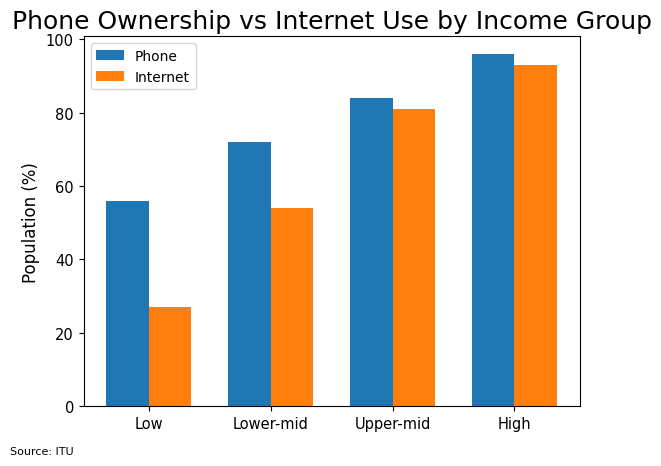
An estimated 3.1 billion people live within mobile broadband coverage but do not use mobile internet. This usage gap is several times larger than the population still outside network reach, signaling that the constraint has shifted from availability to functionality. A connection may exist, but participation depends on whether it can sustain use, whether applications load, transactions complete, and sessions persist without interruption. Where these conditions are not met, access becomes nominal, present in infrastructure but absent in outcome.
| Then | Now | Implication |
|---|---|---|
| Being online | Ability to use digital systems | Access ≠ participation |
| Coverage gaps | Usage gaps | ~3.1B still not using internet |
| Infrastructure focus | Device + performance focus | Capability defines access |
Capability Defines Access, Devices Determine Capability
If access is functional, devices determine its limits.
Global ownership patterns illustrate the divide. While approximately 86% of adults worldwide own a mobile phone, only around 68% own a smartphone, and in low-income countries smartphone ownership falls below 40%. Total mobile ownership in these regions is closer to 56%, compared to over 95% in high-income economies. These differences determine whether individuals can engage with modern digital systems at all.
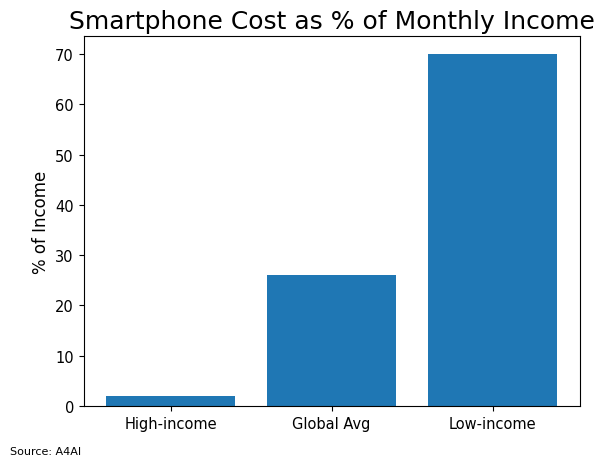
Affordability remains the central constraint. In many low- and middle-income countries, an entry-level smartphone can exceed 20 to 30% of average monthly income, while higher-capability devices remain significantly more expensive. Data costs compound the barrier, with basic mobile internet access exceeding 5% of income in several markets, well above the 2% affordability benchmark. For households managing limited and variable income, device acquisition is not incremental, it is prohibitive.
The result is a breakdown between access and use. A user attempting to access telehealth services may encounter repeated timeouts due to limited processing capacity. Government portals, often designed with high data requirements, may fail to load. Financial applications may install but stall during authentication or transaction processing. The World Bank identifies device capability and usability as primary barriers to digital public service adoption, indicating that connectivity alone does not translate into participation.
Tasks that require continuity, education, financial transactions, service access, become unreliable. During global school disruptions, at least 463 million students were unable to access remote learning due to lack of devices or connectivity. At the same time, approximately 1.7 billion adults remain unbanked, with limited access to digital tools contributing to exclusion. Where systems depend on sustained interaction, unreliable device performance results in exclusion in practice.
Devices are no longer supporting tools; they are the interface through which economic participation occurs.
| Device Type | What Works | What Breaks |
|---|---|---|
| Low-end smartphone | Messaging, basic browsing | Apps, forms, video |
| Mid-range smartphone | Payments, services | Complex tasks |
| High-capability device | Full digital access | Few constraints |
Smartphone Dependency and Tiered Digital Economies
Across low- and middle-income countries, more than 70% of internet users rely primarily on smartphones, while in high-income economies mobile-only access persists along income lines, with 16% of adults and 34% of lower-income individuals depending exclusively on smartphones.
High-capability devices remain unevenly distributed. Smartphones capable of supporting advanced applications, multitasking, and sustained performance often remain beyond the reach of lower-income populations. The constraint has shifted from owning a phone to owning a sufficient one, introducing a reinforcing cycle where limited device capability restricts income-generating activity and constrains the ability to upgrade.
Mobile financial systems illustrate both the progress and the limitation. Globally, mobile money accounts exceed 1.6 billion, with transaction volumes surpassing 2 trillion dollars annually. In Sub-Saharan Africa, adoption has grown to over 28% of adults, up from less than 10% a decade earlier, enabling financial participation in regions where traditional banking infrastructure was limited.
Yet these systems assume device reliability. A user may install a mobile wallet but fail to complete transactions due to app instability, limited memory, or interrupted sessions. Authentication processes may fail, and interfaces may not load consistently. Access exists, but participation remains unstable.
This instability shapes economic outcomes. Smartphone-only users tend to concentrate in lower-productivity segments of the digital economy, platform-based work, microtransactions, and social commerce, while higher-value digital activities remain associated with access to more capable devices and stable computing environments. Both groups are connected, but their economic trajectories diverge as capability determines not only access, but the type of participation that follows.
| Sector | Failure Point | Impact |
|---|---|---|
| Finance | App crashes, login failure | 1.7B remain unbanked |
| Education | Downloads fail | 463M students excluded |
| Healthcare | Session instability | Limited telehealth use |
Digital Inequality Embedded in Economic Systems
Device constraints extend beyond individuals into the structure of economic systems themselves. Digital platforms now underpin financial services, education delivery, healthcare access, and labor markets, and participation assumes reliable, capable access.
The scale of this shift is measurable. Globally, 76% of adults now hold an account with a financial institution or mobile money provider, up from 51% in 2011, yet 1.7 billion remain excluded. In education, remote learning systems reached billions, but at least 463 million students were unable to participate. In healthcare, telehealth adoption exceeded 30% of consultations in some advanced economies, while remaining limited in regions where device capability and connectivity are constrained.
A single user may encounter these constraints across systems. Digital payments may be received but not reliably accessed. Educational content may be available but not usable. Healthcare services may exist but remain functionally inaccessible. These are not isolated failures, they reflect systems built on the assumption of capability.
When that assumption does not hold, friction accumulates. Transactions fail, sessions drop, and processes remain incomplete. What appears as access in aggregate data becomes fragmented participation in practice, and over time these constraints compound, limiting education, restricting financial access, and reducing income-generating opportunities.
Digital inequality is now defined not by connection, but by the ability to operate within systems that require speed, stability, and capable hardware.
Structural Misalignment in Digital Inclusion Policy
Telecommunications networks are predominantly commercial systems, and across most markets infrastructure is privately operated, with investment decisions driven by expected returns rather than universal access.
This model has enabled rapid expansion of coverage, with mobile technologies generating approximately 7.6 trillion dollars in economic value in 2025, equivalent to 6.4% of global GDP. Yet the distribution of that value is uneven. In many low-income countries, smartphones can exceed 30 to 40% of monthly income, while data costs remain above affordability thresholds. Operators prioritize higher-income markets and user segments, reinforcing unequal access.
The result is a disjointed system. A network may be deployed across a region, yet remain underused because devices are unaffordable and service quality varies. Governments measure coverage, and development programs track infrastructure deployment, but the 3.1 billion usage gap persists. The system measures availability, not effective participation.
| System | How It Works | Result |
|---|---|---|
| Telecom | Profit-driven | Uneven coverage quality |
| Devices | Tiered pricing | Good phones are expensive |
| Affordability | High relative cost | 20–30%+ income required |
The consequences are visible in everyday use. A small business owner may have connectivity but lack a device capable of managing payments or inventory. A patient may attempt to access digital healthcare and fail due to device instability. A student may be counted as connected yet unable to complete coursework. Infrastructure addressed access, but it did not resolve capability.
Redesigning Digital Inclusion as an Economic System
Digital inclusion can no longer be treated as a connectivity problem; it is an economic system problem that requires alignment across devices, networks, platforms, and skills.
Devices function as economic infrastructure. Approximately 3.1 billion people remain unconnected despite coverage, with affordability identified as the primary barrier. At the same time, mobile financial systems process over 2 trillion dollars annually, demonstrating the scale of participation enabled when access is functional.
| Component | Role | Outcome |
|---|---|---|
| Affordable devices | Enable access | Higher participation |
| Stable connectivity | Enable completion | Reliable usage |
| Usable platforms | Reduce friction | Broader inclusion |
The difference is practical. A small business owner with a capable device can accept digital payments, track transactions, and expand beyond local markets, while without such a device transactions remain cash-based, limiting scale and resilience.
Emerging models are beginning to address this gap. Pay-as-you-go smartphone financing and microcredit-based acquisition are expanding across multiple regions, enabling users to distribute costs over time. In several markets, these models have increased smartphone adoption by double-digit percentages within targeted populations.
But capability depends on alignment. Devices must be paired with affordable connectivity, usable platforms, and the skills required to navigate them. Where these elements converge, participation increases. Where they do not, access remains fragmented.
The New Boundary of Inclusion
Infrastructure expanded access; it did not equalize participation.
Global connectivity has reached unprecedented levels, yet the divide persists in a different form. Devices now determine whether individuals can participate in financial systems, education, healthcare, and labor markets, shaping outcomes across sectors. The next phase of inclusion will not be defined by connection alone, but by the ability to use that connection effectively, at speed, with stability, and with the tools required to participate fully.
Key Takeaways
- The digital divide is no longer defined by being online; it is defined by the ability to use digital systems effectively.
- Nearly 6 billion people are connected, yet around 3.1 billion remain within coverage but do not use mobile internet.
- Device capability, speed, and stability now determine whether access translates into real participation.
- Owning a phone does not guarantee usability; low-capability devices often prevent completion of basic tasks.
- Smartphone affordability remains a structural barrier, with devices costing 20 to 30% or more of monthly income in many low-income markets.
- Digital systems in finance, education, and healthcare assume reliable devices, excluding users whose technology cannot sustain use.
- Approximately 1.7 billion adults remain unbanked, and at least 463 million students have been unable to access digital learning due to device and connectivity constraints.
- Smartphone-only access limits users to lower-productivity digital activity, reinforcing income inequality.
- Telecom networks and device markets operate on commercial incentives, creating uneven access based on purchasing power.
- The next phase of digital inclusion depends on aligning devices, connectivity, platforms, and skills into a functioning system, not just expanding network coverage.
Sources
- International Telecommunication Union (ITU); Measuring Digital Development: Facts and Figures 2025; – Link
- GSMA; The State of Mobile Internet Connectivity Report 2024; – Link
- World Bank; Global Findex Database 2021 (latest comprehensive dataset); – Link
- UNESCO; Education: From Disruption to Recovery (Global Learning Loss Data);– Link
- Alliance for Affordable Internet (A4AI); Affordability Report 2023; – Link
- Pew Research Center; Mobile Technology and Home Broadband 2024; – Link
- GSMA; State of the Industry Report on Mobile Money 2024; – Link
- World Bank; Digital Development Overview; – Link