

Agriculture’s digital transition is often described in abstract terms, but its measurable effects are becoming increasingly concrete. Global smart agriculture markets surpassed USD 20 billion in 2024 and are projected to grow at compound annual rates exceeding 10%, driven largely by sensor deployments, low-power connectivity, and decision-support software rather than heavy automation alone. Within that growth, small and micro-scale farms represent one of the fastest-expanding adoption segments, particularly in regions where land fragmentation and climate volatility constrain traditional scale economics.
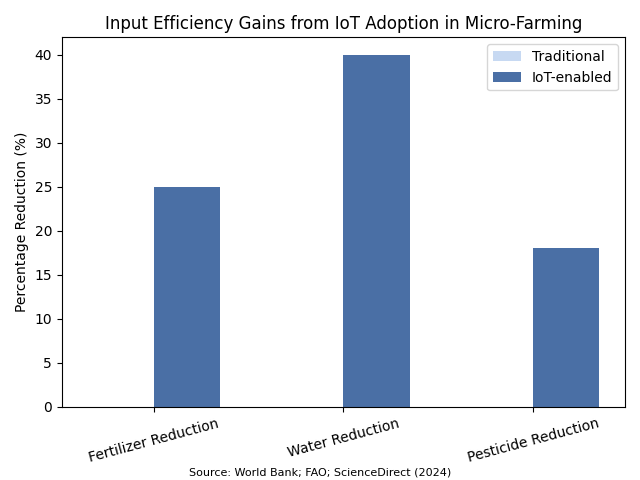
The “Digital Coffee Farmer” initiative in Colombia illustrates why. By combining soil, climate, and crop sensors with LoRaWAN connectivity and AI-driven advisories, participating coffee farms reported reductions in fertilizer usage between 20% and 30% while maintaining or improving yields across monitored plots. For farms typically operating on margins below 10%, such reductions translate directly into viability rather than incremental efficiency.
Institutional research reinforces this shift. The World Bank’s Digital Agriculture Roadmap Playbook documents income improvements ranging from 10% to 40% among smallholders using digital advisory and precision input tools, while cautioning that benefits depend on infrastructure access and system usability.
IoT’s significance, then, lies not in automation spectacle but in its ability to lower the minimum efficient scale of farming. Precision is no longer reserved for large operators; it is becoming measurable, deployable, and economically rational for micro-farms operating on one to five hectares.
| Layer | Technology | Function | Micro-Farm Benefit |
|---|---|---|---|
| Sensing | Soil & climate sensors | Measure field conditions | Reduces guesswork |
| Connectivity | LoRaWAN / NB-IoT | Long-range data transmission | Low-cost rural coverage |
| Analytics | AI decision systems | Translate data into actions | Input optimization |
| Interface | Mobile dashboards & alerts | Deliver recommendations | Operational clarity |
––––––––––––––––––––––––––––––––––––––––––––––––––––––––––––
Economic Decentralization of Agriculture
Historically, scale compensated for uncertainty. Large farms absorbed weather shocks, pest outbreaks, and price volatility through diversification and capital buffers. Micro-farms could not. IoT alters this equation by reducing uncertainty at its source: input timing and application.
Quantitative evidence is mounting. Precision nutrient management studies indicate fertilizer savings between 15% and 35% when sensor-guided application replaces calendar-based schedules, with nitrogen runoff reductions exceeding 20% in monitored environments. These figures are economically decisive for micro-farms, where fertilizer can represent 25% to 40% of variable operating costs.
Water efficiency provides even clearer data. A 2024 peer-reviewed deployment of a low-cost IoT irrigation system reported a 50% reduction in water consumption compared to conventional irrigation during the 2023 growing season, alongside stable yields. For small farms in water-stressed regions, halving irrigation demand fundamentally changes risk exposure.
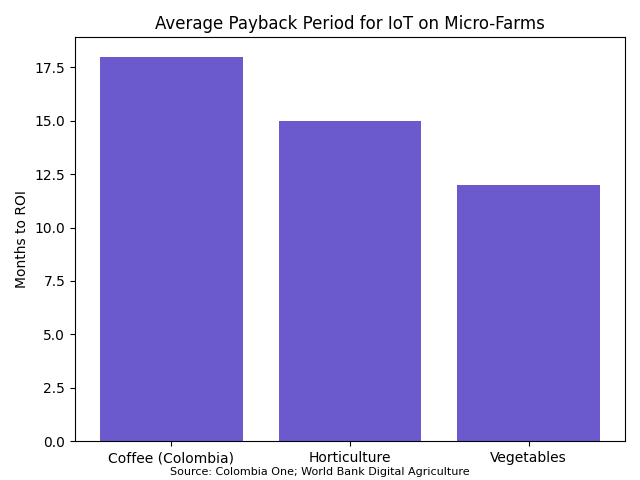
In Colombia’s coffee sector, fertilizer over-application has historically been common due to rainfall variability and pest uncertainty. Sensor-based advisory systems allow growers to shift from preventative to conditional input strategies, reducing both cost and ecological damage. Reported payback periods for sensor kits ranged from 12 to 24 months, placing them well within acceptable investment horizons for smallholders.
What emerges is a decentralized productivity model: farms do not grow larger to survive; they become more measurable. IoT compresses the performance gap between micro-farms and industrial operations by replacing excess input use with data-verified decisions.
––––––––––––––––––––––––––––––––––––––––––––––––––––––––––––
From Heuristics to Instrumentation
Traditional farming decisions rely on experiential heuristics: visual soil inspection, seasonal memory, and regional averages. IoT replaces these with continuous measurement. The distinction is not philosophical; it is statistical.
Sensor networks can generate hundreds to thousands of data points per hectare per season, capturing micro-variations in moisture, temperature, humidity, and disease risk. Machine-learning models trained on these datasets outperform rule-based decision systems in forecasting irrigation needs and pest emergence, particularly under irregular climate conditions.
A 2025 review of IoT-enabled agriculture systems found yield prediction accuracy improvements of 10% to 25% when machine-learning models were fed real-time sensor data rather than historical averages. These gains are especially relevant to micro-farms because variance, not mean yield, determines survival.
The Colombian coffee deployment demonstrates this transition. Instead of relying on region-wide pest calendars, farms receive localized alerts triggered by humidity and temperature thresholds associated with coffee leaf rust and berry borer activity. Early intervention reduces crop loss without blanket pesticide application, lowering chemical use while preserving quality.
Instrumentation also enables accountability. Data logs create auditable records that can support certification, financing, and insurance mechanisms. For micro-farms seeking access to sustainability premiums or climate-linked finance, measured practices increasingly carry more weight than declared intent.
| Region | Crop | IoT Application | Measured Outcomes |
|---|---|---|---|
| Colombia | Coffee | Fertilizer & pest optimization | 20–30% fertilizer reduction |
| India | Vegetables | Smart irrigation | ~50% water savings |
| EU | Greenhouse crops | Climate automation | Higher yield density |
––––––––––––––––––––––––––––––––––––––––––––––––––––––––––––
Connectivity as Agricultural Infrastructure
Sensors alone do not create value; data movement does. For micro-farming, low-power wide-area networks have emerged as the decisive enabler.
LoRaWAN deployments routinely achieve coverage radii of 5–15 kilometers in rural terrain, allowing a single gateway to support dozens or hundreds of farms. Device battery lifetimes often exceed five years, minimizing maintenance burdens. These characteristics reduce per-farm connectivity costs to levels compatible with micro-scale economics.
Industry analyses show that LoRaWAN and cellular LPWAN technologies now account for a substantial share of new agricultural IoT deployments, with adoption accelerating as network interoperability improves. GSMA Intelligence reports growing convergence between unlicensed and licensed LPWAN ecosystems, reducing fragmentation risk for adopters.
In the “Digital Coffee Farmer” case, LoRaWAN connectivity enabled continuous data transmission from remote plots with minimal power infrastructure. This allowed advisory systems to operate reliably despite limited cellular coverage, illustrating how connectivity functions as agricultural infrastructure rather than optional add-on.
From a policy perspective, LPWAN investment behaves like irrigation or rural roads: it expands the feasible operational space for farms. When connectivity becomes reliable and affordable, micro-farming becomes replicable rather than exceptional.
| Year | LoRaWAN (%) | Cellular LPWAN (%) | Satellite IoT (%) |
|---|---|---|---|
| 2020 | 35% | 45% | 20% |
| 2022 | 45% | 40% | 15% |
| 2025 | 55% | 35% | 10% |
––––––––––––––––––––––––––––––––––––––––––––––––––––––––––––
Micro-Farming as a Climate and Labor Response
Climate volatility and labor scarcity are not abstract trends; they are quantifiable pressures. Extreme weather events have increased crop yield variability across multiple regions, while rural labor availability continues to decline.
IoT directly addresses both dynamics. Sensor-guided irrigation and climate monitoring reduce exposure to rainfall irregularity, while automated alerts reduce labor demands for constant field inspection. In controlled-environment and vertical farming systems, IoT-driven management has enabled yield densities multiple times higher than traditional open-field farming, compensating for limited land availability.
Studies of smart irrigation consistently show water savings ranging from 30% to 50%, translating into both cost reductions and regulatory compliance advantages in water-restricted regions. For micro-farms operating near urban markets, these efficiencies support viable production on small footprints.
FAO analyses emphasize that digital tools are increasingly central to climate adaptation strategies, but stress that adoption success depends on farmer-centered design and institutional support rather than technology availability alone.
Micro-farming’s alignment with IoT is therefore structural: both are responses to constrained resources. Sensors, analytics, and automation substitute for land, labor, and predictability.
| Risk Area | Vendor-Controlled Model | Cooperative / Public Model |
|---|---|---|
| Data ownership | Platform retains data | Farmer or cooperative control |
| Advisory logic | Opaque algorithms | Transparent, locally validated |
| Switching costs | High lock-in | Interoperable systems |
| Farmer autonomy | Limited | Preserved |
––––––––––––––––––––––––––––––––––––––––––––––––––––––––––––
Platformization Risks and the Farm Data Question
Quantification cuts both ways. As micro-farms become data-rich, questions of ownership and control intensify.
Digital agriculture platforms often retain rights to sensor data and models, shaping advisory outputs and input recommendations. For micro-farms, dependency risks are acute because switching costs can be prohibitive once systems are embedded.
The World Bank’s data-driven digital agriculture framework highlights the importance of equitable data governance, warning that without safeguards, digitalization can concentrate value upstream rather than empowering producers.
Cooperative and public-interest models offer alternatives. Shared infrastructure and locally governed data pools distribute costs while preserving farmer agency. In such models, IoT enhances decentralization rather than undermining it.
The economic promise of micro-farming depends not only on technology but on governance choices that determine who captures the value generated by precision.
| Risk Area | Vendor-Controlled Model | Cooperative / Public Model |
|---|---|---|
| Data ownership | Platform retains data | Farmer or cooperative control |
| Advisory logic | Opaque algorithms | Transparent, locally validated |
| Switching costs | High lock-in | Interoperable systems |
| Farmer autonomy | Limited | Preserved |
––––––––––––––––––––––––––––––––––––––––––––––––––––––––––––
Recalibrating the Scale of Agriculture
IoT is not making farms smaller; it is making small farms measurable, predictable, and economically legible. Evidence from coffee farms, irrigation systems, and controlled-environment agriculture shows consistent reductions in input use, improvements in yield stability, and faster response to environmental stress.
What emerges is a new viability threshold. Micro-farms equipped with sensors, low-power connectivity, and accountable advisory systems can operate with a level of precision once limited to industrial producers. The future of agriculture will not be defined solely by hectares or horsepower, but by how effectively farms convert data into decisions.
IoT makes micro-farming technically possible. Institutions, markets, and governance will decide whether it becomes structurally durable.
––––––––––––––––––––––––––––––––––––––––––––––––––––––––––––
Key Takeaways
- IoT reduces fertilizer and water use by 15%–50%, materially improving micro-farm economics.
- LPWAN connectivity lowers the cost barrier for continuous sensing in rural and peri-urban environments.
- Sensor-driven decision systems improve yield stability, not just average output.
- Micro-farming aligns with IoT as a response to climate volatility and labor scarcity.
- Data ownership and governance will determine whether IoT decentralizes or recentralizes agricultural value.
Sources
Colombia One; Digital Coffee Farmer: IoT Sensors and AI for Smarter Coffee Decisions; – Link
World Bank; Digital Agriculture Roadmap Playbook; – Link
World Bank; Data-Driven Digital Agriculture (DDAG) Framework; – Link
World Bank; Future of Food: Harnessing Digital Technologies to Improve Food System Outcomes; – Link
FAO; Science and Innovation Forum 2024: Digital Agriculture Changemakers in Action; – Link
GSMA Intelligence; 10 Years of LoRaWAN: The Things Conference 2025 Signals a New Phase for a Converged IoT Future; – Link
ScienceDirect; Development of a Low-Cost Smart Irrigation System for Sustainable Water Management in the Mediterranean Region; – Link
ScienceDirect; Empowering Vertical Farming Through IoT and AI-Driven Approaches; – Link
ACM Digital Library; Leveraging Machine Learning and IoT for Energy Efficiency and Productivity in Vertical Farming; – Link
MDPI IoT Journal; LPWAN Technologies for IoT: Real-World Deployment Performance and Practical Comparison; – Link
Institute of Internet Economics; Precision Fields, Precision Herds: Digital Tools Reshaping Food Systems; – Link