

Healthcare is undergoing a structural transformation as reactive, symptom-based models give way to prediction-oriented systems. This shift is driven by the convergence of artificial intelligence, predictive analytics, continuous biosensing, and advanced remote monitoring infrastructures that together provide clinicians with real-time, high-resolution insight into patient physiology. Instead of treating illness only after symptoms appear, providers are increasingly empowered to anticipate deterioration, intervene earlier, and improve clinical efficiency. The result is a foundational redefinition of 21st-century care delivery, with far-reaching implications for clinical practice, health-system economics, and patient experience.
The Convergence of AI Diagnostics, Predictive Analytics, Continuous Biosensing, and Remote Monitoring
Traditional healthcare relies on episodic encounters that create isolated snapshots of patient health. These gaps contribute to delayed diagnoses and preventable complications; the National Academy of Medicine estimates that delayed identification of clinical decline is a factor in more than 30% of adverse chronic-disease outcomes. Predictive-driven care counters this by producing continuous data streams from biosensors and interpreting them with AI systems and predictive-analytics models capable of identifying subtle physiologic deviations long before symptoms appear.
AI diagnostics have demonstrated strong performance across radiology, cardiology, and oncology. In screening mammography, a large-scale study in The Lancet Digital Health reported that deep-learning models achieved sensitivity rates above 90% for breast-cancer detection, equaling or surpassing radiologist performance. In cardiology, Mayo Clinic studies show that AI-enhanced ECG interpretation can identify asymptomatic left-ventricular dysfunction early enough to alter therapeutic management. Dermatology, ophthalmology, and pathology report similar diagnostic convergence between AI models and specialist clinicians.

Predictive analytics enhances this capability by synthesizing multivariate data across EHRs, laboratory histories, imaging archives, and patient-generated sensor data. Models trained on longitudinal datasets can forecast deteriorations such as heart-failure exacerbation, diabetic complications, or respiratory decline days or weeks before traditional markers emerge. This fusion of analytics and AI strengthens clinical accuracy and sets the stage for automated early-warning workflows.
Working in tandem with these models are continuous biosensing technologies that convert health assessment from periodic measurement into real-time physiologic surveillance. Deloitte projects that more than 400 million medical-grade wearables and biosensors will be in clinical use globally by 2030. These devices capture signals such as cardiac rhythms, respiratory behavior, glucose levels, oxygen saturation, blood pressure, sleep quality, and metabolic markers. Smart ECG patches provide long-duration cardiac monitoring; implantable glucose sensors stream metabolic data every few minutes; multi-sensor wearables support clinical-grade cardiometabolic tracking.
The clinical impact is well documented. In heart-failure management, continuous sensor data combined with predictive alerts has reduced hospitalizations by up to 30% by identifying early signs of fluid retention or arrhythmia. In diabetes, continuous glucose monitoring (CGM) has produced significant improvements; a 2023 JAMA study reported HbA1c reductions of 0.4–0.8 percentage points in adults with type 2 diabetes using CGM, alongside fewer hypoglycemic events. These results illustrate how continuous physiologic measurement and analytics-driven interpretation enable earlier and more precise interventions.
Remote patient-monitoring platforms unify these inputs into centralized dashboards that stratify risk, detect anomalies, and coordinate response pathways. The Veterans Health Administration, one of the largest deployers of remote monitoring systems, reported a 25% reduction in bed-days and a 19% decrease in hospital admissions among monitored patients. The evidence base has continued to strengthen: a 2024 review in NPJ Digital Medicine spanning 29 studies across 16 countries found consistent reductions in readmissions, length-of-stay, and outpatient utilization. Analysts at McKinsey estimate that widespread remote-monitoring adoption could reduce U.S. emergency-department visits by up to 20%.
Clinical, Operational, and Economic Implications
Predictive-driven intervention fundamentally reshapes the economics of care delivery. Chronic diseases account for nearly 90% of U.S. healthcare expenditures, much of which arises from unmanaged progression and preventable acute episodes. Early detection and rapid response disrupt these cost trajectories. Evaluations by the Centers for Medicare & Medicaid Services show that remote-monitoring reimbursement programs improve care coordination while generating net savings through reduced hospitalizations and more efficient clinician time allocation.
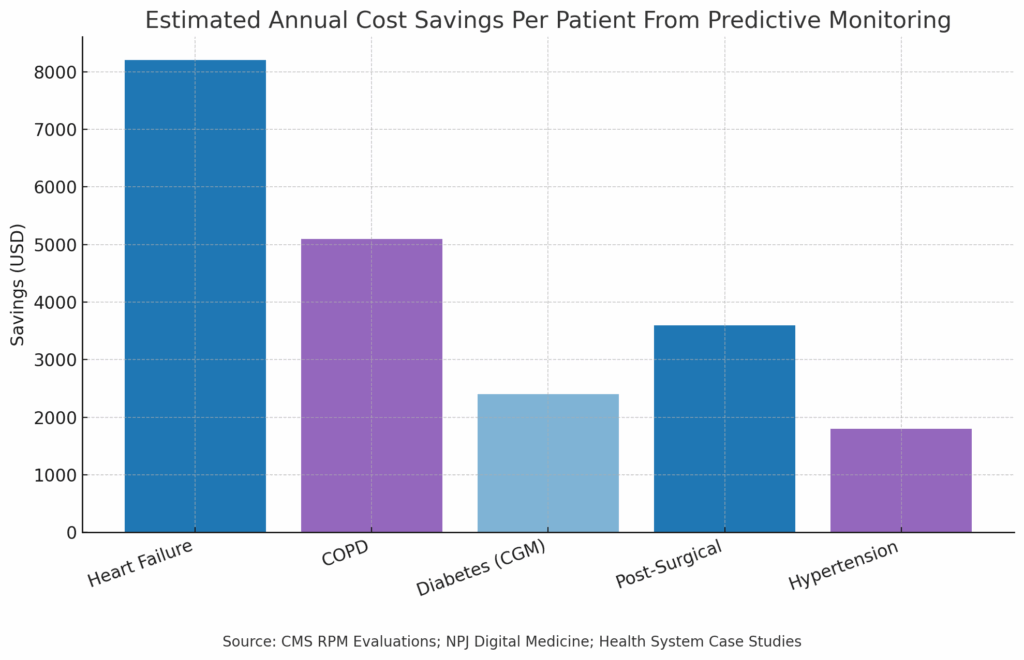
Operational efficiency also improves. AI-supported monitoring platforms direct clinician attention to high-risk patients based on real-time data, reducing unnecessary follow-ups and enhancing workload distribution. Research from the American Medical Association shows that digital tools streamline triage, documentation, and escalation workflows, easing administrative burden and allowing clinicians to focus on complex cases requiring human judgment.
For patients, the transition to predictive-driven care enhances quality of life, stability, and long-term outcomes. Individuals managing conditions such as heart failure, diabetes, respiratory disorders, or surgical recovery benefit from continuous oversight that minimizes uncertainty and enables early correction. A study in Nature Medicine found that patients enrolled in AI-supported monitoring programs experienced higher quality-of-life scores and fewer adverse events. These improvements reinforce trust in care teams and strengthen chronic-disease self-management.
Notably, emerging research highlights constraints that must be addressed for predictive healthcare to scale: variable sensor data quality, interoperability limitations across platforms, and clinician alert fatigue if thresholds are poorly designed. These challenges do not diminish the overall effectiveness of predictive care but underscore the importance of robust implementation strategies and data governance frameworks.
Toward a Prediction-First Model for E-Health
The rapid expansion of prediction-driven healthcare is defined by technological interdependence: AI models interpret vast datasets; predictive-analytics engines forecast risk trajectories; biosensing devices generate real-time physiology; and remote-monitoring systems convert these insights into actionable clinical workflows. Each element reinforces the others, creating a cumulative effect that accelerates early detection and enhances intervention precision.
As digital infrastructure matures, prediction-first healthcare is positioned to become the default model of care rather than an adjunct program. Regulatory frameworks continue to evolve to support continuous monitoring, algorithmic diagnostics, and patient-generated health data. Insurers increasingly incorporate proactive monitoring into reimbursement structures. Patients are adopting continuous engagement as part of routine care, supported by more intuitive devices and integrated digital platforms.
The next decade of e-health innovation will be shaped not by isolated technologies but by the coordinated ecosystems they form. This emerging architecture enables earlier, smarter, and more personalized intervention, strengthening clinical outcomes and system sustainability. Predictive-driven healthcare will define the future of digital medicine, offering a realistic path toward more resilient, efficient, and patient-centered care worldwide.
Key Takeaways
• Predictive-driven healthcare integrates AI diagnostics, predictive analytics, biosensing, and remote monitoring to enable continuous, proactive care.
• High-resolution physiologic data combined with AI and analytics enables earlier intervention and reduces emergency-level events.
• Economic and operational evidence shows significant system-wide benefits, including reduced hospitalizations and improved clinician efficiency.
• Patients experience improved stability, stronger adherence, and better long-term outcomes under continuous monitoring.
• Evidence from 2023–2025 clinical reviews reinforces the effectiveness of predictive-driven care across multiple conditions and populations.
Sources
• Tan SY, et al.; A systematic review of the impacts of remote patient monitoring (RPM) interventions on safety, adherence, clinical and quality-of-life outcomes and cost-related outcomes – Link
• Jansen AJS, et al.; Device-based remote monitoring in digital care and its impact on clinical outcomes – Link
• Shields S, et al.; Continuous glucose monitoring among adults with type 2 diabetes in primary care improves glycemic outcomes – Link
• Martens T, et al.; Effect of continuous glucose monitoring on glycemic control in adults with type 2 diabetes treated with basal insulin – Link
• Kuo S, et al.; Implementation and impact on length of stay of a post-hospitalization remote patient monitoring program for COVID-19 patients – Link
• Noah B, et al.; Impact of remote patient monitoring on clinical outcomes: A quantitative review of randomized and quasi-randomized trials – Link
• Paul MM, et al.; The state of remote patient monitoring for chronic disease management and digital health adoption – Link
• Carlson AL, et al.; Clinical use of continuous glucose monitoring in adults with type 2 diabetes – Link
• Martens T, et al.; Effect of continuous glucose monitoring vs standard blood glucose meter monitoring on HbA1c in type 2 diabetes – Link