

The next few years will determine how deeply quantum computing reshapes the world economy. The technology is entering an integration phase—where research systems evolve into embedded infrastructure for industry, government, and finance. This shift will not be gradual; it will occur in bursts of adoption, policy, and investment.
From 2025 to 2032, quantum computing will move from concept to infrastructure. Hybrid systems will merge quantum processing units with traditional cloud networks, and businesses will experiment with practical use cases in optimization, chemistry, logistics, and finance. But this progress will not be evenly shared. The world is on the verge of what economists increasingly call the Quantum Divide—a systemic inequality between those who possess quantum capability and those who depend on it.
2025–2026
Foundation and Early Access
Experimental projects emerge in logistics, finance, and pharma. Market capitalization small but growing.
2027–2028
Commercial Proof and Ecosystem Growth
Firms begin differentiating on computational efficiency; national strategies formalize.
2029–2030
Mainstream Economic Embedding
Measurable GDP effects in innovation-led economies. Quantum finance and manufacturing ecosystems expand.
2031–2032
Infrastructure and Societal Penetration
Productivity acceleration becomes macroeconomic; new business models form around quantum capabilities.
Economic Integration: From Niche to General Purpose
Quantum integration marks the point where quantum hardware and software begin to merge with enterprise platforms. Over the next few years, major cloud providers will make quantum access standard, enabling experimentation without requiring ownership of physical systems. By the early 2030s, quantum functionality could become a hidden layer of computation within digital supply chains, financial modeling, and energy networks.
McKinsey & Company estimates that integration could unlock hundreds of billions of dollars in annual economic value, especially in sectors that rely on heavy computation—energy, pharmaceuticals, finance, and manufacturing. The World Economic Forum predicts that around 2030, advanced economies will begin embedding quantum systems in industrial planning, weather modeling, and national infrastructure design.
This process mirrors the early years of artificial intelligence adoption—but with greater stakes. Quantum integration will not just improve analysis; it will redefine what problems can be solved within time and cost limits. The first enterprises and nations to integrate quantum systems effectively will dominate the new computational economy.
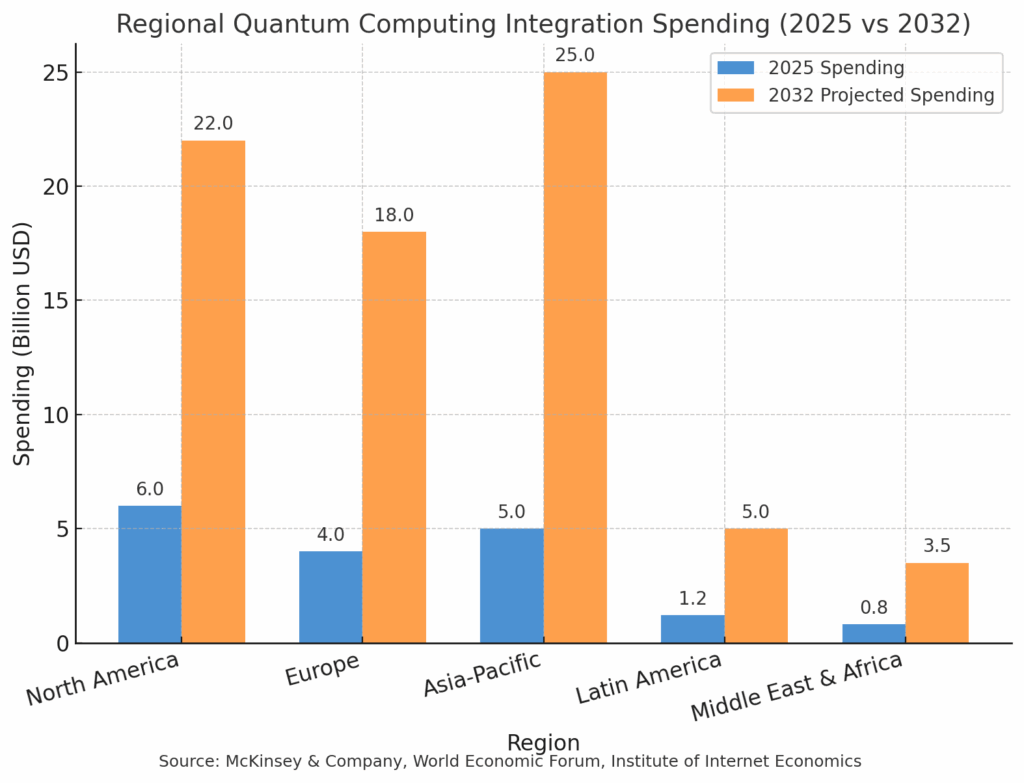
The Quantum Divide: Inequality in Capability
As quantum integration accelerates, the global economy will fracture along a new technological boundary. Nations, corporations, and research ecosystems with access to advanced quantum systems will gain disproportionate influence over innovation, productivity, and information security. Those without access will depend on imported services, rented computation, or external security frameworks.
The Quantum Divide extends beyond hardware ownership—it encompasses access to quantum-trained talent, secure cloud integration, and algorithmic expertise. McKinsey projects that by the early 2030s, over 70% of early quantum value will concentrate in a handful of economies—the United States, China, Japan, and the European Union. These regions possess both the industrial capacity to scale and the policy frameworks to secure national quantum programs.
For developing economies, exclusion from the quantum economy could reinforce structural dependence on external technology providers. Without regional consortia, open-access infrastructure, or targeted public investment, they risk losing competitiveness in pharmaceuticals, logistics, and financial services. Quantum readiness is thus not only a technological metric—it is an indicator of future sovereignty and economic resilience.
The divide also has private-sector implications. Large technology and finance firms capable of integrating quantum workflows will outpace smaller competitors that cannot afford access or talent. Without coordinated global standards or shared research models, the result may be a world where innovation is centralized, and computational advantage becomes a new form of monopoly.
Disruption and Redistribution: Power in Asymmetry
Quantum integration will magnify the principle of asymmetric advantage. Entities capable of quantum simulation or optimization will operate with informational leverage unmatched by classical systems. In financial markets, the ability to price risk or simulate portfolios with higher precision could grant early movers disproportionate influence over global capital flow.
This asymmetry will disrupt existing economic hierarchies. Emerging economies reliant on commodity exports or labor-intensive manufacturing may find their advantages diminished as quantum-enabled logistics and automation increase global efficiency. Conversely, economies with advanced data infrastructure will extract more value per unit of computational power, consolidating their dominance.
The World Economic Forum warns that such asymmetries can destabilize trade, widen inequality, and provoke digital protectionism. As with earlier technological revolutions, the benefits of quantum computing will be determined not by access alone but by the capacity to integrate it meaningfully into national and corporate ecosystems.
Investment and Capital Flow: Quantum Becomes Strategic
Quantum integration will trigger major shifts in capital allocation. Between 2025 and 2032, governments will treat quantum infrastructure as a strategic national asset, funding domestic hardware, post-quantum cybersecurity, and workforce training. Public–private consortia in the United States, Europe, China, and Japan have already committed over US $40 billion to quantum research and commercialization.
Private investment will follow, especially into middleware and hybrid integration—companies that connect quantum systems with existing cloud infrastructure. Venture capital will likely accelerate around 2027–2028, once early enterprise pilots demonstrate measurable returns.
However, capital flows will also reflect the divide. Economies without research ecosystems may find themselves funding external vendors or licensing proprietary algorithms, creating a form of computational dependency. Unless international partnerships and open frameworks evolve, quantum capability could harden into a new layer of economic inequality.
Industrial Transformation: First Integrators and the New Productivity Frontier
Industries already experimenting with quantum integration will set the pace of change. In the next seven years:
- Energy and Materials: Quantum simulation will enhance efficiency in renewable energy storage, battery chemistry, and materials discovery.
- Pharmaceuticals: Drug design timelines could compress by 50%, changing pricing models and access to medication.
- Finance and Insurance: Quantum algorithms will improve risk modeling, portfolio optimization, and fraud detection.
- Logistics and Manufacturing: Advanced optimization will reduce fuel use and material waste, improving both cost and sustainability.
These productivity leaps, while economically positive, may also exacerbate the divide. Regions without access to quantum-enabled R&D could lose competitiveness in sectors they once dominated. As Deloitte notes, the long-term effects may resemble the automation gap of the 1990s—where gains concentrated among firms and countries with early infrastructure readiness.
The Quantum Divide in Global Power
By 2032, computing power itself will constitute geopolitical capital. Nations leading in quantum integration—those able to combine secure networks, human capital, and industrial scale—will gain decisive influence.
The World Economic Forum and the Bank for International Settlements foresee the emergence of quantum-secure financial networks and national encryption standards that could define future digital sovereignty. The countries that first deploy these systems may shape cross-border trade, data policy, and even the architecture of global payments.
The Quantum Divide thus extends into geopolitics: those who control secure computation will effectively control the infrastructure of trust. This reality may reshape alliances, as countries lacking domestic capability seek security guarantees from those who possess it. Quantum infrastructure could become as politically significant as oil reserves or semiconductor fabs once were.
Societal and Human Implications
At the human scale, quantum integration will be both invisible and profound. Consumers will experience faster logistics, personalized health treatments, and stronger cybersecurity—all delivered through systems powered by quantum-enhanced computation.
Yet the social divide may deepen. Wealthier societies will access quantum-accelerated medicine, climate prediction, and financial services, while others depend on external providers. The result could be a computational inequality—a world where access to processing power defines access to progress.
Ethical governance will become essential. Policymakers must ensure transparency, equitable infrastructure access, and protection against the monopolization of computation. Without safeguards, quantum integration could entrench systemic inequity under the banner of technological progress.
Outlook: The Emerging Quantum Order
Between now and 2032, quantum computing will evolve from a technological frontier into an economic boundary. The Quantum Divide will define who benefits from that transformation. For some, quantum systems will accelerate discovery, growth, and national resilience. For others, it will introduce new dependencies and vulnerabilities.
The integration decade is therefore not only a technical transition but a political and moral one. Ensuring that quantum capability enhances collective prosperity—rather than reinforcing hierarchy—will be the defining challenge of the next phase of digital civilization.
Key Takeaways
• Quantum integration will create a new global divide based on computational capability.
• Nations and firms with quantum access will dominate productivity and security innovation.
• Early investments in hybrid infrastructure and human capital yield compounding advantage.
• The Quantum Divide risks reinforcing geopolitical and social inequality.
• Equitable access, policy coordination, and transparent governance are essential to close the gap.
Sources
• McKinsey & Company — The Year of Quantum: From Concept to Reality in 2025 — Link
• World Economic Forum — Embracing the Quantum Economy: A Pathway for Business Leaders — Link
• Deloitte — The Quantum Decade: Preparing for a New Computing Paradigm — Link
• PwC — The Coming Quantum Advantage: How Business Can Prepare — Link
• Bank for International Settlements — Financial Stability Implications of Quantum Computing — Link
• Nature — Learning High-Accuracy Error Decoding for Quantum Processors — Link
• IBM — IBM Lays Out a Clear Path to Fault-Tolerant Quantum Computing — Link