
The modern experience of reading news online rarely feels neutral. Pop-ups interrupt the page before the headline settles. Autoplay video competes with text. Cookie banners, ad reloads, and article limits fragment attention before comprehension begins. A 2023 Deloitte survey found that more than 70 percent of users believe digital advertising has become more intrusive over time, with a majority reporting that it actively interferes with reading. What appears as irritation is not accidental design failure. It is the visible outcome of a business response that has progressively degraded the news product in pursuit of revenue.
This tension did not always exist. In the early web era, digital news was not expected to operate as a self-sustaining business. Online operations were subsidized by print, broadcast, or corporate parents, and success was measured in reach rather than margin. In 2001, most major outlets described their digital divisions as strategic investments, not revenue centers. Pages were lighter, advertising was sparse, and friction was tolerated because digital news still felt scarce, novel, and worth the effort.
That equilibrium collapsed as print advertising declined and platform intermediaries consolidated control over digital ad markets. By the mid-2010s, publishers were competing for a shrinking share of advertising spend dominated by search and social platforms with superior targeting and measurement. At the same time, the cost of operating a modern news site rose sharply. Infrastructure expanded to include video delivery, cybersecurity, analytics, personalization, compliance, and data governance. HTTP Archive data shows that the median news webpage now exceeds 5 megabytes and executes hundreds of network requests, materially increasing hosting and performance costs. Journalism itself remained labor-intensive even as newsroom budgets tightened.
Under this pressure, publishers intensified monetization rather than rethinking the product. Display advertising rates compressed further, with standard formats often generating well under $2 CPM, leaving each page view worth fractions of a cent. From a narrow financial perspective, the response appeared logical. If users generate minimal revenue, targets can only be met by increasing impressions per visit, extending sessions, or layering additional monetization mechanisms. These choices were driven less by editorial judgment than by the arithmetic of declining margins.
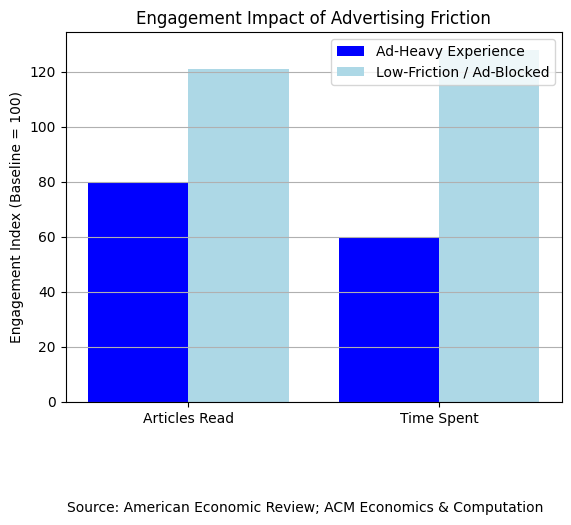
What this strategy misjudged was behavior. Users do not experience cost as a spreadsheet. They respond to friction, perceived fairness, and cognitive load. In markets with near-zero switching costs, even small increases in annoyance can trigger exit. Large-scale academic research analyzing more than three million browsing sessions shows that advertising exposure correlates with roughly 20 percent fewer news articles read and a narrower range of topics consumed. The journalism did not change. The environment did.
| Metric | Ad-Heavy Experience | Low-Friction / Ad-Blocked |
|---|---|---|
| Articles Read | 80 | 121 |
| Time Spent | 60 | 128 |
| Source: American Economic Review; ACM Economics & Computation | ||
When friction is removed, engagement returns. The same research shows that users who adopt ad blockers read between 21 and 43 percent more articles and explore significantly more content categories. This distinction matters. Declining engagement reflects intolerance for how news is delivered, not declining interest in news itself. Yet advertising remains the primary revenue source, creating a contradiction in which monetization directly suppresses the behavior it depends on.
Publishers attempted to resolve this contradiction through enforcement. As ad blocker usage exceeded 40 percent among desktop users in several markets, adwalls were introduced to force a choice: accept ads or leave. Randomized field experiments show that strict adwalls reduce page views and time spent per page by nearly 50 percent, with losses concentrated among casual readers who form the top of the audience funnel. Advertisers fare little better. Nearly 90 percent of consumers report noticing repetitive ads, and more than three-quarters say heavy ad exposure reduces their perception of the hosting platform, weakening attention and return on spend.
| Publisher Assumption | User Reality | Result |
|---|---|---|
| Users will tolerate friction | Users exit immediately | Engagement collapse |
| Scale compensates for low margins | Quality does not scale | Cost escalation |
| Paywalls trigger conversion | Paywalls trigger exit | Audience shrinkage |
| Source: IoIE analysis; Reuters Institute | ||
The result is a self-reinforcing loop. Monetization degrades the product. Degraded experience drives users away. Shrinking audiences intensify monetization pressure. This is not a failure of execution. It is a product failure created by business responses that treat engagement as extractable rather than earned. When perceived cost exceeds perceived value, users behave rationally. They leave.
Common Publisher Monetization Tactics and User Response
| Monetization Tactic | Intended Business Goal | Observed User Reaction |
|---|---|---|
| High ad density | Increase impressions per visit | Faster exits, banner blindness |
| Autoplay video | Boost video CPMs | User irritation, page abandonment |
| Hard adwalls | Force compliance or churn | Large-scale user loss |
| Forced registration | Capture first-party data | Immediate disengagement |
| Source: Reuters Institute; Pew Research; Industry case studies | ||
Why the Industry Keeps Making the Same Mistakes
The degradation of digital news is often attributed to regulation or platform dominance. In practice, it persists because demand-side behavior and structural constraints repeatedly push publishers toward value-destructive strategies. Across high-income democracies, only about 17 percent of users pay for online news, a figure that has remained largely unchanged for nearly a decade. In the United States, more than 80 percent of adults report not paying for digital news in the past year. These numbers reflect a stable equilibrium, not a market in transition.
| Year | Users Paying for Online News (%) |
|---|---|
| 2015 | 15% |
| 2018 | 16% |
| 2021 | 17% |
| 2024 | 17% |
| Source: Reuters Institute; Pew Research Center | |
That equilibrium was learned. For more than two decades, audiences were trained to expect unlimited access at zero price, with advertising absorbing the cost invisibly. Behavioral economics shows that once a reference price is anchored, deviations feel punitive rather than transactional. A modest subscription, forced registration wall, or article limit triggers irritation disproportionate to its monetary value because it violates deeply internalized expectations.
Abundance reinforces this constraint. In most markets, multiple versions of the same story are available within seconds. Reuters Institute surveys consistently show that 60–65 percent of users say they will simply find the news elsewhere if blocked by a paywall. Switching costs collapse, and differentiation becomes invisible at the moment of consumption. Depth and quality may vary, but perceived substitutability dominates behavior.
Age demographics intensify the problem. Among users under 35, payment rates frequently fall below 10 percent, and this cohort reports the highest levels of news avoidance globally. News is encountered ambiently through feeds, notifications, and messaging apps rather than sought out deliberately. When autoplay video, adwalls, or forced registration interrupt that flow, disengagement is immediate. A paywall does not initiate a purchase decision. It ends the interaction.
| Age Group | Primary Access Mode | Payment Willingness | Friction Tolerance |
|---|---|---|---|
| 18–34 | Feeds, social, summaries | Very low | Very low |
| 35–54 | Mixed (direct + platforms) | Low–moderate | Moderate |
| 55+ | Direct sites, apps | Higher | Declining |
| Source: Reuters Institute; Pew Research Center | |||
Older audiences are more willing to pay, but tolerance for degraded experience is eroding here as well. Pew Research shows that a majority of users over 50 report frustration with intrusive advertising, slow load times, and cluttered layouts. Subscriber churn remains high, and industry analysis consistently cites product experience as a contributing factor. Even paying users disengage when the product feels adversarial.
Regulation compounds these pressures without altering the underlying dynamic. In Europe and the United Kingdom, GDPR reduced ad targeting efficiency, with empirical research showing publisher CPMs and revenues fell by roughly 20–30 percent, particularly for smaller outlets. Compliance costs rose simultaneously, adding consent management, legal oversight, and data governance burdens that scale poorly. These effects compressed margins but did not increase willingness to pay.
Publishers responded predictably by intensifying monetization. Ad density increased. Adwalls proliferated. Yet experimental evidence shows these strategies backfire, halving engagement and collapsing the top of the audience funnel. In lighter regulatory environments, outcomes are not meaningfully different. In the United States, 74 percent of users encounter paywalls, yet only a small minority convert. Most leave.
The industry remains trapped in a logic inherited from the dot-com era: that scale can overcome low margins. Journalism does not scale like software. Each additional unit of quality content requires labor, while infrastructure and compliance costs rise with traffic. Chasing volume through degraded experience undermines the engagement that volume depends on. Regulation shapes boundaries, but behavior determines outcomes. Business strategies that ignore demand-side reality do not stabilize the industry. They entrench its decline.
How the Market Is Already Moving On
The response to audience decline is no longer theoretical. It is already visible in publisher behavior, platform design, and consumer usage patterns. Several large publishers have begun rolling back extreme ad density and hard adwalls after internal data showed these tactics suppressed repeat visits and inflated bounce rates. Case reporting indicates that reducing ad load can lower revenue per page by 10–20 percent while improving return visits and session depth enough to partially offset losses. The rediscovered insight is simple: a reader who returns is often worth more than one aggressively monetized visit.
| Model | Key Characteristics | Why It Works |
|---|---|---|
| Platform-native news | Fast load, limited friction | Fits ambient consumption |
| Newsletters | Direct delivery, predictable value | High trust, low churn |
| Bundled subscriptions | Shared cost across services | Lower psychological price |
| AI summaries | Minimal time cost | Matches attention economics |
| Source: Reuters Institute; industry analysis | ||
Platforms have capitalized on this lesson. In-platform news environments such as Facebook News and Apple News remove much of the friction that defines the open web. Pages load quickly, ads are standardized or limited, and users are not confronted with adwalls or repeated consent prompts. Surveys cited by the Reuters Institute show higher satisfaction with platform-native news, particularly among casual readers. For many users, especially under 40, news inside a feed feels less like a transaction and more like background infrastructure.
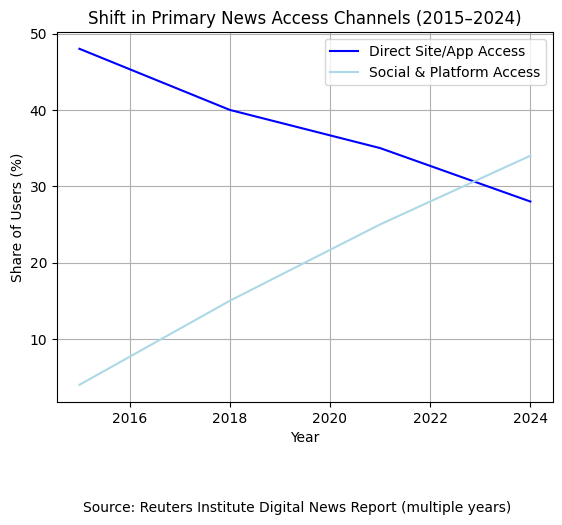
This aligns with broader discovery trends. A majority of users now access news primarily through platforms, aggregators, or search rather than direct homepage visits. Among younger users, intentional site navigation is rare. Traditional monetization models assume deliberate engagement. Feed-based consumption breaks that assumption entirely.
Artificial intelligence accelerates this shift. Surveys show growing comfort with AI-generated summaries for routine news, particularly among users who already avoid traditional sites. Roughly one in four users under 35 has used AI to summarize or explain a news topic. AI collapses time cost, delivering information without the friction that characterizes traditional news consumption.
This decoupling has direct economic consequences. When users are satisfied with summaries, click-through rates decline. Advertising impressions and subscription funnels weaken, especially for general-interest news where differentiation is limited. AI does not merely redistribute traffic. It reduces the need to visit the source at all.
Capital allocation reflects this reality. Venture funding has largely exited mass-market consumer news in favor of tools, infrastructure, newsletters, and professional intelligence products. Niche and creator-led models convert at materially higher rates, often 5–10 percent, by offering focused value with minimal friction. Bundling experiments similarly lower psychological cost by spreading payment across perceived utility.
The most likely outcome is not collapse but reconfiguration. A smaller number of large organizations will persist through scale, licensing, or platform partnerships. Alongside them, niche outlets and vertical services will survive by aligning costs with realistic willingness to pay. The durable models share common traits: low friction, predictable value, and respect for user attention. The future of digital news will be shaped not by extracting more from each visit, but by giving users fewer reasons to disengage.
Key Takeaways
-
The sustainability crisis in digital news is fundamentally a product failure, driven by business responses to declining revenues that degrade user experience and suppress demand.
-
Aggressive monetization tactics—ad overload, autoplay media, and adwalls—are rational financial responses to margin pressure but consistently repel users, creating a self-reinforcing downward spiral.
-
Empirical evidence shows that reduced friction reliably restores engagement, indicating that audience disengagement reflects intolerance for delivery conditions rather than declining interest in journalism.
-
Demand-side behavior is structurally entrenched: audiences have learned to value digital news at near zero, exhibit low tolerance for friction, and face minimal switching costs across outlets.
-
Regulation and platform dominance constrain publisher options but do not alter the core behavioral reality shaping willingness to pay or engage.
-
Younger audiences intensify long-term risk, favoring ambient, feed-based, and AI-mediated news consumption that bypasses traditional site visits and monetization funnels.
-
Emerging models—platform-native news, newsletters, bundling, and niche intelligence services—succeed by realigning value, friction, and cost structures rather than by maximizing extraction per visit.
-
The likely outcome is not recovery of the traditional digital news model, but a reconfiguration toward fewer large-scale players and more focused, lower-friction news products aligned with realistic consumer behavior.
Sources
- Reuters Institute for the Study of Journalism; Digital News Report 2024; – Link
- Institute of Internet Economics; Behavioral Economics and Digital Consumption; – Link
- Reuters Institute for the Study of Journalism; Digital News Report 2025; – Link
- Pew Research Center; Few Americans Pay for News When They Encounter Paywalls; – Link
- Pew Research Center; Americans’ Attitudes Toward Digital Advertising; – Link
- American Economic Review; The Welfare Effects of Ad Blocking; – Link
- ACM Conference on Economics and Computation; Ad Blocking and User Engagement; – Link
- Deloitte; Global Digital Advertising and Consumer Experience Survey; – Link
- HTTP Archive; Web Almanac 2024 – Page Weight and Performance; – Link
- Google; The Need for Mobile Speed; – Link
- Blockthrough; 2023 Ad-Filtering Report; – Link
- PageFair; The Cost of Ad Blocking; – Link
- Australian Government Treasury; News Media and Digital Platforms Mandatory Bargaining Code – Review; – Link
- Internet Society; Case Study: Canada’s Online News Act and Its Impact on Journalism; – Link
- Reuters; Google and Meta Face Penalties Over News Media Competition; – Link