
Computer Programming Jobs in the U.S. Hit Historic Low Amid AI Ascendance
The landscape of computer programming employment in the United States is undergoing a seismic shift, reaching its lowest levels since 1980. This dramatic decline coincides with the rise of artificial intelligence technologies, notably OpenAI’s ChatGPT. As industry leaders grapple with the implications of AI, the future of programming jobs hangs in the balance.
Recent data from the Current Population Survey, released by the Bureau of Labor Statistics, indicates that the number of computer programming jobs has dwindled to approximately 300,000—a stark contrast to the 700,000 jobs available during the tech boom of the early 2000s. This reduction in employment stems not just from economic fluctuations but also from technological advancements that are reshaping job roles within the sector.
Computer programmers are distinct from software developers in both responsibilities and job scope. Programmers execute coding tasks, while software developers engage with broader project management and problem-solving. According to the Bureau of Labor Statistics, software development roles are projected to see a growth of 17% between 2023 and 2033, while the demand for computer programmers is expected to shrink by about 10% during the same period. This decline signals a transition—one that may leave many programmers behind as businesses adapt to new technologies like AI.
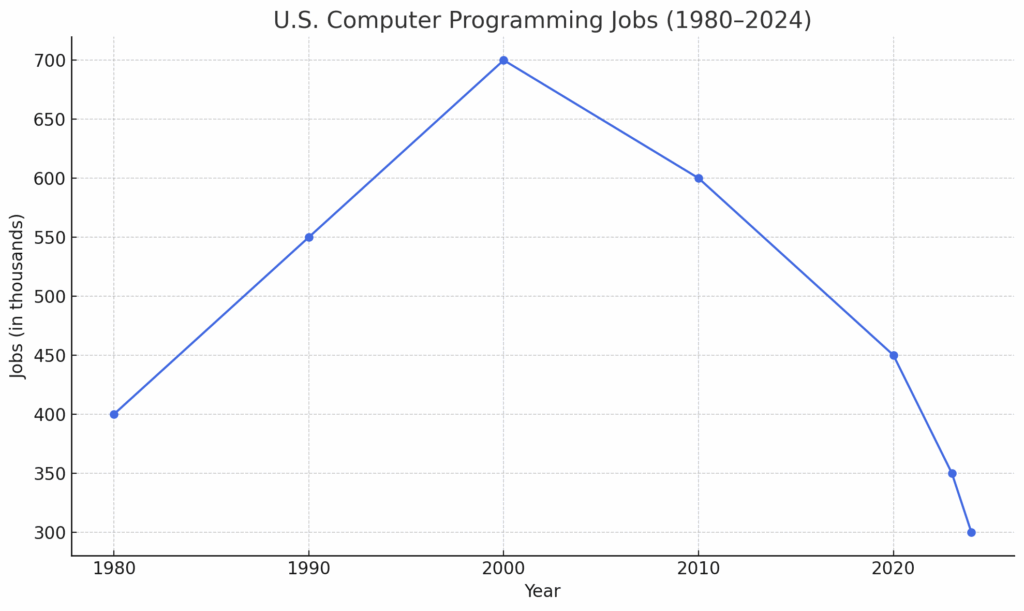
The introduction of ChatGPT has been particularly noteworthy. This powerful tool can efficiently execute coding tasks, often without requiring users to possess deep knowledge of the coding language involved. Since the rollout of ChatGPT, there has been a staggering 27.5% drop in the average employment numbers for computer programmers, underscoring the immediate impact of AI on employment.
Experts are sounding alarms about this correlation, suggesting that the proliferation of AI tools may be displacing coding professionals. Mark Muro from the Brookings Institution has noted that the uptick in unemployment among programmers is a visible early sign of AI’s increasing influence in the job market. Yet, while AI’s role in executing programming tasks is a concern, some argue that job losses may not be as dire as they seem.
For instance, Klarna, a buy now-pay later firm, announced a hiring freeze after collaborating with OpenAI on a chatbot project. The company claimed that this AI-powered solution was comparable to the work performed by 700 full-time employees. While this highlights AI’s role in taking over certain tasks—particularly in customer service—it doesn’t necessarily translate directly to job losses among programmers at large.
Meta’s CEO Mark Zuckerberg also weighed in on the discussion, suggesting that mid-level engineers could find themselves replaced by AI technologies in the near future. Zuckerberg’s comments reinforce a growing perception: AI has the potential to automate several functions traditionally assigned to human programmers, further reducing the need for their skills.
Despite these warnings, opinions vary on the full extent of AI’s impact on the programming profession. IBM’s CEO Arvind Krishna remains optimistic, asserting that human programmers will still be indispensable. He estimates that AI could automate roughly 20-30% of coding tasks, leaving human programmers to tackle more intricate challenges that require their expertise. Krishna argues that automating simpler, repetitive coding tasks will ultimately lead to increased productivity and improved performance across industries, which may not spell doom for those in programming roles.
As companies increasingly adopt AI technologies, they face decisions about how best to integrate these tools while maintaining a skilled workforce. Many organizations find themselves in a paradox: they want to leverage AI for efficiency gains while ensuring that their human resources remain critical to innovation and complex problem-solving.
This dynamic landscape suggests a reshaping of the programming role rather than a complete eradication of jobs. As AI continues to advance, the need for skilled programmers may evolve to prioritize versatile individuals who can collaborate with and manage technology as well as execute tasks. In this scenario, the focus shifts from merely coding to strategic thinking and creative problem-solving—a paradigm that would require reskilling and adaptation.
The evolving relationship between AI and programming jobs poses fresh challenges and opportunities. While it’s clear that AI can perform many tasks traditionally held by humans, it’s also essential to recognize the enduring value of human insight, creativity, and emotional intelligence—qualities that machines are yet to replicate fully.
Addressing the implications of AI on job markets requires not merely a focus on displacement but also a vision for the emerging roles that will arise in its wake. Educational institutions and training programs must pivot to equip the current and future workforce with the skills needed to thrive in an AI-augmented world.
As programmers navigate this turbulent waterscape, continuous learning and adaptability will be crucial. The tech sector has historically demonstrated resilience and the ability to evolve. This adaptability may very well hold the key to future job security and innovation within an increasingly automated landscape.
Key Takeaways:
– U.S. computer programming jobs have fallen to their lowest level since 1980, coinciding with the rise of AI technologies.
– The Bureau of Labor Statistics projects a 10% decline in programming jobs while software development roles are anticipated to grow by 17%.
– AI tools like ChatGPT have significantly impacted employment, with a 27.5% reduction in programming jobs noted since its introduction.
– Experts emphasize the importance of versatility and continuous learning for programmers to remain relevant in an AI-driven environment.
Sources:
– Current Population Survey, Bureau of Labor Statistics
– Washington Post
– Fortune
– Brookings Institution
– Meta
– IBM