

The Rising Tide of Dark Factories Transforming the Manufacturing Sector
Factories have long been symbols of human labor, filled with the noise of machinery, the rhythm of assembly lines, and the presence of workers who transformed raw materials into the goods that shaped modern economies. Today, that image is rapidly fading. A new vision of manufacturing is emerging—one that is quieter, more efficient, and almost entirely devoid of people. Known as dark factories, these facilities operate autonomously, powered by robotics, artificial intelligence, machine learning, and the Industrial Internet of Things (IIoT). Unlike traditional plants, they do not require lights, heating, or break rooms for employees. They run continuously, with precision and speed that redefine industrial productivity.
The rise of dark factories is not just a technological trend; it represents a structural shift in global manufacturing. A report from ResearchAndMarkets estimates the dark factories market was worth $119.19 billion in 2024 and could expand to $194.60 billion by 2030, growing at a compound annual rate of 8.7 percent. This acceleration reflects the urgency of industries under pressure from global supply chain disruptions, rising wages, and competitive demands to cut costs. What was once experimental is becoming a mainstream business model.
Industrial robotics lies at the heart of this transformation. Robots that once performed repetitive welding or assembly tasks now execute complex, adaptive functions with a degree of precision previously thought unattainable. In automotive plants, robots dominate paint shops, body assembly, and even inspection. Companies like Tesla and Toyota rely heavily on automated arms and guided vehicles to streamline production. In electronics, robots conduct delicate soldering and placement tasks at speeds impossible for humans. The pharmaceutical sector has also embraced automation, with robots handling sterile drug packaging and sensitive laboratory procedures. These shifts demonstrate how robotics reduces errors and increases scalability, turning traditional plants into highly automated ecosystems.
The integration of artificial intelligence and machine learning amplifies these capabilities. AI systems in dark factories process streams of real-time data to make decisions that once required supervisors and engineers. They can predict equipment failures before they happen, reroute production lines when bottlenecks appear, and optimize energy usage to lower costs. Machine learning models improve continuously as more data is collected, making each production cycle smarter than the last. This is more than automation—it is self-optimization, creating factories that adapt rather than merely execute instructions.
The Industrial Internet of Things forms the connective tissue of this environment. IIoT networks link sensors, machines, and software into a seamless web, where every action is monitored, logged, and analyzed. In practice, this means predictive maintenance schedules that reduce downtime, supply chain transparency that anticipates shortages, and logistics systems that synchronize production with delivery. A dark factory can detect when a part is wearing down, trigger a replacement order, and schedule a robotic technician to make repairs—all without human involvement. The effect is fewer disruptions and greater reliability, which is critical for industries like aerospace and healthcare that cannot afford delays.
Quality control, traditionally the realm of human inspectors, is also being reimagined through machine vision systems. High-resolution cameras paired with AI algorithms now catch defects invisible to the human eye. In semiconductor plants, these systems identify microscopic imperfections in chips. In food production, they detect contamination or irregularities in packaging. By eliminating reliance on human inspection, machine vision ensures consistent standards across every unit produced, reducing waste and reinforcing brand trust.
Additive manufacturing, or 3D printing, introduces yet another dimension to dark factories. Where robotics and machine learning drive efficiency, additive processes enable flexibility. Companies can rapidly prototype components, customize production runs, or produce spare parts on demand. This technology is particularly powerful for aerospace and medical industries, where precision and customization are paramount. The ability to print complex geometries without the cost of traditional tooling reduces both production time and expenses. Combined with dark factory infrastructure, additive manufacturing accelerates the transition to agile, digitally driven production ecosystems.
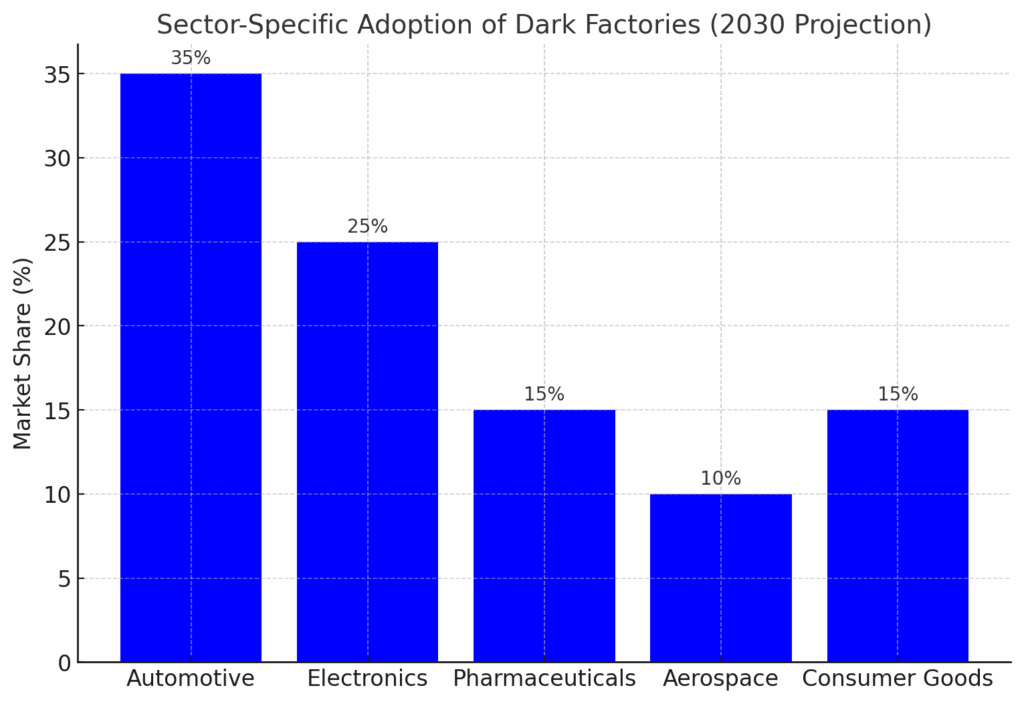
The business case for dark factories is reinforced by sector-specific examples. In the automotive industry, BMW’s fully automated plant in Dingolfing, Germany, is a demonstration of efficiency, where autonomous guided vehicles transport parts through facilities and robots complete nearly every stage of assembly. Electronics giants such as Foxconn, which manufactures products for Apple, have invested heavily in “lights-out” production lines, capable of operating with minimal human oversight. Pharmaceutical firms including Novartis and Pfizer have adopted robotics for sterile environments, ensuring both efficiency and safety. Even consumer goods companies are shifting, with Procter & Gamble experimenting with automated systems that reduce energy consumption while maintaining output.
The labor implications of dark factories are profound. While advocates argue that automation creates new high-skilled positions in engineering and systems management, the reality is that these jobs require advanced education and are far fewer in number than the assembly, logistics, and quality-control roles they replace. A study by Oxford Economics found that each new industrial robot eliminates an average of 1.6 jobs. Scaled across global industries, the displacement could reach millions. The trend risks deepening inequality, especially in communities that have historically depended on manufacturing wages to support middle-class livelihoods.
The global outlook highlights regional contrasts. In North America, adoption is driven by labor shortages and reshoring efforts aimed at reducing dependence on overseas supply chains. Europe’s emphasis on Industry 4.0 initiatives is accelerating integration of robotics and AI across Germany, France, and the UK. Asia-Pacific is expected to dominate overall growth, led by China, Japan, and South Korea, where governments actively support robotics as a national priority. In Latin America and the Middle East, adoption is slower but rising, as multinational corporations build automated plants closer to emerging markets.
The pace of adoption is not without challenges. Initial investment costs for dark factory infrastructure are high, making them more accessible to large corporations than to small and mid-sized enterprises. Cybersecurity also presents a growing risk. With factories connected through IIoT networks, vulnerabilities in one node can ripple across entire production lines, threatening both safety and output. At the same time, social resistance is building, as unions and policymakers grapple with the impact of automation on employment. The tension between efficiency and social responsibility is becoming one of the defining debates of modern industry.
Yet the trajectory is clear: dark factories are redefining what it means to produce goods in the 21st century. They embody efficiency, precision, and resilience in a world where supply chains face increasing volatility. They also raise difficult questions about the human role in production. As companies embrace robotics, AI, and additive technologies, society must balance the economic benefits with the social costs of displacement.
The transformation underway is not a temporary trend but a structural evolution. Dark factories represent both the promise and peril of automation: the promise of higher productivity and lower costs, and the peril of widespread job loss and economic disruption. Whether this future strengthens or undermines societies will depend on how governments, industries, and communities prepare for a world where machines do the work once reserved for people.
Key Takeaways
- The dark factories market is projected to grow from $119.19 billion in 2024 to $194.60 billion by 2030, driven by robotics, AI, IIoT, and additive manufacturing.
- Industries such as automotive, electronics, and pharmaceuticals are leading adopters, with fully automated plants already in operation.
- Machine vision and predictive AI reduce errors and downtime, making quality control and maintenance faster and more efficient.
- Job displacement is significant: each industrial robot eliminates an estimated 1.6 jobs, threatening middle-class manufacturing employment worldwide.
- Regional growth is strongest in Asia-Pacific, but North America and Europe are accelerating adoption through reshoring and Industry 4.0 initiatives.
Sources
- ResearchAndMarkets
- International Federation of Robotics
- Oxford Economics
- McKinsey Global Institute
- World Economic Forum
- Reuters
- Financial Times