

Artificial intelligence did not enter public life gradually. It arrived quickly, broadly, and with little resistance. In the span of a few years, systems once confined to research labs and enterprise pilots became everyday infrastructure. AI now drafts contracts, triages medical images, assists with coding, filters customer service requests, and influences financial decisions at scale. The pace of adoption has been historically unusual. When a leading generative AI system reached 100 million users in roughly two months, it became the fastest-growing consumer application on record, outpacing earlier platform shifts by orders of magnitude.
That speed mattered because it reshaped trust. For consumers, AI felt intuitive rather than technical, helpful rather than invasive. A prompt was enough. Outputs were fluent, confident, and often correct. Surveys conducted in 2023 and 2024 show that a majority of users interacting with generative AI tools do not understand how these systems are trained or how their data may be stored or reused. Unlike earlier digital technologies, AI required no visible configuration, security decision, or literacy threshold. It presented itself as a shortcut. And shortcuts are adopted before they are questioned.
What made this transition distinct from earlier digital waves was not only speed, but selective amnesia. Over decades, individuals, firms, and governments had learned hard lessons about digital risk. Large-scale data breaches, phishing campaigns, and identity fraud led to the normalization of basic security behaviors, reinforced by regulation and institutional practice. By the late 2010s, data protection was uneven but internalized across much of the global economy.
AI bypassed those instincts. Most users did not know what data these systems absorbed, how long inputs persisted, or how outputs were generated. Prompts felt ephemeral. Outputs felt detached from inputs. The routine use of AI inside workplace productivity tools, customer service platforms, banking apps, and personal devices normalized a new behavior: sensitive information flowing into systems whose boundaries were unclear. In early 2023, several large firms restricted employee use of public AI tools after internal audits revealed proprietary code and confidential material had been entered into external systems. These incidents were not outliers. They reflected a widespread mismatch between everyday use and underlying risk.
Enterprises followed a similar trajectory. By 2024, global surveys indicated that more than 70 percent of large organizations had piloted or deployed AI in at least one core business function. Integration cycles compressed from years to weeks as AI features became default components of cloud services, search, and enterprise software. Security reviews, model audits, and data provenance controls struggled to keep pace. In many cases, they were postponed under the assumption that safeguards could be added once value had been demonstrated.
Ranked and Clustered AI Security Concerns
| Rank | AI Security Concern | One-Sentence Description | Primary Impact Cluster |
|---|---|---|---|
| 1 | Data Leakage | Sensitive enterprise or personal data is unintentionally exposed through AI inputs or outputs. | Enterprise / Consumer Harm |
| 2 | AI-Enabled Fraud | Generative models scale impersonation, phishing, and social engineering attacks. | Consumer Harm / National Security |
| 3 | Model Theft | Proprietary AI capabilities are replicated through API abuse or model extraction. | Enterprise / National Security |
| 4 | Prompt Injection | Hidden instructions manipulate AI systems into bypassing safeguards. | Enterprise Harm |
| 5 | Training Data Poisoning | Malicious data alters model behavior during training or retraining. | Enterprise / National Security |
| 6 | Misinformation Generation | AI accelerates the creation and distribution of false or misleading content. | Consumer / National Security |
| 7 | Autonomous Agent Misuse | AI systems execute actions beyond intended scope with limited oversight. | Enterprise Harm |
| 8 | Bias and Discrimination | Training data imbalances produce unfair or harmful automated decisions. | Consumer Harm |
| 9 | Data Sovereignty Violations | Cross-border data use conflicts with national regulations. | National Security |
| 10 | Model Drift | Performance degrades as real-world data diverges from training conditions. | Enterprise Harm |
Source: OECD; Academic AI Security Literature
The economic incentives reinforced that approach. Estimates from international institutions suggest that AI could contribute trillions of dollars to global economic output over the coming decade, with productivity gains concentrated in knowledge-intensive sectors. For executives and policymakers alike, the perceived risk of falling behind often outweighed the less visible risks associated with premature deployment. Security became a downstream consideration rather than a design requirement.
At the national level, the stakes are higher still. Governments increasingly frame AI as strategic infrastructure, comparable to energy systems, telecommunications, or semiconductors. Data sovereignty has entered policy agendas across regions, yet regulatory capacity remains uneven and reactive. Citizen data rights are widely acknowledged, but enforcement often lags deployment. Oversight adapts after systems are in use, not before they are embedded.
The result is a quiet contradiction. AI systems are trusted to generate information, guide decisions, and automate judgment across economic and social life, even as their security properties remain poorly understood by users, unevenly managed by organizations, and inconsistently governed by states. The rapid rise of AI was powered by accessibility, optimism, and immediate utility. What it displaced was caution. Understanding how that imbalance became embedded in AI systems is essential to understanding why AI security has emerged as a systemic challenge rather than a temporary growing pain.
How Modern AI Systems Create Their Own Risk
The security challenges associated with artificial intelligence are not the result of isolated vulnerabilities or exceptional misuse. They stem from how modern AI systems are designed, trained, and deployed at scale. The architectural features that enabled recent breakthroughs – large-scale data aggregation, continuous learning, natural-language interfaces, and cloud-based delivery – have also weakened many of the controls that governed earlier generations of digital systems. Risk, in this context, is not peripheral. It is structural.
Data aggregation sits at the center of this shift. Contemporary foundation models are trained on datasets containing hundreds of billions, and in some cases trillions, of data tokens drawn from a mix of proprietary enterprise sources, licensed content, public repositories, and web-scale scraping. Global assessments indicate that more than 90 percent of leading models released since 2020 rely on training data that is partially or fully opaque to downstream users. This opacity represents a significant departure from pre-AI enterprise systems, where data provenance, ownership, and access permissions were explicit governance requirements rather than secondary considerations.
AI Security Risks by System Layer
| System Layer | Risk Type | Example Failure Mode |
|---|---|---|
| Data | Poisoning | Manipulated inputs distort model outputs over time. |
| Model | Extraction | Attackers replicate proprietary models via repeated queries. |
| Interface | Prompt Injection | Hidden commands override intended system behavior. |
| Deployment | Misconfiguration | Inadequate access controls expose sensitive outputs. |
Source: IEEE; ACM; AI Security Research
The implications are already visible at the organizational level. In 2023 and 2024, multiple large firms across technology, finance, and manufacturing sectors restricted employee use of public generative AI tools after internal audits revealed that proprietary source code, product roadmaps, and confidential communications had been entered into external systems. These incidents were not driven by malicious intent. They reflected routine productivity use in an environment where the boundary between internal data and external models had become blurred. Surveys conducted among enterprise users show that a majority of employees using generative AI tools are unaware of whether their inputs are retained or reused.
Data poisoning exploits the same structural openness. Peer-reviewed research has demonstrated that manipulating as little as 0.1 to 1 percent of a training dataset can induce targeted and persistent changes in model behavior. In operational contexts, this means that compromised data introduced through open repositories, third-party vendors, or user feedback loops can influence systems used for fraud detection, content moderation, credit scoring, or threat analysis. Unlike conventional cyberattacks, the effect does not disappear when the source is removed. The model has already internalized the signal, embedding the risk into future outputs.
Continuous learning intensifies this exposure. Many production AI systems retrain or fine-tune models on new data weekly or even daily. This improves performance and adaptability, but it also allows risk to accumulate incrementally. There is often no single failure event. A poisoned or drifted model can perform plausibly across thousands of interactions before its behavior becomes materially harmful in a high-stakes setting.
Large language models introduce a different category of vulnerability rooted in interface design. Natural language functions simultaneously as data and instruction. This ambiguity enables prompt injection, where hidden commands embedded in user queries, documents, or retrieved web content override system constraints. Security researchers have repeatedly demonstrated prompt injection attacks that caused AI-powered systems to disclose internal policies, operational details, or confidential information. As organizations deploy language models to summarize documents, draft communications, and interact with internal tools, the attack surface expands beyond traditional network boundaries.
This risk grows as AI systems are integrated into automated workflows. Retrieval-augmented generation systems ingest information from external sources that organizations do not control. Autonomous agents are increasingly capable of planning and executing multi-step tasks across tools and platforms. The distinction between trusted and untrusted input becomes porous, and with it the boundary between intended assistance and unintended action.
Training data leakage further complicates governance. Although AI models do not store data verbatim, empirical studies have shown that large models can reproduce rare or sensitive sequences when prompted repeatedly. Researchers have extracted personal identifiers, proprietary code fragments, and confidential text from deployed models, even when such data appeared infrequently in training corpora. For individuals, this creates a persistent risk that information shared years earlier may reappear in contexts entirely outside their awareness or consent.
Robustness failures underscore the limits of current AI reliability. Adversarial inputs – often imperceptible changes to images, audio, or text – can cause confident misclassification. In controlled experiments, minor visual alterations have caused computer vision systems to misidentify objects critical to safety. In real-world deployments, similar weaknesses affect biometric authentication, automated surveillance, and content verification systems. In consumer contexts, these failures enable fraud and impersonation. In government and enterprise systems, they raise concerns about safety, security, and rights.
Economic exposure is equally embedded. Training a frontier-scale AI model can require investments exceeding $100 million in compute, data acquisition, and specialized talent. At the same time, research has shown that models exposed through application programming interfaces can be approximated through systematic querying, allowing competitors or state-backed actors to replicate capabilities at a fraction of the original cost. The result is accelerated diffusion of advanced capabilities with weakened intellectual property protection and limited oversight.
All of this unfolds at speed. AI models are updated far more frequently than traditional enterprise software, often on cycles measured in days or weeks. Surveys of AI practitioners indicate that fewer than half of organizations maintain formal processes for model versioning, rollback, or post-deployment behavioral monitoring. When failures occur, determining whether the cause lies in data drift, adversarial manipulation, or unintended interaction can take longer than the damage itself.
Taken together, these dynamics explain why AI security failures differ from earlier digital incidents. The risk is cumulative rather than episodic. Modern AI systems do not merely introduce new attack surfaces. They reshape how information flows, how decisions are automated, and how control is exercised. Recognizing these structural characteristics is essential before considering governance and policy responses capable of managing AI at scale.
Governing AI at Speed – A Fragmented Global Response
The rapid expansion of artificial intelligence has exposed a structural imbalance between how AI systems operate and how they are governed. AI models are trained across borders, updated continuously, and deployed through global platforms. Governance, by contrast, remains national, uneven, and largely reactive. The result is a fragmented global response in which responsibility for AI risk is distributed unevenly among states, firms, and individuals.
United States:
The United States has emphasized innovation speed and market-led adoption. By 2024, approximately 75 percent of US companies reported using AI in at least one business function, yet fewer than half had implemented formal AI risk or security governance. Federal oversight relies on existing consumer protection, financial regulation, and cybersecurity frameworks rather than AI-specific security mandates. This places much of the burden on firms to self-regulate.
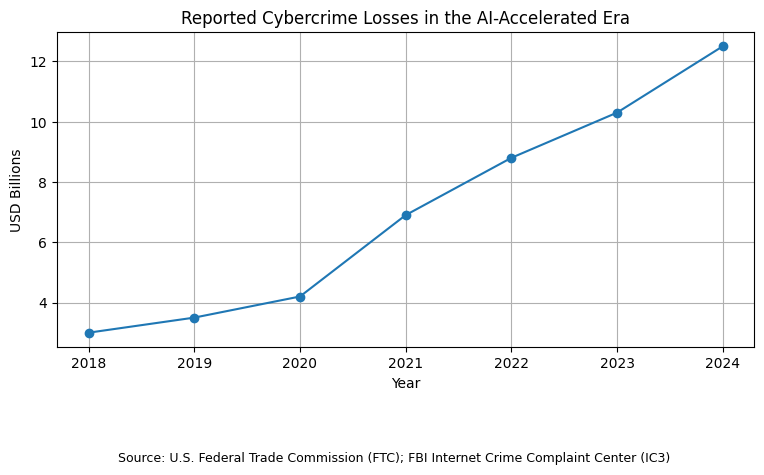
The consequences are visible in the fraud landscape. In 2024, US consumers reported more than $12.5 billion in fraud losses, while the FBI recorded $16.6 billion in total internet crime losses. Although not all of these losses are AI-driven, regulators have documented rapid growth in scams enabled by synthetic voice and text systems. High-profile cases, including deepfake videos falsely featuring Warren Buffett to promote fraudulent schemes, illustrate how AI converts reputational trust into scalable financial risk.
AI Adoption Rates by Region
| Region | AI Adoption Rate (%) | Context |
|---|---|---|
| United States | 75% | Widespread enterprise deployment across productivity, finance, and customer-facing systems. |
| European Union | 14% | Adoption concentrated in larger firms, with compliance and cost cited as key constraints. |
| China | 60% | High adoption driven by platform-scale deployment and state-supported AI integration. |
| Japan and South Korea | 28% | Integration into industrial, manufacturing, and financial systems with strong governance frameworks. |
| India | 87% | Rapid uptake in fintech, digital identity, and service delivery platforms. |
| Latin America | 35% | Growing adoption in banking, retail, and public administration, with uneven governance capacity. |
Source: Eurostat; McKinsey & Company; National Statistics Offices
European Union:
The European Union has adopted a more precautionary approach, embedding AI governance within a risk-based regulatory framework. High-risk systems, particularly those used in credit scoring, biometric identification, and public services, are subject to requirements around documentation, auditability, and human oversight. This has reshaped enterprise deployment decisions, especially in finance and technology.
Yet governance capacity remains uneven. In 2024, only 13.5 percent of EU enterprises with ten or more employees reported using AI technologies, up from 8.0 percent the year before. Regulation is advancing faster than adoption, and enforcement struggles to keep pace with cross-border information flows. As a result, European consumers remain exposed to AI-generated fraud and misinformation originating outside the Union’s regulatory reach.
China:
China’s AI governance model prioritizes state oversight, information control, and data localization. Large-scale AI systems and algorithms that influence public opinion are subject to registration, security review, and content constraints. By mid-2024, more than 190 generative AI models had been registered for public use, serving over 600 million users, with reported registrations exceeding 300 services by year-end.
For businesses, compliance is a prerequisite for scale, shaping product design and deployment timelines. For citizens, AI is less visible as an open consumer tool and more embedded in state-managed platforms. The tradeoff is explicit: reduced exposure to external manipulation in exchange for tighter control over information flows.
Across regions, a consistent pattern emerges. Where enforcement capacity is high, governance shapes the pace and form of deployment. Where it is weak, adoption outpaces oversight, and consumers and smaller firms absorb disproportionate risk.
Asia – High-Income Economies:
In Japan and South Korea, AI governance builds on mature cybersecurity and industrial policy institutions. Japan’s Ministry of Economy, Trade and Industry issued AI guidelines for business in 2024, framing governance as a lifecycle responsibility spanning developers, providers, and users. South Korea reports AI technology adoption rates near 28 percent, reflecting both widespread use and institutional readiness.
In these contexts, AI is integrated into existing risk management and compliance systems rather than treated as an experimental layer. Consumer exposure to AI-enabled fraud exists, but stronger enforcement capacity and higher digital literacy moderate impact.
Asia – Middle-Income Economies:
Across South and Southeast Asia, AI adoption is accelerating fastest in finance, identity systems, and service delivery. India illustrates the dynamic. Its fintech market was valued at approximately $110 billion in 2024 and is projected to reach $420 billion by 2029, alongside an estimated fintech adoption rate of 87 percent. AI-driven credit scoring, onboarding, and fraud detection now operate at massive scale.
Regulatory capacity has not kept pace. Many oversight bodies lack the technical expertise to audit models or enforce data governance. For consumers, this delivers faster access to services alongside opaque automated decisions and limited avenues for appeal. Errors scale as efficiently as benefits.
Middle East:
In the Gulf, AI is framed as a strategic state asset and a driver of economic diversification. The United Arab Emirates estimates that AI could contribute AED 353 billion to GDP by 2030, or roughly 13.6 percent of output. Saudi Arabia is pursuing scale through investment, with AI spending projected to exceed $720 million in 2024 and approach $1.9 billion by 2027.
Governance emphasizes data sovereignty and state-led deployment. Firms such as Abu Dhabi’s G42 have developed localized large language models, including the Jais family, to reduce dependence on foreign systems. For residents and enterprises, the central question is not whether AI will be adopted, but whose rules govern data, infrastructure, and accountability.
Africa and Latin America:
In much of Africa and Latin America, AI governance is shaped by leapfrogging pressures. AI-enabled systems are deployed to expand financial inclusion, automate public services, and compensate for limited institutional capacity. At the same time, exposure to cybercrime is rising. An Interpol-led operation across 19 African countries reported 574 arrests linked to cybercrime networks responsible for more than $21 million in losses, including a thwarted $7.9 million business email compromise targeting a petroleum firm in Senegal.
Latin America faces similar tensions. Regional data show a 32 percent increase in reported fraud in the first half of 2024 compared with the previous year. In Brazil, a cyberattack exploiting access sold by an IT employee at a software provider diverted roughly 540 million reais, or about $100 million, from banking systems connected to the country’s real-time payments infrastructure. These cases highlight how governance failures often occur not at the bank or platform, but within the vendor networks that connect them.
Across income levels, the pattern is consistent. High-income economies emphasize auditability and integration with cybersecurity frameworks. Middle-income economies balance growth with selective regulation. Low-income economies face the greatest asymmetry, gaining access to AI-enabled services while holding the least leverage over data governance and security standards.
For individuals and organizations, these governance gaps are no longer abstract. AI-generated scams mimic familiar voices. Automated misinformation spreads faster than verification. Employees expose sensitive information through routine AI use. Governments struggle to regulate systems that do not respect borders. Governance has become the friction point where everyday digital experience collides with institutional limits, and where the uneven costs of AI adoption are felt most directly.
What Comes Next for AI Security
The next phase of AI security will be defined less by singular regulatory breakthroughs than by accumulation – of incidents, financial loss, institutional adaptation, and public awareness. AI is no longer a marginal or experimental technology. By 2030, international organizations estimate that AI could be embedded in more than 80 percent of enterprise software workflows, with productivity tools, financial services, logistics, and public administration among the most affected sectors. Cloud providers already report sustained double-digit annual growth in AI-related compute demand, reflecting that AI is becoming a permanent layer of digital infrastructure rather than a discretionary add-on.
In the near term, security maturity will continue to diverge sharply by organization size and sector. Surveys of large enterprises show that more than 60 percent now conduct formal AI risk assessments prior to deployment, particularly in finance, healthcare, and critical infrastructure. By contrast, fewer than 30 percent of small and medium-sized firms report having any AI-specific security or governance framework. For these organizations, AI typically arrives bundled into productivity software, customer relationship platforms, and cloud services. Security decisions are made upstream by vendors, leaving firms to inherit risk without visibility or leverage.
AI Security Maturity by Organization Size
| Organization Size | AI Adoption Level | Governance Presence | Typical Risk Exposure |
|---|---|---|---|
| Large Enterprises | High | Formal | Model theft, compliance risk |
| Mid-Sized Firms | Medium | Partial | Vendor dependency |
| Small Businesses | Growing | Minimal | Data leakage, fraud |
Source: McKinsey; Industry Surveys
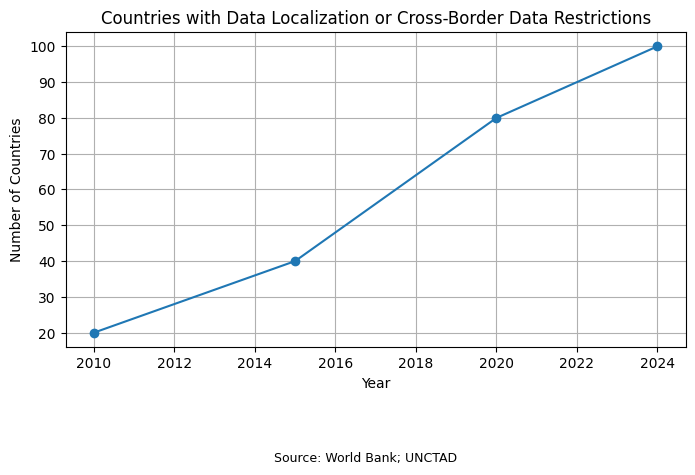
Data sovereignty will move from policy debate to operational constraint. By the mid-2020s, more than 100 countries had enacted or proposed data localization and cross-border data transfer restrictions, a figure that continues to rise annually. AI systems complicate compliance because training, fine-tuning, and inference rely on continuous access to large, often globally distributed datasets. Multinational firms already report increased infrastructure duplication and compliance costs as they segment data and model operations by jurisdiction. For consumers, this fragmentation means that data protection increasingly depends on where data is processed rather than where legal rights are defined.
Data Sovereignty Constraints on AI Operations
| Constraint Type | Affected AI Stage | Business Impact |
|---|---|---|
| Data Localization | Training | Higher infrastructure cost |
| Cross-Border Transfer Limits | Inference | Operational fragmentation |
| Retention Requirements | Storage | Compliance complexity |
Source: World Bank; UNCTAD
Misinformation and fraud are likely to remain the most visible and politically salient AI security failures. Financial regulators in multiple regions report that AI-assisted social engineering and synthetic media are among the fastest-growing fraud categories. In the United States alone, reported consumer fraud losses exceeded $12.5 billion in 2024, while international enforcement agencies have documented sharp growth in impersonation scams enabled by voice cloning and automated messaging. In surveys, a growing share of consumers report difficulty distinguishing real communications from synthetic ones, particularly in voice-based interactions. As generative models improve, impersonation becomes cheaper, faster, and more scalable. Defensive tools will advance as well, but historical patterns suggest attackers adapt more rapidly than institutions.
Cybersecurity itself is being reshaped by AI on both sides of the threat equation. On the defensive side, machine learning systems now underpin anomaly detection, threat prioritization, and automated response across much of the security industry. On the offensive side, attackers increasingly use AI to generate phishing campaigns, probe vulnerabilities, and automate reconnaissance. Industry estimates indicate that the average cost of a data breach continues to rise year over year, driven in part by faster attack cycles and higher complexity. For enterprises, this implies sustained growth in security expenditure, greater reliance on managed security services, and tighter integration between AI governance and core cyber risk management. The separation between AI risk and cybersecurity risk is rapidly eroding.
Regulatory convergence will be slow and partial. High-income economies are refining risk-based AI frameworks and expanding enforcement capacity, particularly in sectors tied to financial stability and critical infrastructure. Middle-income economies continue to balance growth, access, and selective regulation, often adopting external standards rather than shaping them. Low-income economies face the greatest asymmetry, gaining access to AI-enabled services while holding limited leverage over data governance and security practices. International coordination on AI security standards remains constrained by geopolitical competition and divergent approaches to information control, leaving global firms to navigate fragmented compliance regimes.
Over the longer term, AI security will normalize much as cybersecurity did in previous decades. Practices that now appear specialized – model auditability, data provenance tracking, lifecycle governance, and continuous behavioral monitoring – are likely to become baseline expectations. This transition will not occur preemptively. It will be driven by repeated failures, regulatory penalties, financial loss, and public scrutiny. Security maturity will follow consequence rather than foresight.
Taken together, the direction is clear. The rapid rise of AI was fueled by accessibility, optimism, and immediate utility. Consumers adopted systems they did not fully understand. Enterprises prioritized speed and competitive advantage. Governments emphasized innovation and strategic positioning. In doing so, many of the security instincts developed over decades of digital experience were sidelined. AI is no longer an experimental technology at the margins of the economy. It is infrastructure. How securely it is governed will shape economic resilience, institutional trust, and the stability of digital societies in the years ahead.
Key Takeaways
-
The speed of AI adoption has outstripped security awareness, embedding systemic risk into consumer, enterprise, and government systems before safeguards could mature.
-
Modern AI security risks are structural, arising from large-scale data aggregation, continuous learning, and natural-language interfaces that weaken traditional controls over information and access.
-
AI amplifies existing threats such as fraud, impersonation, and misinformation by lowering the cost and skill required to operate at scale.
-
Governance responses remain fragmented, with regulatory capacity varying widely across regions and income levels, leaving risk unevenly distributed.
-
Data sovereignty is shifting from a policy concept to an operational constraint, increasing compliance complexity for organizations and uneven protection for individuals.
-
As AI becomes core infrastructure, security will evolve through accumulated failures, financial loss, and regulatory pressure rather than proactive design.
-
The long-term stability of digital economies will depend less on AI capability and more on how securely these systems are governed, monitored, and constrained.
Sources
-
United Nations Conference on Trade and Development (UNCTAD); Technology and Innovation Report 2023: Opening Green Windows; https://unctad.org/publication/technology-and-innovation-report-2023
-
McKinsey & Company; The State of AI in 2024; https://www.mckinsey.com/capabilities/quantumblack/our-insights/the-state-of-ai-2024
-
OECD; Artificial Intelligence, Data Governance and Privacy; https://www.oecd.org/digital/artificial-intelligence/ai-data-governance-privacy/
-
European Commission (Eurostat); Artificial Intelligence Use in Enterprises; https://ec.europa.eu/eurostat/statistics-explained/index.php?title=Artificial_intelligence_in_enterprises
-
Federal Trade Commission (FTC); New FTC Data Show Big Jump in Reported Losses to Fraud in 2024; https://www.ftc.gov/news-events/news/press-releases/2025/03/new-ftc-data-show-big-jump-reported-losses-fraud-125-billion-2024
-
Federal Bureau of Investigation (FBI); Internet Crime Report 2024; https://www.ic3.gov/Media/PDF/AnnualReport/2024_IC3Report.pdf
-
Ministry of Economy, Trade and Industry of Japan (METI); AI Guidelines for Business; https://www.meti.go.jp/english/press/2024/0419_002.html
-
Cyberspace Administration of China; Interim Measures for the Management of Generative Artificial Intelligence Services; http://www.cac.gov.cn/2023-07/13/c_1690898327029107.htm
-
PwC; Sizing the Prize: What’s the Real Value of AI for Your Business and How Can You Capitalise?; https://www.pwc.com/gx/en/issues/analytics/assets/pwc-ai-analysis-sizing-the-prize-report.pdf
-
Interpol; Operation Sentinel Results in Major Cybercrime Arrests Across Africa; https://www.interpol.int/en/News-and-Events/News/2024/INTERPOL-operation-targets-cybercrime-in-Africa
-
BioCatch; Fraud Trends in Latin America 2024; https://www.biocatch.com/resources/blog/fraud-trends-latam-update
-
World Bank; Data Localization and Cross-Border Data Flows; https://www.worldbank.org/en/topic/digitaldevelopment/brief/data-localization
-
Institute of Internet Economics; AI Security and Data Sovereignty; https://instituteofinterneteconomics.org/ai-security-data-sovereignty