

Connectivity Became the Baseline
For more than a decade, connected systems were designed around a predictable hierarchy. Devices sensed local conditions, networks transported the data, and centralized cloud platforms processed, analyzed, and acted at scale. Intelligence accumulated inside hyperscale environments where compute density and storage elasticity could expand without regard for endpoint constraints. Connectivity itself created strategic advantage.
That advantage has thinned as scale has normalized access.
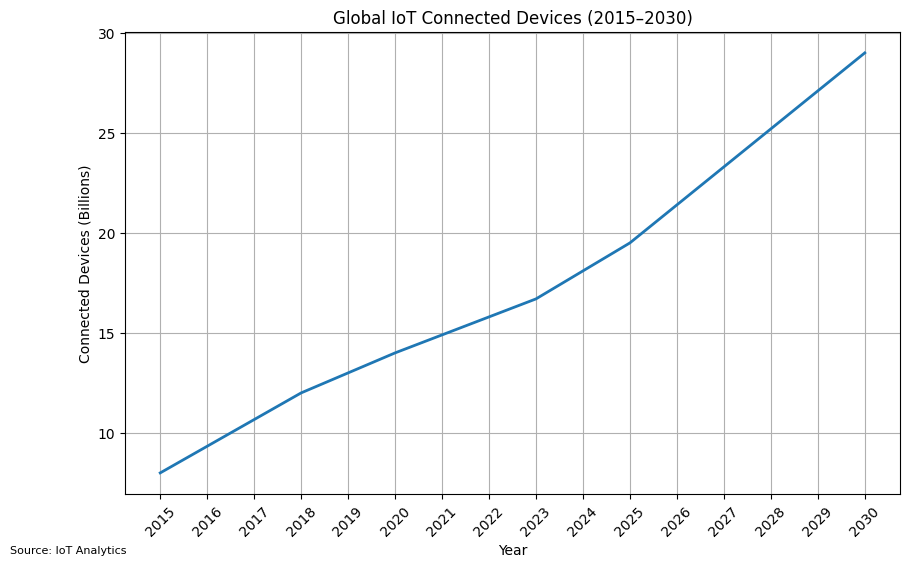
Global IoT connections are projected to exceed 29 billion by 2030, up from roughly 16 billion in 2023, according to IoT Analytics. As enrollment accelerates across homes, factories, hospitals, and logistics networks, interoperability has replaced exclusivity as the gateway to growth. Matter 1.5, released in November 2025, expanded support to cameras and enhanced energy management features, bringing high-bandwidth imaging devices and grid-aware systems into a common standards framework. When surveillance cameras and energy controllers operate seamlessly across ecosystems, connectivity becomes infrastructure rather than differentiation.
The architectural question shifts accordingly. If nearly every device can connect, the competitive frontier becomes where intelligence resides and how independently devices can operate.
Silicon design reflects the transition. Nordic Semiconductor’s January 2026 nRF54L series embedded neural processing capability directly into battery-powered IoT endpoints, enabling always-on inference within tight energy budgets. Qualcomm’s concurrent IoT expansion framed edge AI as deployable enterprise infrastructure rather than a premium add-on. Inference is increasingly engineered into the device at manufacture, signaling a structural separation between connectivity and autonomy.
Why Centralized Compute Is Under Pressure
The cloud-centric model continues to expand, yet the infrastructure that sustains it is entering a period of visible strain. AI workloads are amplifying energy demand, bandwidth utilization, and systemic exposure in ways that connect digital architecture directly to national infrastructure planning.
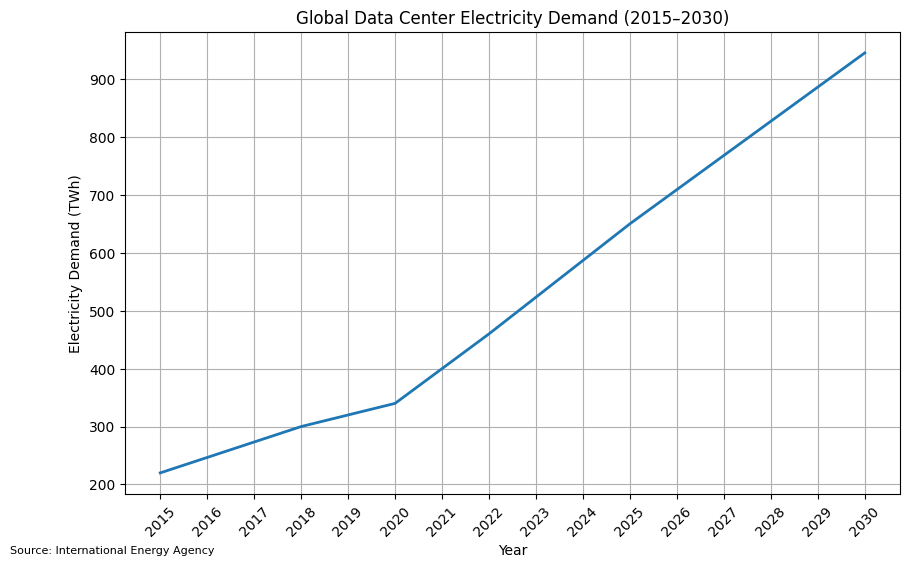
The International Energy Agency projects that global data center electricity demand could rise from approximately 460 terawatt-hours in 2022 to around 945 terawatt-hours by 2030, with AI driving much of the increase. At that level, electricity consumption associated with data centers would approach the current annual usage of Japan. In the United Kingdom, reporting indicates that proposed data center developments could require power capacity exceeding current peak national electricity demand if fully realized. Compute concentration has moved from a technical abstraction to an energy policy variable.
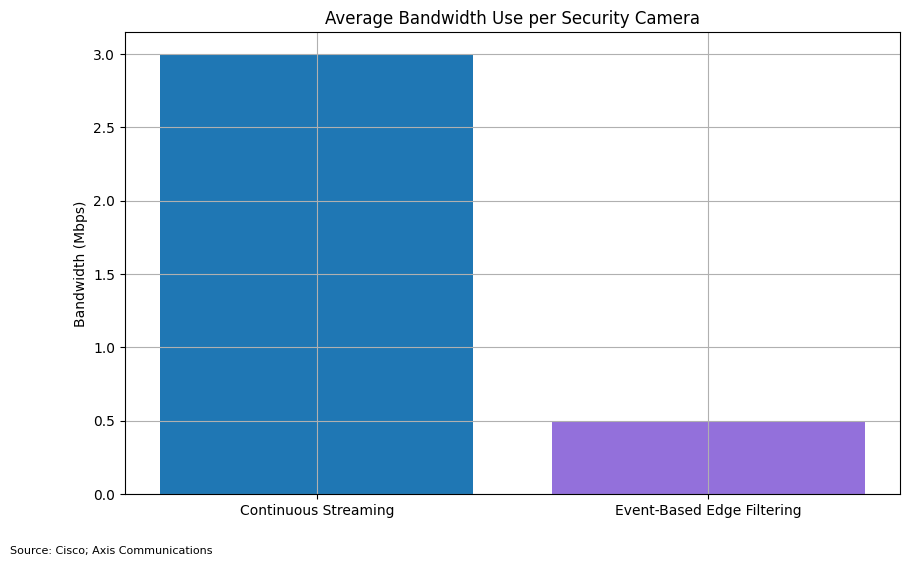
Bandwidth amplifies the effect. A single high-definition security camera can require between 1 and 4 Mbps when streaming continuously. Across commercial campuses or municipal deployments, persistent upstream transmission creates sustained backhaul demand and associated cost. Event-based transmission enabled by local inference reduces this load by sending alerts and structured metadata rather than raw video streams.
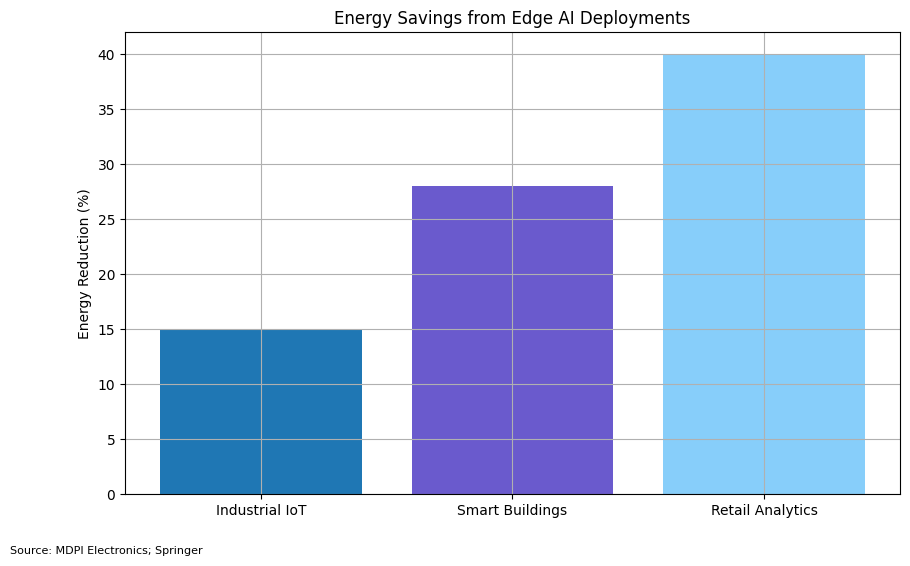
Performance research supports the redistribution argument. A 2025 MDPI Electronics study examining optimized edge AI configurations reported energy savings ranging from 15 percent to over 40 percent depending on workload design, alongside materially lower latency compared with cloud-dependent inference. Industry reporting on smartphone-based AI similarly indicates double-digit percentage reductions in energy draw when models execute locally rather than through remote servers.
Operational fragility adds further pressure. Apple’s February 2026 discontinuation of support for its legacy Home architecture required migrations and hardware updates for users who had not transitioned, illustrating how centralized software decisions cascade across dependent device fleets. Hyperscale outages exhibit similar dynamics when control planes are unified.
Energy density, bandwidth expansion, and systemic concentration are converging on the same architectural tension.
Edge Autonomy as a Systems Strategy
Edge autonomy is emerging not as a rejection of the cloud, but as a recalibration of authority within distributed systems. As compute capability moves closer to data generation, devices evolve from passive sensors into active decision nodes capable of filtering, interpreting, and responding within local context.
In cloud-centric architectures, devices primarily collect and forward continuous telemetry to centralized analytics engines. Subscription services, dashboards, and aggregation platforms depend on persistent connectivity and concentrated compute. By contrast, edge-autonomous systems execute first-pass inference locally. Cameras classify motion before transmitting alerts. HVAC systems optimize temperature in real time based on occupancy and tariff signals. Industrial sensors detect anomalies and initiate responses without routing every data point to distant servers. The cloud coordinates updates, aggregates macro-level insights, and supports federated learning, but it is no longer required to mediate every micro-decision.
This redistribution reshapes infrastructure economics. Compute demand disperses across millions of endpoints rather than concentrating exclusively in hyperscale facilities. Transmission volumes decline as filtered outputs replace continuous raw streams. Sensitive data can remain on-device, narrowing centralized exposure.
Security posture evolves in parallel. The Kimwolf IoT botnet reported in February 2026 demonstrated how compromised edge devices can disrupt broader infrastructure networks, including the I2P anonymity network. Exploitation of end-of-life routers such as CVE-2025-14528 illustrates how unsupported hardware becomes persistent attack capital. Centralized systems consolidate failure domains; distributed systems diffuse them while increasing reliance on secure firmware update pipelines, device identity frameworks, and enforceable lifecycle support.
Distribution lowers systemic single points of failure. It raises the operational bar at the endpoint.
Regulation and Energy Policy Reinforce the Separation
Regulatory frameworks are increasingly aligned with the structural logic of distributed intelligence, embedding governance requirements directly into device design and lifecycle management. As connected products permeate consumer and industrial environments, policymakers are focusing not only on data flows but also on product integrity, update obligations, and accountability at scale.
The EU Data Act, applicable since September 2025, establishes access and portability rights for data generated by connected devices, limiting manufacturers’ exclusive control over device-originated information. Architectures that minimize centralized aggregation align structurally with portability principles, yet distributed inference complicates oversight. When endpoints independently classify and act on data, compliance requires transparency at the firmware and model-governance layer.
The EU Cyber Resilience Act imposes secure-by-design and vulnerability management obligations on products with digital elements. In the United States, the FCC’s Cyber Trust Mark introduces consumer-facing labeling tied to cybersecurity benchmarks. Security expectations are moving from differentiation to baseline requirement.
Energy governance further reinforces the shift. With global data center electricity demand projected to approach 945 terawatt-hours by 2030, grid operators must reconcile digital expansion with resilience and climate targets. Distributed compute architectures enable localized demand-response optimization, allowing buildings and industrial systems to adjust consumption dynamically based on pricing signals without constant cloud mediation. Academic reviews of AI-enabled smart building systems increasingly position edge AI as foundational to real-time energy coordination.
Geopolitics adds another dimension. Advanced AI-capable silicon remains embedded within export controls and strategic competition. Reporting in early 2026 highlighted disputes over advanced chip utilization despite trade restrictions, underscoring that inference hardware has become strategic infrastructure. As neural processing units become standard within IoT-class chipsets, supply chain access and regional policy divergence may influence ecosystem alignment.
Two Architectural Economies
The separation underway is producing two infrastructure logics operating within the same network. Each reflects distinct assumptions about scale, resilience, and value capture.
Cloud-first ecosystems monetize aggregation. Continuous telemetry feeds centralized analytics platforms, subscription services, and cross-device data pooling. Scale drives efficiency, and concentrated compute underpins revenue design.
Edge-autonomous ecosystems monetize performance, resilience, and lifecycle durability. Hardware-software co-design, energy efficiency, predictable support horizons, and privacy-preserving operation become differentiators as interoperability reduces switching friction. For enterprises deploying thousands of endpoints across warehouses, hospitals, or manufacturing plants, architecture selection now influences electricity budgets, bandwidth provisioning, cybersecurity insurance, and compliance overhead simultaneously. Compute placement becomes a capital planning decision.
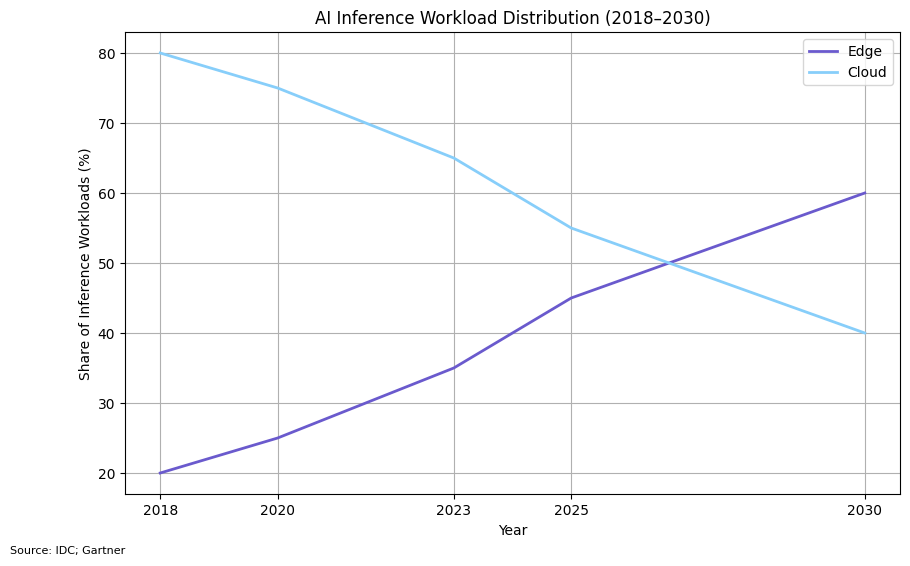
The cloud remains indispensable as coordinator, synchronizing updates and aggregating system-level insight across distributed fleets. It no longer monopolizes intelligence.
Connectivity expanded the network’s reach. Edge autonomy is redefining how authority, cost, and accountability are distributed within it.
Key Takeaways
- Global IoT connections are projected to exceed 29 billion by 2030, making interoperability a baseline condition rather than a strategic differentiator.
- Global data center electricity demand could rise from approximately 460 terawatt-hours in 2022 to around 945 terawatt-hours by 2030, elevating compute placement into energy policy debates.
- Optimized edge AI deployments demonstrate energy savings between 15 percent and 40 percent depending on workload configuration, alongside improved latency performance.
- Event-based transmission enabled by local inference reduces continuous bandwidth demand compared with raw data streaming.
- Regulatory frameworks including the EU Data Act and Cyber Resilience Act are embedding governance and cybersecurity obligations at the device level.
- The separation between cloud-centric and edge-autonomous architectures is producing two distinct infrastructure and revenue models operating across the same network.
Sources
- IoT Analytics; State of IoT 2023 – Number of Connected IoT Devices Growing 16% to 16.7 Billion Globally; – Link
- International Energy Agency; AI Is Set to Drive Surging Electricity Demand from Data Centres; – Link
- MDPI Electronics; An Energy-Aware Generative AI Edge Inference Framework; – Link
- IDC; Worldwide Edge Spending Guide; – Link
- Cisco; Annual Internet Report; – Link
- Axis Communications; Bandwidth and Storage Calculator Guidance; – Link
- Nordic Semiconductor; nRF54L Series SoC with NPU and Nordic Edge AI Lab; – Link
- Qualcomm; Edge AI Expansion for IoT; – Link
- Connectivity Standards Alliance; Matter 1.5 Introduces Cameras and Enhanced Energy Management Capabilities; – Link
- Financial Times; UK Data Centre Capacity and Electricity Demand; – Link
- The Guardian; New Datacentres Risk Doubling UK Electricity Use; – Link
- Apple Support; About the New Home Architecture; – Link
- Krebs on Security; Kimwolf Botnet Swamps Anonymity Network I2P; – Link
- CrowdSec; CVE-2025-14528 Vulnerability Tracking Report; – Link
- European Commission; Data Act; – Link
- European Commission; Cyber Resilience Act; – Link
- Federal Communications Commission; Cyber Trust Mark; – Link
- Reuters; China’s DeepSeek Trained AI Model Using Nvidia’s Best Chip Despite US Ban; – Link