
When Incentives Outran the System
Cross-border e-commerce is entering a structural correction driven not by falling demand, but by a widening gap between digital consumer expectations and the terrestrial economics required to satisfy them. International transactions now account for roughly 30 percent of global e-commerce volume, placing cross-border fulfillment at the core of modern retail rather than at its edges. The disruption unfolding across the sector reflects a collision between incentive-driven behavior and the physical limits of logistics, inventory, and regulation. What is failing is not appetite, but the system that once masked its true cost.
That system was shaped by incentive design. Subscription shipping programs and frictionless checkout flows normalized speed, reversibility, and global availability as default features of online commerce. More than 75 percent of online shoppers report that delivery speed directly influences where they buy, and over half expect delivery within two days or less. From a behavioral economics perspective, these incentives reduced perceived risk and time cost, turning purchasing into a low-commitment, reversible action. Once these expectations scaled, they propagated across the market. Smaller merchants were forced to mirror service levels set by dominant platforms even when their cost structures could not sustain them. Digital interfaces made the promise appear costless; terrestrial systems absorbed the strain.
The imbalance was amplified by global sourcing. A large share of everyday consumer goods sold online—apparel, electronics accessories, home products—are manufactured outside domestic markets. In the United States, roughly 11 percent of consumer spending is directly attributable to imported goods, with higher concentrations in e-commerce-heavy categories. For years, this distance was economically muted by low freight costs, lenient customs treatment, and postal systems built for incremental growth rather than billions of individual parcels. The storefront suggested immediacy and abundance; the physical network quietly accumulated exposure.
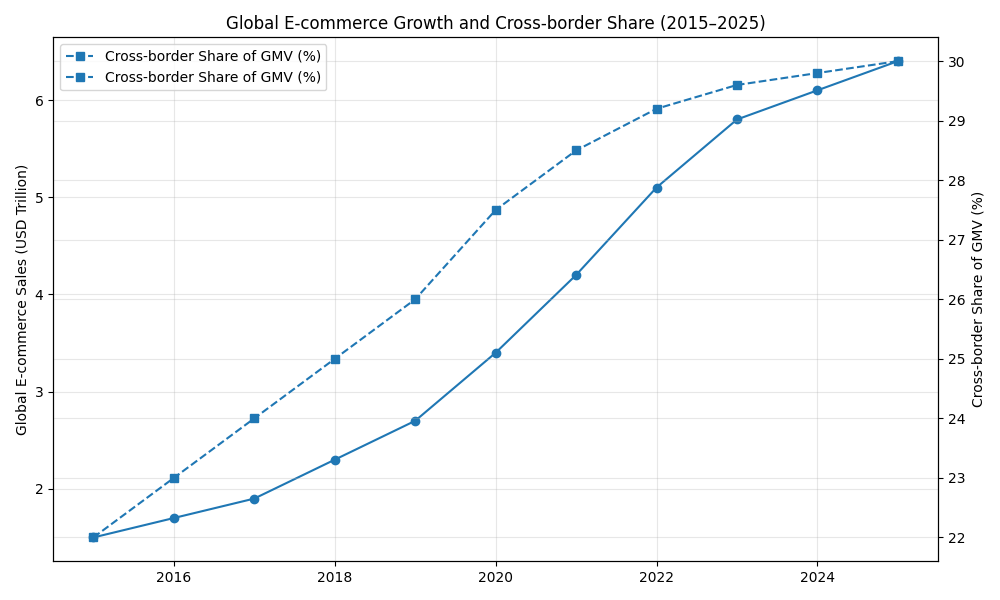
Global E-Commerce and Cross-Border Share (2015–2025)
| Year | Global E-Commerce Sales (USD Trillion) | Cross-Border Share (%) |
|---|---|---|
| 2015 | $1.5t | 22% |
| 2017 | $1.9t | 24% |
| 2019 | $2.7t | 26% |
| 2021 | $4.2t | 29% |
| 2023 | $5.8t | 30% |
| 2025 | $6.4t | 30% |
Source: eMarketer; UNCTAD
Freight volatility exposed that exposure. After 2022, on-time arrival rates on major Asia–Europe and Asia–North America lanes fluctuated by more than 10 to 15 percentage points quarter to quarter. Missed delivery windows translated directly into refunds, reshipments, and higher return initiation. Delivery promises shifted from marketing inputs to financial liabilities, binding inventory placement and promise accuracy together. The logic of centralized, origin-driven fulfillment began to break down.
Returns completed the stress cycle. Online return rates now average 20 to 30 percent globally, compared with under 10 percent in physical retail, with total merchandise returns reaching approximately $850 billion in 2024. Easy returns embedded option value into purchasing behavior, encouraging over-ordering and at-home trial while doubling transport and handling exposure. What had been treated as a back-office function emerged as a primary economic driver, implicitly requiring systems capable of processing, storing, and redeploying goods locally.
Online vs Physical Retail Return Rates by Category (2024)
| Product Category | Online Return Rate | Physical Retail Return Rate |
|---|---|---|
| Apparel | 28% | 9% |
| Electronics | 18% | 6% |
| Home Goods | 20% | 8% |
Source: National Retail Federation; Happy Returns
Regulatory tightening made these dynamics visible rather than creating them. Billions of low-value parcels moving under de minimis thresholds exposed the limits of parcel-level arbitrage and reinforced a basic reality: digital consumers interact with interfaces, but commerce resolves through terrestrial systems. As incentives outpaced infrastructure, the industry crossed a threshold where expectations could no longer be sustained without reengineering how inventory, intelligence, and physical networks interact.
The Industry Balance Sheet Is Being Rewritten
For industry leadership, the binding constraint in cross-border e-commerce has shifted decisively from demand to cost sustainability. Global e-commerce sales exceed $6 trillion annually, with cross-border transactions accounting for roughly 30 percent of online gross merchandise value. International fulfillment is therefore structurally embedded in modern retail. Yet since 2021, logistics, returns, and compliance costs have expanded faster than revenues for many platforms, compressing margins even as volumes grow. What once functioned as a growth lever increasingly appears on balance sheets as a source of structural risk.
Freight provides the clearest illustration of this shift. Transportation now absorbs an estimated 12–15 percent of GMV for cross-border e-commerce, compared with high single digits a decade ago. Volatility, rather than headline rates, has become the dominant issue. Amazon’s shipping and fulfillment costs exceed $160 billion annually, underscoring how delivery reliability has evolved into a material earnings variable. Missed delivery promises cascade into refunds, reshipments, and elevated return initiation, converting operational variance directly into margin erosion. Centralized, origin-driven fulfillment models magnify this exposure by concentrating risk in a single flow.
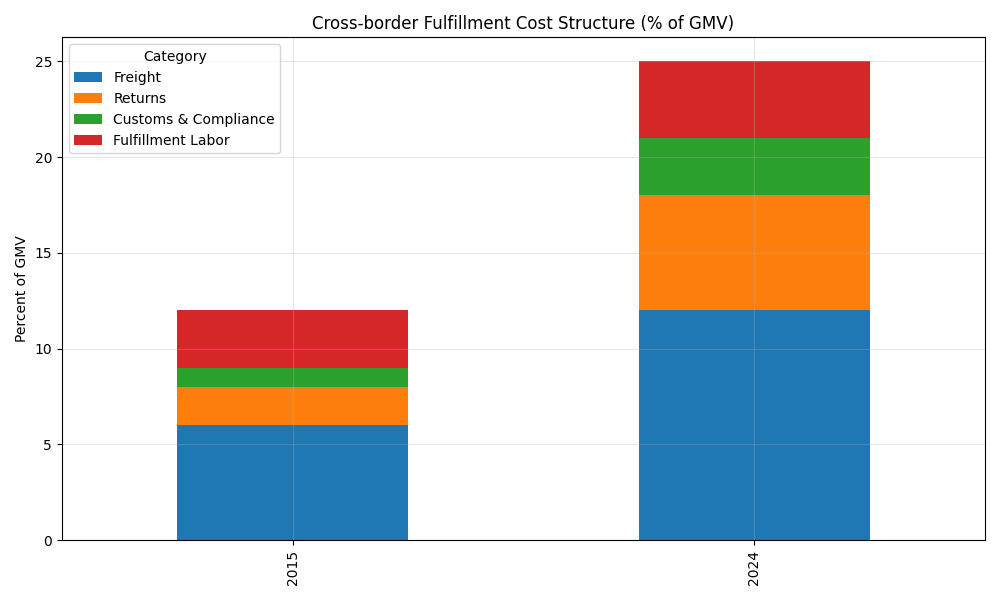
Returns intensify the pressure by creating a second supply chain layered on top of the first. Online return rates average between 20 and 30 percent globally, compared with under 10 percent in physical retail, and total merchandise returns reached approximately $850 billion in 2024. In cross-border contexts, reverse logistics costs are often two to three times higher than forward shipping due to international transport, inspection delays, and resale loss. Returns therefore behave less like a customer-service feature and more like a financial derivative tied to delivery accuracy and inventory location.
Regulatory change converts these variable pressures into fixed cost floors. In the European Union, customs authorities processed more than 4.6 billion low-value parcels in a single year, prompting the introduction of a fixed €3 duty per parcel beginning in 2026. In the United States, more than 1.3 billion shipments entered under de minimis exemptions in a single fiscal year prior to tightening. These measures eliminate parcel-level arbitrage by imposing costs that cannot be diluted through volume alone, shifting the unit economics in favor of inventory consolidation and compliance at scale.
The industry response is a structural redesign of fulfillment architecture. Rather than relying on linear hub-and-spoke flows, leading platforms are moving toward hub → mini-hub networks in which inventory is distributed across multiple inventory-bearing nodes. Each node can store goods, fulfill local demand, process returns, and rebalance stock across the network as conditions change. This increases capital intensity but reduces volatility by shortening delivery paths, limiting repeated border crossings, and stabilizing service levels. From a balance-sheet perspective, decentralization functions as a risk-management strategy, trading higher fixed investment for lower marginal uncertainty.
Centralized vs Hub → Mini-Hub Fulfillment Models
| Dimension | Centralized Model | Hub → Mini-Hub Model |
|---|---|---|
| Inventory Location | Single or limited origin points | Distributed, inventory-bearing nodes |
| Risk Exposure | Concentrated | Diversified across network |
| Returns Handling | Cross-border reverse flows | Local processing and redeployment |
| Cost Behavior | Low fixed, high volatility | Higher fixed, lower marginal uncertainty |
Source: Amazon; Walmart; Boston Consulting Group; IoIE synthesis
When Convenience Became a Right
Consumer expectations in e-commerce are the product of deliberate incentive design rather than organic evolution. Over the past decade, fast delivery guarantees, flat-fee shipping programs, and frictionless returns systematically reduced the perceived cost of buying. More than 75 percent of global online shoppers report that delivery speed directly influences where they purchase, and over half expect delivery within two days or less. From a behavioral economics standpoint, these incentives lowered perceived risk and time cost, transforming online shopping into a low-commitment, reversible action. Once established at scale, these expectations hardened into a baseline condition rather than a preference.
Convenience became comparative as well as absolute. In the United States and Western Europe, the benchmark for e-commerce shifted toward outperforming the effort of visiting a store. Surveys consistently show that consumers rank time saved as the primary reason for shopping online, ahead of price. When ordering replaces errands, even modest delays feel disproportionate. This explains why same-day and next-day delivery adoption accelerated into categories where immediacy once mattered little. E-commerce began competing not just with other retailers, but with physical effort itself.
Emerging markets compressed this shift even faster. In India, same-day and next-day delivery became common across major urban centers within a few years, supported by dense cities, mobile-first commerce, and hyperlocal logistics. Industry data shows that more than 60 percent of Indian e-commerce consumers consider same-day delivery a meaningful factor in purchase decisions for everyday goods. Similar dynamics appear in Southeast Asian cities, where platform-led logistics rapidly reset expectations. Cultural contexts differ, but the behavioral outcome converges: delivery speed becomes culturally embedded rather than aspirational.
Behavioral Incentives and Resulting Economic Effects
| Incentive Mechanism | Consumer Behavior Created | Economic Consequence |
|---|---|---|
| Fast Delivery Guarantees | Low tolerance for delay | Higher cost volatility and delivery risk |
| Free Returns | Over-ordering and at-home trial | Returns function as second supply chain |
| Flat-Fee Shipping | Distance becomes invisible | Freight costs absorbed upstream |
Source: IoIE synthesis; National Retail Federation
Returns completed the behavioral transformation by eliminating perceived downside. Globally, more than 80 percent of consumers say free returns influence purchasing decisions, and online apparel return rates regularly exceed 25 percent. Free returns embed option value into the act of purchase, encouraging over-ordering and at-home comparison. Loss aversion makes consumers more sensitive to being stuck with an unwanted item than to the abstract cost of returning it. As a result, buying becomes experimentation rather than commitment.
Crucially, consumers do not experience the terrestrial systems absorbing these behaviors. Freight volatility, customs complexity, and compliance cost remain invisible. What consumers encounter are interfaces—delivery dates, checkout prices, and free returns buttons. When promises are met, behavior is reinforced. When they fail, dissatisfaction is immediate. This asymmetry explains why expectations remain rigid even as costs rise. The incentives that normalized convenience now amplify pressure across logistics networks and balance sheets, forcing the industry to reconcile digital behavior with physical economics rather than continue masking the gap.
Governance Reasserts the Physical World
Cross-border e-commerce long operated under the perception of borderlessness. Transactions felt instantaneous and digital, even though they ultimately resolved into physical goods, fiscal obligations, and sovereign jurisdiction. That perception has collapsed under scale. In the European Union, low-value parcel inflows reached 4.6 billion in 2024 and rose to an estimated 5.8 billion in 2025, with more than 90 percent originating from China. At this volume, cross-border e-commerce ceases to resemble marginal consumer convenience and begins to function as a trade and infrastructure issue. Governance is responding accordingly.
Trade policy has re-emerged as a direct supply-chain control rather than a distant diplomatic tool. The EU’s decision to introduce a fixed €3 customs duty per parcel on e-commerce shipments under €150 beginning in 2026 is emblematic. The objective is not primarily revenue, but structural correction. A per-item cost floor collapses parcel-level arbitrage and forces consolidation, inventory localization, and compliance at scale. Once applied uniformly, price alone can no longer compensate for inefficient fulfillment models built on ultra-low average order values.
Governance Levers Affecting Cross-Border E-Commerce
| Governance Lever | Policy Objective | Operational Impact on Platforms |
|---|---|---|
| Per-Parcel Duties | Eliminate parcel-level arbitrage | Push toward inventory consolidation |
| Customs Enforcement | Trade fairness and capacity control | Higher compliance automation costs |
| Data Localization Rules | Sovereignty and risk oversight | AI and logistics system redesign |
Source: European Commission; US CBP; Reuters; IoIE synthesis
The United States is moving along a parallel path, framed more explicitly through enforcement and geopolitics. In fiscal year 2024, 1.36 billion shipments valued at $64.6 billion entered under de minimis exemptions, with roughly 73 percent originating from China. Customs agencies processed more than four million such packages per day. At that magnitude, small-parcel flow becomes a matter of industrial competition, border capacity, and foreign relations. Regulation functions less as a brake on e-commerce than as a mechanism to reattach digital retail to national economic interests.
Regional contrasts underscore how governance choices shape market structure. Europe raises cost floors while expanding platform responsibility for product safety and consumer protection, increasing operational burden for price-led marketplaces. The United States emphasizes enforcement and trade fairness but converges toward similar compliance outcomes. In both cases, firms respond by investing in bonded warehouses, regional inventory pools, and shipment aggregation to regain economic control.
Low-Value Cross-Border Parcel Volumes (EU and US)
| Year | EU Parcels (Billions) | US Parcels (Billions) |
|---|---|---|
| 2018 | 1.2b | 0.5b |
| 2020 | 1.8b | 0.7b |
| 2022 | 3.9b | 1.1b |
| 2024 | 4.6b | 1.3b |
| 2025 | 5.8b | 1.36b |
Source: European Commission; US Customs and Border Protection; Reuters
Governance increasingly intersects with technology. Cross-border e-commerce depends on data as much as goods: customs classification, seller verification, risk assessment, and duty calculation are mediated by digital systems. China’s evolving cross-border data transfer regime illustrates how data localization and transfer rules directly shape logistics, compliance, and fraud systems. AI-driven classification, routing, and documentation become mandatory capabilities rather than efficiency enhancements.
The effect of this governance shift is to reintroduce economic accountability. Fixed duties, tighter enforcement, and platform-level compliance reprice physical entry into markets. The cost is fragmentation. Divergent regional rules favor incumbents with the scale to absorb legal, technical, and logistics overhead while raising barriers for smaller cross-border sellers. Digital commerce remains consumer-facing and frictionless, but governance is reasserting the physical world beneath it.
The Next Phase of Cross-Border E-Commerce
The disruption reshaping cross-border e-commerce marks a transition into a more mature economic phase rather than a retreat from global demand. For leadership teams, the strategic challenge is no longer unlocking incremental consumption, but sustaining consumption under tighter physical, regulatory, and financial constraints. Growth remains attainable, but only when operating models can absorb volatility without converting it into margin erosion. Resilience, rather than reach, has become the defining objective.
At the market level, cross-border e-commerce now exhibits a structural divergence. On the demand side, competition remains close to perfectly elastic. Consumers compare prices, delivery speed, and return policies instantly, with minimal switching costs and little tolerance for friction. Expectations are set by the fastest and most generous offers visible at checkout, not by average industry economics. On the supply side, fixed costs are rising sharply. Only a small number of platforms can fund the capital investment, compliance infrastructure, and data systems required to meet those expectations consistently. The result is a market in which consumers experience abundance while firms confront consolidation pressure.
Evolution of Cross-Border Fulfillment Architecture
| Period | Dominant Model | Key Characteristics |
|---|---|---|
| 2010–2018 | Centralized Hub-and-Spoke | Single-origin fulfillment, low freight cost, limited volatility |
| 2019–2024 | Regional Hub Model | Faster delivery, higher inventory duplication, growing compliance burden |
| 2025–2030 | Hub → Mini-Hub (AI-Coordinated) | Distributed inventory, real-time orchestration, volatility management |
Source: Amazon; Walmart; Boston Consulting Group; IoIE Synthesis
The operational response is a shift from centralized fulfillment toward hub → mini-hub architectures. Regional hubs anchor inventory and compliance, but fulfillment increasingly occurs through a network of smaller, inventory-bearing nodes positioned closer to demand. Each mini-hub can store goods, fulfill local orders, process returns, and rebalance inventory across the network as conditions change. This structure shortens delivery paths, reduces repeated border crossings, and limits the financial impact of freight disruption. While it raises capital intensity, it materially lowers marginal cost volatility and earnings risk.
Artificial intelligence functions as the coordination layer that makes this decentralization viable. Real-time inventory visibility, automated documentation, predictive demand models, and dynamic routing allow platforms to orchestrate thousands of nodes as a single system. AI transforms complexity into control, enabling firms to align inventory placement, delivery promises, and compliance requirements continuously rather than episodically.
Role of Artificial Intelligence in Distributed Fulfillment Networks
| AI Capability | Operational Function | Economic Benefit |
|---|---|---|
| Demand Forecasting | Inventory pre-positioning | Lower stockouts and overstock risk |
| Dynamic Routing | Real-time fulfillment optimization | Reduced delivery volatility |
| Automated Compliance | Customs and documentation processing | Lower regulatory friction at scale |
Source: Amazon; BCG; IoIE synthesis
These structural shifts are reshaping innovation and investment priorities. Capital is flowing away from pure demand aggregation and toward infrastructure that enables orchestration—distributed inventory systems, returns optimization, compliance automation, and logistics intelligence. Competitive advantage is migrating behind the interface, into the systems that reconcile digital consumer behavior with terrestrial economics.
Consumer expectations are unlikely to soften. Speed, convenience, and reversibility have been normalized. What is changing is how those expectations are delivered. As cost floors rise, platforms increasingly differentiate through reliability, transparency, and managed service tiers rather than universal generosity. Cross-border e-commerce remains global and digital at the interface, but its sustainability now depends on whether firms can integrate behavior, intelligence, and physical networks into a coherent operating system.
Key Takeaways
-
Cross-border e-commerce is constrained not by demand, but by incentive-driven behavior outpacing physical logistics, inventory, and regulatory economics.
-
Around 30 percent of global e-commerce volume is now cross-border, making international fulfillment a core structural feature of retail.
-
Behavioral incentives normalized speed and reversibility, turning purchasing into low-risk experimentation and hardening expectations that are now non-negotiable.
-
Freight volatility, elevated return rates, and regulatory cost floors have transformed logistics from a variable expense into a structural margin driver.
-
Online return rates of 20–30 percent and merchandise returns approaching $850 billion annually function as a second supply chain.
-
Governance is reintroducing cost and accountability through duties, enforcement, and platform-level compliance.
-
The dominant operating response is a shift from hub-and-spoke fulfillment to hub → mini-hub architectures with distributed inventory.
-
Artificial intelligence enables this decentralization by coordinating inventory, routing, compliance, and demand forecasting in real time.
-
Market structure is bifurcating: consumer demand remains highly competitive while supply consolidates among platforms with scale.
-
Sustainable global e-commerce will be determined by the ability to align digital behavior with terrestrial economics.
Sources
- eMarketer; Ecommerce to Account for More Than 20% of Worldwide Retail Sales Despite Slowdown; – Link
- Amazon.com, Inc.; Amazon.com, Inc. 2023 Annual Report; – Link
- National Retail Federation; NRF and Happy Returns Report: 2024 Retail Returns Total $890 Billion; – Link
- National Retail Federation; Consumers Expected to Return Nearly $850 Billion in Merchandise in 2025; – Link
- National Retail Federation; 2025 Retail Returns Landscape; – Link
- Baymard Institute; 50 Cart Abandonment Rate Statistics 2026; – Link
- Reuters; EU to Impose €3 Duty on E-commerce Parcels From July 2026; – Link
- Council of the European Union; Customs: Council Agrees to Levy Customs Duty on Small Parcels as of 1 July 2026; – Link
- Reuters; European Union Imports of Cheap E-commerce Parcels Jump 26%; – Link
- Reuters; What the End of the De Minimis Exemption Means for US Shoppers and Businesses; – Link
- Boston Consulting Group and DTDC; The Emergence of Rapid Commerce in India; – Link
- FreightWaves; Walmart E-commerce Sales Rise 27% as Shoppers Opt for Same-day Delivery; – Link
- Sea-Intelligence; Global Liner Performance Report; – Link
- Drewry; Container Insight Weekly and Carrier Reliability Reports; – Link
- UN Conference on Trade and Development; Digital Economy Report and E-commerce Indicators; – Link
- US Customs and Border Protection; De Minimis Value and Section 321 Trade Statistics; – Link
- European Commission; Impact Assessment on Customs Reform and E-commerce Parcels; – Link