

Most improvements in digital life do not arrive with announcement. They appear as absence—fewer crashes during peak traffic, fewer delays when systems are under pressure, fewer moments where something simply does not work. Over time, this becomes the baseline expectation. Ticketing systems that once collapsed under sudden demand now hold, banking applications process transactions without interruption, and streaming platforms sustain millions of users without visible degradation. What was once accepted as failure increasingly feels like poor design.
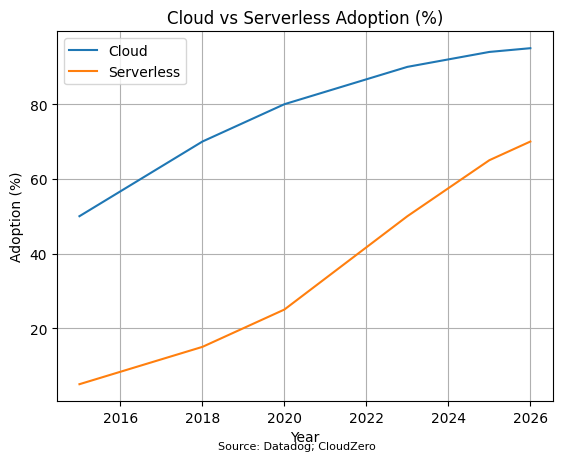
This shift reflects more than incremental improvement. It marks the beginning of the disappearance of failure as a normal condition of digital systems. A growing share of applications now operate on execution models that expand instantly when needed and disappear when idle, eliminating bottlenecks that historically caused outages. Industry data shows that over 70 percent of AWS customers, 60 percent of Google Cloud users, and nearly half of Azure users now operate serverless workloads, embedding this model across everyday digital systems. What users experience as consistency is increasingly the result of systems that no longer wait to respond.
This shift is commonly understood in simpler terms as scaling services through incremental, “pay as you go” upscaling. Rather than committing to fixed capacity, systems grow step by step with demand, expanding only as usage increases and contracting when it falls. It is a model that aligns closely with how people already experience digital services—where scale is not prebuilt, but accumulated in real time through activity.
It is a quiet technological evolution that increases efficiency and improves services in a connected life. Yet the framing risks underselling the shift. Serverless computing does not add visible capability; it removes constraints. Instead of planning for demand, systems react to it. Instead of maintaining capacity, they generate it moment by moment. Across billions of interactions, this reshapes expectations without drawing attention to the mechanism behind it.
From Systems to Execution The Technology Behind the Seamless Experience
For decades, software systems were built around persistent environments that required provisioning and management. Even with cloud computing, developers defined capacity, scaling rules, and system behavior under stress. This introduced inefficiency and fragility. Servers often operated at only 10 to 30 percent utilization, while sudden demand spikes could still overwhelm systems not designed for rapid expansion.
Serverless replaces this model by shifting the unit of computation from machines to execution. Instead of running applications continuously, developers deploy functions triggered by events. These executions are short-lived, scale automatically, and disappear when complete. When demand increases, the system expands instantly. When demand disappears, resource usage returns to zero. There is no idle capacity and no delay associated with scaling decisions.
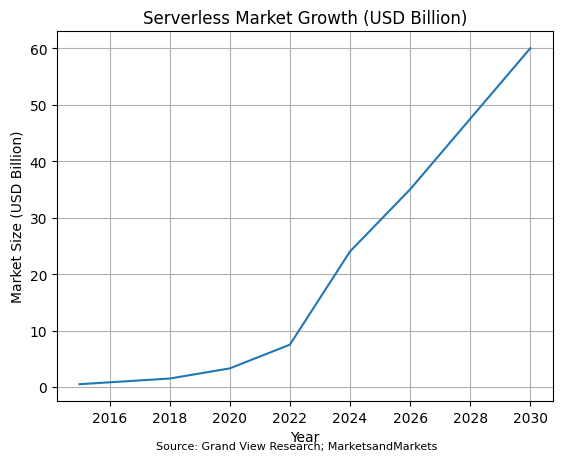
This approach has moved beyond experimentation into sustained adoption. The global serverless market is estimated at approximately $24.5 billion in 2024 and projected to exceed $50 billion by 2030, while enterprise usage shows that most cloud environments now incorporate serverless workloads. Academic research has expanded in parallel, with more than 160 studies examining system behavior and architecture. Together, this reflects a model that is both operationally viable and structurally significant.
Serverless also formalizes a model that users already experience indirectly: scaling services through incremental, pay-as-you-go upscaling. Instead of committing to fixed capacity, systems expand in small, continuous increments as demand increases, with each additional unit of activity—each request, transaction, or event—triggering its own slice of computation and cost. This mirrors how many modern services are consumed, from streaming usage to API calls, where scale is not a step change but a gradual, metered progression aligned with actual demand.
The outcome is not simply improved performance. It is the removal of waiting. Systems no longer prepare for demand; they respond to it in real time.
| Year | Cloud Adoption (%) | Serverless Adoption (%) |
|---|---|---|
| 2015 | 50% | ~5% |
| 2020 | 80% | ~25% |
| 2023 | 90% | ~50% |
| 2025 | 94% | 60–75% |
| 2026 | 95%+ | 70%+ (AWS users) |
Why It Feels Incremental but Isn’t
From the user’s perspective, these improvements feel familiar. Applications become more stable, responses more consistent, and failures less frequent. Yet none of these changes appear as a breakthrough. Expectations adjust gradually, and improvements are absorbed into what feels normal.
This pattern mirrors earlier shifts in computing. Infrastructure was historically provisioned for peak demand, leaving large amounts of capacity idle during normal operation. Improvements reduced inefficiency but did not eliminate it. Users experienced fewer slowdowns, but the underlying model remained constrained.
Serverless removes that constraint entirely. Resources are allocated only when needed and released immediately afterward, replacing prediction with reaction. Early enterprise studies show cost reductions ranging from 60 to 90 percent for certain workloads, largely due to the elimination of unused capacity and operational overhead.
The result is a structural shift that feels incremental. Services feel better, not different. Reliability becomes expected, and the absence of friction becomes invisible.
| Year | Market Size (USD Billion) | Growth Trend |
|---|---|---|
| 2015 | ~0.5 | Early adoption phase |
| 2020 | 3.3 | Initial commercialization |
| 2023 | 9.3 | Enterprise expansion |
| 2024 | 21.9 – 24.5 | Mainstream adoption |
| 2025 | 26 – 28 | Acceleration phase |
| 2030 | 52 – 76+ | Market maturity scaling |
Human Impact Fewer Failures Faster Responses More Access
For users, the impact is defined by consistency. Digital services are expected to function without interruption, particularly during high-demand moments. When they fail, the consequences are immediate—transactions do not complete, services become inaccessible, and trust erodes.
Serverless reduces these failure points by enabling instant scaling. Systems expand automatically in response to demand, reducing overload during peak events such as ticket releases, retail surges, or financial transactions. Enterprise case studies show that workloads involving tens of millions of operations can now be completed in days rather than months, often at significantly lower cost. In one example, 50 million images were processed into 700 million outputs in eight days for approximately $6,000, compared to higher recurring infrastructure costs under traditional models.
Responsiveness improves alongside reliability. Many services rely on event-driven processes—fraud detection, logistics tracking, recommendation systems—that require immediate execution. Serverless systems process these events in real time, enabling continuous updates without performance degradation. For users, this appears as services that respond instantly and operate seamlessly in the background.
Access expands as well. By reducing infrastructure costs and operational complexity, serverless lowers barriers to entry. Smaller teams can build and deploy applications at scale, increasing the diversity of services available across markets. The change is not experienced as transformation. It is experienced as friction disappearing.
Economic and Governance Shifts Behind the Interface
The transition to serverless computing is as much economic as it is technical. Traditional cloud models charge for allocated capacity, creating fixed costs that persist regardless of usage. Organizations must forecast demand and maintain excess capacity, leading to inefficiency.
Serverless replaces this with execution-based pricing. Costs are incurred only when computation occurs, aligning expenditure with usage. This converts fixed costs into variable costs, improving capital efficiency and reducing waste. It also enables new pricing models, where software is monetized per interaction rather than per access, supporting pay-per-use structures that reflect actual consumption.
This shift moves software closer to a utility model, similar to electricity, where usage is metered and infrastructure is abstracted from the user. Value is measured in discrete interactions rather than continuous availability.
| Metric | Traditional Cloud | Serverless |
|---|---|---|
| Average Utilization | 10–30% | 80–100% (on-demand) |
| Idle Cost | High | Zero |
| Scaling Time | Minutes to hours | Milliseconds |
| Cost Efficiency Gain | Baseline | 60–90% reduction |
| Manual Intervention | Required | Minimal / None |
At the same time, dependency increases. Serverless systems are tightly integrated into cloud provider ecosystems, relying on proprietary services that are difficult to replicate. This creates architectural lock-in, reinforcing the dominance of a small number of providers. Industry concentration in cloud computing is already significant, and serverless adoption deepens this trend.
This model extends the logic of incremental scaling into pricing itself, where growth is not provisioned in advance but accumulated through usage, reinforcing a pay-as-you-go structure at both the technical and economic level.
This creates an inversion. As infrastructure becomes less visible, it becomes more important—and more concentrated—within the providers that operate it.
Outlook: The Invisible Transformation
Serverless computing is moving from adoption to normalization. The global market is already above $24 billion, with projections reaching approximately $50 billion by 2030, while most enterprise cloud environments now incorporate serverless workloads. What was once a design choice is becoming a default pattern, particularly for services driven by real-time demand.
For users, the most visible effect will be consistency rather than speed. Many services already operate quickly under normal conditions; the difference will be how they behave under stress. Serverless systems scale without delay, reducing the failures that typically occur during peak demand. Events that once exposed system limits—flash sales, viral traffic—will increasingly feel routine.
Economic behavior will continue to shift as execution-based pricing expands. Growth in serverless adoption reflects its ability to eliminate idle infrastructure and align costs with usage. This will influence how services are priced, particularly in areas already moving toward usage-based models. For users, this may not reduce prices directly but will introduce more flexible pricing tied to actual consumption.
At the same time, platform concentration will intensify. As more services are built on serverless models, dependency on a small number of providers will increase. This remains largely invisible to users but shapes the availability and evolution of digital services.
The defining outcome is not a single breakthrough, but a change in how systems behave. Services become more stable, more responsive, and more adaptable, not because they are fundamentally different, but because the constraints that once limited them have been removed.
This is the nature of the shift. A quiet technological evolution that improves efficiency and service quality. Yet beneath that familiarity, it reshapes how software is built, priced, and controlled.
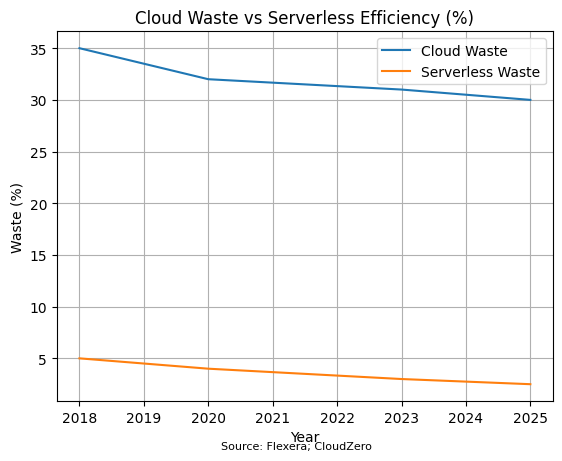
| Metric | Value | Implication |
|---|---|---|
| Cloud Adoption | 94% of enterprises | Universal baseline |
| Workloads in Cloud | 72% | Primary infrastructure layer |
| IT Budget Allocation | 45% to cloud | Capital shift |
| Cloud Waste | 31% | Inefficiency driver |
| Serverless Impact | Eliminates idle waste | Efficiency gain |
Key Takeaways
- Serverless removes infrastructure constraints rather than adding visible features
- Users experience the impact through fewer failures and more consistent services
- Computing shifts from capacity-based systems to execution-based models
- Cost structures move from fixed to variable, improving efficiency
- Software increasingly aligns with transactional, usage-based pricing
- Platform dependency increases as infrastructure becomes centralized
- Future improvements will be felt as consistency rather than speed
Sources
- Economics with Serverless Architectures; – Link
- Amazon Web Services; Case Studies – Optimizing Enterprise Economics with Serverless Architectures; – Link
- Amazon Web Services; Edmunds Serverless Case Study; – Link
- ACM / Imperial College London; Serverless Computing: Economic and Architectural Impact; – Link
- ACM Transactions on Software Engineering and Methodology; Rise of the Planet of Serverless Computing: A Systematic Review; – Link
- Journal of Cloud Computing; Serverless Computing: A Security Perspective; – Link
- Flexera; Cloud Computing Trends: Flexera 2024 State of the Cloud Report; – Link
- McKinsey & Company; Cloud’s Trillion-Dollar Prize Is Up for Grabs; – Link
- Financial Times; Cloud Computing Is Too Important to Be Left to the Big Three; – Link