

When Electricity Becomes the Single Point of Failure
Cloud infrastructure was built on abstraction. Compute became elastic, storage distributed, and resilience defined by replication across availability zones. For more than a decade, uptime was treated as a software problem. That assumption no longer holds. The constraint has shifted from code to electricity.
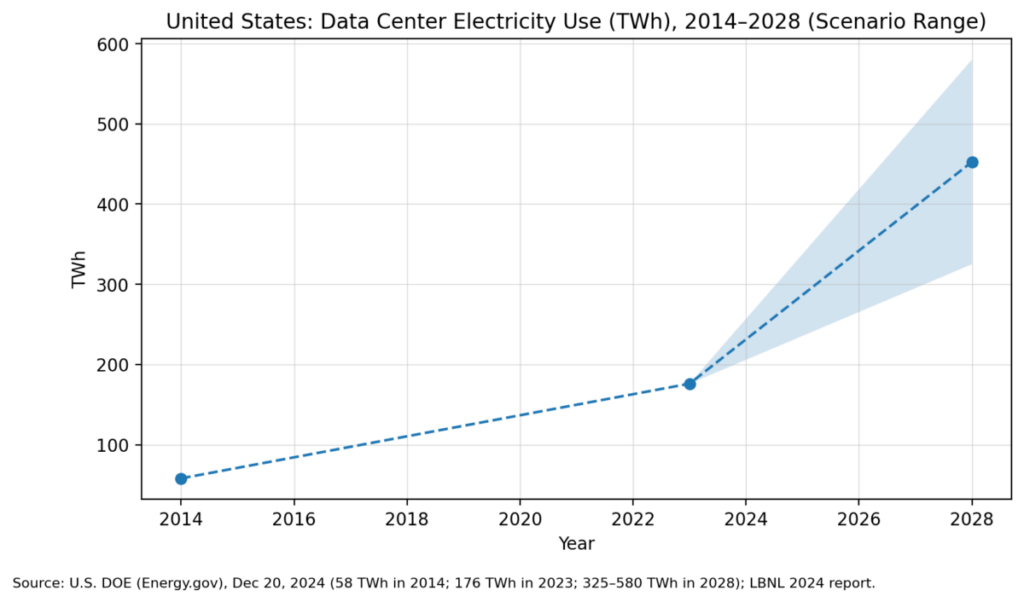
Global data center electricity consumption reached roughly 415 terawatt-hours in 2024 and is projected by the International Energy Agency to approach 945 TWh by 2030 as AI workloads expand. That trajectory implies annual growth near 15 percent, far exceeding overall electricity demand growth in most advanced economies. In the United States, data centers already account for more than 4 percent of national electricity consumption, with projections ranging between 6.7 and 12 percent by 2028. In Ireland, data centers exceed 20 percent of national electricity demand. In Northern Virginia, the world’s largest data center corridor consumes more than a quarter of the state’s electricity.
These are industrial loads embedded within public grids. Individual hyperscale facilities draw between 10 and 100 megawatts; clustered campuses aggregate into gigawatt-scale demand centers. In July 2024, a voltage disturbance in Northern Virginia triggered the simultaneous disconnection of approximately 60 data centers, creating a 1,500 megawatt imbalance that required emergency stabilization. Redundancy within facilities did not prevent synchronized response at the transmission level. Software distribution did not translate into electrical independence.
Enterprise Exposure During Power-Driven Disruption
| Business Function | Cloud Dependency | Failure Scenario | Visible Impact |
|---|---|---|---|
| Digital Payments | Cloud-hosted transaction processing and authentication | Routing or power instability in coordination systems | Card payments declined; retail operations revert to cash |
| Airline Operations | Reservation databases and passenger authentication | Regional data center disconnection | Check-in and boarding delays |
| Healthcare Platforms | Telehealth systems and patient data access | Network congestion or grid disturbance | Session disruption and service interruption |
| Retail Supply Chains | Inventory synchronization across regions | Connectivity pathway failure | Order processing delays and stock visibility loss |
| Public Services | Cloud-hosted identity verification | Authentication infrastructure outage | Digital services inaccessible |
Sources: Deloitte; Reuters reporting on Rogers outage; Uptime Institute
Outage data confirms the exposure. The Uptime Institute’s 2024 Global Data Center Survey reports that 54 percent of respondents attributed their most recent significant outage to power distribution failures. More than half reported financial losses exceeding $100,000, and one in five exceeded $1 million for a single event. For large enterprises, downtime frequently carries costs measured in hundreds of thousands of dollars per hour. Reliability has moved upstream, from server racks to substations and transmission corridors.
Connectivity introduces a parallel vulnerability. Roughly 95 percent of intercontinental data traffic travels through just over 500 active subsea cables worldwide, many converging at a limited number of landing stations. Major internet exchange hubs in cities such as Northern Virginia, Frankfurt, London, Chicago, and Singapore handle extraordinary volumes of traffic. Efficiency is achieved through concentration; resilience is weakened by it.
A one-day full internet shutdown in a highly connected economy can reduce GDP by approximately $23.6 million per 10 million people. Industry surveys indicate that 28 percent of businesses lose up to $5 million annually due to network failures, and 51 percent report monthly losses exceeding $1 million from internet disruptions. The 2022 Rogers outage in Canada halted debit transactions nationwide, affected more than 12 million users, and generated estimated losses exceeding $142 million. Digital reliability now registers in macroeconomic terms.
Cloud resilience is no longer defined solely by replication logic. It is bounded by grid capacity, transmission stability, and network topology. Infrastructure as a Service operates at industrial scale, and its durability reflects the limits of the physical systems that sustain it.
How Network Architecture Amplifies Power Risk
Enterprises distribute workloads across multiple cloud regions believing they have engineered independence. In practice, many of those regions share substations, transmission corridors, backbone carriers, fiber aggregation points, or cable landing stations. Research examining the interdependence between electricity grids and internet infrastructure shows that a significant share of internet components sit within overlapping power grid zones. When grid instability occurs, nominally separate digital environments can be affected simultaneously.
Fiber infrastructure follows geography. High-capacity routes trace highways and rail corridors. Exchange hubs cluster in a small number of metropolitan areas. Logical separation in cloud dashboards does not guarantee physically distinct pathways. Routing instability or backbone congestion can isolate workloads from users even when compute remains powered.
The economic scale of this coupling is substantial. More than 60 percent of enterprise workloads now run in public cloud environments. Global digital payments volume exceeds $8 trillion annually, much of it processed through cloud-hosted infrastructure. Retail supply chains, healthcare systems, and public services rely on centralized identity and authentication platforms. When coordination services or routing frameworks falter, revenue generation, internal operations, and customer access can fail simultaneously.
For enterprises, the risk is synchronized disruption. Payment authorization systems may remain technically functional yet unreachable. Inventory platforms may operate in one region but fail to synchronize across networks. Internal collaboration tools may become inaccessible because authentication services cannot validate sessions. Downtime becomes enterprise-wide rather than application-specific.
Consumers experience this fragility immediately. Card payments decline at checkout. Airline check-in systems stall. Telehealth appointments disconnect mid-session. Online banking portals time out. The root cause may vary, but the interruption is uniform.
Infrastructure as a Service underpins financial markets, transportation networks, healthcare delivery, and global commerce. Yet its physical foundations remain geographically clustered and operationally interdependent. Logical redundancy without physical separation creates the appearance of resilience while preserving systemic exposure.
Preventing the Next Power-Driven Digital Shutdown
As cloud demand reshapes electricity markets, governance is expanding from technical compliance to infrastructure planning. The North American Electric Reliability Corporation has warned that rapid peak demand growth, driven significantly by large data center loads, is tightening reserve margins in multiple regions. Interconnection queues across major grids now stretch years into the future, delaying both generation projects and large-load approvals.
Utilities are adjusting capital plans accordingly. Southern Company recently increased its five-year capital expenditure program to $81 billion, citing more than 10 gigawatts of contracted large-load customers and tens of gigawatts of additional data center connection requests. Similar patterns are emerging across other U.S. and European markets. Grid expansion timelines, transformer manufacturing capacity, and transmission permitting have become decisive variables in cloud deployment strategy.
These developments are triggering regulatory scrutiny. State utility commissions are examining whether hyperscale facilities should bear a greater share of transmission upgrade costs rather than shifting them onto residential ratepayers. Special tariff structures and minimum demand commitments are increasingly part of negotiations. Over the next 18 to 24 months, rate design and interconnection reform will influence where new data centers can be developed and at what economic cost.
Near-Term Governance and Infrastructure Response
| Governance Domain | Current Pressure | Emerging Response | Strategic Implication |
|---|---|---|---|
| Energy Regulation | Rapid data center load growth tightening reserve margins | Revised interconnection rules and special large-load tariffs | Cloud site selection increasingly tied to grid capacity planning |
| Operational Resilience Oversight | Systemic risk from cloud concentration | Formal resilience testing and reporting requirements | Board-level accountability for cloud dependency |
| Decarbonization Policy | Continuous load vs intermittent renewable supply | Long-term PPAs, battery storage, microgrid investment | Energy procurement becomes resilience engineering |
| Concentration Risk | Shared grid and fiber exposure across regions | Geographic diversification and architectural portability | Logical redundancy must align with physical independence |
Sources: NERC; International Energy Agency; European Commission DORA; Bank of England; Reuters
Environmental policy intersects directly with reliability. Continuous data center demand must align with decarbonization commitments. Major cloud operators are expanding long-term power purchase agreements and targeting 24/7 carbon-free energy matching. U.S. grid-scale battery storage capacity has more than tripled since 2021, reflecting integration of storage into reliability planning. Microgrid architectures and on-site generation models are emerging as resilience tools rather than optional sustainability features.
Regulatory oversight is formalizing the systemic importance of cloud providers. In Europe, implementation of the Digital Operational Resilience Act subjects designated critical ICT third-party providers to supervisory review tied to financial stability. The United Kingdom has adopted comparable operational resilience frameworks. These measures recognize that large cloud operators function as economic infrastructure.
Over the next two years, stricter outage reporting requirements, formal resilience testing, and greater scrutiny of concentration risk are likely. Enterprises will be expected to demonstrate credible workload portability and documented recovery capability. Energy reliability will move into board-level capital allocation discussions alongside cost and performance.
Power is no longer a background utility input. It has become a primary determinant of whether digital systems remain online. When electricity falters, the internet does not simply slow; it stops. The durability of the digital economy now depends on whether power systems, connectivity networks, and governance frameworks can evolve fast enough to sustain industrial-scale demand without synchronized failure.
Key Takeaways
- Electricity infrastructure, not software architecture, is increasingly the binding constraint on cloud reliability.
- Global data center demand reached approximately 415 TWh in 2024 and could approach 945 TWh by 2030, placing industrial-scale pressure on public grids.
- In certain regions, data centers account for more than 20 percent of total electricity consumption, creating concentrated exposure to grid instability.
- 54 percent of significant outages are linked to power distribution failures, and one in five exceeds $1 million in direct losses.
- Logical redundancy across cloud regions does not guarantee physical independence when substations, transmission corridors, and fiber routes overlap.
- A one-day internet shutdown can reduce GDP by approximately $23.6 million per 10 million people, underscoring macroeconomic sensitivity to infrastructure failure.
- Over the next 24 months, grid capacity planning, interconnection reform, energy procurement strategy, and regulatory oversight will shape cloud resilience outcomes.
Sources
- International Energy Agency; Electricity 2024 – Analysis and Forecast to 2026; – Link
- International Energy Agency; Energy and AI – Energy Demand from Data Centres and Artificial Intelligence; – Link
- Uptime Institute; Global Data Center Survey 2024; – Link
- North American Electric Reliability Corporation; 2025 Long-Term Reliability Assessment; – Link
- Deloitte; The Economic Impact of Internet Shutdowns; – Link
- Reuters; Rogers outage hits millions of Canadians, disrupts payments; – Link
- Reuters; Southern Co raises spending plan amid surge in data center demand; – Link
- Submarine Telecoms Forum; Submarine Cable Almanac; – Link
- European Commission; Digital Operational Resilience Act (DORA); – Link
- Bank of England; Operational Resilience – Supervisory Statement SS1/21; – Link