

Bitcoin now operates within global financial markets as a recognized digital commodity rather than a niche technological experiment. Liquidity has expanded dramatically, institutional participation has grown, and trading occurs across exchanges and derivatives markets that process tens of billions of dollars in daily activity. What once functioned primarily as an experimental technology has entered the mainstream of financial markets.
Bitcoin has moved from being a fad investment into a loosely regulated commodity that increasingly follows the general dynamics of commodities traded on global markets.
The historical trajectory is widely understood. Introduced in 2009 as a decentralized digital currency, Bitcoin initially circulated among technologists and early adopters. Trading volumes were limited and mining could be performed on consumer computers. Over the following decade, the ecosystem expanded rapidly as exchanges, custody providers, and payment platforms developed around the network.
Today the scale of Bitcoin markets is materially different. Bitcoin’s market capitalization has repeatedly approached or exceeded $1 trillion during market cycles and typically represents between 45 and 55 percent of the total cryptocurrency market according to CoinMarketCap. Global spot trading volumes frequently exceed $30 billion per day across exchanges, while derivatives trading adds tens of billions more in futures and options markets.
The defining characteristic of Bitcoin’s market structure remains its fixed supply. The network protocol caps total issuance at 21 million coins. Approximately 19.6 million are already in circulation, meaning more than 93 percent of the eventual supply has already been mined. The April 2024 halving reduced the block reward from 6.25 Bitcoin to 3.125 Bitcoin per block, lowering new issuance to roughly 450 coins per day.
In commodity markets where supply cannot respond quickly to changes in demand, price adjustments tend to absorb shifts in capital flows. Bitcoin exhibits a similar pattern. Production cannot increase when demand rises, meaning price movements often reflect capital entering or leaving the market rather than increases in supply.
Institutional participation has amplified this dynamic. Spot Bitcoin exchange traded funds approved in the United States in 2024 created a regulated pathway through which institutional investors could access Bitcoin through traditional brokerage accounts. By early 2025, these ETFs collectively held nearly 900,000 Bitcoin, representing roughly five percent of the circulating supply.
The behavior of Bitcoin markets has therefore evolved. During periods of strong equity markets and expanding global liquidity, Bitcoin often experiences rising demand. When financial conditions tighten or risk appetite declines, capital frequently retreats from digital assets alongside other risk-oriented investments.
It is also important to distinguish Bitcoin as an asset from the broader technological systems that enable it. This article focuses on Bitcoin and cryptocurrency markets specifically. Blockchain technologies represent the computational framework underlying these systems and are increasingly being integrated into financial settlement systems, cross-border payment networks, and digital record management across the global financial sector.
Bitcoin’s evolution therefore reflects more than technological adoption. It reflects the emergence of a new financial asset class operating under supply dynamics that resemble commodities but trading within capital markets that increasingly resemble traditional finance.
Bitcoin Market Quick Facts (2025)
| Metric | Value | Economic Significance |
|---|---|---|
| Maximum Supply | 21 million BTC | Hard supply cap establishes scarcity similar to commodities such as gold |
| Circulating Supply | ~19.6 million BTC | More than 93% of total supply already issued |
| Daily New Supply | ~450 BTC per day | Reduced issuance after the 2024 halving event |
| Market Capitalization | ~$1 trillion (cycle range) | Largest cryptocurrency and major alternative asset class |
| Global Trading Volume | ~$30B daily average | Indicates deep liquidity and global market participation |
| Institutional ETF Holdings | ~900,000 BTC | Represents roughly 4–5% of circulating supply |
| Network Hashrate | ~600 EH/s | Reflects industrial-scale computational security investment |
| Mining Energy Consumption | ~120–150 TWh annually | Comparable to electricity usage of mid-sized industrial economies |
| Global Crypto Ownership | ~420 million users | Demonstrates rapid expansion of global retail participation |
Source: CoinMarketCap; Cambridge Centre for Alternative Finance; Blockchain.com; Bloomberg Intelligence; Triple-A Crypto Ownership Report
Industrial Mining and the Production Economics of Bitcoin
Bitcoin’s production system has evolved from a decentralized hobby into a capital-intensive global industry. Mining remains the mechanism through which new coins enter circulation, yet the economics of that process now resemble commodity extraction industries more than early digital experimentation.
In the early years of the network, individuals mined Bitcoin using consumer hardware. As the network expanded, mining difficulty increased and specialized machines replaced general-purpose devices.
Modern mining now relies on application-specific integrated circuit machines designed exclusively for Bitcoin’s cryptographic calculations. These machines operate within industrial facilities that contain thousands of devices running continuously. Cooling systems, electrical distribution networks, and automated monitoring technologies are necessary to maintain operational stability.
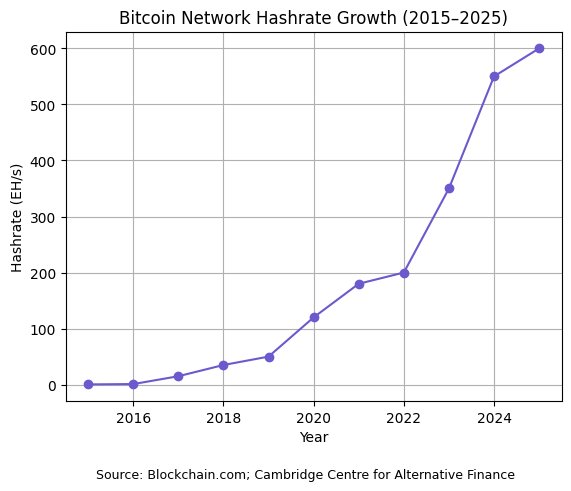
Global computational power securing the network now exceeds 600 exahashes per second according to Blockchain.com and Cambridge Centre for Alternative Finance data. This represents an enormous increase from roughly 1 exahash per second recorded in 2016 and reflects the scale of investment in mining capacity.
Mining has therefore become an energy-intensive industrial activity. The Cambridge Bitcoin Electricity Consumption Index estimates that Bitcoin mining consumes between 120 and 150 terawatt-hours of electricity annually, roughly comparable to the electricity consumption of a mid-sized industrial economy.
Mining is also becoming increasingly expensive. The cost of producing a Bitcoin varies widely by region but is commonly estimated between $40,000 and $70,000 depending on electricity prices and hardware efficiency.
Mining is becoming expensive and problematic in certain regions, and for some operators it is beginning to approach the point where the economics are no longer attractive. When production costs approach or exceed market prices, inefficient operations tend to shut down or reduce activity. Over time this dynamic can stabilize supply growth by limiting the entry of new mining capacity.
This production structure increasingly resembles commodity industries in which extraction costs influence supply behavior and market stability.
Demand Pricing and Portfolio Integration
Bitcoin’s integration into financial markets has significantly altered how demand forms and how prices respond to capital flows.
Retail investors remain a visible component of the market. Cryptocurrency exchanges and brokerage platforms have expanded access to digital assets globally, and industry research suggests that more than 420 million individuals worldwide now hold some form of cryptocurrency.
Institutional participation has become increasingly important. Asset managers, hedge funds, and family offices now evaluate Bitcoin within broader portfolio allocation strategies. Regulated custody services and investment vehicles have reduced operational barriers that once limited institutional participation.
Corporate treasury strategies have also incorporated Bitcoin in certain cases. Public companies such as MicroStrategy collectively hold more than 200,000 Bitcoin as part of treasury diversification strategies.
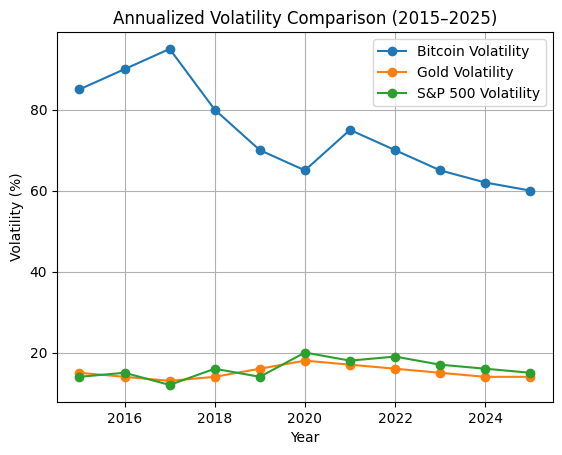
Bitcoin is now treated within many financial discussions as a security-like investment whose price responds to external pressures in ways similar to other traded assets. Its price volatility is increasingly influenced by macroeconomic forces including liquidity conditions, interest rate policy, and investor sentiment.
Demand growth interacts with Bitcoin’s rigid supply structure. Because the network produces only around 450 new coins each day following the 2024 halving, relatively modest increases in capital inflows can produce large price movements.
Institutional investment products can intensify this effect. On certain trading days during 2025, inflows into spot Bitcoin ETFs exceeded the entire daily mining output of the network.
Market liquidity has improved substantially as derivatives trading expanded. Bitcoin futures and options markets process tens of billions of dollars in daily trading volume across exchanges including CME Group.
Research by Fidelity Digital Assets suggests that small allocations between one and five percent of portfolio value historically improved risk-adjusted returns in diversified portfolios due to Bitcoin’s historically low long-term correlation with traditional assets.
Despite these developments, volatility remains a structural feature of the market. Bitcoin’s annualized volatility has historically ranged between 60 and 80 percent—substantially higher than most equity indices or commodities.
Bitcoin’s evolving role therefore reflects the intersection of capital flows, constrained supply, and global investor demand.
Governance Regulation and Financial Integration
As Bitcoin has entered mainstream financial markets, governments and regulators have expanded oversight of digital asset markets.
Now that Bitcoin has gone mainstream, governments have become increasingly interested in regulating its influence, protecting investors, and ensuring that cryptocurrency markets do not disrupt broader financial systems.
One central policy question concerns classification. In the United States, Bitcoin is generally treated as a commodity rather than a security. This classification places derivatives markets under the oversight of the Commodity Futures Trading Commission while other aspects of digital asset markets fall under additional regulatory authorities responsible for investor protection and market transparency.
International regulatory frameworks are also evolving. The European Union introduced the Markets in Crypto Assets regulation, which establishes licensing requirements and operational standards for digital asset service providers operating across member states.
More than 60 jurisdictions worldwide have now introduced formal cryptocurrency regulatory frameworks governing exchanges, custody providers, and digital asset financial products.
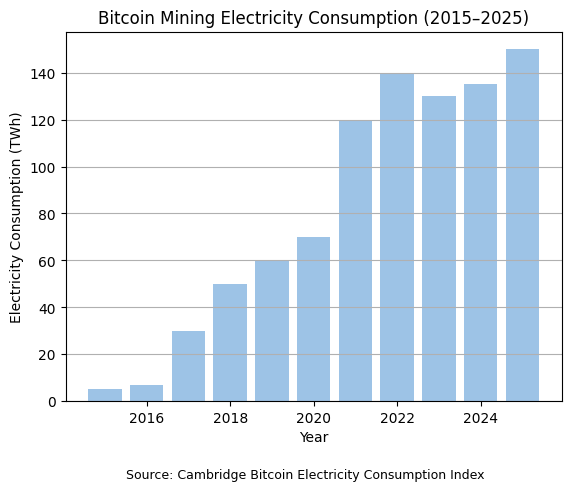
Mining operations have also entered policy discussions. Because large mining facilities consume substantial electricity—estimated between 120 and 150 terawatt-hours annually—governments in several jurisdictions have evaluated environmental and energy policy implications.
Financial institutions have simultaneously expanded their engagement with digital assets. More than one hundred banks, brokerage firms, and asset managers globally now offer some form of cryptocurrency custody, trading, or advisory service.
Bitcoin’s presence within global capital markets therefore intersects with broader economic discussions concerning financial innovation, digital assets, and the evolving architecture of the international financial system.
The Next Phase of Bitcoin
Bitcoin’s next phase will likely be shaped by the interaction between institutional capital flows, regulatory development, and continued industrial expansion of mining operations.
Now that Bitcoin has entered mainstream finance, it is increasingly likely to behave like other commodities traded on open markets. Prices will continue to rise and fall in response to external economic forces including liquidity conditions, macroeconomic policy, and investor sentiment.
Institutional participation is expected to remain a central driver of market activity. As regulated investment products mature and financial infrastructure improves, additional asset managers and pension funds may incorporate digital assets into diversified portfolios.
Mining economics will continue evolving. Approximately 1.4 million Bitcoin remain to be mined before the network reaches its maximum supply of 21 million coins, a process expected to continue gradually until approximately the year 2140.
Regulatory clarity across major economies will likely influence institutional participation. Governments continue developing policies governing exchanges, custody providers, and digital asset investment products.
As Bitcoin continues to mature within financial markets, price volatility may gradually moderate as liquidity deepens and institutional capital expands. However, its fixed supply structure ensures that price movements will remain sensitive to shifts in global capital flows.
Bitcoin’s transformation from experimental digital currency into globally traded digital commodity reflects the maturation of the broader cryptocurrency ecosystem. The asset now operates within financial markets rather than outside them, and its future will likely be shaped by the same economic forces that influence other globally traded investment assets.
Major Institutional and Market Developments in Bitcoin (2015–2025)
| Year | Development | Market Impact |
|---|---|---|
| 2015 | Bitcoin trading expands across major global exchanges | Establishes continuous global liquidity and price discovery |
| 2017 | CME launches Bitcoin futures markets | Introduces institutional derivatives participation |
| 2020 | Corporate treasury adoption begins expanding | Public companies begin holding Bitcoin reserves |
| 2021 | Bitcoin market capitalization exceeds $1 trillion | Asset enters mainstream financial discussion |
| 2022 | Institutional custody and brokerage services expand | Major financial institutions begin supporting digital assets |
| 2023 | Global crypto ownership surpasses 400 million users | Demonstrates expanding global retail demand |
| 2024 | U.S. spot Bitcoin ETFs approved | Creates regulated institutional investment channel |
| 2025 | Institutional ETF holdings approach one million BTC | Institutional demand begins influencing supply dynamics |
Source: CME Group; CoinMarketCap; Bloomberg Intelligence; Fidelity Digital Assets; Institute of Internet Economics
Key Takeaways
- Bitcoin’s circulating supply is approximately 19.6 million coins out of a fixed maximum of 21 million.
- The 2024 halving reduced new issuance to roughly 450 Bitcoin per day.
- Bitcoin’s market capitalization has approached $1 trillion and typically represents around half of the total cryptocurrency market.
- U.S. spot Bitcoin ETFs accumulated roughly 900,000 BTC within their first year of operation.
- Global mining capacity exceeds 600 exahashes per second and consumes approximately 120–150 terawatt-hours of electricity annually.
- Institutional capital flows increasingly interact with Bitcoin’s fixed supply to influence price dynamics.
Sources
- Cambridge Centre for Alternative Finance; Cambridge Bitcoin Electricity Consumption Index; – Link
- Cambridge Centre for Alternative Finance; Cambridge Bitcoin Electricity Consumption Index Methodology; – Link
- Blockchain.com; Bitcoin Network Hash Rate Chart; – Link
- CoinMarketCap; Bitcoin Market Capitalization and Circulating Supply Statistics; – Link
- CoinMarketCap; Global Cryptocurrency Market Capitalization and Bitcoin Dominance Charts; – Link
- CoinMarketCap; Bitcoin Dominance Metric Explanation; – Link
- CoinGecko; Global Cryptocurrency Market Capitalization Charts; – Link
- U.S. Energy Information Administration; Tracking Electricity Consumption from Cryptocurrency Mining Operations; – Link
- Digiconomist; Bitcoin Energy Consumption Index; – Link
- Triple-A; Global Cryptocurrency Ownership Data Report; – Link
- CME Group; Bitcoin Futures and Cryptocurrency Derivatives Market Data; – Link
- Fidelity Digital Assets; Bitcoin Portfolio Allocation Research and Institutional Market Analysis; – Link
- Commodity Futures Trading Commission; Bitcoin and Digital Asset Commodity Oversight Guidance; – Link
- European Commission; Markets in Crypto Assets Regulation (MiCA) Overview; – Link