

AI Titans of 2025: Matching the Right Model to the Right Task
The artificial intelligence field in 2025 is defined by a competitive race among powerful models, each fine-tuned for different priorities. From general-purpose conversation tools to specialized reasoning engines, the market now offers a range of choices for individuals, businesses, and developers. The most prominent players—ChatGPT (GPT-5), DeepSeek (R1/V3), Google’s Gemini 2.5 Pro, Anthropic’s Claude 4, xAI’s Grok 3, and a new wave of open-weight models—bring distinctive strengths that shape how they are best deployed. Selecting the right one can determine whether an AI system is merely functional or a game-changing asset.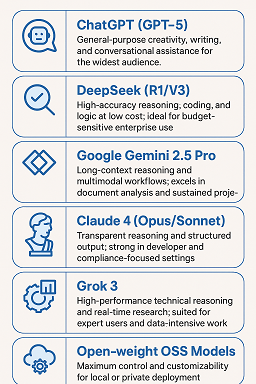
ChatGPT, now driven by GPT-5, remains the most widely used AI worldwide. With an estimated 700 million weekly users, it dominates the global market and accounts for more than half of AI web traffic. GPT-5’s key advancement is an internal routing system that automatically chooses the most suitable sub-model for each prompt, making the experience seamless for everyday users. Its appeal lies in versatility: it performs well in creative writing, brainstorming, summarization, and conversational tasks without requiring technical expertise. For students, content creators, and general users, GPT-5 offers an accessible balance of speed, quality, and adaptability.
DeepSeek’s R1 and V3 models have quickly gained attention for delivering strong reasoning skills at low cost. Their Mixture-of-Experts architecture activates only the most relevant parameters—about 37 billion per token from a total of 671 billion—keeping computational demands modest. This design, combined with efficient training on a fraction of the GPU resources used by competitors, makes DeepSeek attractive for enterprises looking to control expenses. Benchmark testing shows the model excelling in mathematics, coding, and logic puzzles, often outperforming larger rivals in these areas. While it has been embraced by companies seeking affordable AI integration, its origin has sparked governance and security discussions, making due diligence essential before adoption.
Google’s Gemini 2.5 Pro focuses on high-context, multimodal reasoning. Its one-million-token context window allows it to maintain continuity across hours-long sessions, making it well-suited for in-depth research, document review, and complex project management. With variants like Gemini Flash for speed-critical work, it balances cost efficiency with advanced capabilities. For organizations building autonomous agents or workflows that require deep integration of text, images, and code, Gemini 2.5 Pro provides an environment where context retention is a competitive advantage.
Claude 4, Anthropic’s flagship family, emphasizes transparency, reliability, and structured reasoning. The Claude Opus 4 variant supports sustained focus for multi-hour reasoning and development tasks, while Sonnet 4 offers an efficiency-optimized option. A notable feature, “thinking summaries,” reveals the logic behind its responses, making it valuable for developers, analysts, and any user who needs to trace how an answer was reached. Claude 4 is particularly effective in coding assistance, analytical writing, and compliance-driven environments where explainability is as important as output quality.
Grok 3, built by xAI, represents a different end of the spectrum: raw computational power paired with deep research capabilities. Running on the “Colossus” data center infrastructure, Grok 3 uses ten times the compute of its predecessor and delivers high performance in advanced mathematics, scientific reasoning, and technical analysis. Its “DeepSearch” function can aggregate and summarize data from the internet and X (formerly Twitter), giving it strong capabilities for real-time intelligence gathering. Power users, engineers, and research teams benefit most from Grok’s technical depth and access to large-scale search and reasoning.
The open-weight model movement—accelerated by releases like OpenAI’s gpt-oss-120b and gpt-oss-20b—brings flexibility and local control into the spotlight. These models, comparable in many respects to premium proprietary systems, can be run and customized locally, enabling deployment on servers, laptops, or even mobile devices. For independent developers, academic research groups, and organizations requiring strict data control, open-weight AI provides a level of customization and autonomy unavailable with closed-source alternatives.
When selecting a model, the question is not which is “best” in absolute terms, but which is best suited to the specific application:
- ChatGPT (GPT-5) – General-purpose creativity, writing, and conversational assistance for the widest audience.
- DeepSeek (R1/V3) – High-accuracy reasoning, coding, and logic at low cost; ideal for budget-sensitive enterprise use.
- Google Gemini 2.5 Pro – Long-context reasoning and multimodal workflows; excels in document analysis and sustained projects.
- Claude 4 (Opus/Sonnet) – Transparent reasoning and structured output; strong in developer and compliance-focused settings.
- Grok 3 – High-performance technical reasoning and real-time research; suited for expert users and data-intensive work.
- Open-weight OSS Models – Maximum control and customizability for local or private deployment.
The competition between these models continues to accelerate innovation. GPT-5’s accessibility, DeepSeek’s cost efficiency, Gemini’s context capacity, Claude’s explainability, Grok’s technical reach, and the freedom of open-weight models represent not just different tools but different philosophies of AI design. As businesses and individuals adapt their workflows to take advantage of these strengths, the winners will be those who align each AI system’s unique capabilities with the precise demands of the task at hand.
Key Takeaways
- Leading AI models in 2025 offer specialized strengths, from general creativity to technical reasoning and large-context analysis.
- ChatGPT dominates in accessibility, while DeepSeek leads in low-cost, high-logic applications.
- Gemini excels in long-context, multimodal reasoning; Claude prioritizes explainability; Grok delivers unmatched technical depth.
- Open-weight models provide customization and control for organizations seeking local deployment.
Sources
- Windows Central
- Business Insider
- The Guardian
- Wikipedia
- GitHub
- Wall Street Journal
- TechRadar