

Latin America is no longer waiting to join the internet economy. By mid-2026, digital systems have become part of daily economic life: how households pay, how firms reach customers, how governments deliver services, and how banks assess risk.
Through mobile access, the region is highly connected, though gaps remain in the most rural areas and among older populations. The population and business environment are increasingly online, with broad access to the basic capabilities of the internet. Household home-internet access stands at 68.4%, while urban access reaches 74.8% and rural access remains much lower at 35.8%. Mobile technologies and services generated USD 600 billion in economic value in 2025, equal to 8.6% of regional GDP, with an estimated contribution of USD 620 billion in 2026.
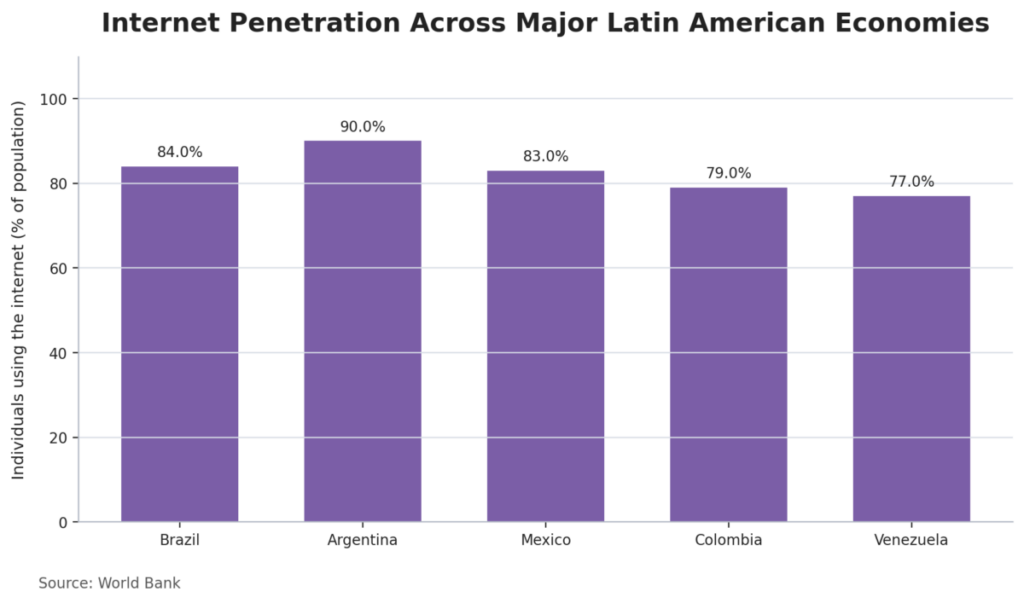
The question is no longer whether the region is connected. It is whether its internet systems can scale with consumer demand, improve efficiency, and embed digital systems into work culture and daily life.
Latin America’s internet economy is both promising and fragile. Digital adoption has advanced quickly, but the foundations beneath it remain uneven. Growth still depends heavily on consumption, while investment in technology, innovation, skills, and institutional capacity remains limited. As a result, external platforms, payment providers, cloud firms, and fintech’s often shape the market.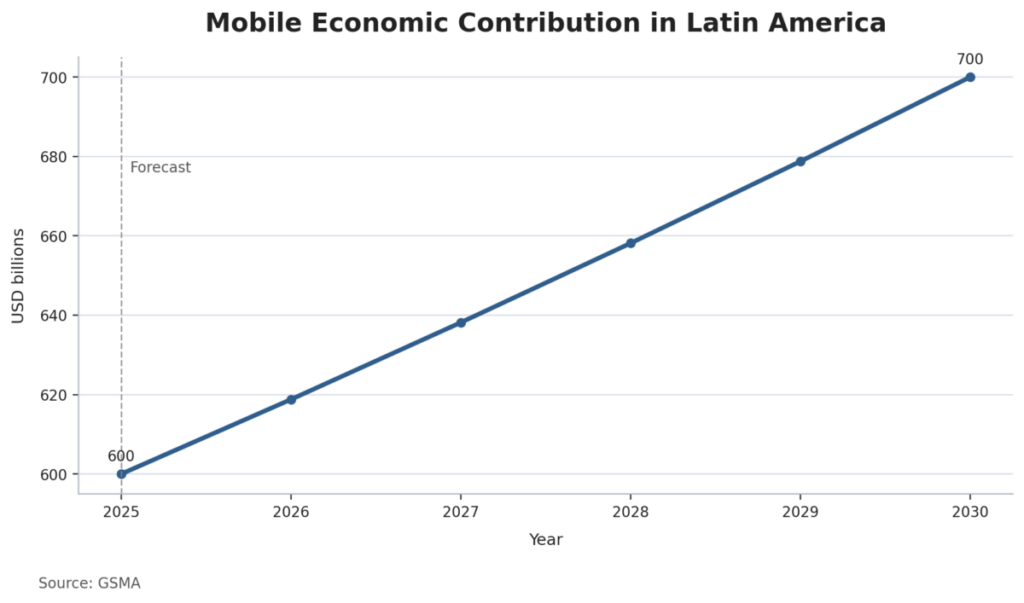
The rollout is also geographically uneven. In the northern economies, mobile-first adoption dominates, making the phone the main gateway to finance, commerce, work, and public information. In the southern productive corridor, stronger platforms, payment rails, logistics, and cloud demand support service-oriented growth. In the Caribbean and island economies, digital systems are judged by resilience: whether they can keep tourism, remittances, public services, and essential commerce functioning.
Coverage alone no longer defines progress. Latin America has moved from an access problem to a reliability problem. More households and firms are online, but many still cannot depend on the connection, device, platform, or institution behind the service. Internet blackouts, weak infrastructure, limited data, pay-per-use restrictions, poor design, and unreliable portals continue to restrict participation.
A household may have internet access and still be practically excluded. A student may open a learning platform but lose the class. A patient may find a health portal but fail to confirm an appointment. A firm may advertise online but lack the tools to manage orders, payments, delivery, and customers reliably.
Mobile now sits at the center of this shift. The phone is no longer just an access device; it is an operating layer for output, employment, public services, taxation, and household participation.
Latin America has expanded access. Its next challenge is absorption: turning connectivity into reliable participation, institutional capacity, and durable economic value.
| Connectivity and ICT Absorption | ||||
| Name | 2025 | 2026 (est)* | % Growth | Source |
|---|---|---|---|---|
| Household home-internet access | 68.4% | 68.4% baseline | n/m | World Bank |
| Urban household internet access | 74.8% | 74.8% baseline | n/m | World Bank |
| Rural household internet access | 35.8% | 35.8% baseline | n/m | World Bank |
| Mobile economic contribution | USD 600B | USD 620B | 3.3% | GSMA |
Regional Scope and Market Structure
Market Scale Without Market Unity
Latin America has enough scale for its internet economy to matter globally, but not enough uniformity to behave as a single market. As a result, the cost of digital rollout is shouldered by the developer or financed. The region’s strongest cities have a different operating dynamic than rural spaces. Each layer produces a different version of digital value.
The commercial market has already formed. Latin American e-commerce is projected to reach USD 215.31 billion in 2026. Argentina, Brazil, and Mexico account for nearly 85% of regional online sales, while smartphones carry 84% of purchases. The region is decisively mobile-first, but the value created by that reach is concentrated. It gathers where purchasing power, delivery reliability, payments trust, and platform density already reinforce one another.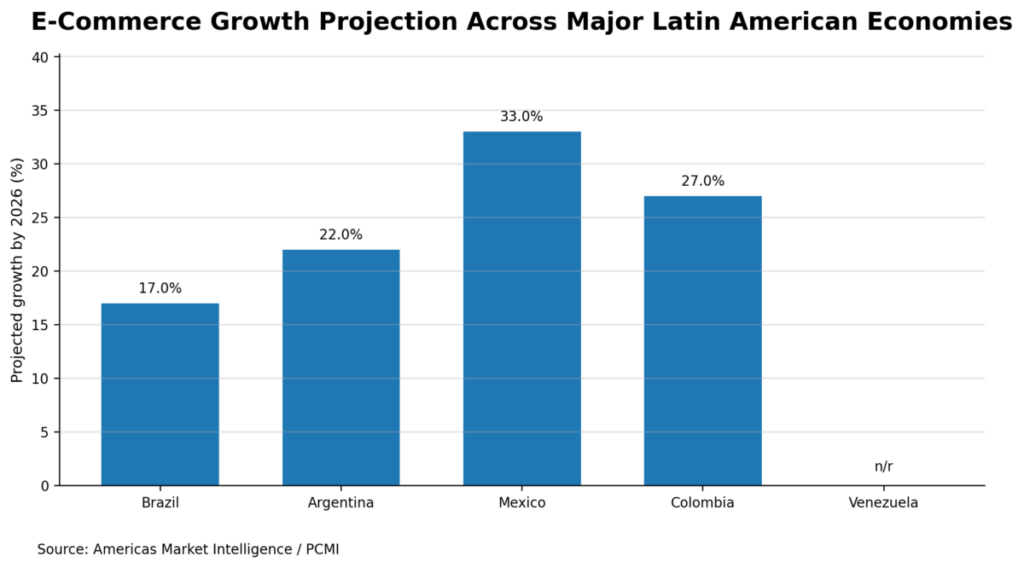
Northern Latin America is digitally active, yet mobile use becomes economic infrastructure only when it can step beyond the mobile sphere and interact with the outside. This includes: household finance, gig economies, and the efficiencies of modern office tools.
The southern corridor has the deepest market base, but scale does not become productivity while smaller firms and secondary cities remain outside the strongest rails. Rural connectivity is high, but capacity and access restrict massive integration.
Island service economies show digital dependence most clearly. Online access supports tourism systems and personal entertainment use through mobile access.
A giant digital market has arrived. Its gains follow the old maps of capability.
| Digital Market Structure | ||||
| Name | 2025 | 2026 (est)* | % Growth | Source |
|---|---|---|---|---|
| E-commerce market size | n/m | USD 215.31B | n/m | Reuters |
| Top-three country sales share | Nearly 85% | Nearly 85% | n/m | Reuters |
| Smartphone share of online purchases | 84% | 84% | 0.0 pp | Reuters |
Platforms, Commerce, and Finance
Commerce and Payments Become the Region’s Economic Plumbing
Digital commerce is no longer a retail side-channel. It is becoming intertwined with the fabric of the region. The phone has become the interface through which households pay, borrow, and deal with institutions. Fintech and SuperApp solutions are strong for the consumer and average citizen as they enable money movement, and secure settlement. They provice lower the entry point for consumers and provide a strong match with gig economy workers and fast settlement transactions. Person-to-person transactions can be instant, and the system enables person-to-business methods without requiring strict institutional banking requirements.
On the merchant side it does not automatically scale as record keeping, and administrative functions must be integrated for benefit. A merchant can reach demand through a platform and still lack the delivery reliability and management routines that turn digital sales into productivity.
MercadoLibre’s business-to-business expansion shows the next phase. More than 4 million users were enabled for wholesale purchases across Latin America before the platform pushed deeper into procurement and firm operations. Digital demand is moving from consumer convenience into the productive economy. The conversion depends on whether smaller firms join the operating layer rather than merely selling through it.
Payments carry the same transformation with greater public force. Brazil’s Pix reached nearly 170 million users by its fifth year, while transactions totaled BRL 11 trillion in 2024. A payment rail becomes infrastructure when daily economic behaviour reorganises around it. Pix shows what happens when central-bank credibility, interoperability, merchant acceptance, and daily usefulness become one trusted system.
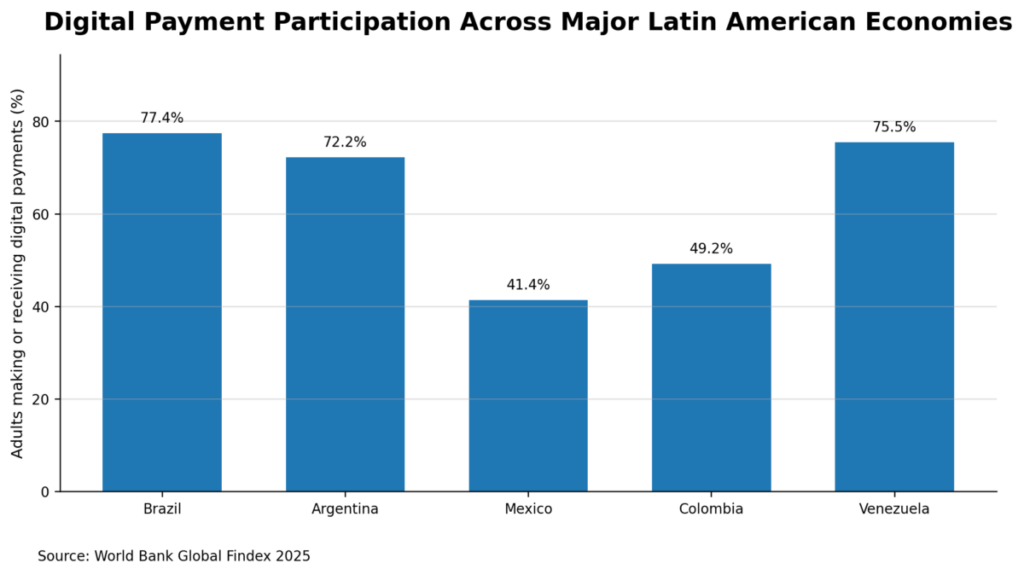
Northern markets that utilize digital services and Superapps are changing the speed of money as remittances and cross-border exchange can become simplified.
The southern productive corridor faces the larger productivity test. Digital commerce and fintech-aligned payments have the potential to reshape firm operations, but real progress must reach the lowest levels of the economy, including individual users, microenterprises, and the blurred space between personal activity and small business.
Corporate and mid-level businesses already have some form of internet connectivity and are largely less constrained by basic access. The more important question is whether smaller firms and informal operators can use digital tools consistently enough to improve sales, payments, inventory, logistics, and customer relationships.
For the corridor to unlock broader productivity gains, digital adoption cannot remain concentrated among larger firms. It must become practical, affordable, and reliable for the individuals and small businesses that form the base of everyday economic activity.
The Caribbean reveals how payment tools can support service continuity and household transfers even when dependence on external rails remains high.
Consumer adoption is ahead of firm absorption.
| Commerce and Payments Infrastructure | ||||
| Name | 2025 | 2026 (est)* | % Growth | Source |
|---|---|---|---|---|
| MercadoLibre B2B users enabled | More than 4M | More than 4M | n/m | Reuters |
| Pix users | Nearly 170M | 170M+ | n/m | Central Bank of Brazil |
| Pix transaction value | BRL 11T | BRL 11T baseline | n/m | Central Bank of Brazil |
AI, Cloud, and Productivity
Cloud and AI Expose the Gap Beneath Digital Use
Cloud and infrastructure-as-a-service now sit beneath ordinary economic activity for most commerce. Firms, banks, public agencies, hospitals, and platforms increasingly depend on remote compute and shared data environments that users rarely see. Cloud is not merely a software layer. It is where operational power is being relocated. It is the operating system.
Compute growth quickly becomes a physical constraint. Enterprise efficiency now depends on whether power systems, cooling capacity, fibre networks, permitting regimes, and grid planning can sustain the machinery behind digital scale.
Latin America’s data-center colocation market is projected to grow from USD 5.85 billion in 2025 to USD 12.87 billion by 2030, a 17.1% compound annual growth rate. Data-center construction is expected to rise from USD 5.59 billion in 2025 to USD 6.05 billion in 2026 and reach USD 8.96 billion by 2031.
AI makes the divide sharper. The region is using AI faster than it is building the investment base, technical depth, and governance structure beneath it.
Latin America and the Caribbean account for 14% of global visits to AI solutions and rank third worldwide in downloads of generative-AI applications. Yet the 19 countries tracked in the Latin American Artificial Intelligence Index receive only 1.12% of global AI investment, despite representing 6.6% of global GDP and 8.8% of the world’s population.
Usage does not become productivity by itself. AI becomes most productive when firms redesign work, improve decision-making, and retire weaker processes.
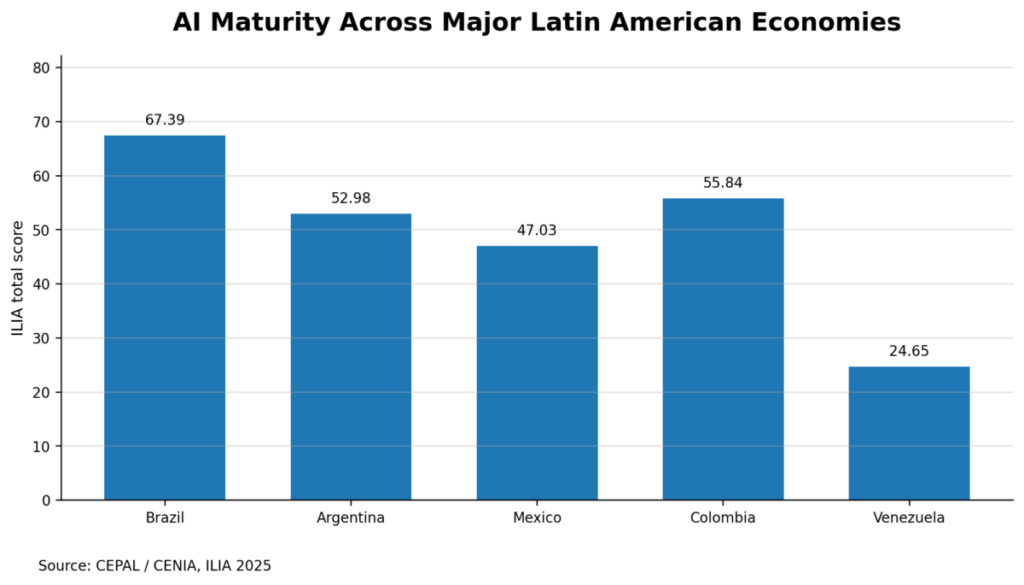
Northern markets may see the most AI efficiencies through the higher level of administration as they improve logistics, finance, and manufacturing. The southern productive corridor carries the hardest test because compute is becoming intertwined into the production base itself. Island economies will experience AI through imported service tools as they lack the population size to demand a data center, and self-generate analysis.
Latin America is not waiting for AI. It is already using it, just at lower capacities than more advanced nations with established computing capacity.
| AI, Cloud, and Compute Capacity | ||||
| Name | 2025 | 2026 (est)* | % Growth | Source |
|---|---|---|---|---|
| Data-centre colocation market | USD 5.85B | USD 6.85B | 17.1% | MarketsandMarkets |
| Data-centre construction market | USD 5.59B | USD 6.05B | 8.2% | Mordor Intelligence |
| AI web-solution usage share | 14% | 14% baseline | n/m | CEPAL / ILIA |
| AI investment share | 1.12% | 1.12% baseline | n/m | CEPAL / ILIA |
Sectors, Commerce, and Industrial Systems
Digital Systems Enter the Physical Economy
The internet economy is moving from screens into physical coordination. Connected tools are beginning to shape how goods move, services continue, resources are managed, and production responds to pressure. The region’s digital future will not be decided only by consumer applications. It will be decided by whether the internet can reduce friction in the physical economy. While robot automation may not the focus for the near future, basic automation and computer-assisted supply chain will have profound impacts. The largest benefit will be through connecting low-cost sensor devices aligned with IoT technologies and using AI as an analyst that improves decision-making and coordination.
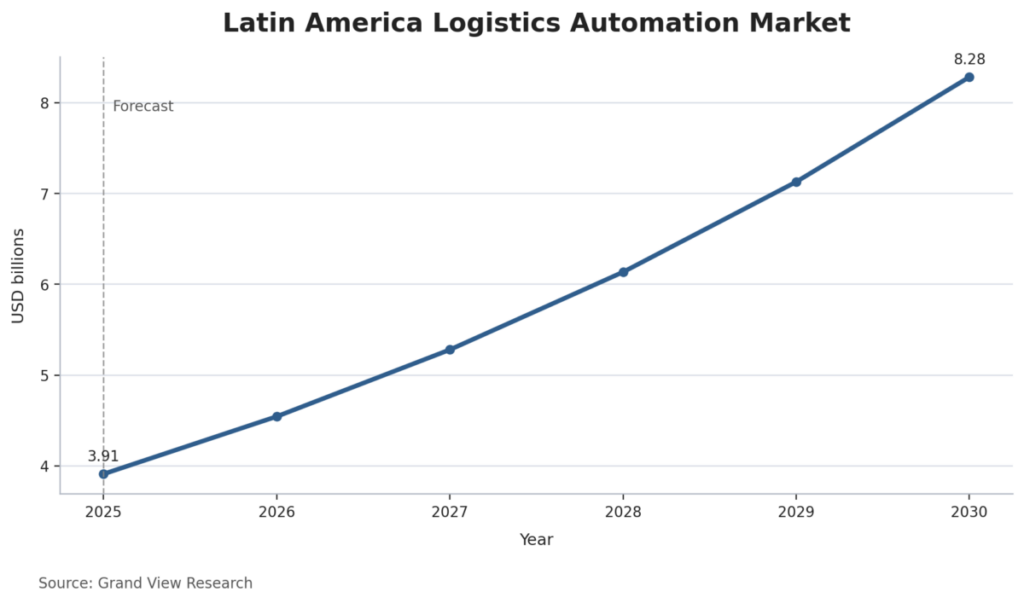
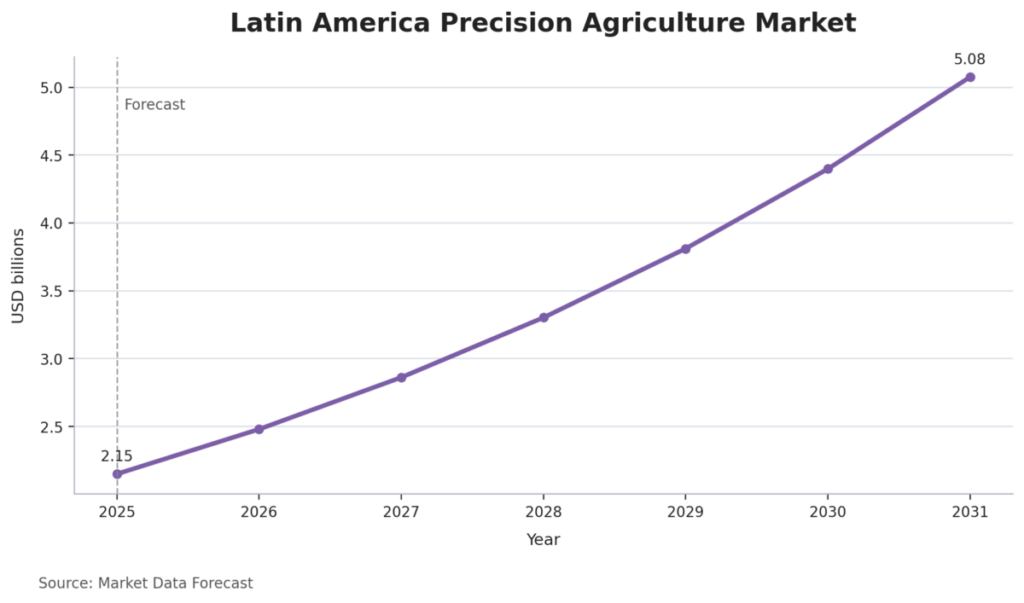
The market signals are measurable. Logistics automation generated USD 3.91 billion in regional revenue in 2025 and is expected to grow at a 16.2% compound annual rate from 2026 to 2030. Precision agriculture reached USD 2.15 billion in 2025 and is projected to reach USD 2.48 billion in 2026. These figures do not yet prove broad diffusion; they show digital coordination entering the production base through movement, resource management, and agricultural efficiency.
Manufacturing exemplifies the advancements in the northern economies. Cross-border production receives it’s maximal benefit when digital reliability becomes routine. A supplier that cannot maintain records, manage delivery timing, or connect to buyer systems does not achieve optimal benefit.
In the southern productive corridor, digital infrastructure is becoming tangible infrastructure. Expensive investment or modernization methods become balance sheet assets and a capital value. While not the largest contributor they become intertwined with the items that move goods, power industry, and connect producers to markets. Connectivity, internet use and integration is becoming embedded into the fabric of the system.
Healthcare belongs in this service-reach frame. Medical access in much of the region is shaped by distance, records, scheduling, follow-up, and institutional continuity. Digital systems are being used to reduce communication and produce reliably structured data that aligns with reliable access. They can also deepen exclusion when tools work best only where institutional capacity was already strongest. The health question is not whether services can be digitized. It is whether digitization can overcome the connection and usage gap.
| Industrial and Physical-System Digitization | ||||
| Name | 2025 | 2026 (est)* | % Growth | Source |
|---|---|---|---|---|
| Logistics automation market revenue | USD 3.91B | USD 4.54B | 16.2% | Grand View Research |
| Precision agriculture market size | USD 2.15B | USD 2.48B | 15.3% | Market Data Forecast |
Labour, Skills, and Public Services
Human Capability and the Digital State
Human capability determines how much value Latin America can extract from digital rollout. For many countries the functional shift from a labor force to a skilled specialist system will be disruptive. Workers will be required to do more than a single job, but may be tasked with interpreting basic data from a computer and entering it reliably. Workers may learn new tools, but the larger test sits with the integration on the instructional level where schools, agencies, and households integrate digital tools into routine life.
A 2026 IDB analysis covers more than 6.2 million online job vacancies across 15 Latin American countries between 2022 and 2025. Labor-market demand is now visible at regional scale, but productivity has not moved with the same force. Labor productivity grew only 0.9% annually from 1991 to 2024, below the OECD’s 1.2%, with services-sector productivity especially weak. The region can identify demand for new skills more easily than it can convert that demand into broad productivity growth.
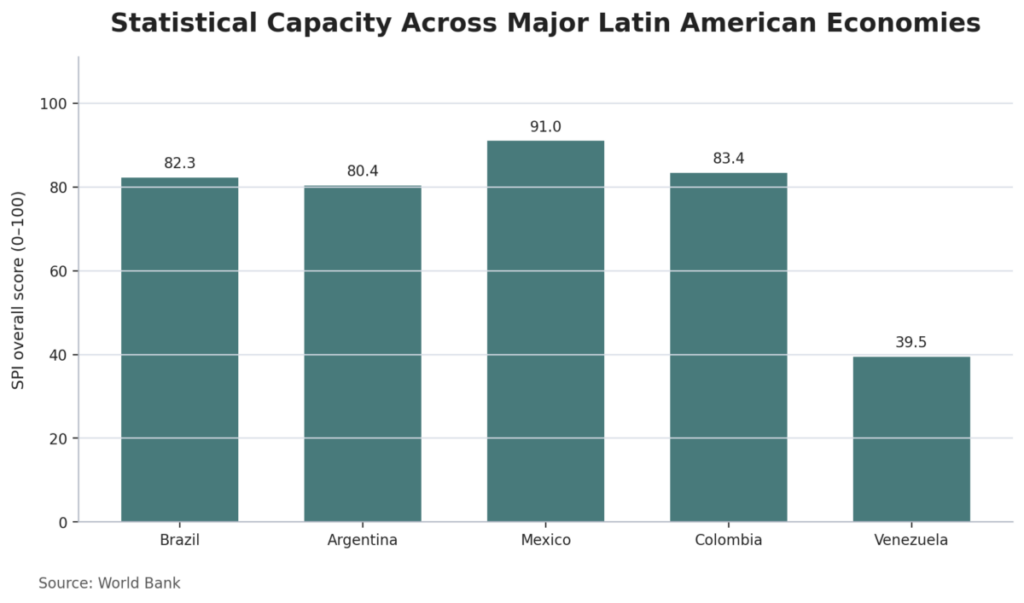
The OECD/IDB Digital Government Index benchmarks 23 governments in Latin America and the Caribbean and shows public digital foundations advancing unevenly. The direction is clear, but maturity still depends on country capacity, agency discipline, and public trust.
Trust is the operating layer. People use digital systems when credibility and reliability are high. The need to trust that payments clear, data is protected, services work, and mistakes can be corrected. Firms invest when infrastructure is reliable and rules are predictable. Governments gain legitimacy when digital access improves basic services and reduces delay.
Technology adoption is no longer the hard part. Institutional absorption is.
| Human Capability and Digital State: Annual Statistics and 2026 Estimates | ||||
| Name | 2025 | 2026 (est)* | % Growth | Source |
|---|---|---|---|---|
| Online job vacancies analysed | More than 6.2M | More than 6.2M baseline | n/m | IDB |
| Labour productivity growth | 0.9% annually | 0.9% baseline | 0.0 pp | OECD |
| OECD productivity comparison | 1.2% annually | 1.2% baseline | 0.0 pp | OECD |
| Governments benchmarked for digital maturity | 23 governments | 23 governments | 0.0% | OECD / IDB |
| * Estimate | ||||
Governance and Regulation
Governance Sets the Terms of Absorption
Latin America’s internet economy will not be limited only by users, apps, or infrastructure. It will be limited by the rules and institutions that decide whether digital channels can safely carry money, safely manage a digital identity, and provide public services. As the internet moves deeper into economic life, governance becomes part of the operating system reinforcing and strengthening the systems that boost reliability and credibility.
Payments show the upside of credible governance. Pix did not become infrastructure simply because it was digital. It became infrastructure because the central bank created a trusted rail that households, merchants, banks, and public systems could use at scale. The lesson is broader than payments. Digital adoption accelerates when users believe the system is useful, predictable, and protected.
AI and cloud make the governance problem more complex. When firms depend on remote compute and algorithmic tools, productivity gains begin to rely on data quality, privacy rules, and cyber resilience. Weak governance does not stop people from using digital systems, it limits how deeply firms and governments can trust them with essential operations.
Northern markets face digital scrutiny through poor standards, technology advancement and upgrade pressures, and uneven public credibility. The southern productive corridor faces pressures that restrict the region’s ability to adapt at scale, and where the edge of completion and technological advancement align. The region’s next digital divide has surpassed the hurdle of connected and unconnected users and now faces the challenge of systems trusted enough to organize economic life and systems.
The Caribbean faces the issue through resilience and external dependence.
Regulation is not a brake on the internet economy. In the next phase, it is one of the conditions that allows rollout to become productive power and the governs the collective standards providing oversight. Loss of credibility or reliability can be the most costly business element to overcome, both are commodities in the digital sphere.
| Governance, Trust, and Digital Rules | ||||
| Name | 2025 | 2026 (est)* | % Growth | Source |
|---|---|---|---|---|
| Pix users | Nearly 170M | 170M+ | n/m | Central Bank of Brazil |
| Digital government benchmark coverage | 23 governments | 23 governments | 0.0% | OECD / IDB |
| AI investment share | 1.12% | 1.12% baseline | n/m | CEPAL / ILIA |
Outlook
Rollout Without Concentration
Latin America’s internet economy is operating. Mobile enabled everyone to be online and now everyone is using it. Connectivity does not mean guaranteed capacity or being able to find the most efficient use. A merchant might have the best webpage, have the top of the line phone, but the carrier that connects them all might be deficient. All elements of the system need to be on the same level, otherwise unequal levels create inefficiencies.
Overall the system is has modern elements and reflects the influence of the strong economies it interacts. Innovation from the top countries has given the region payment rails, e-commerce solutions, cloud infrastructure and AI engagement. The public sector has embraced digitization and the emerging digital-health advances. Despite capacity overall connectivity digital systems part of economic life. The constraint is conversion.
The internet economy is becoming more physical as it becomes more advanced. The burden beneath that conversion is becoming heavier. Data-center construction is expected to reach USD 8.96 billion by 2031. The heavy resource drain of compute is turning cloud and AI expansion into an land, permitting, and grid-planning issue.
Mobile services supported nearly 3 million jobs in Latin America in 2025 and contributed USD 50 billion in public revenues. The internet economy is now tied directly to employment, fiscal capacity, and the productive structure of the region. Digital systems are large enough to shape development, but investment limits will decide how far development reaches.
The 2026 midpoint reveals three stress tests. Northern markets are testing implementation under institutional unevenness. The southern productive corridor is testing whether scale can become productivity. Island service economies are testing continuity.
Latin America is not behind the internet economy. It is unevenly absorbing it. The danger is that digital progress keeps moving fastest where capital, talent, infrastructure, and institutional reach already concentrate.
| Outlook and Internet Ecology | ||||
| Name | 2025 | 2026 (est)* | % Growth | Source |
|---|---|---|---|---|
| Data-centre construction market | USD 5.59B | USD 6.05B | 8.2% | Mordor Intelligence |
| Mobile-supported employment | Nearly 3M jobs | Nearly 3M jobs | n/m | GSMA Intelligence |
| Mobile public revenue contribution | USD 50B | USD 50B baseline | n/m | GSMA Intelligence |
| Regional GDP growth | 2.4% | 2.1% | -0.3 pp | World Bank |
Sources
- World Bank; Latin America and the Caribbean April 2026 Economic Update; – Link
- Inter-American Development Bank; IDB Projects Latin America and Caribbean to Grow 2.1% in 2026 amid Global Uncertainty and Persistent Challenges; – Link
Regional Scope and Market Structure
- Reuters; Latin American E-Commerce to Top $215 Billion as Consumers Demand Rapid Delivery; – Link
Connectivity and Market Access
- World Bank; Internet Access and Use in Latin America and the Caribbean; – Link
- GSMA; The Mobile Economy Latin America 2026; – Link
Platforms, Commerce, and Finance
- Reuters; MercadoLibre Launches New B2B Unit to Tap Corporate Market; – Link
- Central Bank of Brazil; Pix at 5 — The Innovation That Transformed Payments in Brazil; – Link
AI, Cloud, and Productivity
- CEPAL Digital Development Observatory; Latin American Artificial Intelligence Index ILIA 2025; – Link
- Mordor Intelligence; Latin America Data Center Construction Market Size & Share Analysis; – Link
Sectors, Commerce, and Industrial Systems
- Grand View Research; Latin America Logistics Automation Market Size & Outlook; – Link
- Market Data Forecast; Latin America Precision Agriculture Market; – Link
Labour, Skills, and Public Services
- OECD / IDB; 2023 OECD/IDB Digital Government Index of Latin America and the Caribbean — Results and Key Findings; – Link
Governance and Regulation
- OECD / IDB; 2023 OECD/IDB Digital Government Index of Latin America and the Caribbean — Results and Key Findings; – Link
- Central Bank of Brazil; Pix at 5 — The Innovation That Transformed Payments in Brazil; – Link
Outlook
- GSMA; The Mobile Economy Latin America 2026; – Link
- World Bank; Latin America and the Caribbean April 2026 Economic Update; – Link
Keywords: Latin America internet economy, digital absorption, mobile-first economy, digital payments infrastructure, AI adoption Latin America, cloud infrastructure, digital inclusion, regional digital divide
Latin America North: Costa Rica, El Salvador, Guatemala, Honduras, Mexico, Nicaragua, Panama
Northern South America: Colombia, Ecuador, Venezuela
South America’s Productive Infrastructure Corridor: Argentina, Bolivia, Brazil, Chile, Paraguay, Peru, Uruguay
Caribbean and Small Island States: Barbados, The Bahamas, Caribbean island economies, Dominican Republic, Jamaica, Trinidad and Tobago