

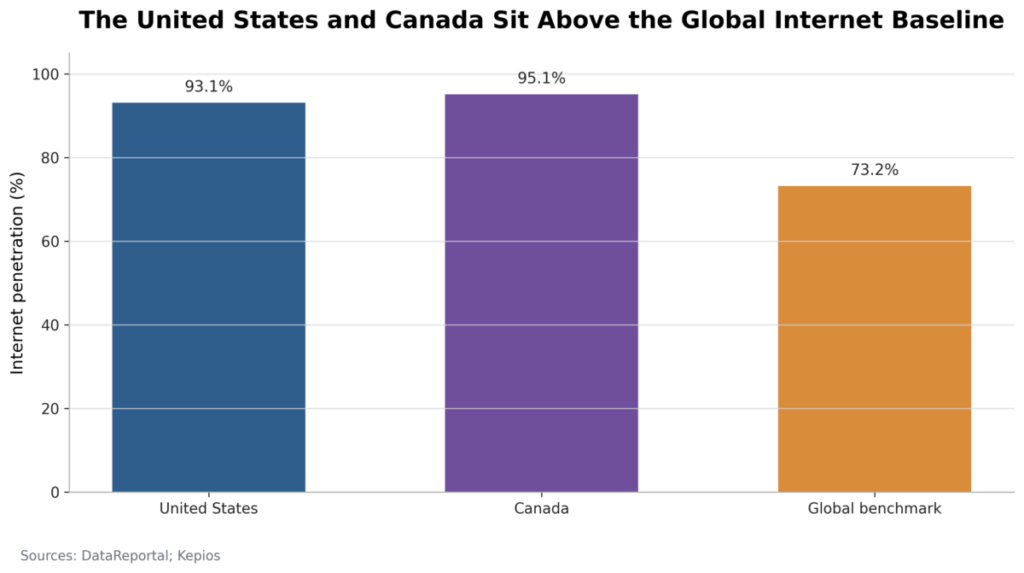
At mid-year 2026, the United States and Canada have a mature internet economy that is moving from access expansion into productivity absorption. Both countries are among the world’s most internet-integrated economies. Internet penetration stood at 93.1% in the United States and 95.1% in Canada at the end of 2025, compared with a global rate of 73.2%. The region’s central question is no longer whether households and firms can connect, but whether digital infrastructure can raise output, widen market access, improve public capacity, and strengthen resilience without creating new constraints in power systems, cybersecurity, market concentration, and firm-level adoption.
The two countries operate inside one regional digital system, but their roles differ. The United States provides larger platform scale, AI investment, cloud demand, and venture-capital depth. Canada adds a highly connected population, strong institutions, skilled labor, cross-border commercial depth, and energy assets that matter more as computing becomes power intensive. Together, they form a high-income digital market shaped by deep cloud integration, advanced financial systems, mature cybersecurity capacity, digital commerce, telehealth, connected logistics, and growing AI adoption.
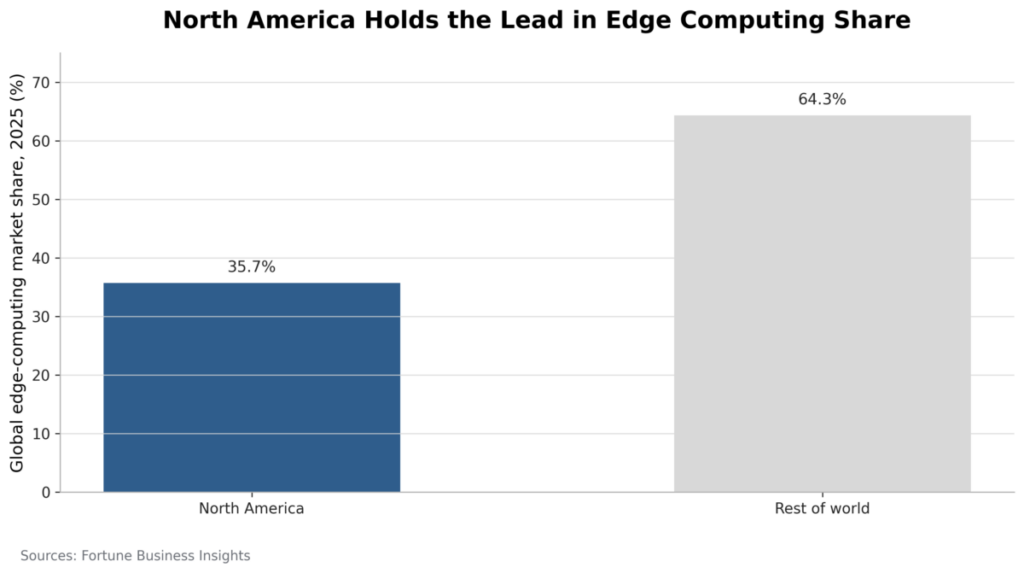
The region is also advancing across the broader “Internet of Everything,” where networks, devices, platforms, infrastructure, and institutions increasingly function as one connected economic system. North America held 35.7% of the global edge-computing market in 2025, showing the importance of bringing computation closer to users, firms, vehicles, homes, factories, clinics, and public systems. In a region defined by major metros, long borders, rural communities, and remote northern geography, near-user computing is becoming part of economic capacity rather than a technical upgrade.
By the second half of 2026, the internet economy in the United States and Canada functions as the coordination layer beneath business activity, public administration, finance, health systems, logistics, and labor markets. AI and cloud infrastructure, cybersecurity, digital finance, platform commerce, telehealth, connected logistics, and data-center energy demand now reinforce one another through data flows, identity systems, payment rails, cloud platforms, connected infrastructure, and institutional rules. The practical result is a regional economy in which the internet determines whether payments clear, clinics reach patients, small firms find demand, logistics networks adjust to disruption, and public agencies deliver services on time.
The state of the region is advanced but uneven. Connectivity is high, capital investment is strong, AI adoption is rising, digital commerce is normalizing, and digital health has become a regular service channel. The harder test is whether digital adoption can translate into measurable productivity gains. Data-center growth is pressing power systems, cyber losses are rising, and smaller firms still face higher costs when adopting advanced systems. The economic question is whether North America can convert digital integration into lower frictions, wider access, stronger productivity, and greater resilience without allowing infrastructure strain, cyber exposure, and market concentration to weaken the gains.
| Name | 2025 | 2026 (est)* | % Growth | Source |
|---|---|---|---|---|
| United States internet penetration | 93.1% | 93.6% | +0.5 pp | DataReportal; Kepios |
| Canada internet penetration | 95.1% | 95.5% | +0.4 pp | DataReportal; Kepios |
| Global internet penetration benchmark | 73.2% | 75.0% | +1.8 pp | DataReportal; Kepios |
| North America edge-computing market share | 35.7% | 35.5% | -0.2 pp | Fortune Business Insights |
Connectivity and Market Access
Access Is High, but Productive Use Is Uneven
At mid-year 2026, internet access is no longer the main measure of digital progress in the United States and Canada. Connectivity now functions as market infrastructure. Its economic value depends on whether digital systems turn access into usable economic capacity. A household or business can be connected and still be constrained if essential functions remain fragmented, unreliable, costly, or unable to work together.
Connectivity matters when it changes what people, firms, and public services can actually do. A rural clinic can use digital systems to make care less dependent on distance. A small retailer can reach customers beyond its neighborhood and manage the commercial relationship after checkout. Strong integration reduces delay, expands market reach, and allows services to move across geography.
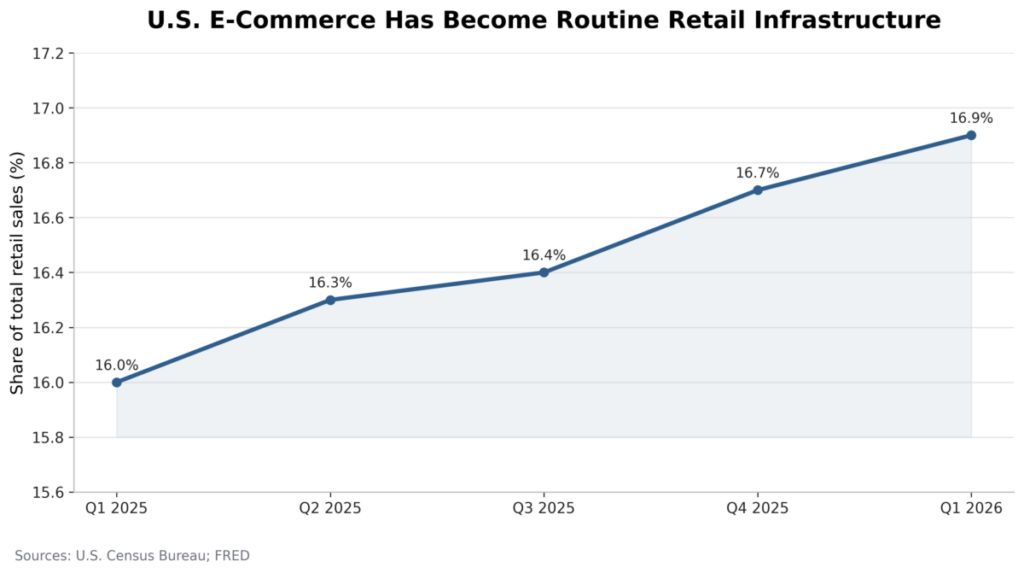
U.S. e-commerce accounted for 16.9% of total retail sales in the first quarter of 2026, showing that online retail is now part of ordinary market structure. Buying and selling increasingly depend on digital systems that coordinate the commercial chain behind the visible transaction. For U.S. firms, digital commerce is tied directly to margin. For Canadian firms selling into the larger U.S. market, it offers a route to scale without building a national physical footprint.
Canada’s e-commerce share remains lower than the U.S. level, which makes the regional difference important. Canadian firms face a smaller domestic market and wider geography, so cross-border digital access matters more for scale. The same tools that open U.S. demand can also leave Canadian SMEs exposed to costs, rules, and platform conditions set outside their own operations.
The border remains a practical test of the internet economy. Digital systems reduce friction when cross-border commerce works as one coordinated process. They expose weakness when commercial data, delivery capacity, and compliance do not align. The economic value of connectivity is visible when transactions move faster and less capital is trapped in delay.
Data-center growth turns connectivity into a physical economic issue. Data centers consumed about 415 TWh globally in 2024 and are projected to consume about 945 TWh by 2030. Digital services may look weightless on a screen, but they depend on power, computing capacity, networks, and public systems. For North America, every expansion in advanced digital activity creates new pressure on power systems and local permitting.
| Name | 2025 | 2026 (est)* | % Growth | Source |
|---|---|---|---|---|
| United States retail e-commerce share | 16.4% | 16.9% | +0.5 pp | U.S. Census Bureau |
| Canada retail e-commerce share | 5.9% | 6.2% | +0.3 pp | Statistics Canada |
AI, Cloud, and Productivity
Economic Influence — AI Investment Is Ahead of Absorption
The most influential technologies now sit close to the point where information becomes action. AI matters because it can change decisions before costs appear: demand can be forecast before stock is ordered, suspicious activity can be stopped before money leaves an account, administrative bottlenecks can be cleared before patients wait longer, and logistics delays can be addressed before they spread through a supply chain. Its economic weight comes from daily use, not novelty.
AI is the strongest signal that the U.S.–Canada internet economy has entered a new investment cycle. AI-related investment contributed 0.97 percentage points to real U.S. GDP growth in the first three quarters of 2025 and accounted for 39% of total growth over that period. The United States is the main driver of that measured effect because it has the cloud scale, technology capital, enterprise software base, and data-center demand that make AI visible in GDP growth. The investment is not only in models. It is also in the infrastructure and business systems needed to make them usable.
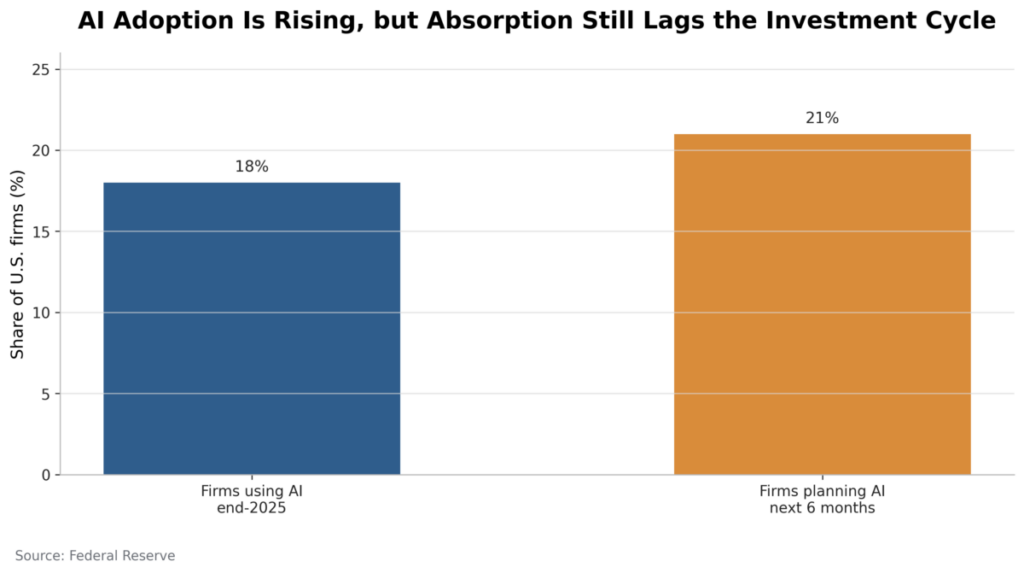
Investment, however, has moved faster than absorption. U.S. firm-level AI adoption reached about 18% by the end of 2025, showing real diffusion but also an early stage of broad implementation. A company does not become more productive because it buys access to a model. Productivity appears when work is redesigned around it, managers trust the outputs, data are usable, risks are governed, and older processes are retired rather than digitized in place.
Canada is tied to the same AI economy from a different position. Canadian firms can use tools developed at continental scale, and Canadian research talent remains important to the broader ecosystem. The challenge is internal capacity. Smaller firms may access AI services through cloud platforms but lack the management systems or technical staff to turn those services into productivity gains.
At mid-year 2026, AI is therefore both a growth source and an absorption test. The U.S. economy is already receiving investment benefits, while the wider regional productivity gain depends on whether smaller firms, Canadian enterprises, public agencies, and non-technology sectors can use AI to improve operating performance. The technologies carrying the most economic force now behave less like consumer products than economic institutions, which makes governance, resilience, and trust part of the productivity question itself.
| Name | 2025 | 2026 (est)* | % Growth | Source |
|---|---|---|---|---|
| United States firm AI adoption | 18.0% | 21.0% | +3.0 pp | Federal Reserve |
| Canada business AI adoption | 12.2% | 14.0% | +1.8 pp | Statistics Canada |
| AI-related contribution to U.S. real GDP growth | 0.97 pp | 1.10 pp | +0.13 pp | Federal Reserve Bank of St. Louis |
| AI-related share of U.S. real GDP growth | 39.0% | 41.0% | +2.0 pp | Federal Reserve Bank of St. Louis |
Platforms, Commerce, and Finance
Platform Coordination Has Become a Source of Market Power
The regional internet economy in 2026 is increasingly shaped by platform coordination. Large platforms no longer merely host transactions. They organize how customers find sellers, how trust is established, how payment moves, and how much margin remains with the business. The storefront has become an interface, and the interface increasingly determines who captures value.
The United States sets the regional scale because its consumer market and digital infrastructure are larger. Canada participates in that scale as both a market and a seller base. A Canadian business can reach U.S. consumers faster than it could through traditional expansion, but the cost of that access is often set by platform rules rather than by the firm itself. Market access expands, but dependency grows when sellers cannot easily move their commercial relationships elsewhere.
Mobile payments show how quickly consumer behavior is changing the commercial base. Among U.S. adults aged 18 to 24, mobile phones accounted for 45% of all payments in the 2025 Diary of Consumer Payment Choice. The phone is becoming the main place where trust, banking, identity, and checkout converge. As younger consumers carry those habits forward, merchants in both countries will face higher expectations for secure mobile-first transactions.
Platform finance also changes competition. Digital payments reduce friction for consumers and small firms, but they concentrate data and transaction control inside the same interface. Banks, fintech firms, retailers, and platforms increasingly compete for the customer relationship. The result is not simply more digital commerce. It is a new structure for who captures margin.
The same interface logic now reaches supply chains, where commercial systems increasingly connect sellers, warehouses, delivery networks, and customers into one operating environment. Efficiency improves when platform control lowers friction. Competition narrows when exit becomes too costly.
| Name | 2025 | 2026 (est)* | % Growth | Source |
|---|---|---|---|---|
| U.S. mobile-phone payment share, ages 18–24 | 45.0% | 47.0% | +2.0 pp | Federal Reserve Bank of Atlanta |
Digital Health and Public Services
Technology Is Now a Capacity Tool
Digital transformation reaches people when access becomes practical capability. A patient in a remote community benefits from virtual care only when the surrounding system can support the visit, protect trust, and complete the next step. The same test applies to public services, education, work, and small-business access. Digital inclusion exists when the system responds, not when the tool merely exists.
Digital health is one of the clearest measures of whether internet infrastructure is improving real service capacity. In 2024, 71.4% of U.S. physicians used telehealth weekly, up from 25.1% in 2018. In Canada, 57.5% of patients in 2023 used in-person appointments only, 5.3% used virtual appointments only, and 37.2% used both. Digital care has not replaced physical care. It has made hybrid care part of the operating model for extending scarce clinical capacity.
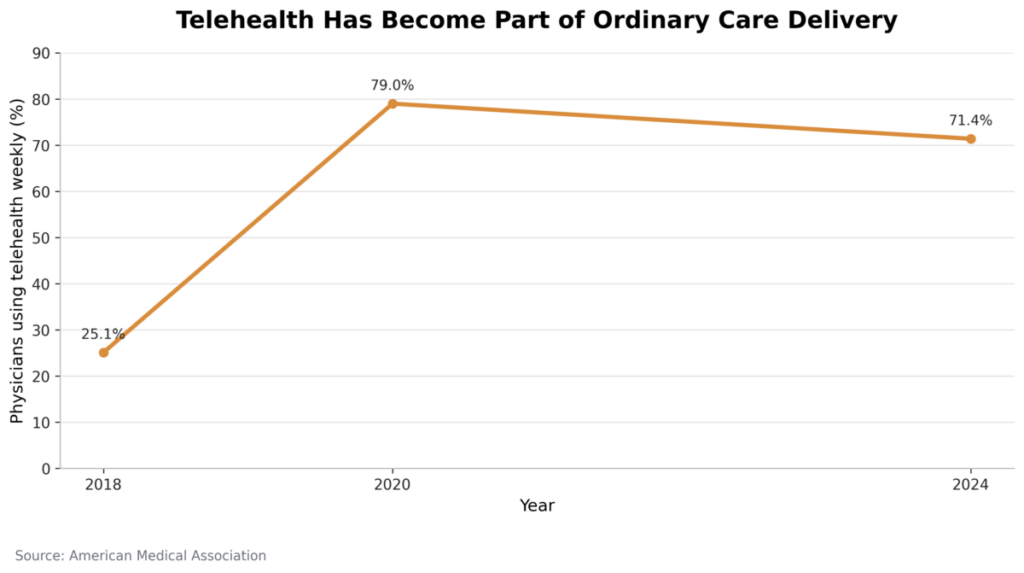
The economic meaning differs by country. In the United States, telehealth can reduce travel burdens and help providers manage specialist shortages. In Canada, virtual and hybrid care are tied to provincial health systems and the challenge of serving communities across distance. In both countries, the technology matters because it can extend capacity where staff, time, and geography create limits.
Public services face the same pattern. Digital systems can reduce paperwork and speed delivery only when agencies can verify identity, use records effectively, support residents, and act on the information they receive. High internet penetration creates the possibility of better administration. The measurable gain comes when agencies reduce delay, improve follow-up, and make services easier to use.
Workers feel the shift as access to jobs, credentials, schedules, and tasks increasingly depends on digital systems. Innovation capacity determines whether the region merely consumes digital tools or adapts them to real conditions. Strong institutions, skilled workers, capable firms, and credible regulators turn adoption into economic capability. Weak absorptive capacity leaves communities dependent on vendor systems that solve immediate problems while limiting local learning.
| Name | 2025 | 2026 (est)* | % Growth | Source |
|---|---|---|---|---|
| U.S. physicians using telehealth weekly | 72.0% | 72.5% | +0.5 pp | American Medical Association |
| Canada hybrid health appointments | 39.0% | 40.5% | +1.5 pp | Statistics Canada |
Data Centers and Energy
The Digital Economy Has Become a Power Issue
The physical cost of the internet economy is now central to the regional outlook. Data centers consumed about 415 TWh globally in 2024 and are projected to consume about 945 TWh by 2030. What once looked like background infrastructure has become a main constraint on cloud, AI, and digital-service growth.
The United States is already seeing the pressure. U.S. data-center power demand is expected to rise from 31 GW in 2025 to 41 GW in 2026 and 66 GW in 2027. That increase is large enough to shape utility planning, power procurement, permitting, and regional development strategy. The digital economy is becoming visible on the grid.
A new data center can support cloud expansion, attract capital, and strengthen local tax bases, but it also places demands on power systems and public consent. The economic benefit is strongest when compute investment builds broader local capacity rather than crowding out other priorities.
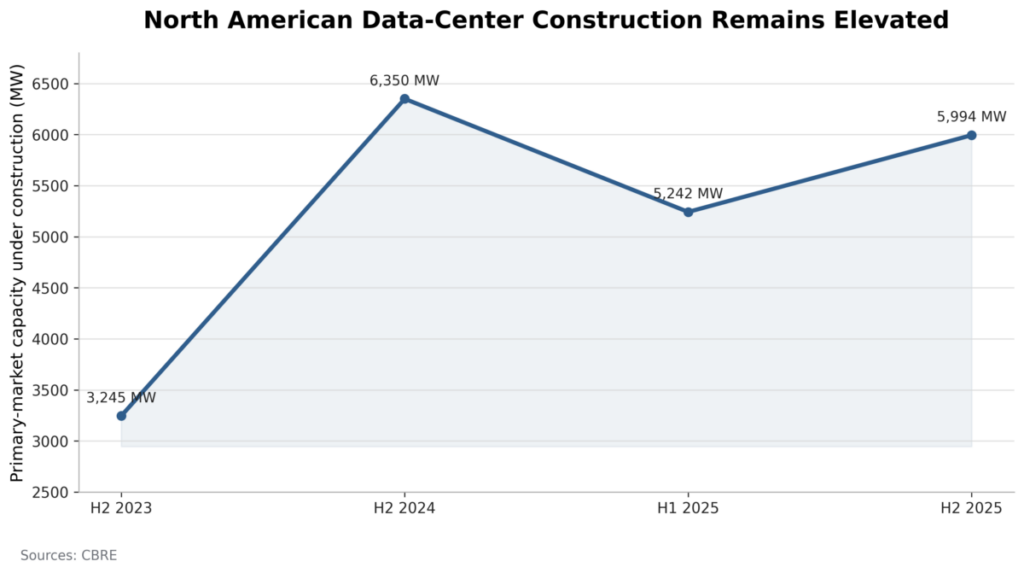
Canada has a different opportunity. Its energy and climate advantages can make parts of the country attractive for compute expansion, but those strengths matter only if planning, transmission investment, local consent, and higher-value digital activity develop alongside the infrastructure. Hosting power-intensive compute is less valuable if most software revenue and strategic control remain elsewhere.
The distributional constraint is just as important. Digital gains often arrive first for organizations with capital, skills, and internal capacity, while smaller firms and less connected communities face higher adoption costs and weaker bargaining power. The same platform that expands market reach can also deepen dependence on external rules and fees.
| Name | 2025 | 2026 (est)* | % Growth | Source |
|---|---|---|---|---|
| Global data-center electricity use | 476 TWh | 546 TWh | 14.7% | International Energy Agency |
| United States data-center power demand | 31 GW | 41 GW | 32.3% | Goldman Sachs Research |
| North American data-center construction | 5,994 MW | 6,500 MW | 8.4% | CBRE |
| North American frontier-market data-center buildout | 64.0% | 66.0% | +2.0 pp | JLL |
Risk and Distribution
The Region Is More Capable and More Exposed
The United States and Canada are more digitally capable than they were five years ago. They are also more exposed. Cybersecurity, platform dependence, infrastructure strain, and uneven adoption now sit inside ordinary economic activity. The risks are part of the operating cost of the internet economy.
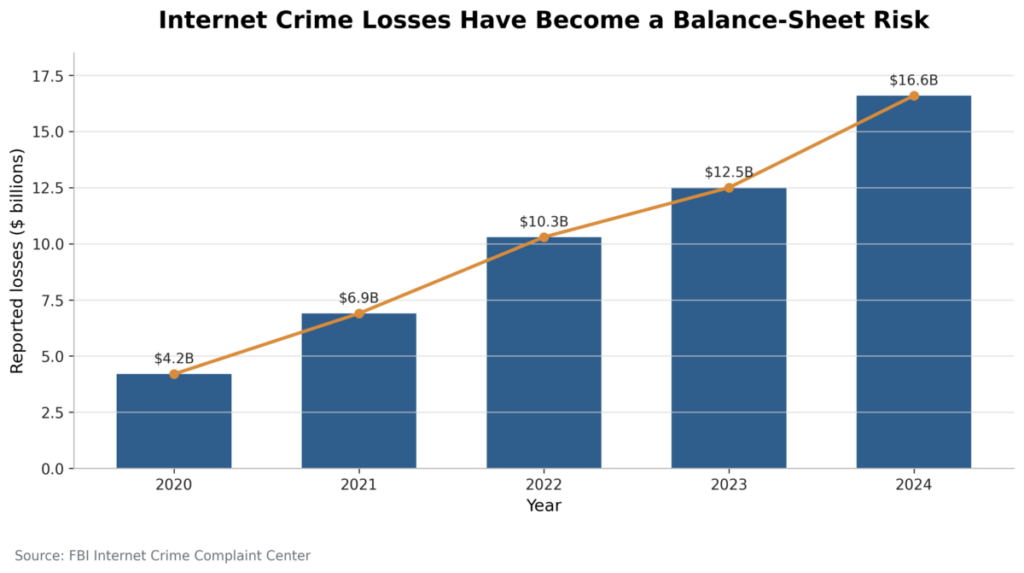
Cyber losses show the financial scale of that exposure. FBI-reported internet-crime losses exceeded $16 billion in 2024, up 33% from 2023. The figure is U.S.-based, but the meaning is regional because Canadian firms, consumers, vendors, and financial systems operate through many of the same platforms and supply chains. Cyber risk now affects payments, business continuity, household security, and trust in digital services.
Distributional effects are also widening. Canada’s digital transformation market is projected to reach US$74 billion by 2025, but spending alone does not guarantee broad gains. Firms with capital, usable data, skilled workers, and management capacity will absorb technology faster. Smaller firms and lower-income households face higher adjustment costs. Rural and remote communities may gain new reach but also become more dependent on outside platforms and vendors.
The same pattern appears in the United States. Large firms can convert cloud, AI, and automation into competitive advantage more quickly than smaller suppliers. Workers in high-skill roles may gain productivity and flexibility, while workers in monitored or platform-mediated roles may face weaker bargaining power. The internet economy is raising capacity and widening differences at the same time.
| Name | 2025 | 2026 (est)* | % Growth | Source |
|---|---|---|---|---|
| Canada digital transformation market | US$74B | US$85B | 14.9% | Market Research Future |
| FBI-reported internet-crime losses | US$22.1B | US$29.4B | 33.0% | FBI Internet Crime Complaint Center |
Outlook
2026 Will Test Absorption, Infrastructure, and Trust
Governance now decides whether digital convenience becomes durable capacity. A cloud outage, payment failure, or data-center dispute can quickly move from a technical issue into a broader economic problem. The rulebook behind the screen is now part of the economy people experience.
Regulation has become part of the production system. Rules for AI, platforms, privacy, cybersecurity, digital finance, and infrastructure now shape whether digital systems remain accountable, competitive, resilient, and trusted. Good regulation moves fast enough to protect users but steadily enough to support investment. Weak rules leave markets exposed to fraud, concentration, cyberattacks, and infrastructure stress, while rigid rules can protect incumbents and delay useful innovation.
North America’s challenge is institutional alignment. AI depends on data governance. Cloud resilience depends on competition policy and critical-infrastructure planning. Digital finance depends on identity, consumer protection, and settlement infrastructure. Data centers depend on energy planning, permitting, and local legitimacy. The rules now have to work together because the systems already do.
The second half of 2026 will be less about whether the United States and Canada are digitally advanced and more about whether that advancement produces broad economic value. The region already has high connectivity, deep cloud use, rising AI investment, active digital commerce, and expanding digital health. The unresolved question is whether those systems improve productivity, service capacity, resilience, and market access beyond the strongest firms and largest metros.
For the United States, the main test is whether AI investment spreads into operating performance. Data centers, chips, and cloud contracts can lift investment before they lift productivity. The gains become durable only when firms and public agencies redesign how work is done.
For Canada, the main test is value capture. The country is highly connected and closely integrated with U.S. digital markets, but it risks depending too heavily on external platforms and cloud systems. Its opportunity is to use digital infrastructure to strengthen smaller firms, health systems, public services, clean-power-linked compute, and cross-border trade.
At mid-year 2026, the U.S.–Canada internet economy is advanced but not settled. The region has moved beyond access and into absorption. The next measure of success will be whether digital systems raise productivity, widen participation, protect trust, and remain resilient under the weight of their own infrastructure demand.
Sources
Summary
- DataReportal; Digital 2025: The United States of America; – Link
- DataReportal; Digital 2025: Canada; – Link
- OECD; OECD Digital Economy Outlook 2024, Volume 1; – Link
Connectivity and Market Access
- U.S. Census Bureau; Quarterly Retail E-Commerce Sales Report; – Link
- Federal Reserve Financial Services; 2025 Diary of Consumer Payment Choice; – Link
Economic Influence
- Federal Reserve; Monitoring AI Adoption in the U.S. Economy; – Link
- Federal Reserve Bank of St. Louis; Tracking AI’s Contribution to GDP Growth; – Link
Human Impact, SDGs, and STI
- American Medical Association; New Data Details How Telehealth Use Varies by Physician Specialty; – Link
- Statistics Canada; Virtual Care Use in Canada: Variation Across Sociodemographic and Health-Related Factors; – Link
Risks and Outlook