
A country does not modernize food production simply by putting sensors on farms. Modernization begins when better information changes how producers use physical assets, financial institutions assess risk, and markets respond to more predictable output. The economic question is larger than whether agriculture becomes more digital. It is whether a more capable primary food production system makes the surrounding economy more productive.
Across crops, livestock, aquaculture, and other biological production, uncertainty imposes a persistent cost because resources must be committed before weather, disease, biological conditions, or markets reveal the outcome. Connected equipment and digital services make more of those conditions visible earlier, improving decisions before scarce resources are committed.
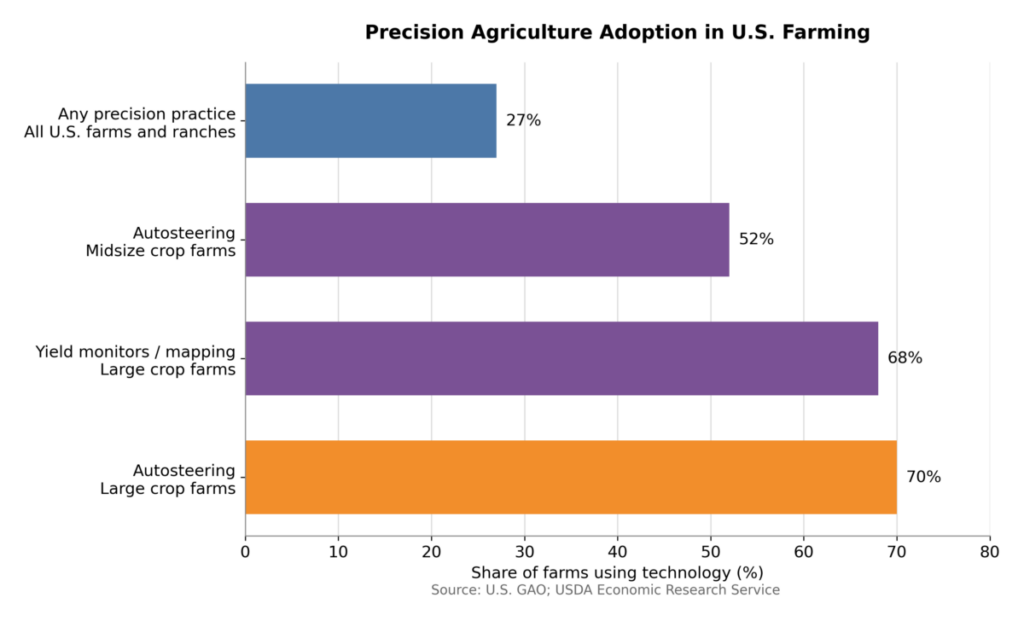
The economics of adoption are already visible in the United States. Only 27 percent of farms and ranches used precision practices to manage crops or livestock in 2023. Yet autosteering reached 70 percent of large crop farms and 52 percent of midsize operations. Scale makes fixed costs easier to absorb, while complexity and limited support weaken the business case for smaller producers.
At regional or national scale, the larger value is predictability. Greater visibility reduces uncertainty around production and gives both producers and surrounding institutions a firmer basis for investment. Predictability becomes the first transferable economic asset in the modernization process.
| System Measure | Figure | Scope |
|---|---|---|
| Rural population using the internet | 58% | Global |
| Urban population using the internet | 85% | Global |
| Rural internet use | 14% | Low-income countries |
| Smallholders with commercial finance access | Fewer than 1 in 10 | Global |
Sources: International Telecommunication Union, World Bank
Productivity Is Only the First Multiplier
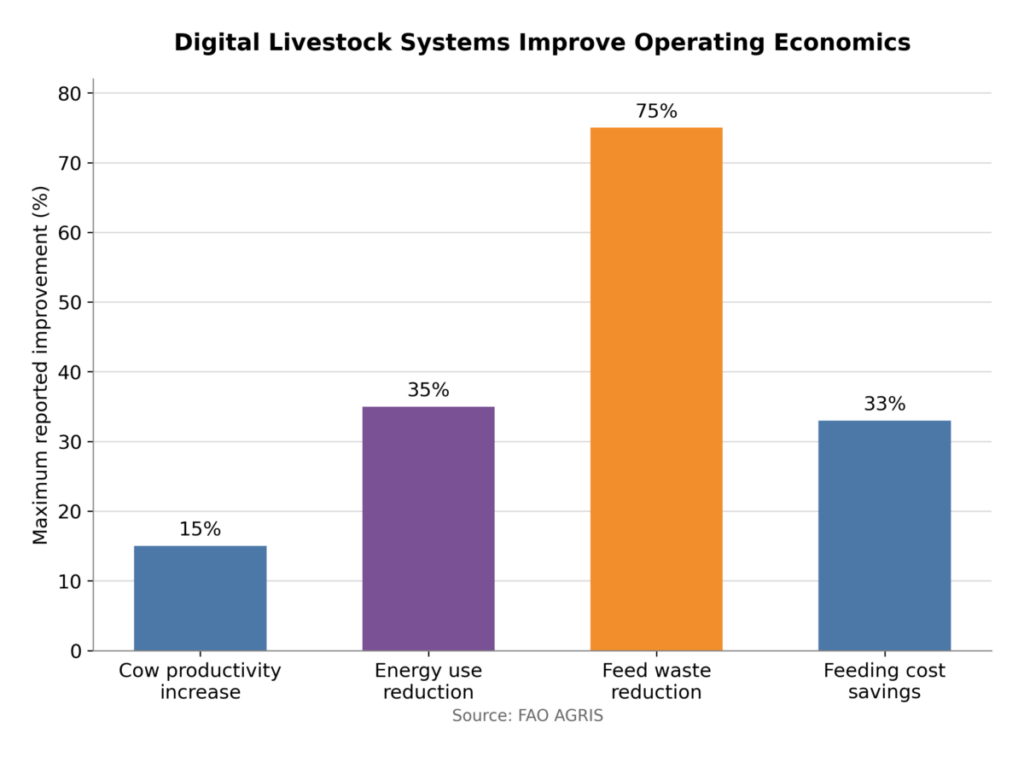
Inside production, the first gains appear through better timing and fewer avoidable losses. Earlier information improves decisions about irrigation, feeding, disease response, and inputs. More consistent output then gives producers a clearer basis for planning. The shift is not simply higher efficiency, but greater confidence in what the production system is likely to deliver.
India’s Kisan Call Center shows how information can create value before expensive machinery arrives. A 2026 study covering about 17 million farmer queries across ten states from 2009 through 2019 found that a 1 percent increase in seasonal weather queries was associated with a 0.008 tonne-per-hectare increase in paddy yields, roughly 0.3 percent of average yield. Information arriving after pest damage developed could not recover losses in the same way.
Timing is therefore part of the economic mechanism. Information has its greatest value before labor, water, fertilizer, feed, or biological capacity is committed; afterward, it may only document the loss. Livestock and aquaculture follow the same logic even when their technologies and biological risks differ.
As production becomes more predictable, the economic relationships around it begin to change. Better records and more reliable output give lenders and insurers stronger evidence, while buyers and logistics providers gain clearer expectations about what the production system can deliver.
| Measure | Result | Scope |
|---|---|---|
| Agrifood share of GDP | More than 30% | Low-income countries |
| Agrifood share of employment | About 70% | Low-income countries |
| Real net revenue | +29% | Rural organizations in Bahia |
| Beneficiary food security | 46% → 58.2% | Bahia |
| Families directly supported | 40,000 | Bahia |
Sources: World Bank
Production Gains Cascade Through the Economy
Finance is one of the first places where predictability produces a second-order effect. Agricultural lending is difficult partly because output is volatile and operating histories are often incomplete. Better records do not remove weather, disease, or commodity risk, but they reduce information asymmetry and make viable producers easier to evaluate.
When financing follows, an initial productivity gain can help fund the next one. Capital invested in equipment, irrigation, storage, or animal health expands productive capacity. Stronger production, in turn, improves the case for further investment. Modernization begins to reinforce itself.
The same transmission reaches supply chains. FAO estimates that 13.3 percent of food was lost globally after harvest and before retail in 2023, compared with 13.0 percent in 2015. Little improvement over eight years underscores how much value still disappears beyond the production stage. Information cannot replace roads or refrigeration, but clearer expectations about volumes and timing can improve how physical assets are used before food is lost.
At this point, the cascade is economic rather than technological. More predictable production strengthens finance, which expands productive capacity and improves the reliability of output moving into markets. Better market participation can raise the value producers retain, with some of that gain returning to production and some entering household spending.
| Economic Link | Result | Example |
|---|---|---|
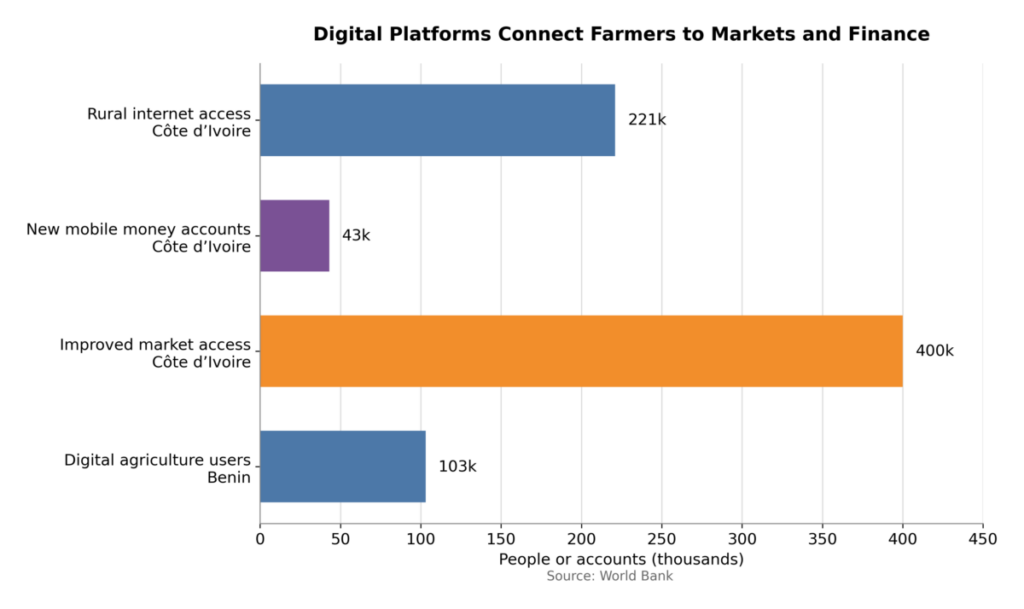
| Rural internet access | 221,000+ | Côte d’Ivoire |
| New mobile-money accounts | 43,000+ | Côte d’Ivoire |
| Improved market access | 400,000+ | Côte d’Ivoire |
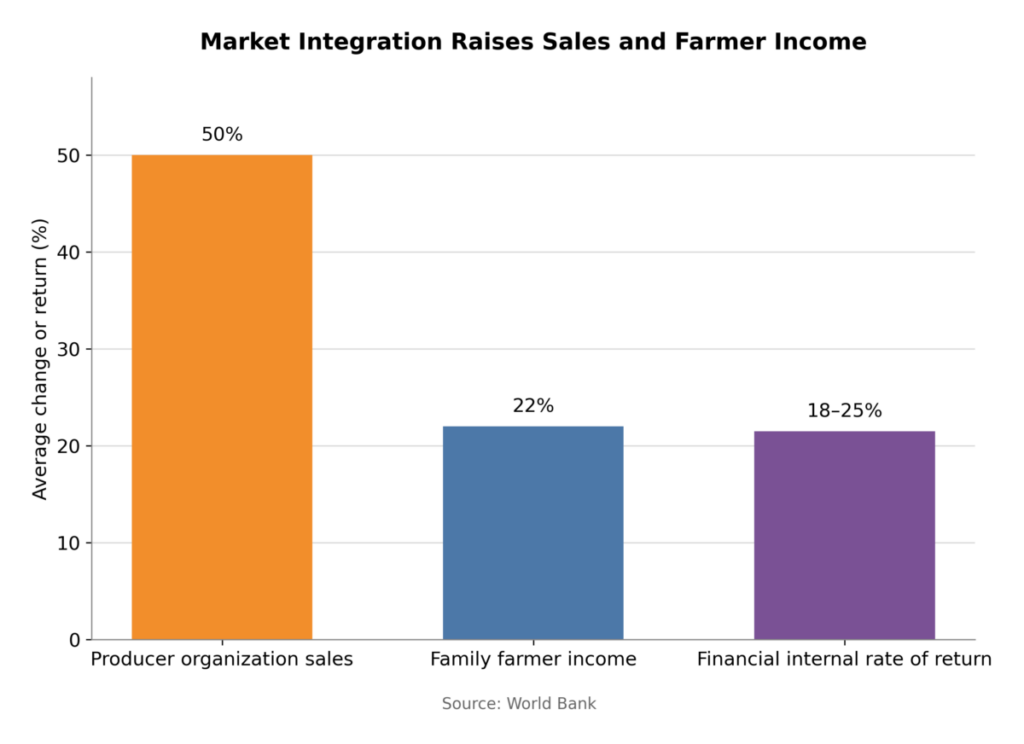
| Producer-organization sales | +50% | Productive Alliances |
| Family-farmer income | +22% | Productive Alliances |
| Financial internal rate of return | 18%–25% | Productive Alliances |
Sources: World Bank
The Multiplier Reaches Households and Regions
Food production occupies an unusual position in development because improvements reach businesses and households simultaneously. In 2025, an estimated 645 million people, or 7.8 percent of the global population, faced hunger, while about 2.1 billion experienced moderate or severe food insecurity. The scale makes the performance of primary food production an economic and human concern far beyond the producer.
For households tied directly or indirectly to primary production, greater predictability makes income easier to plan around. Avoiding a preventable crop or livestock loss can preserve the ability to service debt, finance the next production cycle, employ labor, or spend locally. Repeated across a region, those transactions support economic activity beyond agriculture.
The same transmission can run in reverse. Weak connectivity reinforces poor information, constraining productivity and making finance harder to obtain. Underinvestment then restricts market access and income, allowing an initial capability gap to widen as it travels through the economy.
Where agriculture represents a substantial share of employment and output, those differences become macroeconomic. IMF modeling for Sub-Saharan Africa estimates that AI adoption under current conditions could raise regional productivity by about 0.2 percent cumulatively over a decade. A higher-adoption scenario raises the modeled median productivity effect to about 2.1 percent and GDP by roughly 4 percent. These are scenarios rather than forecasts, but the contrast shows why productive absorption matters more than technical availability alone.
| Measure | Result | Scope |
|---|---|---|
| Agrifood share of GDP | More than 30% | Low-income countries |
| Agrifood share of employment | About 70% | Low-income countries |
| Real net revenue | +29% | Rural organizations in Bahia |
| Beneficiary food security | 46% → 58.2% | Bahia |
| Families directly supported | 40,000 | Bahia |
Sources: World Bank
Modernization Still Depends on Traditional Economics
Digital systems can accelerate modernization, but they cannot remove its physical foundations. Farms still require water and energy, while food depends on functioning transport, storage, and refrigeration. A mobile service may bypass an outdated information channel, but it cannot compensate indefinitely for unreliable electricity or an impassable road.
The path therefore differs by starting condition. Capital-intensive systems may gain most from automation and integrated machinery. Expanding commercial systems may benefit more from combining connectivity with finance and market infrastructure, while lower-income regions may realize earlier returns from inexpensive information services before large-scale automation becomes economical.
Governments are already treating modernization as a systems problem rather than a device-adoption problem. FAO recorded more than 775 smart-farming policy actions across 65 governments between 2015 and 2026, with almost 80 percent concentrated in inputs and production. The pattern reflects an effort to connect technological capability with the institutional and physical conditions required to make it productive.
Policy determines whether those capabilities reinforce one another. Communications networks must reach production areas, producers need finance and skills, and physical infrastructure must develop alongside digital systems. Technology generates larger returns when complementary assets turn information into productive capacity.
A stronger food production system then becomes more than an agricultural achievement. Higher productivity improves the conditions for finance and investment, while stronger market participation supports household income and regional business activity. At sufficient scale, those gains become part of national development.
The multiplier is not the technology itself. It is the sequence through which greater predictability strengthens production, investment, infrastructure use, income, and economic activity beyond the producer. When modernization strengthens that sequence across a region or country, improvements at the beginning of the food system become part of the wider development process.
| Physical Constraint | Figure | Scope |
|---|---|---|
| Locally produced food lost or wasted | 37% | Africa |
| Food supply-chain length | Up to 4× longer | Africa vs Europe |
| Supply-chain share of food prices | Up to 45% | Selected staples |
| Priority transport bottlenecks | 50 | Sub-Saharan Africa |
| Priority border crossings | 20 | Sub-Saharan Africa |
| Priority ports | 10 | Sub-Saharan Africa |
Sources: World Bank
TL;DR Summary
- Modernizing primary food production is an economic-development strategy, not simply an agricultural technology program.
- Better information reduces uncertainty before it raises output.
- Greater predictability strengthens the conditions for lending, insurance, and investment.
- Finance can support subsequent rounds of productive modernization.
- Better production information can improve logistics and market access.
- Lower food losses preserve value across the supply chain.
- More predictable income supports household spending and regional business activity.
- Weak connectivity can create a reverse multiplier through productivity, finance, and income gaps.
- Digital modernization cannot replace physical infrastructure.
- Countries will modernize differently according to their capital base and institutions.
- Policy determines whether digital and physical capabilities reinforce one another.
- At sufficient scale, stronger food production becomes part of national economic infrastructure.
Sources
- U.S. Government Accountability Office; Precision Agriculture: Benefits and Challenges for Technology Adoption and Use; – Link
- USDA Economic Research Service; Precision Agriculture Use Increases with Farm Size and Varies Widely by Technology; – Link
- International Telecommunication Union; Global Connectivity Report 2025; – Link
- World Bank Group; Remarks at the AgriConnect Flagship Event; – Link
Productivity Is Only the First Multiplier
- Agricultural Economics; Access to Digital Extension Services and Crop Yield: Evidence From Paddy Cultivation in India; – Link
- FAO AGRIS; Digitalization of Agriculture and Its Impact on Productivity, Market Access, and the Digital Divide among Smallholder Farmers in Developing Countries; – Link
- World Bank; Can AI Give Small Scale Producers the Right Advice?; – Link
- FAO AGRIS; Economic and Environmental Benefits of Digital Agricultural Technological Solutions in Livestock Farming; – Link
Production Gains Cascade Through the Economy
- World Bank; From Fields to Markets: The Role of Digital Platforms in West Africa’s Agricultural Success; – Link
- Food and Agriculture Organization of the United Nations; Global Food Loss Indicator; – Link
- World Bank; Can Warehouse Receipts Unlock Farmer Finance?; – Link
- Global Agriculture and Food Security Program / World Bank; $75 Million Financing Window to Mobilize Private Agricultural Investment; – Link
The Multiplier Reaches Households and Regions
- Food and Agriculture Organization of the United Nations; The State of Food Security and Nutrition in the World 2026; – Link
- International Monetary Fund; Unlocking the Potential: AI in Sub-Saharan Africa; – Link
- World Bank; Enhancing the Competitiveness of Family Farms: The Power of Productive Alliances in Latin America and Africa; – Link
- World Bank; Unlocking Guinea’s Agriculture Development: Creating Jobs for Inclusive Growth; – Link
Modernization Still Depends on Traditional Economics
- Food and Agriculture Organization of the United Nations; Agrifood Policy Highlights July 2026; – Link
- World Bank; Improving Transport Connectivity for Food Security in Africa; – Link
- International Telecommunication Union; Facts and Figures 2025: Mobile Network Coverage; – Link
- World Bank; One Year into AgriConnect: What We’re Learning in Africa; – Link