
A mobile signal reaching a village in Tanzania, fiber running into a factory in northern Mexico, and a high-capacity network linking production sites in the Netherlands all count as connectivity. Technically, they belong to the same category. Economically, they can perform very different work.
For a Tanzanian household, mobile broadband can widen access to employment, payments, and markets that distance once made difficult to reach. In a Mexican factory, dependable broadband can link customer demand with production and suppliers. Inside a highly digitized Dutch firm, network capacity can help equipment, software, skilled workers, and data operate as one production system. The technology connects each setting, but what it amplifies is different.
Connectivity has no fixed economic return because its value depends on what surrounds the connection. At lower development levels, its largest contribution may be widening participation. As firms and institutions develop stronger digital capabilities, networks increasingly integrate economic activity. In highly digitized economies, they support production that depends on continuous coordination.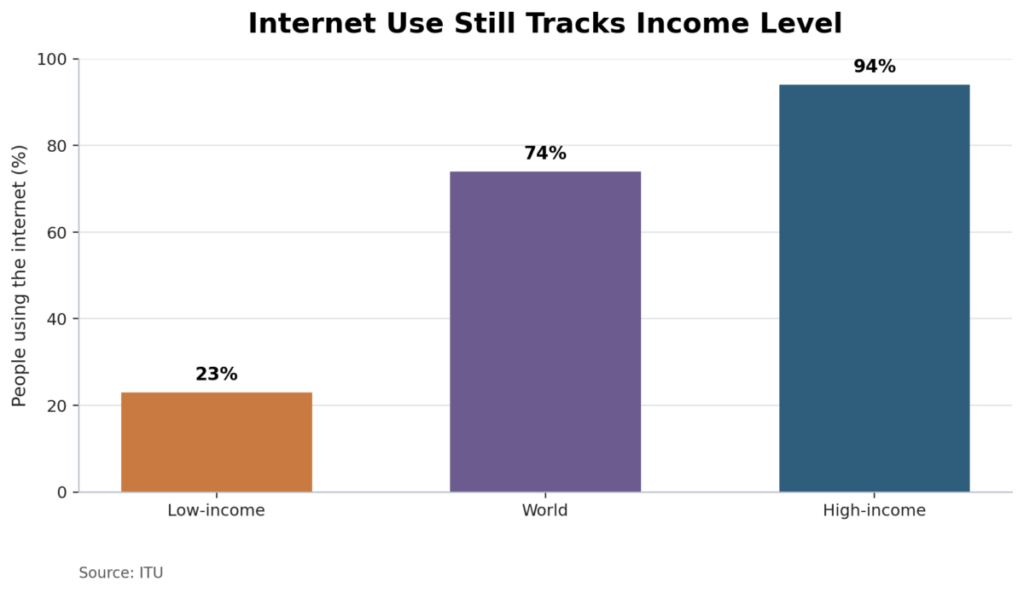
Connectivity becomes a multiplier when it makes another economic resource more useful.
Coverage, penetration, and speed still dominate measures of digital development. They reveal the presence and capacity of infrastructure, but less about its economic function. Two countries with similar internet-use rates can possess very different productive capabilities. The more useful question is what better connectivity allows an economy to do next.
How Connectivity’s Economic Function Changes Across Development Tiers
| Connectivity Context | Internet Use | Rural Constraint | Primary Development Challenge |
|---|---|---|---|
| Low-income economies | 23% | 14% of rural residents online | Participation and reach |
| Global | 74% | 58% of rural residents online | Quality and meaningful use |
| High-income economies | 94% | 59% rural 5G coverage | Capacity and coordination |
Sources: ITU
Connectivity Multiplies Participation
In lower-income economies, connectivity can reduce the economic penalty imposed by distance. Workers can search beyond local employment networks, households can transact without traveling, and producers can reach buyers beyond the nearest physical market. These are simple uses of sophisticated infrastructure, but they enlarge the practical economy available to households and small businesses.
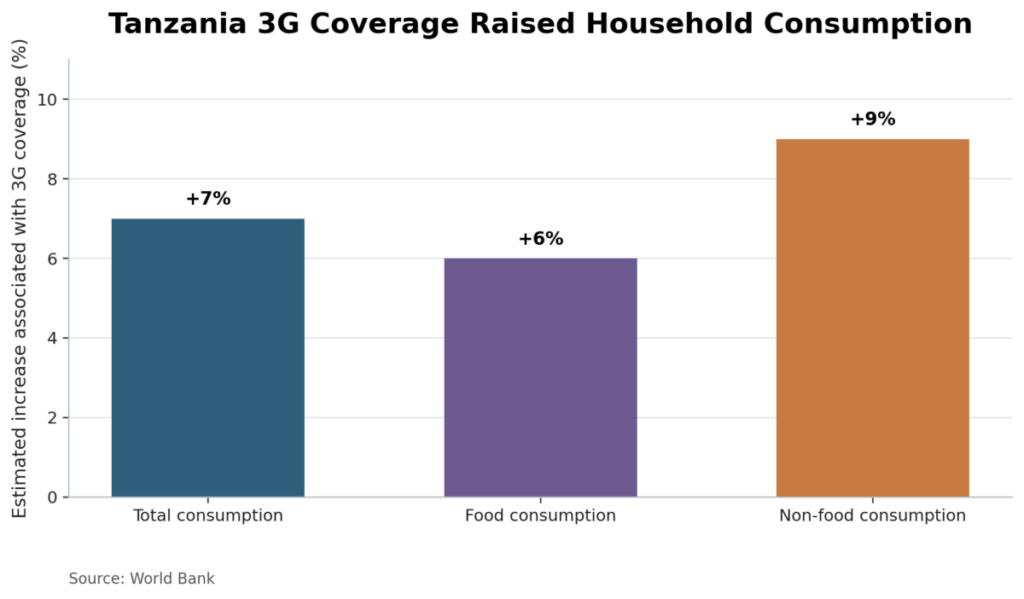
Expanded 3G coverage in Tanzania raised household consumption and reduced poverty while shifting employment toward wage work and nonfarm self-employment. Agricultural employment declined among working-age people in covered areas. Mobile broadband was not merely making existing activity easier. It was associated with changes in the kinds of economic activity households could pursue.
Fast-internet expansion across Africa produced further evidence of employment gains. Hjort and Poulsen found sizable positive effects following the staggered arrival of submarine cables across 12 countries. A later reanalysis by David Roodman challenged the robustness of several estimates under alternative geographic and data treatments. The study remains important evidence, but not a universal measure of broadband’s employment effect.
At this stage, broadband resembles earlier infrastructure because it changes what people can practically reach. Roads enlarge physical markets; connectivity reduces informational and transactional isolation. The economic gain comes from widening the reach of labor, commerce, finance, and services rather than from the network producing income by itself.
Those gains are not automatic or evenly distributed. Affordability, devices, skills, and local economic conditions determine whether access becomes economic participation or remains largely a communications channel.
Connectivity and the Expansion of Economic Participation
| Country | Connectivity Change | Consumption Effect | Poverty Effect |
|---|---|---|---|
| Tanzania | 3G coverage | +7% to 11% | −4 to 7 percentage points |
| Senegal | 3G coverage | +14% | −10% extreme poverty |
| Nigeria | 3G mobile broadband | Positive | −4.3% extreme poverty |
Sources: World Bank
The Larger Multiplier Appears When Firms Integrate
Once basic participation is widespread, the more consequential digital divide begins to run through firms that are already connected. Mexico illustrates the shift. Large parts of its economy participate in international production and trade, while telecommunications are broadly available. The question becomes whether connectivity remains at the edge of the business or becomes embedded in how the business operates.
Two manufacturers can have broadband while possessing very different digital capabilities. One may use email and messaging while keeping purchasing, inventory, accounting, and logistics separate. Another can connect customer orders with inventory and supplier decisions so production responds to the same information. Both firms are online. Only one has turned connectivity into operational integration.
Once information moves across business functions, the network raises the usefulness of the systems around it. Better inventory visibility improves purchasing. Faster supplier coordination reduces delays and sharpens delivery commitments. Connectivity stops functioning mainly as a communications channel and begins linking processes that previously operated apart.
Network quality now carries a different economic meaning. An unstable connection may still support messaging or occasional payments but undermine cloud applications and synchronized operating systems. The constraint has moved from whether a firm can connect to whether it can reliably organize activity around the connection.
Mexico’s average broadband speed was 47 Mbps in the OECD’s 2026 survey, compared with 120.8 Mbps across the OECD. Its 5G network covered 52 percent of the population against an OECD average of 76 percent. Such gaps matter because data-intensive business systems require more than nominal access, and weaker performance can constrain deeper cloud adoption.
Indonesia shows the same underlying problem from another starting point. Internet use rose from 13 percent of adults in 2011 to 51 percent in 2019, yet connectivity quality and productive digital use remained uneven. The next economic gains depend less on adding another basic connection than on whether firms can use digital systems deeply enough to change how they produce, sell, and coordinate.
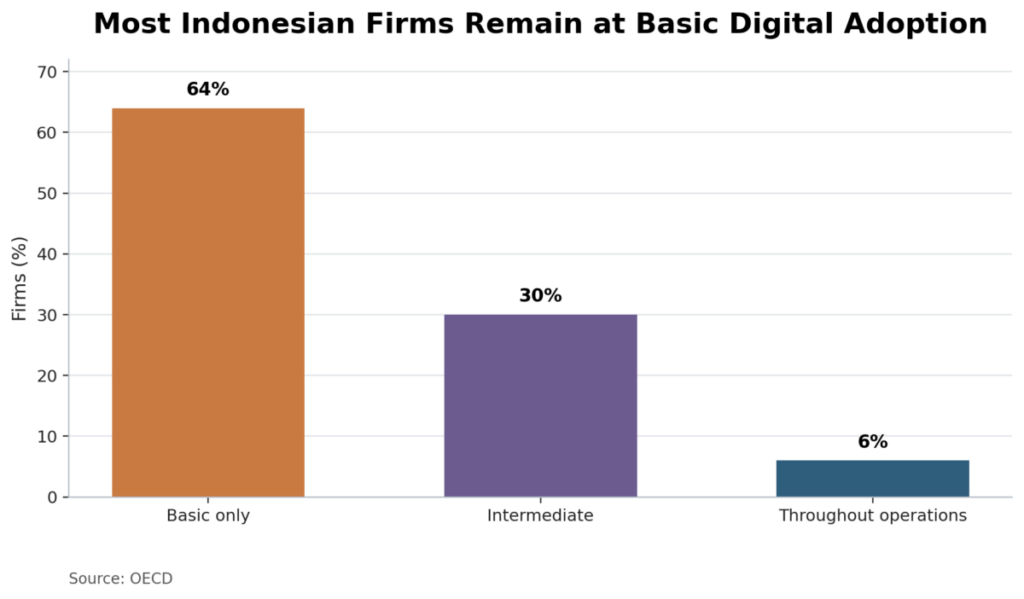
The multiplier becomes clearest at this stage because technology begins to alter relationships among existing business assets. A reliable network makes software more useful; shared information improves management; better coordination can improve the use of working capital and supplier capacity. Economic value comes from interaction rather than from telecommunications alone.
Network investment cannot close that gap by itself. Firms need the organizational capacity to redesign work around digital systems, while financing and workforce capability determine how deeply those systems enter daily operations. Connectivity can reduce friction, but it cannot substitute for the business capabilities needed to exploit that advantage.
From Digital Access to Business Integration
| Business Indicator | Observed Pattern | Integration Signal |
|---|---|---|
| Social media use | More than 60% of businesses by 2021 | Basic digital adoption |
| Cloud adoption | SME use doubled in under six years | Shared digital infrastructure |
| Cloud by firm size | 56% large firms vs. 27% small firms | Scale-related adoption gap |
| ERP, CRM and SCM | Among the largest SME digital gaps | Process integration |
Sources: OECD
Advanced Economies Multiply Productive Complexity
In advanced economies, the marginal role of connectivity shifts again because firms already possess large stocks of digital and organizational capital. Access gaps still matter, but more network value comes from coordinating productive systems whose components already depend on one another.
A modern manufacturer can link machinery with enterprise software, engineering teams, suppliers, and demand information. None of those assets becomes productive merely because the network is faster. Once they are in place, however, greater capacity and reliability allow the firm to coordinate them more intensively and respond faster to changing conditions.
Dutch firm-level data found positive and sizable productivity benefits from high-speed broadband uptake and ICT hardware investment. Digital skills and other intangible investments also affected productivity, with stronger hardware gains among firms that already possessed complementary capital or management capabilities. The network became more valuable because there was more productive capacity available to coordinate.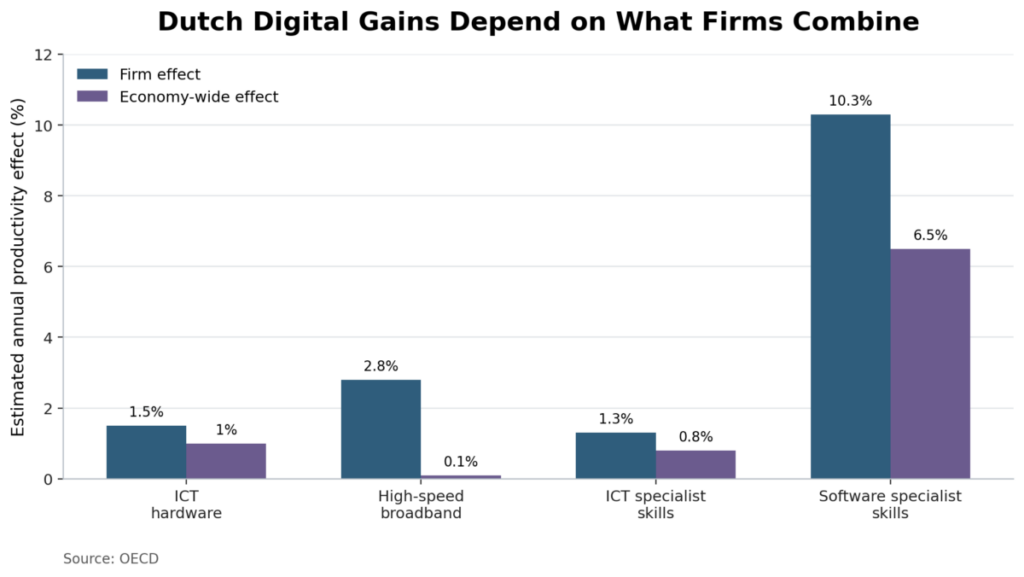
Broadband adoption in Norway also changed the relative value of labor. It complemented skilled workers performing nonroutine abstract tasks while substituting for some routine work. Greater connectivity can therefore raise productive capacity without distributing gains evenly, strengthening some skills and activities while reducing the value of tasks that digital systems can absorb.
At the technological frontier, network capacity matters because there is more economic complexity available to coordinate.
Connectivity and Productive Complexity in Advanced Economies
| Productive Capability | Measured Change | Observed Effect |
|---|---|---|
| Software specialists | +1 standard deviation in employment share | ≈10.3% higher annual labour productivity |
| ICT specialists | +1 standard deviation in employment share | ≈1.3% higher annual labour productivity |
| High-speed internet | Access above 100 Mbps | 5% higher seller network centrality |
| High-speed internet | Access above 100 Mbps | 4% higher buyer network centrality |
Sources: OECD
There Is No Single Broadband Multiplier
A rural household obtaining dependable mobile broadband, a Mexican factory integrating suppliers and inventory, and a Dutch manufacturer coordinating digitally intensive production are not receiving larger and smaller versions of the same benefit. The network performs different economic functions as the productive environment around it changes.
The progression is not a rigid national development ladder. Lower-income countries contain sophisticated firms, advanced economies retain disconnected communities, and businesses within the same market can possess very different digital capabilities. The important relationship is the fit between the network and the economic system using it.
Neither penetration nor speed captures that relationship on its own. A high-capacity connection creates limited productive value when firms cannot reorganize around it, while sophisticated businesses can be constrained when reliability or capacity falls below what their operations require. Infrastructure and productive readiness have to meet.
Connectivity is therefore better understood as a complementary economic technology than as a mechanical multiplier of GDP. Its return emerges from what it enables other resources to accomplish, whether widening participation, integrating production, or coordinating more complex systems.
The development value of connectivity is not contained in the connection alone. It lies in what the connection makes the rest of the economy capable of doing.
A Measurement Framework for the Connectivity Multiplier
| Measurement Dimension | Participation | Integration | Productive Complexity |
|---|---|---|---|
| Network measure | Coverage and affordability | Reliability and usable speed | Capacity and continuity |
| Adoption measure | People online | Cloud and process systems | Data-intensive operations |
| Complementary measure | Devices and basic skills | Management and finance | Digital skills and capital |
| Economic signal | Market participation | Operational integration | Coordination intensity |
| Outcome measure | Income and employment | Firm productivity | Productivity and task mix |
Sources: Institute of Internet Economics, ITU, OECD, World Bank
TL;DR Summary
- Connectivity performs different economic functions as surrounding productive capabilities change.
- In lower-development settings, mobile connectivity expands participation by reducing informational and transactional distance.
- Tanzanian 3G expansion was associated with higher consumption, lower poverty, and movement toward wage and nonfarm employment.
- African fast-internet research supports employment effects, although later methodological criticism narrows the certainty of some estimates.
- Access becomes a less useful dividing line as firms move deeper into digital adoption.
- Middle-development economies capture larger gains when networks integrate business processes rather than merely support communication.
- Mexico illustrates how network quality can constrain data-intensive business adoption after basic connectivity becomes widespread.
- Indonesia shows that rapid internet adoption can coexist with uneven productive digital use.
- Advanced economies derive greater network value from coordinating accumulated digital, organizational, and human capital.
- Dutch firm evidence links high-speed broadband and ICT investment with productivity gains shaped by complementary capabilities.
- Norwegian evidence shows that broadband can complement skilled work while substituting for routine tasks.
- The economically relevant measure is the fit between network capability and what households, firms, and institutions can do with it.
Sources
- International Telecommunication Union; Facts and Figures 2025; – Link
- OECD; Broadband Networks of the Future; – Link
- Institute of Internet Economics; Economic Development Tiers; – Link
Connectivity Multiplies Participation
- World Bank; Mobile Broadband Internet Poverty and Labor Outcomes in Tanzania; – Link
- American Economic Association; The Arrival of Fast Internet and Employment in Africa; – Link
- David Roodman; The Arrival of Fast Internet and Employment in Africa Comment; – Link
- World Bank; Accelerating the Use of Digital Technologies Is Key to Creating Productive Jobs and Boosting Economic Growth in Africa; – Link
The Larger Multiplier Appears When Firms Integrate
- OECD; OECD Economic Surveys Mexico 2026; – Link
- World Bank; Beyond Unicorns Harnessing Digital Technologies for Inclusion in Indonesia; – Link
- OECD; Making the Digital Transformation Work for All; – Link
- OECD; Digital Tools and Practices SME Access and Uptake; – Link
Advanced Economies Multiply Productive Complexity
- OECD; The Impact of Digitalisation on Productivity Firm Level Evidence from the Netherlands; – Link
- National Bureau of Economic Research; The Skill Complementarity of Broadband Internet; – Link
- OECD; Digitalisation and Productivity in Search of the Holy Grail; – Link
- OECD; Digital Adoption During COVID 19; – Link
There Is No Single Broadband Multiplier
- International Telecommunication Union; Global Connectivity Report 2025; – Link
- OECD; The OECD Going Digital Measurement Roadmap 2026; – Link
- World Bank; The Impact of Infrastructure on Development Outcomes; – Link
- Institute of Internet Economics; ICT 2026 Stats and Summary Report Mid Year; – Link
Keywords: Information Technology, Mobile Connectivity, Digital Development, Economic Growth, Digital Integration, Productive Complexity, Connectivity Economics