
[Primary SDGs: 2 – Zero Hunger; 6 – Clean Water and Sanitation; 7 – Affordable and Clean Energy; 9 – Industry, Innovation and Infrastructure; 11 – Sustainable Cities and Communities]
When Physical Systems Become Visible Outcomes Can Change
Long before infrastructure visibly fails, physical deterioration can already be generating losses that organizations have not yet recognized. A leaking pipe wastes treated water, while a worn bearing can threaten an entire production line.
The Internet of Things changes when those conditions become knowable by bringing physical activity into the information systems that guide operating decisions. Sensors measure conditions, networks move the data, and computing systems help operators interpret what is happening while intervention remains possible.
That timing gives IoT its strongest connection to sustainable development and places SDG 9, Industry, Innovation and Infrastructure, at the center of the economic argument. Resilient infrastructure and productive industrial systems increasingly depend on how effectively existing capital is monitored, maintained, and coordinated.
The same information advantage extends into water, electricity, agriculture, and urban infrastructure through SDGs 6, 7, 2, and 11. Each addresses a different development problem, but connected measurement can narrow the gap between deterioration and institutional response.
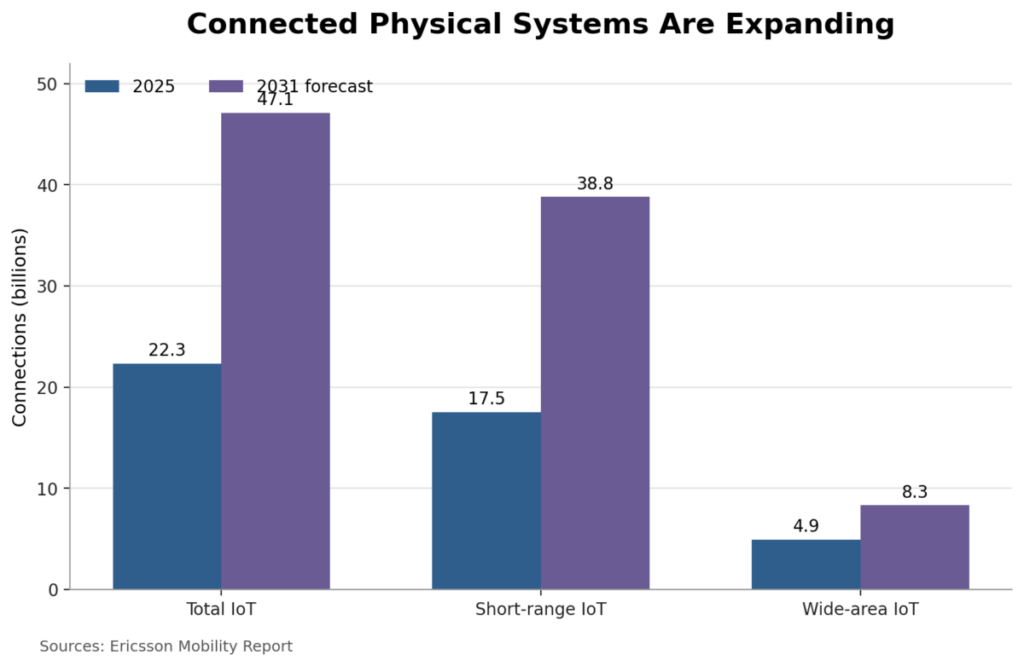
Once physical conditions become continuously observable, organizations gain something more valuable than another stream of data: decision time. Earlier intervention can limit failure, resource loss, emergency expense, and lost production before the effects spread.
A prevented factory shutdown can preserve supplier orders and worker hours. Earlier detection of water or electrical stress can protect essential services. Connectivity creates visibility; economic value appears when that visibility changes what happens next.
When Physical Systems Become Visible: Connected-System Scale
| IoT Segment | 2025 | 2031 Forecast | CAGR |
|---|---|---|---|
| Total IoT | 22.3B | 47.1B | 13% |
| Short-range IoT | 17.5B | 38.8B | 14% |
| Wide-area IoT | 4.9B | 8.3B | 9% |
| Cellular IoT | 4.5B | 7.8B | 10% |
Sources: Ericsson Mobility Report
Reliability Is a Human Development Technology
Much of human development rests on infrastructure that attracts little attention until it stops working. Water reaches households, electricity remains available, food stays usable, and industrial systems continue supporting employment and income.
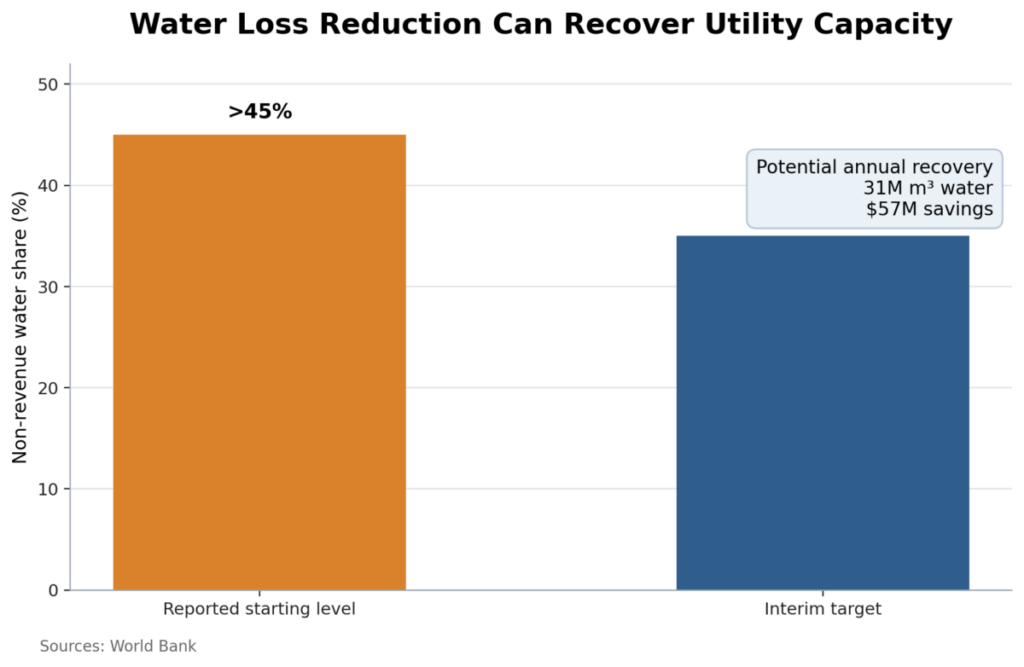
When utilities cannot see where water is being lost, they may continue treating and pumping supply that never reaches customers. Connected pressure and flow monitoring can reveal deterioration earlier, giving operators more time to isolate faults and direct repairs.
Earlier detection changes more than maintenance performance because water losses also consume energy and financial capacity. More reliable service protects households and institutions while advancing SDG 6 through stronger efficiency, management, and continuity. In 2024, 2.1 billion people still lacked safely managed drinking water.
Electricity systems expose the same dependence between infrastructure reliability and wider economic activity. An outage can halt production while disrupting other essential services that rely on continuous power.
As grids become more complex, connected equipment can improve visibility into demand and equipment condition before physical stress becomes a larger interruption. Annual grid investment is near $400 billion, while major transmission projects can require five to fifteen years to complete.
Those constraints make better use of existing infrastructure part of the SDG 7 equation, not merely a technical optimization problem. Global electricity access reached 92 percent in 2024, yet 655 million people still lived without electricity.
Agricultural systems gain from the same reduction in uncertainty when soil conditions, irrigation flows, or storage environments become easier to observe. Earlier information can protect crops before stress becomes irreversible and identify deterioration before food is lost.
That operating advantage aligns directly with SDG 2.4, which links food security with productive and resilient agriculture. Around 2.3 billion people experienced moderate or severe food insecurity in 2024, making avoidable resource loss economically consequential.
Urban infrastructure extends the argument because cities concentrate utilities, transportation, and public services within tightly connected environments. Earlier information about system stress can improve how limited maintenance and capital resources are allocated.
More than half of the global population already lives in cities, and that share is projected to approach 70 percent by 2050. SDG 11 therefore depends partly on whether institutions can convert better infrastructure information into more resilient services rather than simply collect more data.
Inside factories, connected sensing can reduce hazardous manual inspection while providing earlier warning of unsafe equipment conditions. Yet greater visibility can also intensify workplace monitoring and increase the value of technical skills, making training part of the productivity equation.
Reliability Is a Human Development Technology: System Loss Exposure
| System | Supplemental Measure | Quantitative Signal |
|---|---|---|
| Water | Five-utility NRW program | Above 45% toward 35% |
| Water | Potential annual recovery | 31M m³; 1M people |
| Utility finance | Estimated annual savings | $57M |
| Electricity | Potential losses without reliability gains | Nearly $1.3T through 2030 |
| Food systems | Loss before retail | 13.2% |
Sources: World Bank, International Energy Agency, FAO
Connected Manufacturing Changes the Economics Around the Machine
Manufacturing reveals the economic mechanism clearly because one equipment failure can impose costs well beyond the machine where deterioration began. Unexpected downtime can interrupt production, delay orders, disrupt suppliers, and increase the inventory firms hold against uncertainty.
Connected sensing changes that sequence by giving firms more information before equipment failure becomes a production event. Machine condition can move from sensors into control systems, then into maintenance software and operating decisions.
The economic boundary lies between monitoring and integration rather than between connected and unconnected equipment. An overheating alert creates awareness; a process that checks parts availability, schedules maintenance, and adjusts production turns information into coordination.
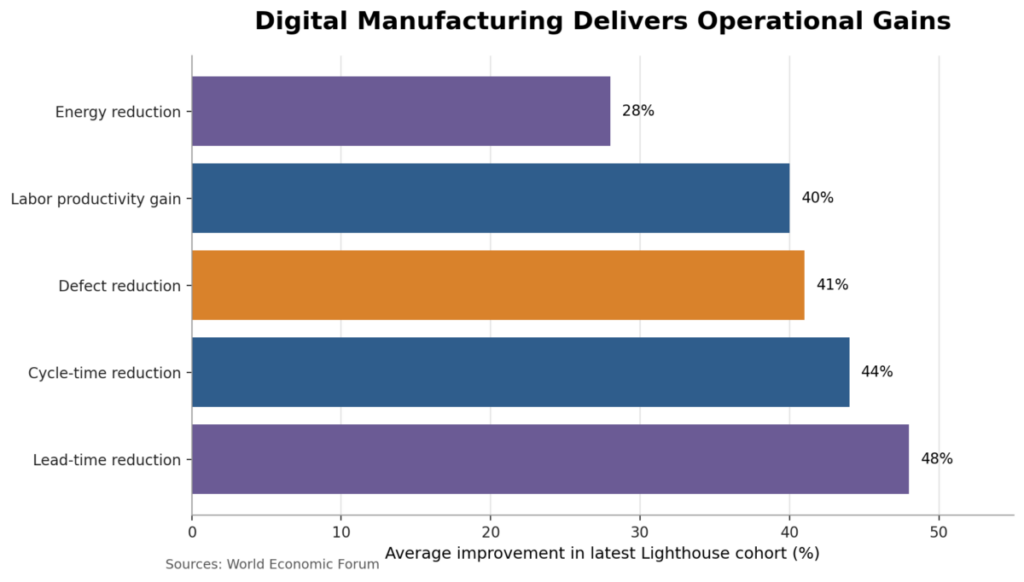
Better coordination improves capital utilization because machinery already purchased produces more when avoidable downtime falls. Greater predictability can also reduce emergency purchasing and some precautionary inventory while improving delivery performance.
Industrial resource use creates another major opportunity for connected measurement. Industry accounts for nearly 40 percent of global final energy demand and has generated about two-thirds of its increase since 2019, while energy-intensity improvement has slowed to less than 0.5 percent annually.
Recurring process losses become easier to address once they are continuously visible. A compressed-air leak can waste energy through every operating shift, while an unnoticed production deviation can turn material and labor into scrap.
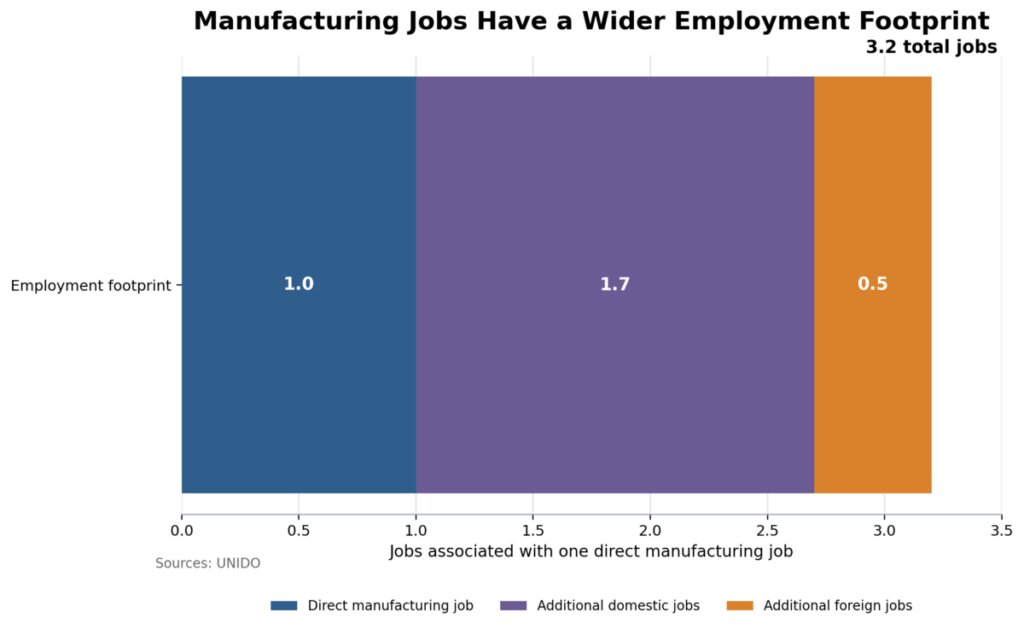
These gains reinforce SDG 9 because sustainable industrialization depends partly on extracting more productive value from capital, energy, and technological capability. UNIDO estimates that every direct manufacturing job generates roughly 2.2 additional jobs elsewhere in the global economy.
Industrial IoT is therefore better understood as coordination infrastructure than as another stage of automation. Its economic contribution emerges when information from physical systems changes maintenance, production, investment, and supply-chain decisions.
Connected Manufacturing: Measured Operational Outcomes
| Operating Measure | Average Change |
|---|---|
| Labor productivity | +53% |
| Conversion cost | −26% |
| New-product introduction time | −50% |
| Material waste | −30% |
| Energy and water use | −25% |
Sources: World Economic Forum
The Same Technology Produces Different Outcomes Across Economies
Connected infrastructure produces different economic returns depending on the systems already surrounding it. Advanced economies often have established automation and technical workforces, making integration across existing systems the larger marginal challenge.
Across many middle-income economies, advanced industrial clusters operate beside smaller firms with far weaker digital capabilities. Development gains become broader when connected information diffuses through supplier networks instead of remaining concentrated inside leading factories.
Lower-income economies face a different balance between technological opportunity and basic capacity. Wireless sensing can sometimes add measurement to pumps, agricultural systems, or machinery without recreating every legacy information system used in wealthier markets.
Technology cannot indefinitely substitute for the infrastructure required to act on the information it produces. A sensor may identify a failing pump, but repair still requires finance, parts, and technical skill.
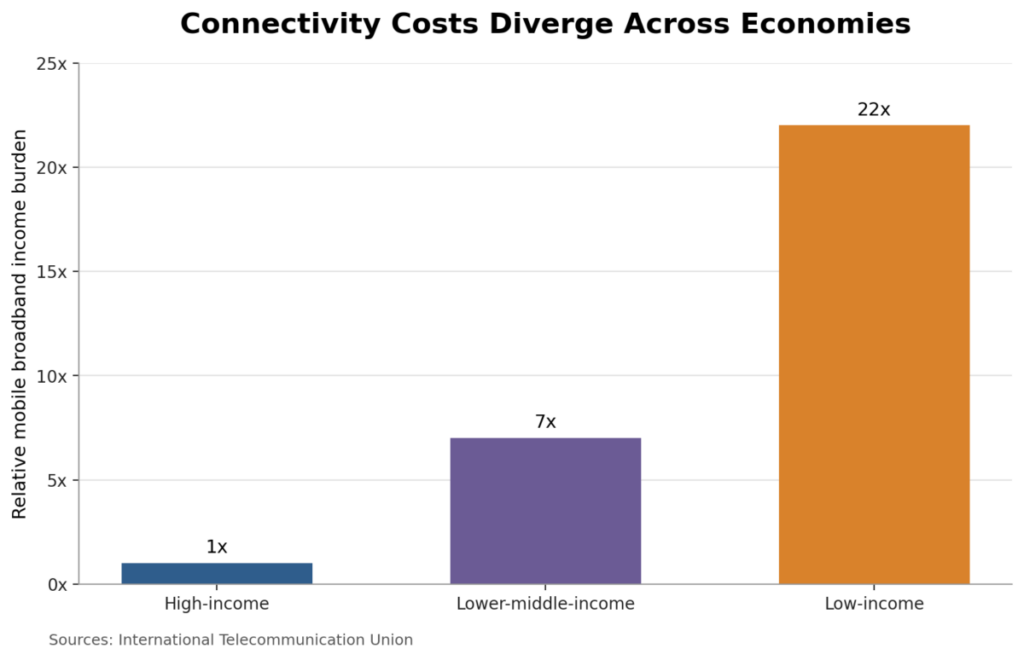
The relevant divide is therefore less about whether an economy possesses IoT than whether firms and institutions can absorb connected information into productive behavior. In 2025, 5G covered 84 percent of people in high-income economies but only 4 percent in low-income economies.
Raw device counts consequently reveal little about development performance by themselves. Two factories can deploy similar sensors while producing very different results if only one embeds the resulting information into operating and financial decisions.
The Same Technology Produces Different Outcomes: Digital Constraints Across Economies
| Constraint | 2025 Evidence |
|---|---|
| Mobile broadband burden | Lower-middle income ≈ 7× high income |
| Mobile broadband burden | Low income ≈ 22× high income |
| Fixed broadband burden | Over 25% of average income in low-income economies |
| Mobile-data intensity | High-income user ≈ 8× low-income user |
| Affordability target | 130 of 205 economies meet mobile target |
Sources: International Telecommunication Union
The Next Stage Is Integration Not Device Growth
As IoT matures, the economic question is shifting from how many objects can connect to whether connected systems are dependable, interoperable, secure, and useful. Device growth matters less when information remains isolated from the decisions that determine productivity.
Industrial equipment may remain in service for decades even as software and communications standards change much faster. Manufacturers therefore need practical ways to connect older machinery with newer systems without rebuilding entire plants.
Utilities and public institutions face the same integration problem when sensor information remains trapped inside separate platforms. Operational value rises when information reaches maintenance planning, capital allocation, and service decisions rather than ending at a dashboard.
Deeper connectivity also makes cybersecurity part of the economics of reliability. A networked factory or utility gains visibility while creating additional paths through which a digital incident can reach physical operations.
Falling sensor costs do not eliminate the capital problem because integration and security still require substantial investment. Smaller manufacturers and financially constrained utilities can face attractive long-term returns without having the resources required to realize them.
Human capability may ultimately impose the harder constraint because connected systems create value only when people and institutions know how to use the information. The emerging divide may be between organizations that convert data into continuous improvement and those that merely accumulate it.
Across the Sustainable Development Goals, the causal chain remains consistent even as the applications differ. SDG 9 supplies the industrial pathway, while better water, energy, agricultural, and urban information can strengthen SDGs 6, 7, 2, and 11.
More reliable factories support workers and suppliers, while stronger utilities support households, businesses, and public institutions. The development value of IoT lies less in what becomes connected than in what becomes possible once physical conditions can enter economic decisions.
The Next Stage Is Integration: Network and Security Signals
| Integration Signal | Scale |
|---|---|
| 5G RedCap commercial launches | 14 service providers |
| RedCap investment | 42 providers in 27 countries |
| Completed 3G shutdowns | 80 service providers |
| Completed 2G shutdowns | 46 service providers |
| Industrial ransomware groups | 119 tracked in 2025 |
| Industrial organizations impacted | More than 3,300 |
Sources: Ericsson Mobility Report, Dragos
Key Takeaways
- IoT influences sustainable development by making physical deterioration visible early enough for intervention before losses grow.
- SDG 9 is the central pathway because connected systems can improve infrastructure reliability, capital utilization, industrial productivity, and technological capability. UN Sustainable Development Goal 9
- SDG 6 benefits when monitoring identifies water loss or deterioration early enough to improve management and service continuity. UN Sustainable Development Goal 6
- SDG 7 benefits when connected electricity infrastructure improves visibility into equipment condition, energy use, and reliability. UN Sustainable Development Goal 7
- SDG 2 is linked through agricultural measurement and reductions in preventable food-system losses. UN Sustainable Development Goal 2
- SDG 11 benefits when connected infrastructure improves decisions around utilities, transportation, and urban resilience. UN Sustainable Development Goal 11
- Manufacturing is a strong IoT use case because machine information can feed directly into operational and capital decisions.
- Industrial productivity has wider multiplier effects, with UNIDO estimating roughly 2.2 additional jobs elsewhere for every direct manufacturing job.
- Industry accounts for nearly 40 percent of global final energy demand, making recurring process losses economically significant.
- Comparable technologies can produce different outcomes depending on integration depth, infrastructure, finance, institutions, and workforce capability.
- Connectivity gaps remain substantial, including the 84 percent versus 4 percent 5G coverage divide between high-income and low-income economies in 2025.
- IoT contributes most to development when visibility becomes coordination and coordination improves reliability, productivity, resilience, and human capability.
Sources
- United Nations; Sustainable Development Goal 9 Industry Innovation and Infrastructure; – Link
- Ericsson Mobility Report; IoT Connections Outlook; – Link
- Institute of Internet Economics; IoT and the New Economics of Coordination; – Link
Reliability Is a Human Development Technology
- United Nations Statistics Division; The Sustainable Development Goals Report 2026; – Link
- World Bank; Water Utility Creditworthiness Reduce Leaks Secure Future; – Link
- International Energy Agency; Electricity 2026 Grids; – Link
- Food and Agriculture Organization; Food Loss and Food Waste Database; – Link
Connected Manufacturing Changes the Economics Around the Machine
- World Economic Forum; Global Lighthouse Network 2025; – Link
- International Energy Agency; Energy Efficiency 2025 Industry; – Link
- United Nations Industrial Development Organization; Industrial Development Report 2024; – Link
- Ayvaz and Alpay; Predictive Maintenance System for Production Lines in Manufacturing; – Link
The Same Technology Produces Different Outcomes Across Economies
- World Bank; Technology Adoption by Firms in Developing Countries; – Link
- International Telecommunication Union; Facts and Figures 2025 Affordability of ICT Services; – Link
- International Telecommunication Union; Facts and Figures 2025 Internet Traffic; – Link
- OECD; Digital Dividend Policies to Harness the Productivity Potential of Digital Technologies; – Link
The Next Stage Is Integration Not Device Growth
- Dragos; OT Cybersecurity Year in Review; – Link
- Ericsson Mobility Report; 5G RedCap Advancing IoT Beyond 4G; – Link
- Institute of Internet Economics; IoT 2026 Stats and Summary Report Mid Year; – Link