

Digital Learning Changes the Way We Think
For most of modern history, education systems were organized around scarcity. Knowledge was difficult to access, and institutions such as universities, libraries, and schools functioned as primary gateways to information. Students learned largely through textbooks, lectures, and structured curricula designed to transmit knowledge that was otherwise difficult to obtain.
The internet has fundamentally altered that structure. Information is now abundant, searchable, and continuously accessible. As of 2024, roughly 5.4 billion people — about 67 percent of the global population — have internet access, compared with less than 16 percent in 2005. Digital education platforms have expanded alongside this growth. Massive open online course systems now serve more than 220 million learners globally, while Coursera reports more than 168 million registered users and partnerships with over 350 universities and companies delivering courses across disciplines ranging from artificial intelligence to public policy.
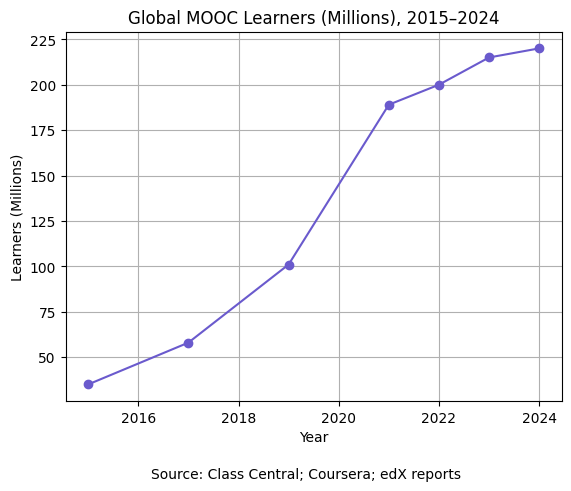
This expansion has dramatically increased the reach of education. During the COVID-19 pandemic, school closures affected 1.6 billion students across 190 countries, according to UNESCO. Institutions that had previously treated digital learning as supplementary were suddenly required to rely on remote instruction at scale. By 2022, more than 90 percent of universities worldwide reported incorporating online platforms, recorded lectures, or digital assignments into their teaching systems.
Yet access alone does not capture the significance of the transformation underway. The deeper change lies in how individuals interact with knowledge itself. When information can be retrieved instantly through search engines, digital libraries, and AI-assisted tools, memorization becomes less central to learning. Education increasingly involves navigating large information environments, evaluating sources, and synthesizing knowledge drawn from multiple digital channels.
This shift alters the economics of learning. In an environment defined by information abundance, attention becomes the primary scarce input in learning. Education can therefore be understood through a learning production function in which information serves as raw material while attention and memory determine whether that material becomes usable knowledge.
In this framework, attention functions as a form of capital. Just as human capital refers to accumulated knowledge and skills, attention capital represents the cognitive capacity required to focus long enough for learning to occur. Digital technologies dramatically expand the supply of information, but they also intensify competition for attention.
The internet therefore transforms not only how knowledge is distributed but also the economic structure of learning itself.
Attention, Memory, and the Cognitive Structure of Digital Learning
The expansion of digital technologies has reshaped the cognitive environment in which learning occurs. Traditional classrooms concentrated attention around a limited set of instructional inputs such as lectures, textbooks, and assignments. Digital environments distribute attention across multiple streams simultaneously. Instruction now exists alongside messaging systems, video platforms, search engines, and social media feeds.
Evidence from the OECD illustrates how pervasive this competition has become. Across OECD countries, 59 percent of students report being distracted by other students’ use of digital devices during lessons, while roughly 30 percent say this occurs in most or every class.
Cognitive science helps explain why this matters. Deep learning requires maintaining information in working memory long enough for it to be encoded into long-term memory. Frequent shifts in attention interrupt this process. Studies of media multitasking show that individuals who frequently switch between digital tasks often demonstrate weaker attentional control and reduced working-memory capacity.
A widely cited Stanford study found that heavy media multitaskers performed significantly worse than their peers on tests measuring the ability to filter irrelevant information. Classroom experiments show similar effects. In university lecture environments, students using laptops for unrelated activities scored about 11 percent lower on comprehension tests, while nearby students experienced performance declines of up to 17 percent.
Student Digital Distraction in Classrooms (OECD PISA)
| Classroom Distraction Frequency | Share of Students Reporting | Observed Academic Impact |
|---|---|---|
| Occasional Distraction from Devices | 59% | Minor short-term attention disruption |
| Frequent Distraction | 30% | Lower comprehension during lessons |
| Every Lesson | 10–15% | Consistent negative association with test scores |
Source: OECD; PISA Student Digital Device Use Study
Digital technologies also influence how knowledge is stored. Psychologists refer to this behavior as cognitive offloading, in which individuals rely on external tools to store information rather than memorizing it internally. In the widely cited Google effect experiment, participants who expected to retrieve information online were significantly less likely to remember the information itself.
Reading behavior reflects similar dynamics. A meta-analysis examining 54 comparative studies of digital and print reading found that comprehension scores were consistently lower when learners read informational texts on screens, particularly when tasks involved longer analytical passages.
Yet digital tools can also strengthen learning when they encourage active engagement. A meta-analysis of 145 simulation-based learning studies reported a large positive effect size of 0.85, demonstrating that interactive digital environments can significantly improve conceptual understanding when integrated into structured instruction.
These findings reinforce a broader principle. Digital technologies expand the supply of information dramatically, but educational outcomes ultimately depend on how effectively attention and memory convert that information into knowledge.
Digital Learning and Student Outcomes
Within formal education systems, the internet has transformed how students approach learning tasks. Students now routinely consult search engines, video tutorials, collaborative forums, and AI-generated explanations while completing academic work. These tools expand access to knowledge but also reshape learning strategies.
International assessments reveal a complex relationship between technology use and academic performance. OECD analysis of PISA data shows that students who use digital devices moderately for learning — roughly one to five hours per day — often achieve higher academic performance than students who report no digital use. However, students who report more than seven hours of daily digital use tend to perform significantly worse.
Digital reading environments illustrate this challenge. Studies comparing print and screen reading show that comprehension scores for long informational texts can decline by six to eight percentage points when students read digitally rather than in print under typical classroom conditions. Researchers attribute this difference partly to scanning behavior and partly to the absence of spatial cues that help readers mentally organize complex material.
Screen Time Growth Among Teenagers
| Year | Average Daily Screen Time (Hours) | Primary Devices Used |
|---|---|---|
| 2015 | 6.1 hours | Smartphones, laptops |
| 2017 | 6.5 hours | Smartphones dominate |
| 2019 | 7.0 hours | Mobile streaming and social platforms |
| 2021 | 7.2 hours | Remote learning expansion |
| 2023 | 7.4 hours | Short-form video platforms |
| 2024 | 7.5 hours | Integrated mobile and AI tools |
Source: Common Sense Media; Ofcom Digital Media Use Study; DataReportal
Educators have begun adapting teaching strategies accordingly. Active learning approaches that combine shorter lectures with problem solving and collaborative discussion have demonstrated measurable improvements in academic outcomes. A meta-analysis of undergraduate STEM courses found that active learning increased exam scores by roughly six percent compared with traditional lecture-based instruction.
Artificial intelligence introduces a new dimension to student learning behavior. A 2025 survey conducted by the Higher Education Policy Institute found that 92 percent of university students reported using AI tools, compared with 66 percent the previous year, while 88 percent reported using AI to assist with coursework or assignments.
These tools can provide rapid explanations and personalized feedback, but they also introduce the risk of false mastery when students complete tasks successfully without developing deeper conceptual understanding.
Lifelong Learning in the Digital Workforce
The transformation of learning extends beyond schools and universities into the structure of modern labor markets. Rapid technological change has made continuous skill development a central feature of professional life.
According to the World Economic Forum, 39 percent of workers’ core job skills are expected to change by 2030, while approximately 59 percent of the global workforce will require retraining or upskilling within the decade. Labor market research also indicates substantial wage premiums associated with digital competencies. In many advanced economies, workers with advanced digital skills earn 10 to 20 percent higher wages than workers with comparable education but weaker digital capabilities.
Digital learning platforms have become a primary mechanism for delivering this training. Coursera reported 36.7 million course enrollments in 2024, including more than 1.8 million learners enrolled in artificial-intelligence-related courses translated into multiple languages.
Corporate training programs are shifting toward digital delivery as well. LinkedIn’s Workplace Learning Report shows that 68 percent of organizations identified as career-development leaders provide structured online training programs, and employees in these organizations report higher retention and career mobility.
Patterns of digital learning differ significantly across regions. Advanced economies such as Singapore, Estonia, and Finland have integrated digital platforms directly into national education strategies. In Singapore, participation in structured online job-related learning rose to 51.5 percent of workers in 2020.
Digital Skills Wage Premium in Advanced Economies
| Country | Estimated Wage Premium for Advanced Digital Skills | Key Sectors Driving Demand |
|---|---|---|
| United States | 18% | Technology, finance, AI development |
| United Kingdom | 16% | Digital services, fintech |
| Germany | 14% | Industrial automation, manufacturing |
| Singapore | 20% | Technology, logistics, digital finance |
| Australia | 15% | Information technology, services |
Source: OECD Skills Outlook; World Economic Forum; LinkedIn Workforce Data
Emerging economies are adopting digital learning systems at a different pace. In many regions of Africa and South Asia, mobile learning platforms and low-bandwidth educational tools extend access to education where traditional infrastructure remains limited. These systems illustrate how digital technologies can support educational participation even in resource-constrained environments.
Artificial intelligence tools are beginning to reshape professional learning as well. AI-powered assistants increasingly provide contextual explanations, coding assistance, and technical guidance. Coursera reported that approximately 1.7 million learners used its AI tutoring system during its first year.
These developments demonstrate how digital learning now spans the entire life cycle of education, linking classroom instruction with workforce skill development.
Designing Digital Learning Systems That Support Real Understanding
If digital technologies reshape attention and memory, education systems must adapt their design accordingly.
Research in cognitive psychology consistently demonstrates the effectiveness of retrieval practice, in which learners actively recall information rather than repeatedly reviewing it. Studies show that retrieval-based learning significantly improves long-term retention compared with passive review methods.
Digital platforms are well suited to implementing these strategies. Adaptive quizzes, spaced repetition systems, and automated feedback tools allow learners to revisit material while testing their ability to recall information from memory.
Attention management has become another central design challenge. OECD analysis shows that moderate educational use of digital devices can improve outcomes, but excessive exposure can reduce performance. Students who report five to seven hours of daily digital device use score roughly 12 PISA points lower in mathematics than students who report three to five hours of use.
National education systems increasingly treat digital learning as part of a broader cognitive infrastructure supporting knowledge economies. Estonia connected all schools to the internet by 2001 and now reports that 62.6 percent of its population possesses at least basic digital skills, compared with the European Union average of 55.6 percent.
Assessment methods are evolving as well. UNESCO reports that two-thirds of higher education institutions worldwide have introduced policies governing the use of artificial intelligence in academic work, reflecting the rapid integration of AI tools into learning systems.
These developments illustrate a central lesson of digital education. Expanding access to information is not sufficient. Education systems must also preserve the cognitive conditions required for learning.
Outlook: The Next Phase of Digital Learning
Digital learning systems will likely continue evolving rapidly as artificial intelligence becomes more deeply integrated into education.
Estonia’s AI Leap initiative plans to introduce AI learning tools to 20,000 secondary school students, supported by an initial investment of €3.2 million that is expected to rise to €6 million by 2026.
Workforce demand will continue driving this transformation. According to the World Economic Forum, nearly six out of ten workers globally will require additional training before 2030, while emerging technologies such as artificial intelligence and data analytics are expected to create millions of new technology-related roles.
For governments and institutions, the central challenge will be ensuring that expanded access to digital knowledge strengthens rather than weakens cognitive capability. In economies increasingly defined by information abundance, the institutions that succeed will be those that treat attention not merely as a behavioral constraint but as a strategic educational resource.
Education policy in the coming decade will therefore depend on how effectively systems cultivate attention capital — the cognitive capacity that allows learners to transform information into knowledge.
Key Takeaways
- Digital technologies have transformed education from a system defined by knowledge scarcity to one shaped by information abundance.
- Attention has emerged as the primary scarce resource in digital learning environments.
- Moderate use of digital tools can improve academic outcomes, while excessive use can reduce performance.
- Artificial intelligence is rapidly becoming a central component of both academic and professional learning systems.
- Effective digital education requires instructional designs that reinforce attention, retrieval practice, and analytical reasoning.
- The long-term success of digital learning will depend on how effectively education systems cultivate attention capital.
Sources
- OECD; Students, Computers and Learning Making the Connection; – Link
- OECD; PISA 2018 Results What Students Know and Can Do; – Link
- OECD; Digital Technologies and Education Evidence from PISA; – Link
- UNESCO; Education Disruption and Response to COVID-19; – Link
- World Bank; Remote Learning During COVID-19 Lessons from Today Principles for Tomorrow; – Link
- International Telecommunication Union; Measuring Digital Development Facts and Figures; – Link
- Class Central; MOOC Stats and Trends in Online Education; – Link
- Coursera; Coursera Investor Relations Platform Statistics; – Link
- Stanford University; Cognitive Control in Media Multitaskers; – Link
- Science; Cognitive Consequences of Having Information at Our Fingertips; – Link
- Delgado P.; Don’t Throw Away Your Printed Books A Meta-Analysis on Reading Media; – Link
- Higher Education Policy Institute; Student Use of Generative Artificial Intelligence Survey 2025; – Link
- World Economic Forum; The Future of Jobs Report 2025; – Link
- LinkedIn Learning; Workplace Learning Report 2024; – Link
- OECD; OECD Skills Outlook Skills for a Digital World; – Link
- HolonIQ; Global EdTech Investment Report; – Link
- Crunchbase; Global EdTech Venture Funding Data; – Link
- Common Sense Media; The Common Sense Census Media Use by Tweens and Teens; – Link
- Ofcom; Children and Parents Media Use and Attitudes Report; – Link
- DataReportal; Digital 2024 Global Overview Report; – Link