

At mid-year 2026, China’s internet economy is a mature national system shaped by high connectivity, state coordination, industrial policy, and platform scale. Its path differs from the United States and Europe because digital growth is tied less to individual firm strategy and more to national economic capacity. Commercial platforms remain central, but the broader logic connects internet infrastructure to manufacturing strength, public administration, and long-term prosperity.
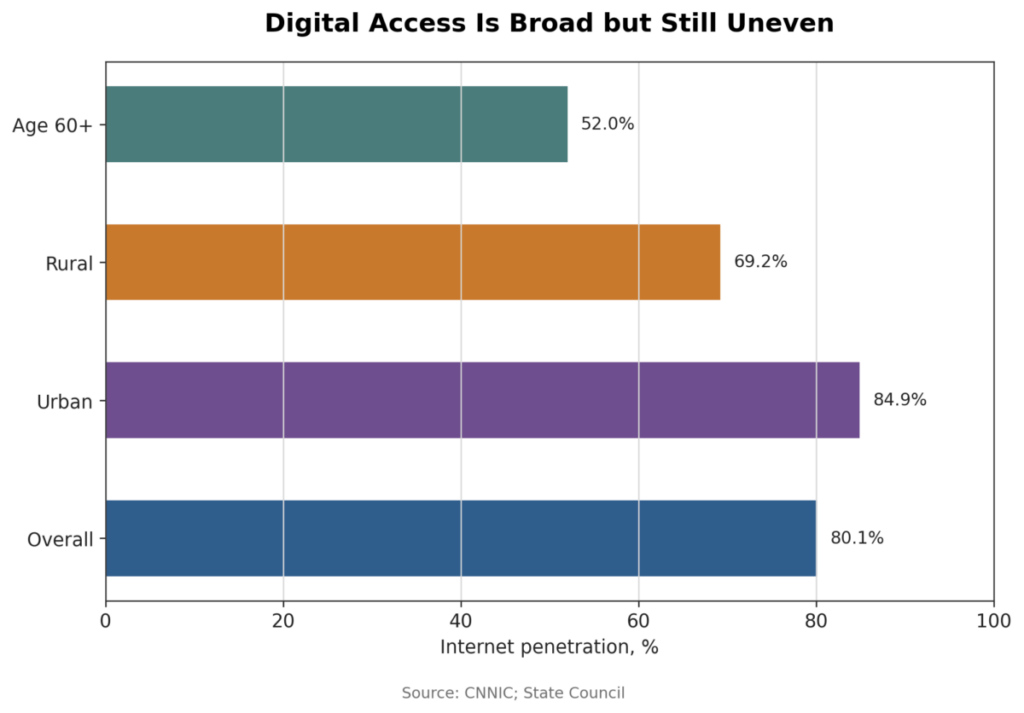
The scale is structural. China had 1.125 billion internet users by the end of 2025, with internet penetration at 80.1%. Generative AI adoption reached 42.8%, up 25.2 percentage points year over year. Online retail sales reached RMB 15.9722 trillion in 2025, up 8.6%, while online physical-goods sales reached RMB 13.0923 trillion and accounted for 26.1% of total retail consumer-goods sales. These figures show an internet economy that has moved beyond adoption into market infrastructure.
China’s digital economy feels simple at the point of use because deeper systems are doing the work underneath it. A mobile purchase can activate payment, fulfillment, analytics, and platform governance in one process. Similar coordination supports firms, hospitals, manufacturers, and public agencies as they move more activity through digital channels. The visible convenience reflects a larger operating chain in which infrastructure, finance, industry, and administration increasingly work together.
China requires standalone regional treatment because its internet economy is large enough and institutionally distinct enough to operate as its own development model. It stands as a model for smart-city integration and leads the world in industrial automation. Regulation reflects the same method: user access is controlled, corporations remain aligned with state priorities, and innovation advances under oversight rather than outside it. Efficiency boosts are always welcomed in the management of the world’s top population.
Bitcoin mining formally receded after the 2021 crackdown, but the broader shift continued toward regulated digital payments, cloud infrastructure, AI, and industrial systems. The central question is no longer whether China can adopt internet technologies at scale. It is whether those technologies continue to raise productivity and improve access.
A user base above 1.1 billion gives the digital economy unusual operating depth. It creates transaction density, rapid diffusion, and deep data flows, but it also raises the cost of failure.
Cyber incidents, governance errors, platform disruption, or uneven access carry greater consequence in a system this large.
| Name | 2025 | 2026 (est)* | % Growth | Source |
|---|---|---|---|---|
| Internet Users | 1.125B | 1.142B* | 1.5% | CNNIC; State Council |
| Internet Penetration | 80.1% | 81.3%* | +1.2 pp | CNNIC; State Council |
| Generative AI Penetration | 42.8% | 50.0%* | +7.2 pp | CNNIC; State Council |
Connectivity and Market Access
Access Is Broad, but Productive Use Depends on the Digital Stack
China enters the second half of 2026 from a position of maturity rather than early adoption. Connectivity is broad, digital payments are normalized, e-commerce is structurally embedded, and public agencies increasingly use digital systems for service delivery.
Connectivity remains the entry condition for China’s digital market, but access becomes economically meaningful only when networks support credibility. Credibility within the entire eco-system will be paramount to continued integration. A rural merchant with a smartphone can reach urban consumers when the underlying system works as one market process. The household sees a mobile interface; the economy depends on the infrastructure behind it.
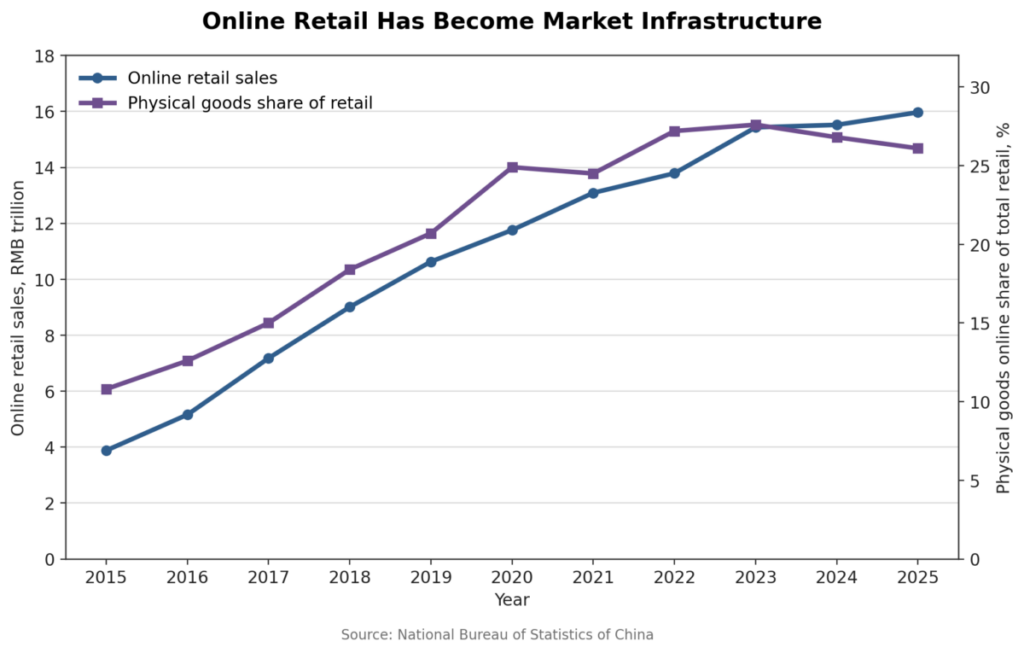
Online retail sales of RMB 15.9722 trillion in 2025 show that digital market access has become part of China’s consumer economy. Online physical-goods sales of RMB 13.0923 trillion and a 26.1% share of total retail consumer-goods sales show that online channels are embedded in ordinary consumption, merchant strategy, and logistics capacity.
A user base above 1.1 billion gives the digital economy unusual operating depth. It creates transaction density, rapid diffusion, and deep data flows, but it also raises the cost of failure. China’s digital infrastructure widens participation, but it also concentrates power around major gateways that control access, visibility, and the economic data generated by participation.
| Name | 2025 | 2026 (est)* | % Growth | Source |
|---|---|---|---|---|
| Urban Internet Penetration | 84.9%* | 86.0%* | +1.1 pp | CNNIC; State Council |
| Rural Internet Penetration | 69.2%* | 71.0%* | +1.8 pp |
Platforms, Commerce, and Finance
Digital Commerce Has Become Market Infrastructure
Connectivity remains the entry condition for China’s digital market. Access has economic value only when networks become part of a functioning commercial system. A rural merchant with a smartphone can reach urban consumers when the platform environment turns a mobile interaction into a trusted transaction. The user sees a simple interface; the economy depends on the infrastructure beneath it. Superapps should align well with the system if users believe in the authenticity of the settlement. Platforms do more than connect buyers and sellers. They shape who is seenThe interface itself has become a source of market power.
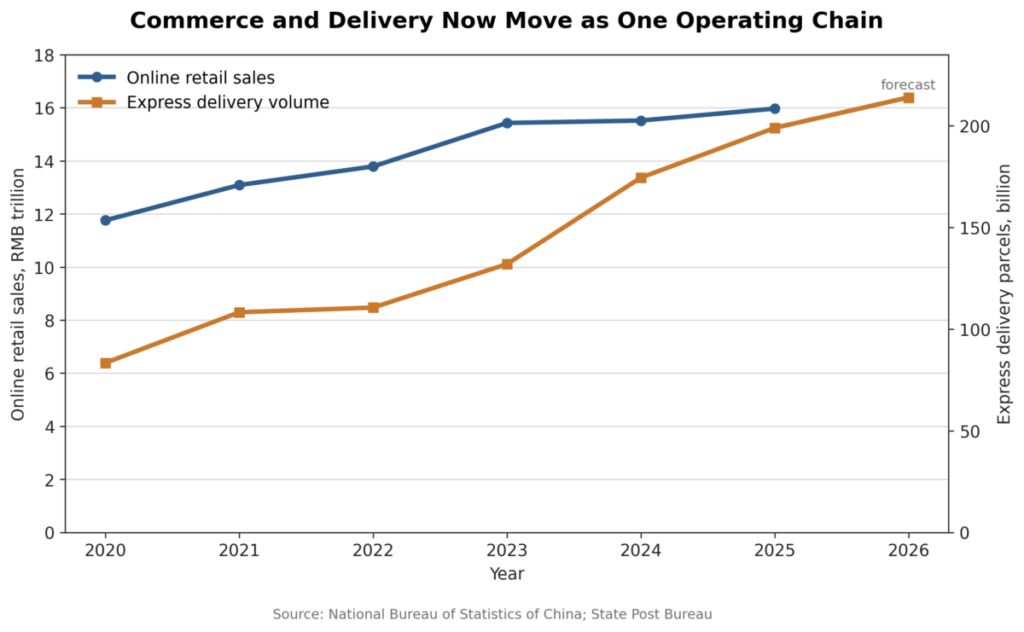
Online retail sales of RMB 15.9722 trillion in 2025 show that digital market access is now built into China’s consumer economy. Online physical-goods sales of RMB 13.0923 trillion and a 26.1% share of total retail consumer-goods sales show that online systems now sit inside ordinary retail behavior rather than outside it.
The market-access finding is two-sided. China’s digital infrastructure widens participation for smaller firms, but it also concentrates power around major gateways that determine visibility, terms, and the value of data. China’s platform economy remains productive and deeply embedded, but its public value depends on governance that preserves competition, merchant resilience, consumer trust, and innovation.
| Name | 2025 | 2026 (est)* | % Growth | Source |
|---|---|---|---|---|
| Online Retail Sales | RMB 15.9722T | RMB 17.0264T* | 6.6% | National Bureau of Statistics of China |
| Online Physical-Goods Sales | RMB 13.0923T | RMB 14.0742T* | 7.5% | National Bureau of Statistics of China |
| Online Physical-Goods Retail Share | 26.1% | 25.5%* | -0.6 pp | National Bureau of Statistics of China |
| Express Delivery Volume | 199B Parcels | 214B Parcels* | 7.5% | State Post Bureau |
AI, Cloud, and Productivity
AI Demand Is Turning Cloud Into Operating Infrastructure
At mid-year 2026, China’s most important internet technologies function less as separate tools than as operating infrastructure. AI brings automated judgment into daily decisions, while cloud computing provides the secure environment that makes those models usable at scale.
Ai influence one the finance and personal finance system are profound as the analytical possibilities of AI are seemingly endless. Integration into office, development, and government is a natural step forward.
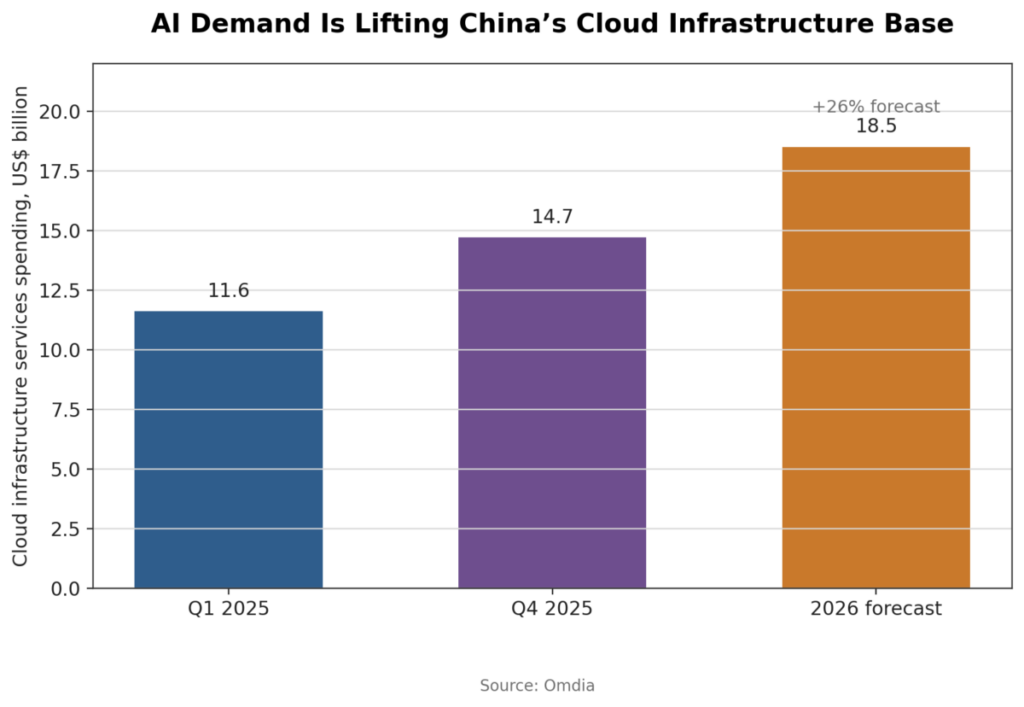
Mainland China’s cloud infrastructure services spending reached US$14.7 billion in Q4 2025, up 26% year over year, with 2026 spending also forecast to grow 26%. AI demand has pushed cloud from back-office computing into the operating base of firms and public agencies. Generative AI users reached 602 million in 2025 and are estimated at 700 million in 2026, while cloud infrastructure spending is estimated to rise from US$52.3 billion in 2025 to US$65.9 billion in 2026. The broader shift is clear: models, data, and institutions now depend on computing environments that are secure, scalable, and close enough to operational decisions to change performance.
| Name | 2025 | 2026 (est)* | % Growth | Source |
|---|---|---|---|---|
| Generative AI Users | 602M | 700M* | 16.3% | CNNIC; State Council |
| Cloud Infrastructure Spending | US$52.3B* | US$65.9B* | 26.0% | Omdia |
Industrial Internet and Automation
Robotics Has Become China’s Manufacturing Execution Layer
China’s industrial internet position is central to its 2026 digital economy because the country’s model is tied to manufacturing as much as consumer applications. Industrial digital systems support production upgrading by making factories, suppliers, logistics networks, and export channels operate with greater coordination. This is where China’s internet economy becomes an industrial strategy rather than only a services story.
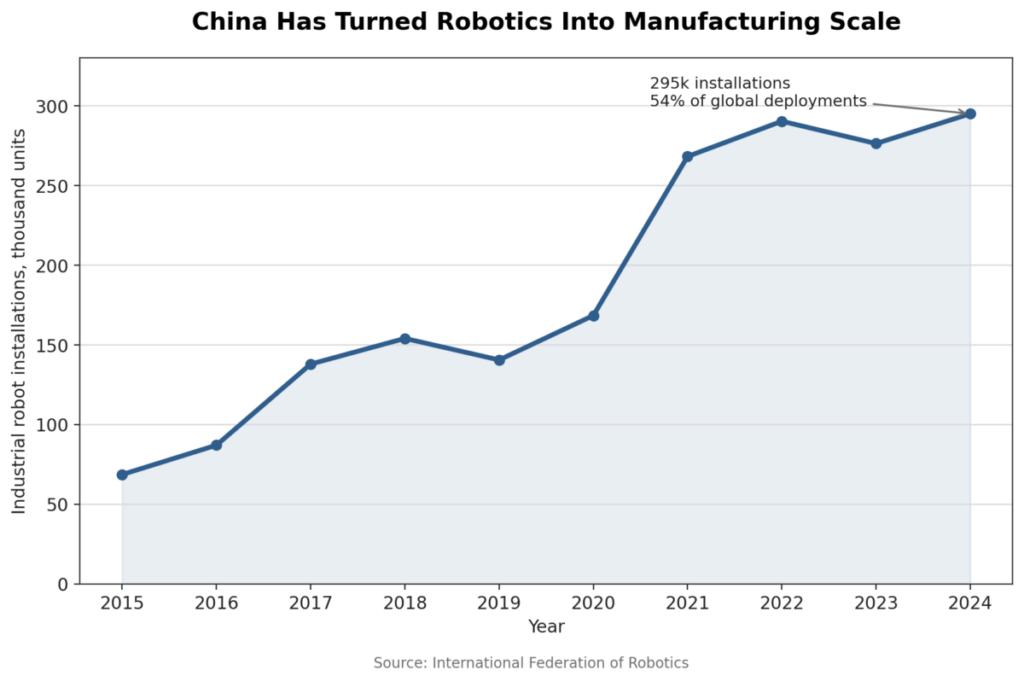
Robotics deployment is the clearest indicator of this shift. China installed 295,000 industrial robots in 2024, representing 54% of global deployments. Robotics has moved from factory upgrade to national productivity strategy, strengthening China’s ability to standardize quality, manage labor constraints, improve throughput, and support advanced manufacturing. Digital systems become valuable when they change production routines rather than simply add software to existing processes.
The constraint is no longer technology availability alone. It is organizational absorption. Automation can raise productivity, but it also intensifies pressure on routine labor and firms that cannot adapt quickly.
| Name | 2025 | 2026 (est)* | % Growth | Source |
|---|---|---|---|---|
| Industrial Robot Installations | 313K* | 344K* | 10.0% | International Federation of Robotics |
| China Share of Robot Deployments | 54.0%* | 55.0%* | +1.0 pp | International Federation of Robotics |
Digital Health and Public Services
Digital Services Are Expanding Access, but Inclusion Remains Uneven
China’s digital transformation reaches households when everyday systems become practical channels for economic participation. The influence of fintech solutions on the personal finance sphere is immense. Digital finance supports inclusion when people can transact safely and build reliable economic records without depending on distant branches. This inclusion brings trust through financial settlement and transaction times; the speed of money becomes a factor, and all money systems are sped up as a result. E-health expands service capacity when clinics can manage demand, share information, and follow up through trusted digital channels.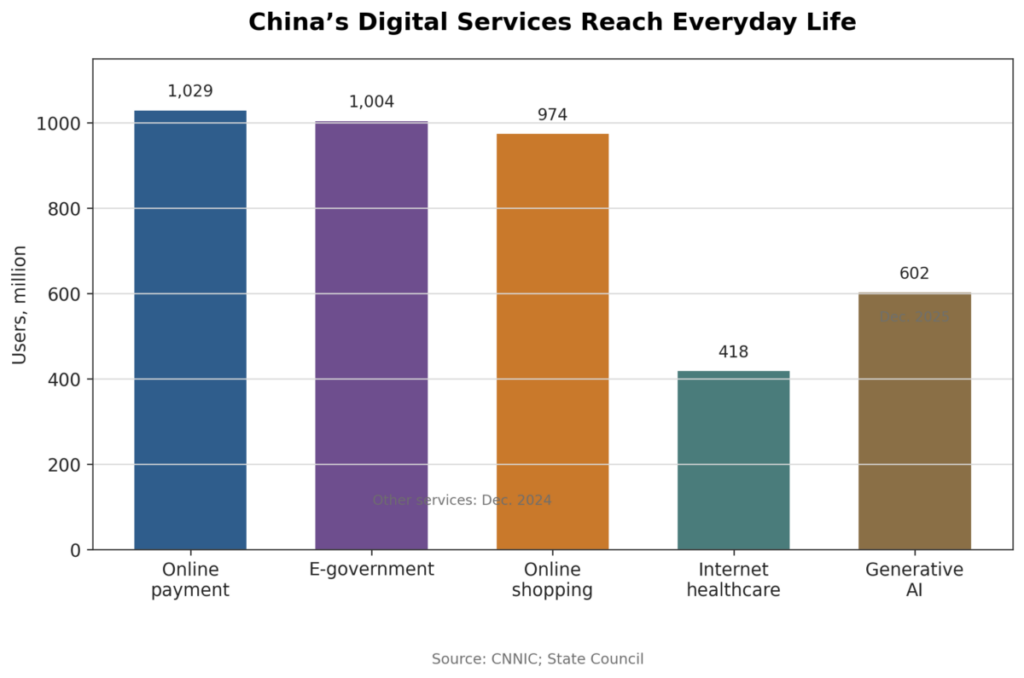
The inclusion picture is advanced but uneven. National connectivity is high, but the strongest gains flow to people and firms already equipped to use digital systems productively. Rural users, older residents, smaller businesses, and informal workers still face barriers in affordability, trust, skills, and practical use.
Science, technology, and innovation capacity determine whether China merely deploys digital tools or converts them into durable national capability. China’s next development challenge is distributional: making digital gains reach beyond frontier firms and urban consumers.
| Name | 2025 | 2026 (est)* | % Growth | Source |
|---|---|---|---|---|
| Internet Healthcare Users | 430M* | 455M* | 5.8% | CNNIC |
| Age 60+ Internet Penetration | 52.0%* | 55.0%* | +3.0 pp | CNNIC; State Council |
Governance and Regulation
State-Aligned Oversight Sets the Digital Market Boundary
Governance is a defining feature of China’s internet economy at mid-year 2026. Regulation sets the operating terms for digital systems, making compliance part of technical capability rather than a separate legal layer. Platforms, financial institutions, health systems, and AI providers now depend on governance as much as infrastructure.
China’s amended Cybersecurity Law took effect on January 1, 2026, marking the first major change since the original 2017 law. It strengthened the compliance framework for network operators, critical infrastructure, penalties, and security responsibilities. Regulation has not stopped innovation, but it channels digital growth through permission, supervision, and state priorities.
Risk and Distribution
China Is More Capable and More Exposed
China’s internet economy carries risks that reflect its scale. The same structure that supports coordination also increases exposure to cyber disruption, and the impact of heavy handed regulation. A platform rule change can affect thousands of merchants. A cybersecurity failure can disrupt essential services. A power constraint can reach data centers, cloud services, and manufacturing operations.
Distributional pressure remains central. Digital systems improve outcomes first for firms and governments with capital, skills, data, and organizational capacity. Smaller firms, lower-income households, rural communities, and informal workers face higher adoption costs and weaker bargaining power.
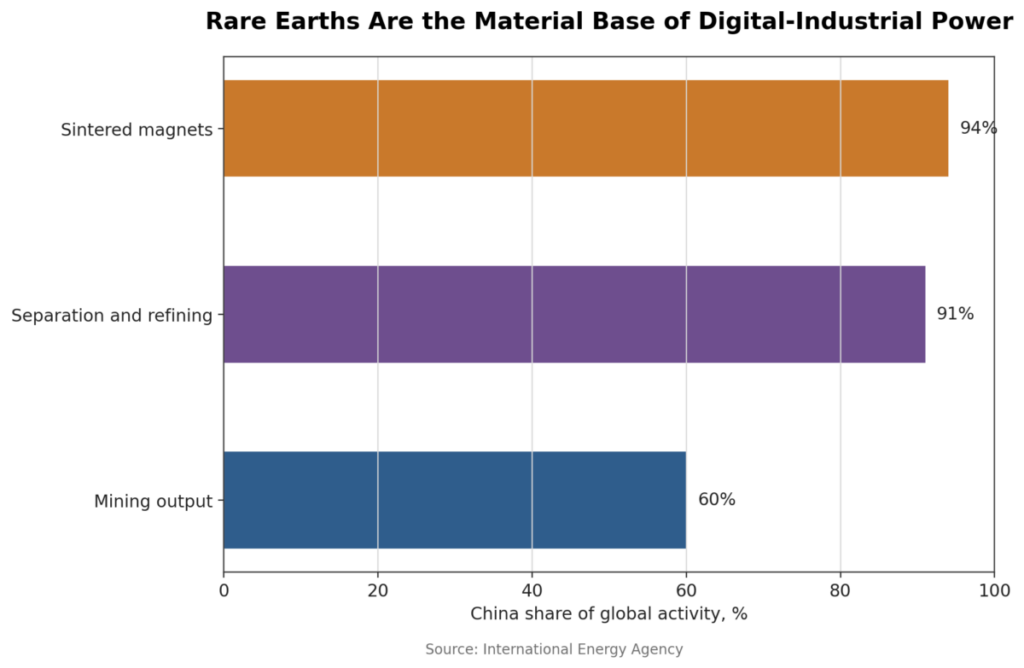
Rare earths sharpen the strategic supply-chain dimension. China accounted for about 60% of global rare-earth mining output in 2024 and about 91% of global separation and refining production for key magnet rare earths. This gives its manufacturing and export base leverage in the advanced supply chains. Their influence on clean energy, automation, defense, and electronics cannot be overstated.
| Name | 2025 | 2026 (est)* | % Growth | Source |
|---|---|---|---|---|
| Rare-Earth Mining Share | 60.0%* | 60.0%* | 0.0% | International Energy Agency |
| Rare-Earth Separation and Refining Share | 91.0% | 90.0%* | -1.0 pp | International Energy Agency |
| Rare-Earth Magnet Share | 94.0%* | 93.0%* | -1.0 pp | International Energy Agency |
Outlook
Late 2026 Will Test Absorption, Resilience, and Trust
The second half of 2026 will test whether China can turn years of digital investment into measurable productivity gains across firms, public services, iand manufacturing. Simply adding digital capacity alone will not define the next phase. The key issue is absorption: whether firms and institutions can redesign workflows, protect trust, improve resilience, and avoid dependence on constricted. gateways.
China enters this phase from a position of considerable strength. AI adoption has reached 42.8%. Cloud infrastructure spending is growing at a 26% pace. Online retail remains a RMB 15.9722 trillion market. Robotics installations account for more than half of global deployments. These figures show scale across the main layers of the internet economy, even if productivity gains may not be evenly distributed.
The outlook remains very positive. China is positioned at the forefront of the next generation of internet development, smart-city deployment, and high-tech manufacturing. It already leads in industrial robotics and continues to advance in humanoid systems and fully automated robotic helpers.
Fundamentally, deeper internet integration aligns with national policy priorities and the demands of the world’s largest population. China’s internet economy has moved beyond social adoption and is now embedded in daily life. Mobile phone use and basic internet access are highly saturated, making China one of the world’s most digitally integrated societies.
Its next test is performance. Prudence will be needed to manage all facets of the growing internet influence. Whether digital infrastructure, platforms, and industrial automation, combine to produce durable productivity gains and measurable public value. If China can turn scale into absorption, and absorption into efficiency, it will remain one of the defining forces in the next leap of the global internet economy.
Sources
- CNNIC; 57th Statistical Report on China’s Internet Development / China’s Internet User Base Hits 1.125 Billion as AI Adoption Accelerates; – Link
- CNNIC; 55th Statistical Report on China’s Internet Development; – Link
Connectivity and Market Access
- National Bureau of Statistics of China; Total Retail Sales of Consumer Goods in December 2025; – Link
- State Council of China; China’s Postal Delivery Volume Hits 216.5 Billion Items in 2025; – Link
Economic Influence / Cloud, AI, and Robotics
- Omdia; Mainland China Cloud Infrastructure Spending Rises 26 Percent in Q4 2025 Driven by AI and Agent Growth; – Link
- International Federation of Robotics; World Robotics 2025 Report — Industrial Robots; – Link
- International Federation of Robotics; Best of World Robotics 2025; – Link
Sectors, Business Models, and Market Structure
- Institute of Internet Economics; E-Commerce — 2026 Stats and Summary Report (Mid-Year); – Link
- Institute of Internet Economics; Internet Ecology and the Economics of Digital Infrastructure — 2026 Mid-Year Report; – Link
Regulation and Economic Coordination
- Greenberg Traurig; China’s Amended Cybersecurity Law Takes Effect; – Link
Risks, Distributional Effects, and Strategic Supply Chains
- International Energy Agency; Rare Earth Elements — Executive Summary; – Link
- International Energy Agency; With New Export Controls on Critical Minerals, Supply Concentration Risks Become Reality; – Link
Keywords: Internet Economy, Digital Infrastructure, Artificial Intelligence, Cloud Computing, E-Commerce, Industrial Automation, Digital Governance, China