
For most of the digital age, the cloud has encouraged a useful illusion. A prompt is sent, an answer returns, a model runs, and the machinery disappears behind the interface. Artificial intelligence is making that abstraction harder to sustain because modern computing depends on vast physical infrastructure. Global data center electricity consumption is projected to reach roughly 945 terawatt hours by 2030, more than double its recent level.
That pressure is moving an idea once confined largely to technical speculation into actual hardware. Google is preparing an orbital test of Tensor Processing Units under Project Suncatcher, while India’s TakeMe2Space is developing orbital edge computing for customers that want data processed before it returns to Earth. China has also launched the first satellites of a planned space-computing constellation. The underlying idea is simple: process useful data in orbit before deciding what needs to return to Earth.
These projects differ sharply in scale and ambition, and none shows that hyperscale computing is about to migrate into orbit. The more consequential development is that computation is gaining another potential physical production environment. Location affects what data can be processed economically, how much infrastructure must support a processor, who controls access, and which workloads become commercially viable. The near-term market begins with data that already exists in space. The harder question is whether those systems can eventually add meaningfully to the broader supply of compute.
| Measure | 2024 | 2030 Outlook |
|---|---|---|
| Data-center electricity use | 415 TWh | ~945 TWh |
| Share of global electricity | ~1.5% | Just under 3% |
| Annual demand growth | ~12% recent rate | ~15% through 2030 |
| Accelerated-server electricity growth | AI-led expansion | ~30% annually |
| U.S. + China share of demand growth | — | Nearly 80% |
Sources: International Energy Agency
The First Market Is Where the Data Already Lives
The most practical case for orbital computing begins with a familiar constraint: moving data costs money. Earth-observation satellites and scientific instruments can generate more raw information than is practical to transmit continuously. Conventional systems collect the data, send it to Earth, and process it afterward. An onboard computer changes that sequence by analyzing information where it originates and transmitting only what matters.
A satellite imaging thousands of square kilometers may produce only a handful of useful observations. An orbital AI system can identify a plume, vessel, storm system, or other feature before scarce bandwidth carries the result home. TakeMe2Space’s model follows this logic: customers can upload applications that execute as the spacecraft passes over selected regions, reducing the need to downlink entire raw datasets.
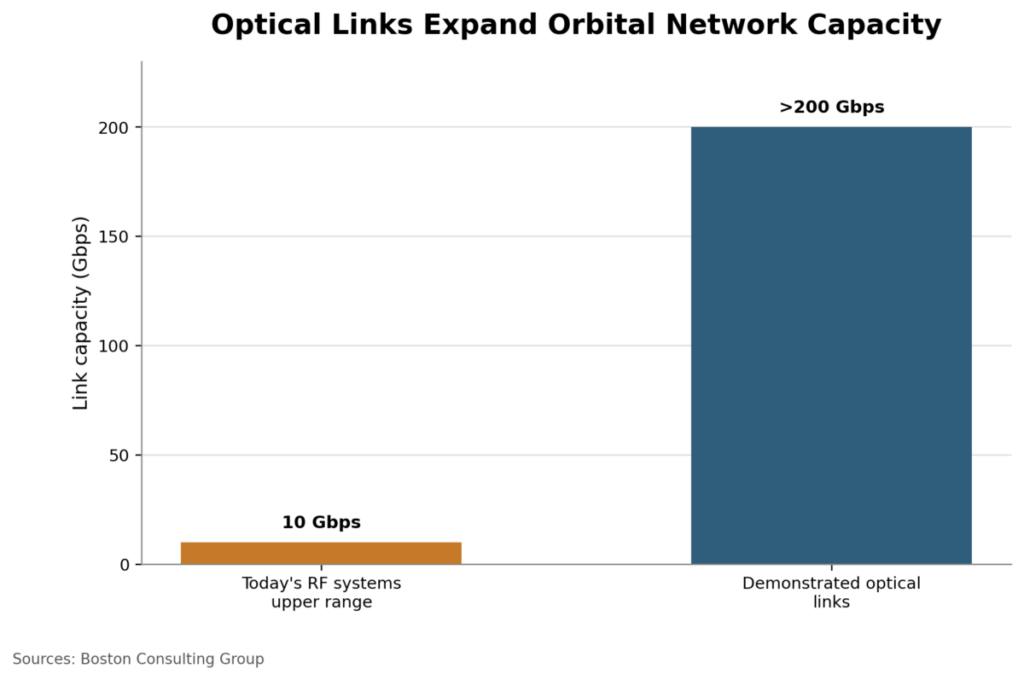
This separates orbital edge computing from the far harder proposition of placing large AI clusters in space. Inference on locally generated data may require a modest processor and manageable communications. Frontier training depends on dense, high-bandwidth links among accelerators, with intermediate results moving continuously between processors. Splitting that cluster across spacecraft makes networking part of the computing architecture itself.
Research on distributed machine learning in satellite networks already treats bandwidth and connectivity as coupled constraints, while Project Suncatcher is exploring a more ambitious version of the same problem through optical links. If enough satellites can cooperate closely, a constellation begins to resemble one computer whose components happen to be orbiting Earth.
| Data Constraint | Measured Evidence | Onboard Effect |
|---|---|---|
| Cloud-covered optical imagery | 50% or more | Discard unusable images before downlink |
| Hyperspectral products | 10×–100× smaller | Transmit processed products instead of full image cubes |
| Polarimetric data processing | Up to 100× data-rate reduction | Reduce transmission load before ground contact |
Sources: European Space Agency, NASA
Orbit Changes the Production Function of Compute
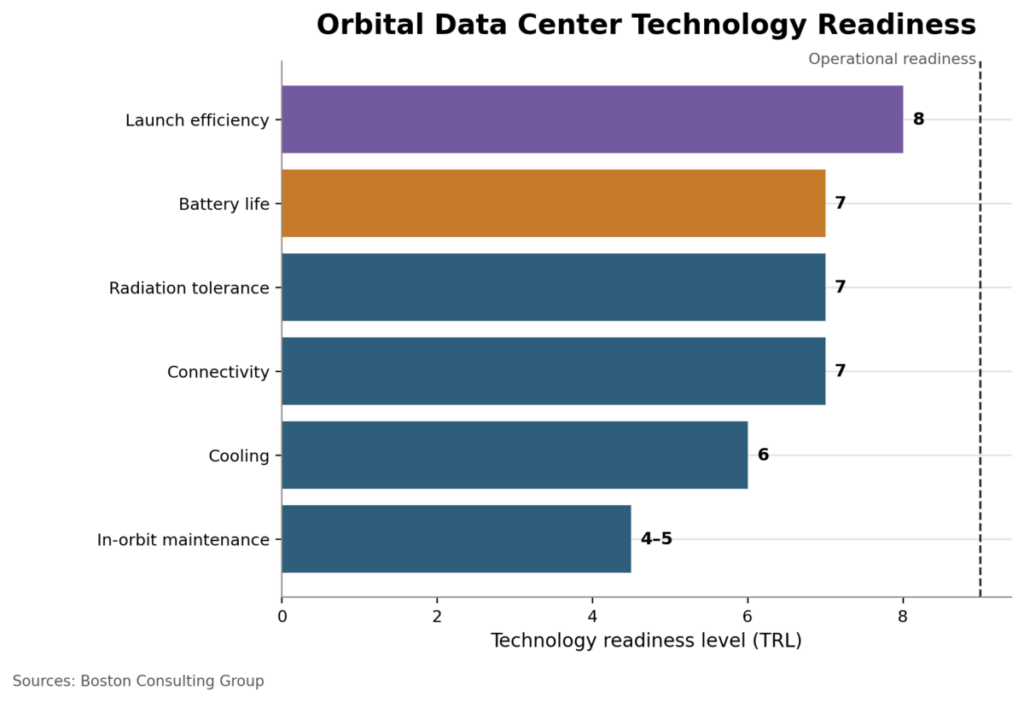
Terrestrial data centers depend on power, cooling, networking, and physical facilities. Orbit changes that production system rather than eliminating it, replacing part of the terrestrial support structure with spacecraft, thermal radiators, optical communications, and launch capacity.
Orbital computing is infrastructure substitution, not infrastructure escape.
Thermal management shows why the distinction matters. Space is cold, but vacuum prevents electronics from shedding heat through ordinary convection, so high-performance processors still need substantial radiating surfaces. The U.S. Government Accountability Office identifies thermal rejection as a major engineering challenge for large space-based data centers. Putting a hot processor into an extremely cold environment does not automatically make it easy to cool.
Replacement economics create another mismatch. Terrestrial accelerators can be upgraded as processor generations improve, while low-Earth-orbit spacecraft are designed for service lives measured in years. AI hardware can become economically outdated much faster. An orbital computer may therefore remain mechanically healthy after its processor has lost much of its commercial value, making launch cadence and hardware refresh part of the same economic problem.
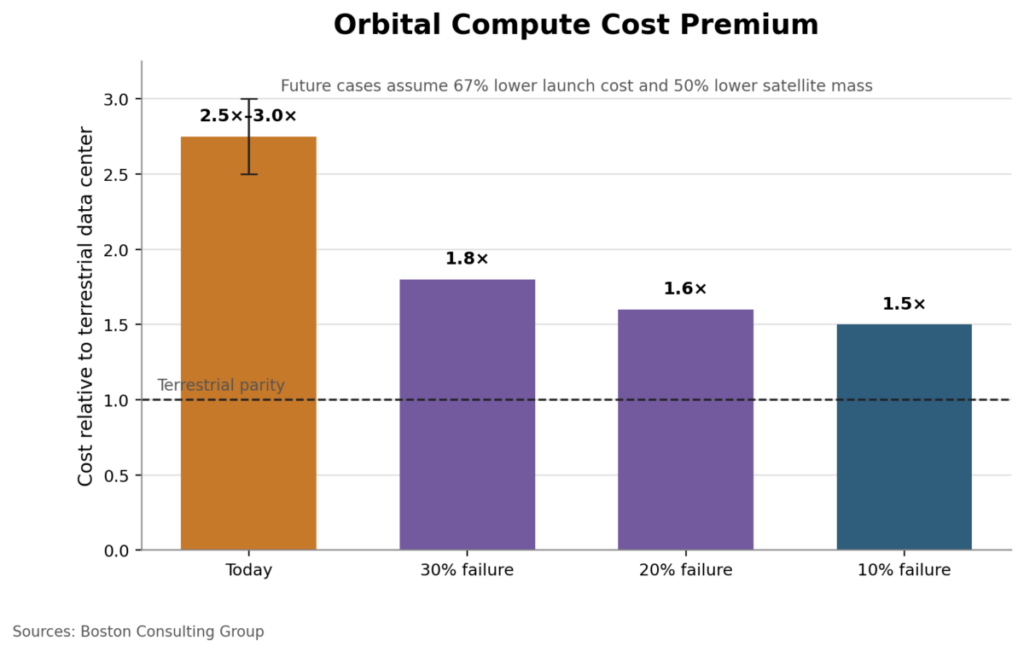
Current cost models underline the difficulty. BCG estimates that space-based data centers could remain roughly 2.5 to 3 times as costly as comparable terrestrial infrastructure under present assumptions, with the premium narrowing as launch costs fall and reliability improves. Even favorable scenarios generally retain some premium, making the value created by location more important than simple cost parity.
| Economic Measure | Orbital Evidence | Terrestrial / Reference |
|---|---|---|
| 20-year TCO per MW | $660M–$750M | $230M–$300M |
| Current modeled cost premium | 2.5×–3× | 1× baseline |
| Premium with 30% failure rate | ~1.8× | Improved launch and mass assumptions |
| Premium with 10% failure rate | ~1.5× | Same improvement assumptions |
| Typical LEO satellite design life | ~5 years | Frequent replacement relative to higher orbits |
Sources: Boston Consulting Group, Congressional Budget Office
The Business Case Is Value by Location
Businesses already pay more for computing when location reduces latency or bandwidth requirements. Orbital systems can follow the same logic when information originates in space. A processor can be valuable because it sits beside the data, not because orbit makes it intrinsically faster.
The business case therefore depends on workloads for which local processing changes the economics. Space-generated data and autonomy-sensitive systems may justify a premium when communications are expensive or constrained. Terrestrial infrastructure will also improve, so orbital systems must compete against the data centers that exist when they reach commercial scale.
That competition makes the market selective rather than irrelevant. Orbit does not need to become the cheapest place to perform every calculation. It needs workloads for which location materially changes the value of the calculation.
| Measure | Modeled Outlook |
|---|---|
| Current orbital cost premium | 2.5×–3× terrestrial cost |
| Realistic longer-term premium | ~1.5× |
| Technical feasibility at scale | 5–10 year modeled horizon |
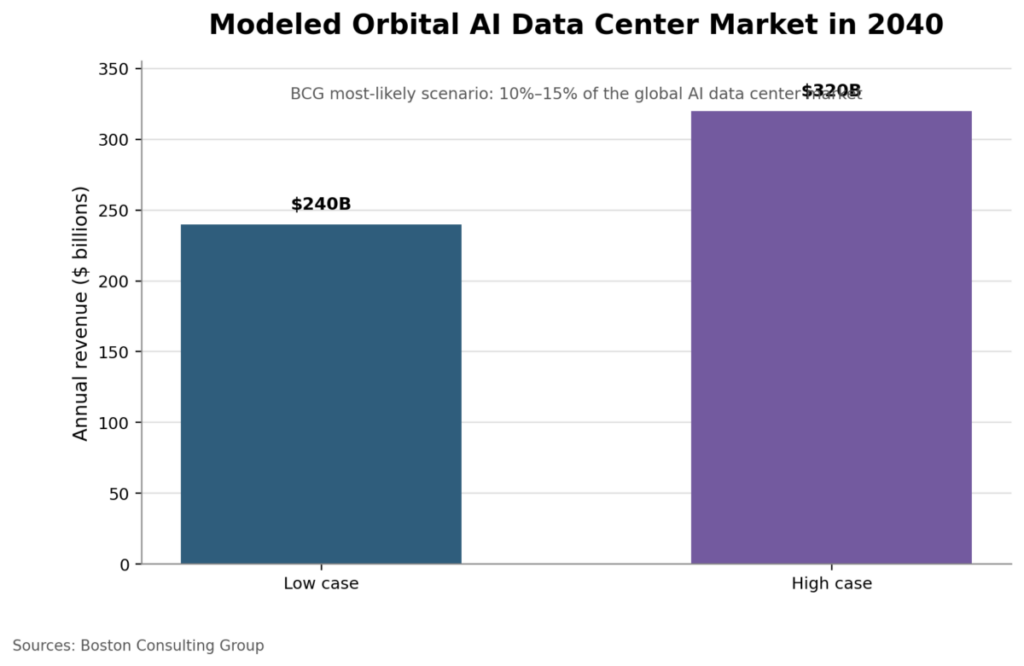
| Orbit-advantaged share of AI data-center market | 10%–15% by 2040 |
Sources: Boston Consulting Group
New Compute Creates New Bottlenecks
If orbital computing grows beyond isolated experiments, its economics will increasingly depend on who controls the infrastructure needed to operate it. Terrestrial compute already relies on concentrated suppliers and networks. Orbit adds another chain of dependencies around launch, spacecraft production, communications, and access to suitable orbital resources, creating new places where scarcity can become bargaining power.
A company that purchases those capabilities from separate suppliers faces a different cost structure from one able to coordinate several internally. Falling launch prices could therefore influence competition in computing as well as aerospace, while control of key interfaces could become commercially important when substitutes remain limited.
International activity already shows why infrastructure control matters without establishing a national ranking. China’s initial Three-Body deployment consists of 12 interconnected computing satellites, while much larger capacity remains an announced objective. In the United States, firms are pursuing different orbital-computing models, and the FCC has accepted SpaceX’s orbital data-center application for filing without granting authorization. European institutions are also examining space-based data centers as a strategic infrastructure domain.
Scale also transfers some costs onto shared orbital resources. Large constellations consume spectrum and maneuvering room while increasing tracking requirements and collision exposure. GAO warns that substantial growth in orbital data-center satellites could complicate traffic management and increase collision risk. An operator can capture the return from additional capacity while other users bear part of the congestion and risk, making governance part of the economics rather than a separate policy issue.
| Orbital Measure | Current Scale |
|---|---|
| Functioning satellites | ~15,900 |
| Regularly tracked space objects | ~47,080 |
| Objects larger than 10 cm | ~68,450 |
| Debris between 1 cm and 10 cm | ~1.5 million objects |
| SpaceX orbital data-center application | Up to 1 million proposed satellites |
Sources: European Space Agency, Federal Communications Commission
What Becomes Worth Computing
The longer-term significance appears only if orbital systems eventually add meaningful capacity to the broader computing economy. The first effects are likely to remain space-native as satellites move from collecting data to interpreting it, sharing workloads, and deciding which observations deserve priority before contacting Earth.
The progression is easy to visualize. A satellite begins as a sensor, then becomes a sensor with enough compute to understand part of what it sees. Connect many such spacecraft and they can divide work and coordinate decisions. At sufficient scale, the boundary between a constellation and a distributed computer begins to blur.
If those constraints can be managed economically, more geographically distributed compute expands the computational budget available for problems that demand repeated simulation or extensive search. Terrestrial high-performance computing already demonstrates the value of that expansion by allowing researchers to model phenomena that cannot be observed at full scale and explore much larger solution spaces.
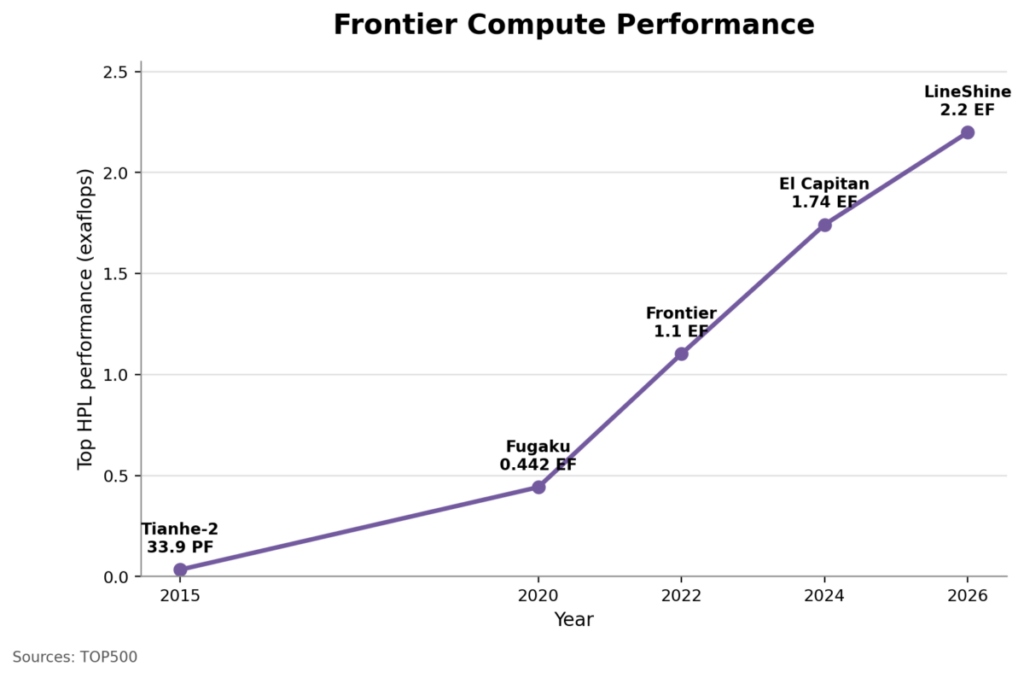
The relevance to orbital computing remains conditional. Additional capacity in space will matter only when it complements terrestrial systems at a useful cost and location. Compute cannot substitute for good theory, reliable experiments, useful data, or sound engineering, but it can increase the number of possibilities society can afford to examine.
Space-based computing may never become the preferred environment for most workloads. Thermal rejection could remain too difficult, replacement costs too high, tightly coupled accelerator networks too demanding, or terrestrial systems could improve faster. Those possibilities narrow the market without making the experiment economically trivial.
Artificial intelligence and other computationally intensive systems have created enough demand that companies, governments, and research institutions are testing whether the geography of computing itself should expand. Today, computers are equipment carried by spacecraft. A more consequential transition begins when spacecraft and orbital networks are built partly because economies need computation where those systems operate, or because they need additional environments in which to produce it.
It becomes another part of the computer.
| Computational Measure | Scale | Demonstrated Use |
|---|---|---|
| Exascale threshold | 1018 calculations per second | Very large scientific simulations |
| Frontier performance | 1.35 exaflops | Open scientific computing |
| Largest earthquake simulations | Up to 500 billion grid points | Meter-scale geological and structural modeling |
| Frontier vs. Summit debut performance | More than 7× higher | Larger and higher-resolution problems |
Sources: U.S. Department of Energy, Oak Ridge National Laboratory
TL;DR Summary
- Orbital computing is moving from speculation toward hardware tests and early deployments.
- Near-term economics favor processing information that already originates in space.
- Local processing can reduce downlink requirements by deciding what information matters before transmission.
- Large AI training systems are harder to distribute because high-bandwidth networking becomes part of the computing system.
- Orbital computing substitutes one infrastructure system for another rather than eliminating physical constraints.
- Hardware lifetime and accelerator obsolescence create a distinctive replacement problem.
- Current cost models retain a substantial orbital premium, making value by location more important than cost parity.
- Launch and communications could become important sources of bargaining power as the industry scales.
- Large computing constellations would create congestion and collision externalities.
- Satellites can progress from sensors to processors and eventually to cooperating computational systems.
- Greater usable compute can expand simulation and scientific search without guaranteeing discovery.
- The larger possibility is not replacing Earth’s cloud, but expanding where computation can occur and what becomes worth computing.
Sources
- International Energy Agency; Energy demand from AI; – Link
- Reuters; Google plans first test of AI chips in space under Project Suncatcher; – Link
- State Council Information Office of China / Xinhua; China launches space computing satellite constellation; – Link
The First Market Is Where the Data Already Lives
- NASA Jet Propulsion Laboratory; How NASA Is Testing AI to Make Earth-Observing Satellites Smarter; – Link
- European Space Agency; AI for image compression; – Link
- Open Access Series in Informatics; OrbitalBrain A Distributed Framework for Training ML Models in Space; – Link
- Reuters; India’s TakeMe2Space to launch orbital computing satellite on SpaceX rocket; – Link
Orbit Changes the Production Function of Compute
- U.S. Government Accountability Office; Science & Tech Spotlight Data Centers in Space; – Link
- Google Research; Exploring a space-based scalable AI infrastructure system design; – Link
- Nature Electronics; The development of carbon-neutral data centres in space; – Link
- Congressional Budget Office; Large Constellations of Low-Altitude Satellites A Primer; – Link
The Business Case Is Value by Location
- Boston Consulting Group; Space-Based Data Centers More Than Hype but Not a Revolution; – Link
- ABI Research; Orbital Data Centers Economics Outlook; – Link
- Axiom Space; Orbital Data Centers; – Link
- Thales Alenia Space; ASCEND feasibility study on space data centers; – Link
New Compute Creates New Bottlenecks
- European Space Agency; ESA Space Environment Report 2026; – Link
- Federal Communications Commission; Space Bureau Accepts for Filing SpaceX’s Application for Orbital Data Centers; – Link
- U.S. Government Accountability Office; Large Constellations of Satellites Mitigating Environmental and Other Effects; – Link
- European Space Agency; Strategy Forum on Space-Based Data Centres; – Link
What Becomes Worth Computing
- U.S. Department of Energy Office of Science; Accelerating Scientific Discovery through Advanced Computing; – Link
- TOP500; June 2026 TOP500 List; – Link
- Nature; Accelerating scientific discovery with Co-Scientist; – Link
Keywords: Internet Economics, Orbital Computing, Cloud Computing, Compute Infrastructure, Distributed Computing, Infrastructure Economics, Space Based Data Centers