
The web experience is undergoing a fundamental transformation. For most of its history, the internet has revolved around destinations: a retailer to shop, an airline website to book a flight, a bank to move money, or Google to find information. Businesses define the interface and control how the interaction unfolds. The user adapts to the software.
That model is changing across a connected economy of unprecedented scale. Six billion people, 74 percent of the world’s population, were online in 2025, compared with 60 percent in 2020. In five years, another 1.3 billion people joined an environment central to commerce, work, and institutional life.
Instead of navigating independently through provider-designed destinations, people increasingly interact through software that interprets intent and assembles services around it. This is the transformation of the web experience from a destination-based model into a Personal Web centered on YOU. Agents and APIs increasingly connect individual intent with remote services and infrastructure.
The web stops being a destination and becomes an input. Remote systems still supply data and capabilities, while software increasingly determines what to request and how to present the result. More advanced client-side custom software can eventually extend this model, but the near-term shift does not depend on moving every capability onto the user’s device.
Interfaces have always been economic control points. Search engines gained power over the path between intention and destination, while platforms gained power over discovery and customer relationships. As software mediates more interactions for individuals, some of that control moves with it.
The Web Stops Being a Destination
| Signal | Evidence | Observed Scope |
|---|---|---|
| AI answer exposure | 58% encountered at least one AI summary | U.S. Google users in tracked sample |
| Direct source clicking | 1% clicked a source inside an AI summary | Visits containing an AI summary |
| Intermediated synthesis | 88% of AI summaries cited 3+ sources | Observed Google AI summaries |
Sources: Pew Research Center
From Destinations to Intent
The shift is already visible in search. Traditional search offers destinations and leaves comparison and decision-making to the user. AI increasingly moves that work into the intermediary, delivering an answer rather than simply identifying where one exists.
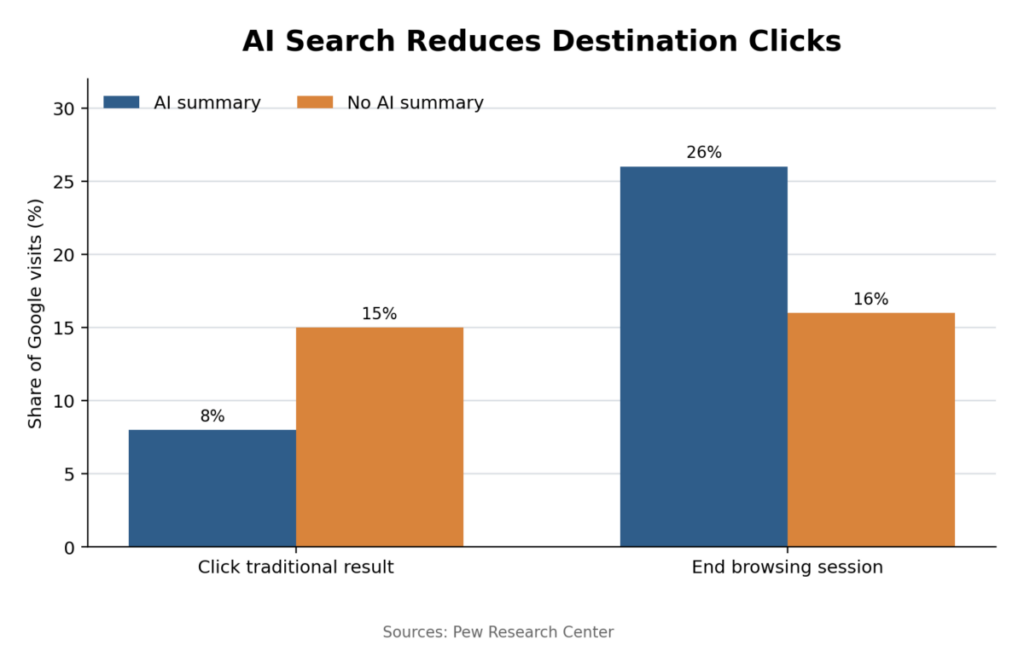
Users clicked conventional search results in 8 percent of Google visits containing an AI summary in March 2025, compared with 15 percent when no summary appeared. They ended the browsing session after 26 percent of searches containing an AI summary, versus 16 percent without one. AI summaries appeared in 18 percent of observed searches and in 53 percent of searches containing ten words or more.
When the intermediary produces a usable result, visiting a destination becomes less necessary. An answer engine tells you what it finds; an Agent can move from finding toward doing. The Personal Web extends that progression by organizing information and services around the person making the request. The World Wide Web organizes destinations; the Personal Web increasingly organizes them around identity and intent.
Much of the technical foundation already exists. Modern applications separate data from presentation, while AI adds interpretation. WebMCP, now in origin trial as a proposed web standard, lets websites expose structured tools that agents can invoke directly rather than relying solely on simulated clicks and typing. The direction is clear even if no single protocol wins: services are becoming more legible to software acting for users.
Commerce provides a practical example. A user can ask software to find a product under a specified price and delivery window, compare available options, and increasingly move toward checkout without navigating every merchant interface directly. Commercial systems already support parts of that flow while merchants retain payment, fulfillment, and account functions. The provider remains essential; the webpage becomes less exclusive as the route to the service.
The service remains remote; the experience becomes personal.
The Personal Web Reaches Outward From YOU
| Readiness Measure | Latest Evidence | Domain |
|---|---|---|
| Annual cloud expansion | Q4 revenue rose $29B year over year | Cloud capacity |
| AI-focused cloud scale | CoreWeave exceeded $1.5B quarterly revenue | AI infrastructure |
| Passkey familiarity | 90% of surveyed consumers | User identity |
| Regular passkey use | 49% use passkeys regularly when available | User identity |
| Workforce deployment | 68% deploying, piloting, or rolling out passkeys | Enterprise identity |
Sources: Synergy Research Group, FIDO Alliance
The Personal Web Reaches Outward From YOU
Viewed from the individual outward, the architecture becomes clear. YOU come first. Your objective drives the software, Agents translate it into requests, and those requests determine which services matter. IaaS supplies much of the remote capacity beneath them.
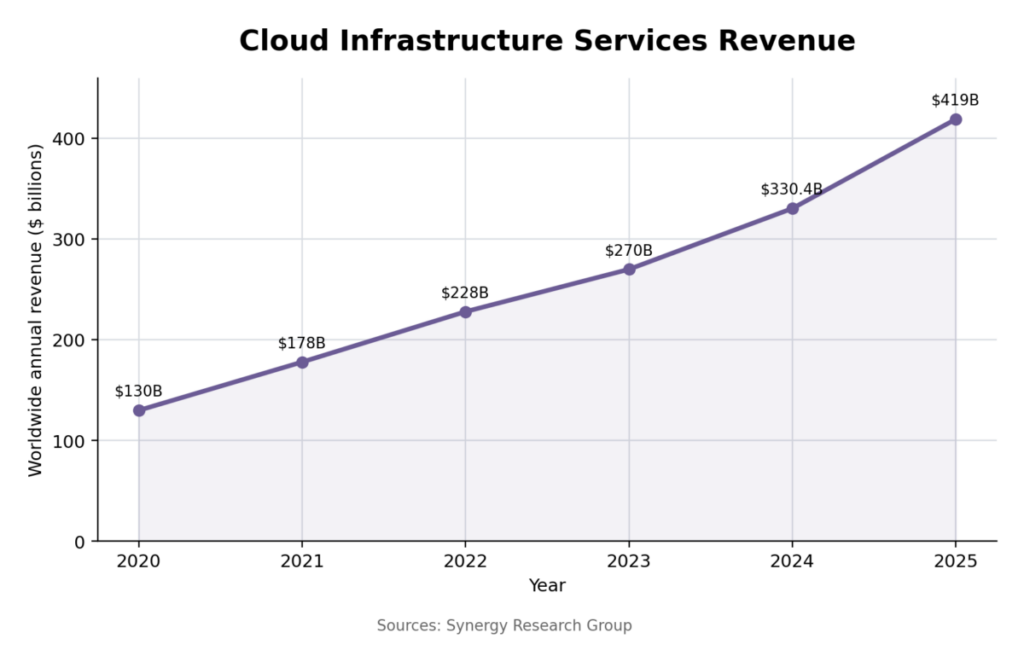
Cloud-infrastructure services generated $419 billion in 2025, reaching $119.1 billion in the fourth quarter as public IaaS and PaaS grew 34 percent year over year. The three largest providers held 68 percent of the public-cloud market. The Personal Web therefore develops on top of a concentrated and rapidly expanding industrial base rather than replacing it.
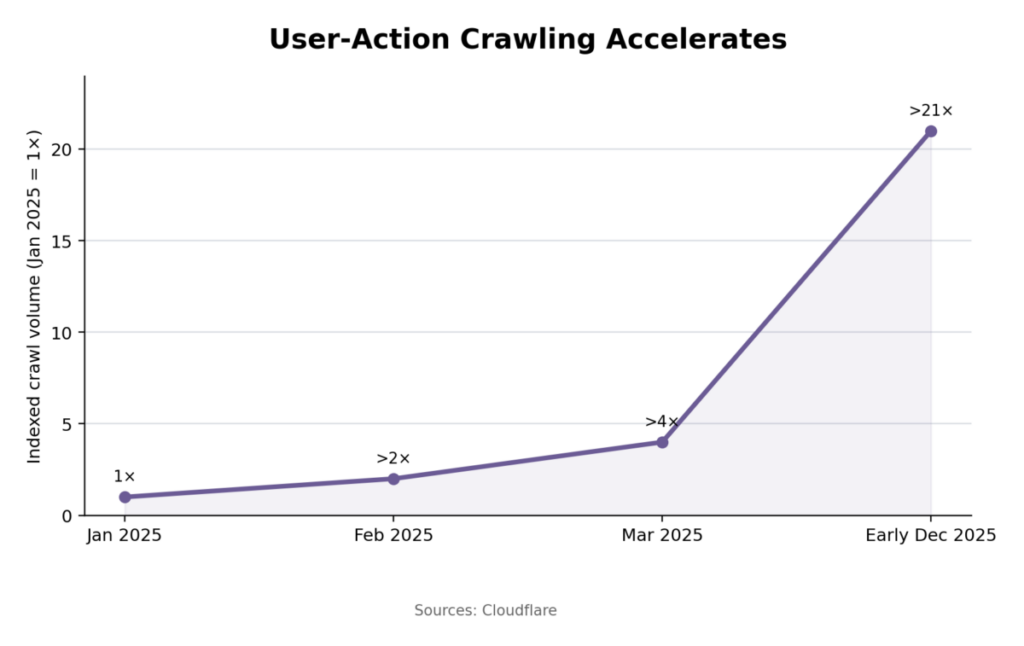
Machine activity is expanding alongside that infrastructure. Global internet traffic grew 19 percent in 2025, while AI “user action” crawling increased more than fifteenfold. A request to arrange dinner after a meeting can trigger calendar checks, restaurant queries, a reservation, and an update. One human act of intent can produce many machine transactions.
Identity becomes part of that operating model. Five billion passkeys are in active use worldwide, while current digital-credential standards increasingly place the user agent between credentials and external services. The September 2026 W3C draft explicitly defines user-agent mediation for digital credential presentation and issuance, moving identity closer to the user’s software environment.
Identity, permissions, and persistent context give software what it needs to act for an individual. More advanced personal software can eventually consolidate those elements directly, but current Agent environments are already moving beyond isolated visits. People have historically adapted themselves to software created by websites and platforms; the Personal Web begins reversing that relationship.
Action and Interpretation Risk
| Risk Measure | Observed Result | Control Direction |
|---|---|---|
| Injected instruction uptake | 16%–86% across WASP agent tests | Treat external content as untrusted |
| Attacker goal completion | 0%–17% across WASP tests | Limit agent authority |
| Consequential actions | Travel booking and money transfer require stronger safeguards | Request user confirmation |
Sources: WASP, Google Chrome for Developers, OpenAI
Personalization Changes What Reaches You
Entertainment makes personalization highly visible, but it does not define the web experience. Adult internet users spend about 6 hours and 38 minutes online each day and roughly 2 hours and 21 minutes on social media. Social networks and short-video feeds together account for approximately 13 hours and 48 minutes each week, 35 percent more than television consumption.
The functional web is larger, connecting commerce, work, healthcare, and public services to outcomes in the physical economy. Entertainment primarily asks what you want to consume; the Personal Web asks what you want to accomplish.
That distinction exposes the central risk. A Personal Web is not necessarily an objective web because the systems making an experience useful also influence what enters it and how that information is interpreted. U.S. internet advertising generated $294.6 billion in 2025, up 13.9 percent in one year, underscoring the economic value attached to automated selection and presentation.
Commercial influence does not disappear when the webpage recedes. A retailer or service provider can still favor sponsored inventory, preferred options, or higher-margin alternatives before information reaches the user. Personal software adds another interpretive layer by deciding what enters a comparison and which recommendation follows.
Agentic systems introduce an additional operational risk. Malicious instructions embedded in external content can influence software capable of acting, turning an interpretation failure into a transaction or security failure.
Data is not the experience. Interpretation creates the experience.
Past behavior and preferences help software represent a person while also creating feedback loops. Preferences influence what Agents request, those requests determine which services respond, and the results shape subsequent interactions. The Personal Web does not eliminate intermediaries; it changes where intermediation occurs.
The Economic Control Point Moves With the Interface
| Market Signal | Quantitative Evidence | Measured Channel |
|---|---|---|
| AI retail referrals | AI-driven U.S. retail traffic rose more than 4,700% | Retail discovery |
| AI shopping experience | 85% of AI-shopping users reported improvement | Consumer commerce |
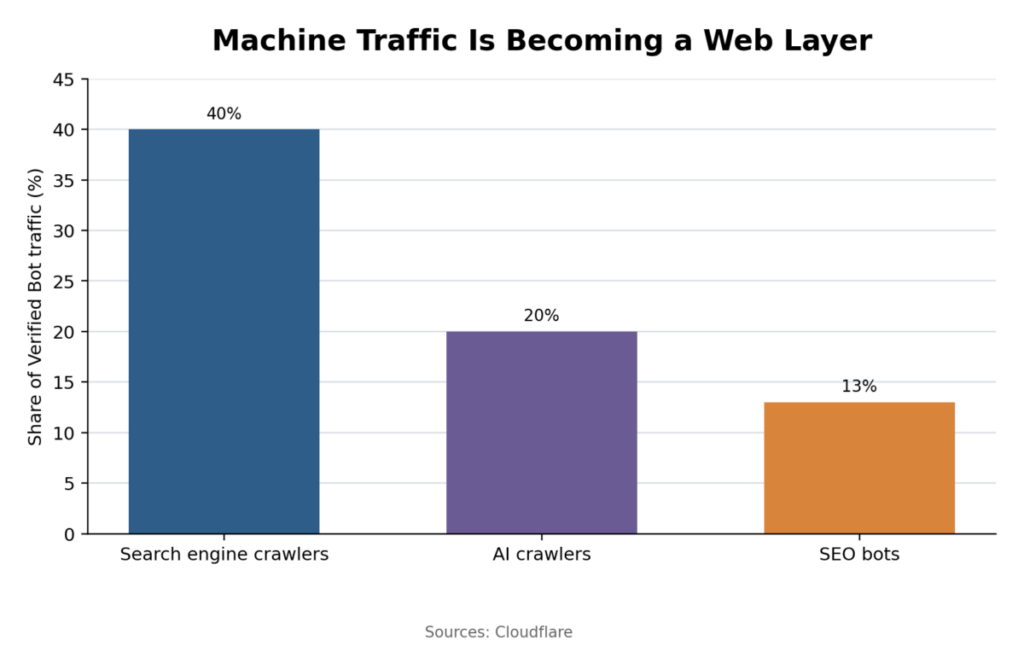
| Search crawler activity | 40% of Verified Bot traffic | Machine discovery |
| AI crawler activity | 20% of Verified Bot traffic | AI access to web content |
| Largest single verified bot | Googlebot generated more than 28% | Automated web retrieval |
Sources: Visa, Cloudflare
The Economic Control Point Moves With the Interface
The transformation changes internet economics because interfaces govern access to economic activity. The commercial web spent decades competing for destinations, clicks, and screen space. The Personal Web moves part of that competition closer to the individual and toward the software representing the individual.
Existing value pools show the stakes. U.S. internet advertising revenue reached $294.6 billion in 2025, while cloud-infrastructure services generated $419 billion. One market monetizes discovery and presentation; the other supplies the computing capacity required to interpret requests and execute digital activity. The Personal Web brings those economics closer together.
When an Agent chooses which retailer or service to query, businesses compete for machine selection as well as human attention. Machine legibility therefore becomes a distribution asset. A provider’s products and transaction capabilities increasingly need to be understandable to software as well as people, while emerging commerce protocols give merchants ways to recognize legitimate agents and verify user authorization.
Economic value consequently shifts toward the systems mediating that interaction, including APIs, cloud infrastructure, Agent platforms, and user software. More capable client-side personal software can eventually extend that model, but the economic direction does not depend on one implementation winning.
Websites survive. Companies and infrastructure continue operating beneath and alongside the Personal Web. What changes is the relationship above them: Agents increasingly represent individual intent, APIs connect that intent with outside capabilities, and IaaS supplies much of the remote capacity.
The World Wide Web organizes information around destinations. The Personal Web increasingly organizes those destinations around the individual. The web stops being somewhere you always have to go and becomes something software increasingly assembles around what you are trying to do.
TL;DR Summary
- The web experience is shifting from provider-defined destinations toward a Personal Web organized around individual intent.
- Agents and APIs increasingly mediate how people reach information and services.
- Client-side custom software remains an advanced direction rather than the required near-term architecture.
- Search behavior already shows declining destination dependence when intermediaries provide usable results directly.
- Structured web tools are making provider capabilities increasingly legible to agents.
- Commerce already shows how software can mediate discovery and transaction without eliminating merchants.
- IaaS supplies much of the remote capacity beneath increasingly agent-mediated experiences.
- Identity and persistent context allow software to represent individual authority across interactions.
- Entertainment demonstrates personalization but represents only one part of the functional web.
- Personalization introduces commercial, interpretive, and security risks.
- Machine legibility becomes increasingly important as businesses compete for software selection.
- The Personal Web redistributes interface control without eliminating providers or the infrastructure underneath them.
Sources
The Web Stops Being a Destination
- International Telecommunication Union (ITU); Measuring Digital Development: Facts and Figures 2025; – Link
- Pew Research Center; Google Users Are Less Likely to Click on Links When an AI Summary Appears in the Results; – Link
From Destinations to Intent
- Google Chrome for Developers; WebMCP: Structured Tools for AI Agents; – Link
- OpenAI; Buy It in ChatGPT: Instant Checkout and the Agentic Commerce Protocol; – Link
- OpenAI Developers; Agentic Commerce Protocol: Merchant Integration and Structured Commerce; – Link
The Personal Web Reaches Outward From YOU
- Synergy Research Group; GenAI Helps Drive Quarterly Cloud Revenues to $119 Billion as Growth Rate Jumped Yet Again in Q4; – Link
- Cloudflare; The 2025 Cloudflare Radar Year in Review: The Rise of AI, Post-Quantum, and Record-Breaking DDoS Attacks; – Link
- FIDO Alliance; The State of Passkeys 2026: Global Consumer and Workforce Report; – Link
- World Wide Web Consortium (W3C); Digital Credentials: W3C Working Draft, September 2026; – Link
Personalization Changes What Reaches You
- DataReportal, We Are Social, and Meltwater; Digital 2025: Global Overview Report; – Link
- DataReportal; Digital 2025 July Global Statshot Report: Social Media and Television Consumption; – Link
- Interactive Advertising Bureau (IAB) and PwC; Internet Advertising Revenue Report: Full Year 2025; – Link
- NeurIPS 2025; WASP: Benchmarking Web Agent Security Against Prompt Injection Attacks; – Link
The Economic Control Point Moves With the Interface
- Adobe Digital Insights; How AI Is Reshaping Black Friday Shopping: AI-Driven Retail Traffic Growth; – Link
- Adobe Digital Insights; Generative AI-Powered Shopping Rises With Traffic to U.S. Retail Sites; – Link
- Visa; Trusted Agent Protocol: Verifying AI Agent Identity and Authorization in Commerce; – Link
- Cloudflare; The Crawl-to-Click Gap: Cloudflare Data on AI Bots, Training, and Referrals; – Link