

Quantum computing is entering its first decade of strategic business relevance. What once occupied theoretical physics journals is now being tested in corporate pilot programs and cybersecurity frameworks. Although still pre-commercial for most applications, the technology has matured enough to warrant serious executive planning.
Milestones such as the standardization of post-quantum cryptography by the National Institute of Standards and Technology (NIST), advances in hybrid computing frameworks, and the global quantum-economy agenda led by the World Economic Forum are moving the field into strategic decision-making territory. The early commercial impact will center on optimization, simulation, and security—domains where quantum algorithms already show measurable potential.
Building Quantum Readiness: Hardware Progress and Early Pathways
Quantum hardware remains noisy and unstable, but progress is accelerating. Peer-reviewed studies published in Nature describe new learning-based error-decoding methods and scalable surface-code architectures that make logical qubits more resilient to failure. These developments narrow the uncertainty around when commercial advantage could emerge.
IBM’s hardware roadmap now focuses on fault-tolerant designs with low-density parity-check codes, marking an inflection point in practical engineering. This shift allows corporate R&D leaders to plan more confidently. Benchmarks such as gate-error rates and qubit fidelity are becoming key metrics in determining when pilot investments can be justified.
For business strategists, this phase represents a transition from technical curiosity to operational readiness. The ability to forecast hardware improvement now feeds into broader investment cycles and partnership models.
The Security Imperative: Transitioning to Post-Quantum Protection
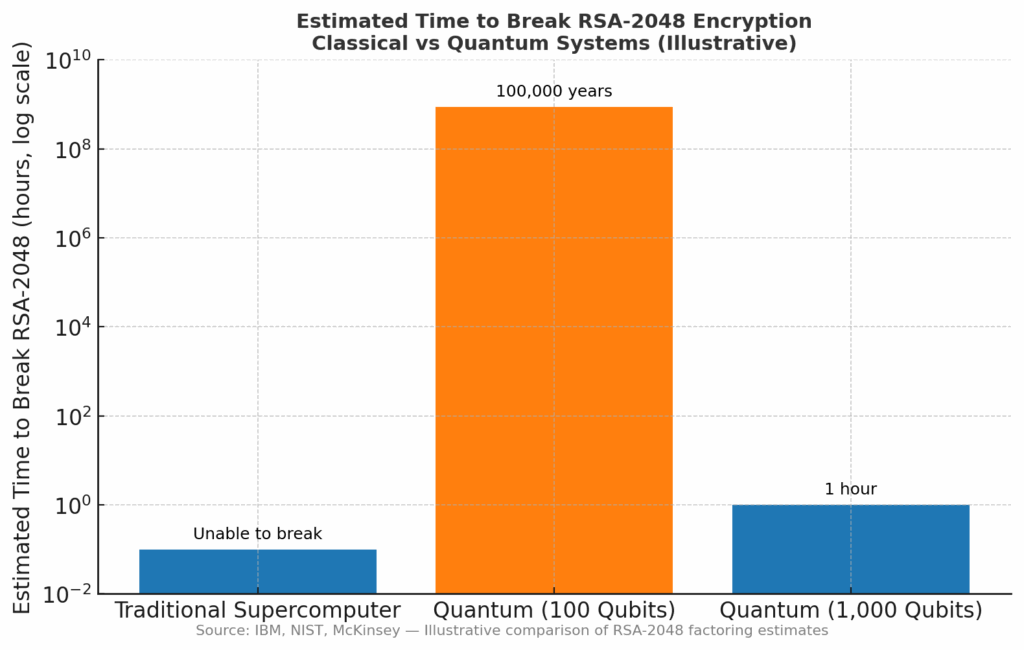
The first clear business case for quantum computing is defensive: cybersecurity. Quantum machines could one day break widely used encryption standards, undermining data privacy and digital trust. In response, NIST finalized three post-quantum cryptographic algorithms in August 2024—ML-DSA, ML-KEM, and SLH-DSA—marking the start of the global migration toward quantum-safe encryption.
The “harvest now, decrypt later” threat identified by multiple financial and security institutions underscores the urgency. Data intercepted today may be stored until quantum hardware is powerful enough to decrypt it. As the World Economic Forum notes, organizations must begin transitioning critical systems before such hardware exists, ensuring continuity of trust across digital infrastructure.
The transition presents uneven challenges. Enterprises with significant cybersecurity budgets can adapt quickly, while smaller businesses and public-sector agencies may struggle. This disparity risks widening digital inequality, as firms in advanced economies harden systems faster than those in emerging markets.
Business Applications: Optimization and Simulation Advantage
Quantum computing’s earliest measurable benefits will come from optimization and simulation—two computationally intense categories where classical systems already strain.
According to McKinsey & Company’s The Year of Quantum report, applications in supply-chain optimization, logistics routing, energy modeling, and molecular simulation stand to benefit first. Quantum algorithms can reduce computation time or improve solution accuracy for complex systems, such as global logistics networks or materials-design models.
The World Economic Forum’s Embracing the Quantum Economy report emphasizes that these capabilities can shorten R&D cycles in chemicals, energy, and pharmaceuticals. By simulating molecular interactions more precisely, companies can accelerate discovery, reduce waste, and lower costs.
D-Wave’s applied-research projects demonstrate incremental progress. In pilot studies for logistics optimization at the Port of Los Angeles and financial portfolio modeling, hybrid quantum-classical systems already yield performance improvements over traditional heuristics. Although limited in scale, such pilots build foundational expertise and identify viable use cases.
Competitive Differentiation: The First-Mover Advantage
Quantum computing provides a new axis of strategic differentiation. Early adopters that integrate quantum-ready processes can build intellectual property, expertise, and datasets that compound over time.
McKinsey notes that firms pursuing structured quantum programs—through partnerships, university collaborations, or dedicated R&D centers—are positioning themselves to control future value chains. They can patent early algorithms, build quantum-ready APIs, and integrate simulation workflows that competitors may find difficult to replicate.
In finance, experiments with quantum algorithms for fraud detection and derivative pricing illustrate early attempts to extract business value. Even modest performance gains in these computationally intensive areas can lead to disproportionate financial advantages.
However, expert consensus warns against uncalibrated enthusiasm. The World Economic Forum stresses that premature investment in unproven technologies or vendor lock-in may waste resources. The rational path is controlled exploration: using cloud-accessible quantum processors, documenting learnings, and evaluating returns without full commitment.
Hybrid Computing: Bridging Present and Future
Hybrid quantum-classical computing allows companies to participate in the quantum era before hardware reaches full maturity. NVIDIA’s CUDA-Q platform, for instance, enables developers to test algorithms that combine classical GPU power with quantum processing units (QPUs).
These systems provide practical pathways for experimentation. PwC and Deloitte both recommend this model, noting that hybrid pilots can generate near-term efficiency gains while preparing organizations for future integration. Quantum-inspired algorithms—classical programs that mimic quantum behavior—offer additional ways to achieve value immediately, such as improved routing or scheduling performance.
Hybridization also reduces risk. Companies can scale their involvement as hardware stabilizes, maintaining flexibility and avoiding premature capital lock-in.
Organizational Readiness: Building Capacity and Governance
Corporate readiness for quantum adoption now depends as much on human capital as on hardware access. McKinsey estimates that fewer than 10,000 professionals globally possess advanced quantum skills. The shortage could delay adoption unless firms act early to build in-house expertise.
Training programs and academic partnerships are emerging as strategic investments. Companies are sponsoring university collaborations and internal “quantum literacy” tracks to familiarize technical staff with the principles of quantum algorithms and cryptography.
Governance must evolve alongside technical capacity. As firms experiment with hybrid and post-quantum systems, clear internal policies are needed for validation, audit, and accountability. Lessons learned from artificial-intelligence governance—transparency, bias checks, and performance verification—apply equally in quantum initiatives.
Risk, Timing, and Strategic Posture
Industry consensus from Deloitte and the World Economic Forum indicates that substantial business value from quantum computing will likely emerge between the late 2020s and mid-2030s. The prudent corporate posture is proactive preparation, not aggressive deployment.
This entails identifying high-value use cases, monitoring hardware progress, and securing intellectual property positions. Executives should align quantum initiatives with digital-transformation goals—treating them as an extension of advanced analytics and high-performance computing rather than a standalone technology.
The term “quantum literacy” captures the appropriate mindset: cultivate awareness, run small-scale pilots, and position resources for scale once the inflection point arrives.
Outlook: The First Decade of Quantum Business
The first business decade of quantum computing will reward foresight over speed. Firms that establish disciplined programs today—focusing on cryptographic migration, hybrid experimentation, and talent development—will build an advantage grounded in knowledge and readiness.
Quantum’s initial impact will augment rather than replace classical computing. By improving optimization, simulation, and security, it can deliver cumulative performance advantages that redefine productivity frontiers. As McKinsey concludes, the question is not whether quantum computing will matter, but when organizations will be ready to capture its value.
Key Takeaways
• Post-quantum encryption is now standardized; migration has begun.
• Early value lies in optimization and simulation pilots.
• Hybrid computing bridges current infrastructure with quantum readiness.
• Workforce development and governance are critical for adoption.
• Strategic patience and literacy yield sustainable competitive advantage.
Sources
• NIST — NIST Releases First 3 Finalized Post-Quantum Encryption Standards — Link
• McKinsey & Company — The Year of Quantum: From Concept to Reality in 2025 — Link
• World Economic Forum — Embracing the Quantum Economy: A Pathway for Business Leaders — Link
• Nature — Learning High-Accuracy Error Decoding for Quantum Processors — Link
• Nature — Suppressing Quantum Errors by Scaling a Surface Code Logical Qubit — Link
• IBM — IBM Lays Out a Clear Path to Fault-Tolerant Quantum Computing — Link
• Deloitte — The Quantum Decade: Preparing for a New Computing Paradigm — Link
• PwC — The Coming Quantum Advantage: How Business Can Prepare — Link
• NVIDIA — CUDA-Q Platform Overview — Link