

Digital transformation has shifted the foundations of global economic activity. Where nations were once defined by physical territory, institutional structures, and social identity, today’s economies increasingly operate through mobile networks, cloud platforms, financial technologies, and data systems. These digital systems do not simply support economic growth; they function as integrated environments with their own rules, boundaries, and mechanisms of participation.
As digital ecosystems mature, they begin to resemble functional national systems operating alongside physical governments. They have infrastructures comparable to national utilities, financial systems that underpin daily economic activity, governance frameworks shaped by data sovereignty and regulation, cultural layers reflecting societal expectations, and industrial architectures driven by domestic business paradigms. These elements collectively explain why digital economies are evolving into full virtual nations: they now possess the structural, economic, cultural, and governance characteristics traditionally associated with sovereign national systems.
International institutions such as the World Bank, ITU, OECD, and UNCTAD increasingly describe digital transformation in quasi-sovereign terms. The Institute of Internet Economics highlights that digital economies have become coherent national-scale systems, complete with digital borders, identity frameworks, rights structures, and economic engines. The convergence of ICT infrastructure, fintech integration, regulatory authority, cultural identity, and business paradigms forms the architecture of these virtual nations.
Internet Use by Region (2024)
| Region | Internet Use (% of population) | Year |
|---|---|---|
| World | 68% | 2024 |
| Africa | 37.5% | 2024 |
| CIS | 91.5% | 2024 |
| Urban (Global) | 83% | 2024 |
| Rural (Global) | 48% | 2024 |
ICT Infrastructure: The Structural Basis of Virtual Nation Formation
The first and most fundamental reason digital economies evolve into virtual nations is the role of ICT infrastructure. ICT forms the structural backbone upon which all virtual national activity occurs. Mobile phones, broadband networks, cloud platforms, and internet-based applications function as the equivalent of roads, administrative buildings, and communication systems in the physical world.
Mobile connectivity is especially critical. In many emerging economies, mobile devices became the primary gateway to the digital world. Research from the World Bank shows that mobile broadband adoption increases economic inclusion, improves labor market participation, and expands access to services. These trends enable citizens to function economically within a virtual national space even when physical infrastructure remains limited.
Kenya provides a central case. Its mobile-first environment gave rise to M-Pesa, which became not only a financial tool but also a foundation of digital economic life. Mobile networks created a functional economic territory, enabling users to work, transact, and access services through virtual channels. Similar dynamics occur across Southeast Asia and South Asia, where mobile-first ICT systems define the contours of digital participation.
Cloud Market Distribution (2024)
| Region | Share of Global Cloud Market | Year |
|---|---|---|
| North America | ~39% | 2024 |
| Europe | ~15% | 2024 |
| Asia-Pacific | ~20% (fastest-growing) | 2024 |
Cloud platforms reinforce these structural foundations. They host government portals, identity systems, business software, and communication tools. By enabling digital public services, cloud systems replicate state functions at national scale. As ICT infrastructure becomes more sophisticated, digital economies develop the essential utilities of a virtual nation.
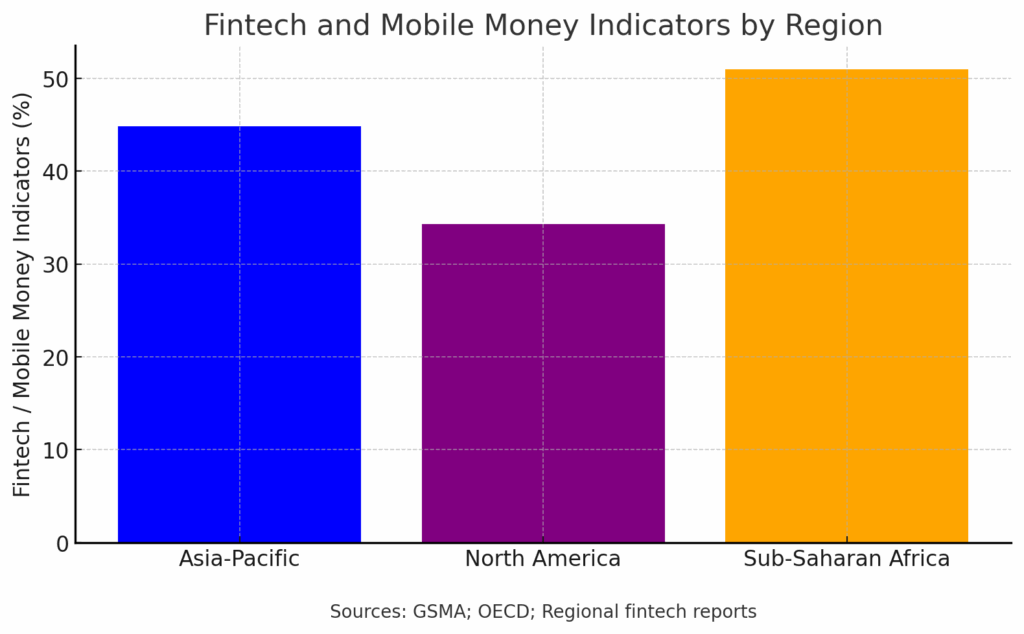
Fintech Systems: The Unifying Economic Engine of Virtual Nations
Fintech systems explain how digital economies achieve cohesion, allowing them to operate like unified national spaces. Payments, digital banking, and financial platforms serve as the economic circulatory system of virtual nations.
Fintech aligns the interests of three critical actors:
• financial institutions seeking efficiency and expanded reach,
• governments seeking transparency and inclusion,
• citizens seeking access to income, savings, and services.
The result is a harmonized economic environment that resembles a national monetary system.
India’s Unified Payments Interface demonstrates how fintech unifies a population inside a virtual economic structure. When integrated with Aadhaar, UPI created a nationwide infrastructure for identity-verified digital transactions. This links individuals directly to financial institutions, government programs, and digital marketplaces, enabling a cohesive virtual national economy across more than a billion people.
Brazil’s Pix, Singapore’s digital finance systems, and EU digital banking regulations illustrate similar dynamics. Fintech transforms digital economies from fragmented digital markets into integrated virtual nations with unified economic operations. Without fintech, digital environments lack cohesion; with it, they develop the functional characteristics of economic sovereignty.
Table D — Data Protection & Privacy Laws by Region (2024–2025)
| Region / Group | Countries with Data Protection Laws (%) | Year |
|---|---|---|
| World | 79% | 2024 |
| Africa | 76% | 2024 |
| Asia-Pacific | 65% | 2024 |
| LDCs | 57% | 2024 |
| SIDS | 51% | 2024 |
| Europe | ~100% | 2025 |
Global Data Protection and Privacy Law Coverage
Regulation and Data Sovereignty: The Governance Framework of Virtual Nations
Every nation requires governance, and in the digital realm, this governance arises from regulation and data sovereignty. These frameworks explain why virtual nations become politically meaningful structures.
Regulation defines the rights, responsibilities, and constraints governing digital activity. Data sovereignty determines where information resides, who controls it, and how it flows across borders. Together, these decisions function as the constitutional and legal framework of virtual nations.
Political alignment plays a central role. Governments construct regulatory systems that reflect their ideological and strategic priorities:
• The European Union’s rights-based framework emphasizes privacy, accountability, and fair competition.
• The United States emphasizes innovation, market dynamism, and decentralized platform governance.
• China emphasizes state oversight, security, and controlled data ecosystems.
Each governance model produces a distinct virtual national identity. China’s digital governance integrates industrial planning with data control, producing a centralized virtual nation with tightly defined digital boundaries. The European approach creates a virtual nation characterized by digital rights, user protections, and structured oversight.
Data sovereignty is equally critical. Estonia’s national digital identity and secure data exchange systems demonstrate how a coordinated data governance model can modernize public administration. India’s Aadhaar-linked ecosystem illustrates how identity and data sovereignty can scale in large populations. These systems function as digital constitutions, defining the rules that structure the virtual nation.
Culture and Society: The Human Identity Layer of Virtual Nations
Virtual nations also emerge because digital economies reflect the cultural preferences, behaviors, and demands of their populations. Digital culture shapes how citizens interact with institutions, platforms, and one another. The expectations and behaviors of a society become embedded in the digital systems it builds.
South Korea demonstrates how cultural expression shapes virtual national identity. The Korean Wave, amplified through digital platforms, extends Korea’s cultural presence globally, giving its virtual nation a worldwide footprint. This is not merely entertainment; it is part of the cultural identity projected into digital space.
Kenya shows how socioeconomic realities shape digital culture. High mobile adoption and reliance on mobile payments created norms of digital participation that influence the country’s virtual economic identity. These cultural behaviors define how virtual nations develop and operate.
Digital literacy further influences cultural expression. Countries with high digital literacy develop virtual nations characterized by civic engagement and participatory digital culture. Nations with lower digital literacy often reproduce offline inequalities inside the virtual environment.
Business Paradigms and Industrial Structures: The Economic Backbone of Virtual Nations
Existing businesses and industrial paradigms explain why virtual nations take on distinct economic identities. The digital economy does not exist independently of the physical economy; it is built on its infrastructure, hardware, and investment cycles.
Business demand drives much of the growth in digital infrastructure. Data centers, fiber networks, cloud services, digital logistics systems, and hardware manufacturing expand primarily because industries require them. OECD research shows that commercial investment accounts for the majority of digital infrastructure spending in advanced economies.
Singapore illustrates this dynamic. Its digital nation has emerged from coordinated business and government investment in cybersecurity, cross-border data infrastructure, cloud platforms, and digital trade systems. The result is a virtual nation with a clearly defined economic role in global digital commerce.
The Nordic countries similarly demonstrate how industrial history and business paradigms produce digital national characteristics. Strong telecommunications sectors and software industries lead to virtual nations built on innovation, digital trust, and interoperability.
Virtual nations are therefore reflections of the businesses they serve. Their infrastructure, capabilities, and economic identity arise from domestic industry structure, commercial demand, and investment priorities. Business paradigms shape what the virtual nation becomes.
Why Digital Economies Are Turning Into Virtual Nations
Digital economies are evolving into full virtual nations because they now possess the structural, economic, cultural, and governance components traditionally associated with sovereign national systems. ICT infrastructure creates the digital territory. Fintech systems unify economic activity. Regulation and data sovereignty define political identity. Culture supplies the human layer of collective identity. Business paradigms provide the economic foundation and growth trajectory.
These elements collectively produce digital ecosystems that function as national entities. As digital transformation accelerates, virtual nations will become central to global competition, economic development, and digital governance. Nations capable of integrating ICT infrastructure, fintech systems, regulatory frameworks, cultural factors, and industrial capabilities will define the next phase of global digital order.
Key Takeaways
• Digital economies evolve into virtual nations because they possess the structural, economic, cultural, and governance components of national systems.
• ICT infrastructure forms the structural boundaries and utilities of virtual nations.
• Fintech systems unify digital economies and function as national-scale financial infrastructure.
• Regulation and data sovereignty establish governance frameworks comparable to digital constitutions.
• Culture shapes digital behavior, identity, and expectations, influencing virtual nation dynamics.
• Business paradigms determine economic structure, infrastructure investments, and the identity of the virtual economy.
Sources
• Institute of Internet Economics; Virtual Nations & Digital Economies – https://instituteofinterneteconomics.org
• World Bank; Digital Development Overview – https://www.worldbank.org/en/topic/digitaldevelopment
• OECD; Digital Economy Outlook – https://www.oecd.org/digital/oecd-digital-economy-outlook-2020-bb167041-en.htm
• ITU; Measuring Digital Development – https://www.itu.int/itu-d/reports/statistics/
• UNCTAD; Digital Economy Report – https://unctad.org/topic/ecommerce-and-digital-economy/digital-economy-report