
At Huafon’s spandex plant in Chongqing, demand for customized products was rising while market prices were falling. The response combined robotics with digital process control across 62 applications, reducing defects by 35 percent and increasing labor productivity by 60 percent. Robotics contributed to a broader transformation; the figures cannot be attributed to the machines alone.
Customers receiving more consistent material from the upgraded plant have less reason to reject deliveries or interrupt production. Any saving reaching clothing prices would also benefit households. Competitors, meanwhile, face a producer better equipped to meet demand at the prevailing price.
Early adopters establish profitable applications inside their own operations; the emerging second phase spreads that experience to other firms, changing how an industrial region produces and supplies goods.
| Operating Measure | Fedegari, Italy |
|---|---|
| Overall production cycle time | 50% reduction |
| Production capability | 35% increase |
| Vessel-size range covered by cell design | 83% |
Sources: International Federation of Robotics, ABB Robotics
What the Early Movers Reveal
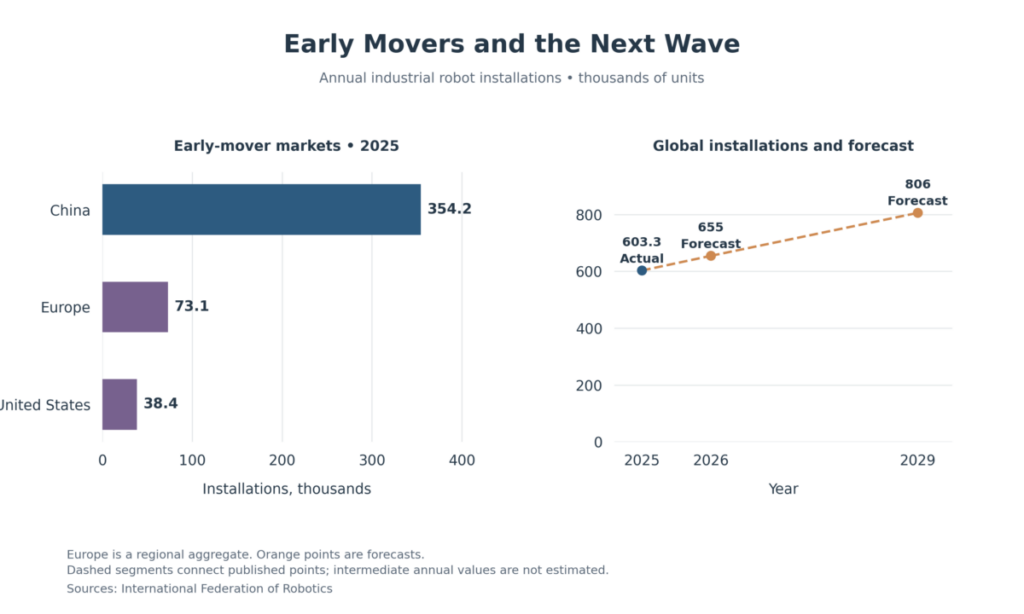
China installed approximately 354,000 industrial robots in 2025, out of roughly 603,000 worldwide, compared with about 38,400 added in the United States. European installations fell 14 percent to approximately 73,100. Those contrasting trajectories reflect different industrial conditions, with national totals concealing substantial variation among manufacturers.
Chinese brands have supplied more than half their country’s annual installations since 2024, reflecting a domestic equipment market alongside demand for automated production. Other countries need not manufacture robots to benefit from using them, but local engineering services offer another opportunity: retaining expenditure on adapting and maintaining imported machinery.
Robotic adoption in U.S. manufacturing clusters in regional hubs where integrators are also more prevalent. Their association does not establish that integrators caused adoption, but it places engineering expertise alongside equipment in the development of industrial regions. Smaller firms cannot necessarily reproduce a neighboring automotive plant’s investment.
Early adoption gives way to expansion and diffusion as successful applications become easier to commission elsewhere. Broad adoption would make robotics an ordinary investment consideration across suitable industries; mature integration would make supporting skills and services routinely available. These four phases describe a progression within industries, rather than a timetable for entire countries.
The emerging second phase turns on the cost of repeating success, which standardized cells and simpler programming reduce by making applications easier to deploy. Physical AI could extend the range into less predictable tasks, although demonstrated movement still has to become dependable production. China’s expanding equipment industry illustrates how adoption creates commercial opportunities around the factory investment. Countries following it have a practical starting point in proven applications and the local services needed to keep them productive.
| Economy | Robots per 10,000 Manufacturing Employees |
|---|---|
| South Korea | 1,220 |
| Germany | 449 |
| United States | 307 |
| China | 166 |
Sources: International Federation of Robotics
What Changes Next in Production and Supply
For manufacturers producing varied items, switching work can be expensive enough to keep an otherwise capable robot underused. At Schenck Process in Kansas, cumbersome programming limited a welding cell to a narrow selection of parts. A retrofit incorporating machine vision reduced setup for a new product to 10–15 minutes and expanded the work it could accept.
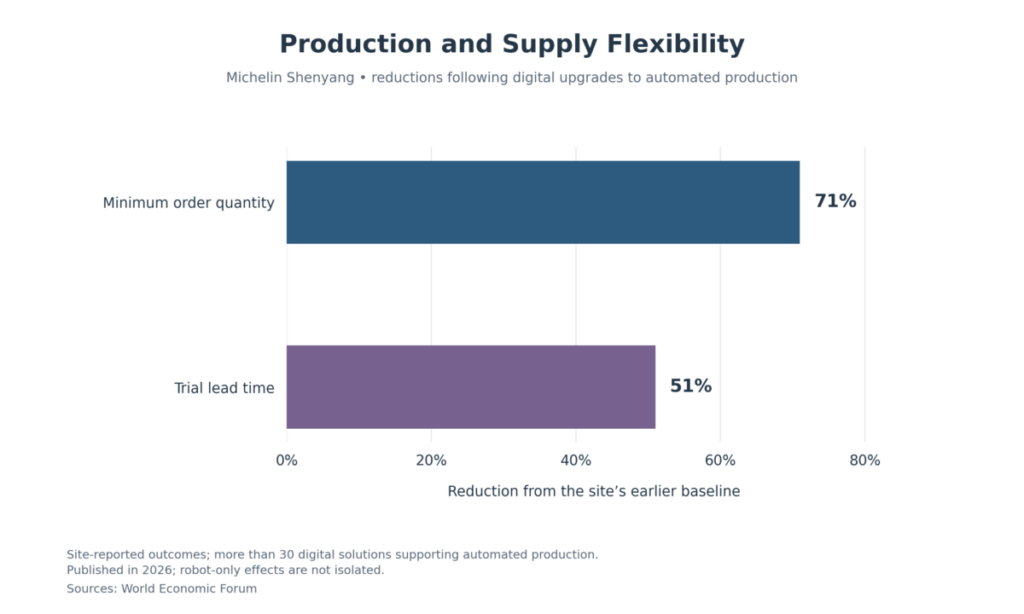
Reducing changeover expenditure lets manufacturers recover setup costs across fewer units, changing the quantity they need to produce profitably. Long runs spread costly preparation, sometimes requiring customers to buy more than they immediately need. When switching becomes easier, smaller orders become more attractive to the producer. Wider deployment of such applications would give buyers greater freedom to order against consumption, provided the supplier can accommodate the revised schedule profitably. Purchasing decisions would then give delivery performance greater weight alongside unit prices.
The experience of Danish fittings manufacturer VOLA shows how much flexibility depends on movement between operations, where a fast machine can still wait for material. It introduced mobile robots to connect its warehouse and assembly operations within a made-to-order system. Central coordination linked transported items with employee work instructions, requiring changes to layout and work organization. Faster processing would have achieved little if material continued to arrive at the wrong station or time.
Dependable replenishment gives customers a basis for reconsidering the stock held against uncertain deliveries. A buyer receiving components more frequently might commit less cash to inventory without reducing annual purchases. Some released money could repay borrowing; some could finance additional capacity. Less finished stock also reduces exposure to goods becoming obsolete before sale. These are expected economic consequences of improved delivery, and their scale must be established from inventory and financing changes.
Just-in-time methods still require protection against vulnerable inputs. Faster assembly cannot shorten a distant shipping route or remove uncertainty at an unreliable component supplier. Buffers remain valuable wherever disruption threatens production, so wider integration should encourage selective stock reductions where delivery performance warrants them. Eliminating inventory indiscriminately would sacrifice resilience for an apparent saving.
Connected ordering could further shorten the interval between a customer’s purchase and a supplier’s production decision. Its usefulness depends on equipment responding without an expensive changeover and materials being available when needed. The financial measure is the full interval from order to usable delivery, including the capital committed along the way. A robot completing its task faster earns a wider economic return when that improvement lets another business serve demand with less money tied up before payment arrives.
| Production Measure | Michelin Shenyang, China |
|---|---|
| Minimum order quantity | 71% reduction |
| Trial lead time | 51% reduction |
| New-energy-vehicle tire portfolio | More than 250 SKUs |
Sources: World Economic Forum, Michelin
How Businesses and Industrial Networks Respond
For smaller manufacturers, accessible automation can make previously impractical contracts worth pursuing, as KAD Models illustrates through overnight machine tending across varied prototype parts in the United States. Overnight production shortened turnaround and expanded its ability to serve local manufacturers. Consistent quality and additional operating hours offer commercial advantages where customers need specialized components promptly.
Implementation can also consume the resources intended to produce those advantages. Pennsylvania manufacturer Metal Integrity increased output on its first automated job from 180 to 475 parts per week, but a dual gripper caused control problems and the initial workholding arrangement failed to maintain required tolerances. The project included other equipment and software investments. Its difficulties demonstrate why purchase price alone is a poor investment guide: troubleshooting absorbs skilled employees while financing costs begin before dependable production delivers the anticipated return. Enough suitable work must remain available afterward to justify the commitment.
A regional robotics manufacturing hub gives firms access to application assessment and testing before installation, bringing outside expertise into decisions smaller manufacturers might otherwise have to make alone. An experienced integrator brings knowledge of errors another manufacturer has already encountered. Continuing maintenance belongs within the same commercial calculation, since a successful commissioning does not guarantee reliable operation throughout ownership.
China’s combination of equipment demand and domestic supply shows one route by which adoption supports further business activity. Elsewhere, local installation and support services offer firms a way to participate without producing the robots themselves.
Customers accustomed to dependable deliveries may extend those expectations across their supplier base, putting pressure on firms that have purchased no automation. Some suppliers will gain work as customers expand; others will face requirements they cannot economically meet. The choice concerns the firm’s position within those relationships. Additional capacity earns little if the output cannot reach a paying customer.
| Payback Basis | Estimate | Status |
|---|---|---|
| Initial project expectation | 4 months | Pre-installation target |
| Reallocated labor alone | 6 months | Post-deployment projection |
Sources: Innovative Manufacturers Center
When Industrial Gains Become Wider Prosperity
Measured productivity gains among Chinese robot adopters have been accompanied by benefits to larger non-adopting firms in the same industry and city. The estimated adoption effect was strongest in the first two years and lost statistical significance from the third year onward. That limits confidence about persistence without proving earlier gains disappeared. These local spillovers provide a basis for expecting benefits beyond individual investments as integration spreads, although they do not establish that every supplier gains or identify a universal national multiplier.
In Spanish manufacturing, robot adopters have expanded while non-adopters have suffered competitive losses. A manufacturer winning business from a domestic rival has not created an equivalent increase in national output, even if shifting production toward the more efficient operation raises aggregate productivity.
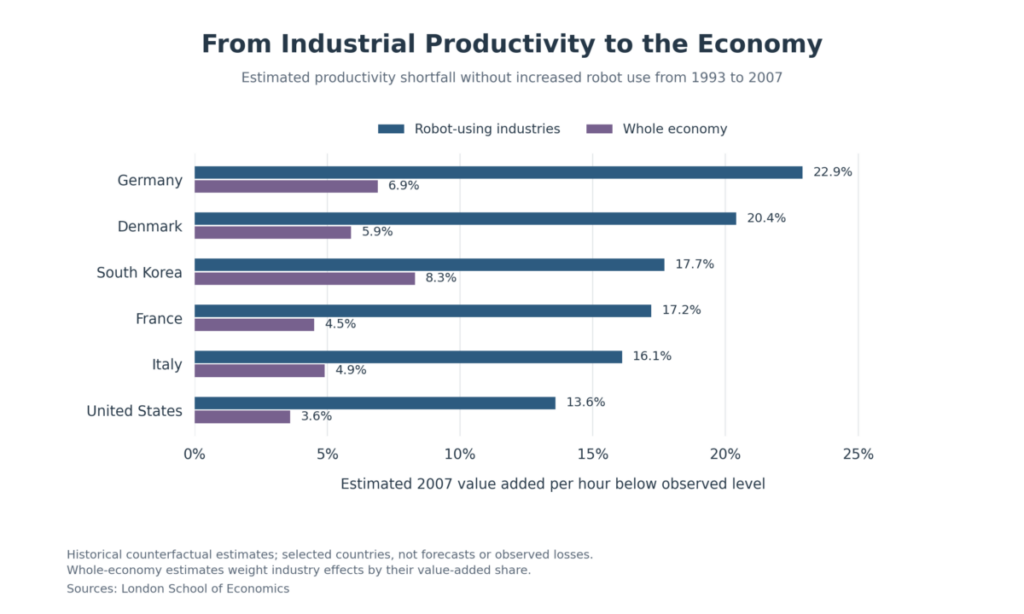
Additional activity arises when lower costs or better availability enable customers to expand their own output. Domestic suppliers can receive more orders, while technical services gain continuing work. Additional earnings support household consumption. These channels strengthen the national return where local businesses have capacity to respond; importing the equipment does not prevent productivity gains, but it sends part of the initial expenditure abroad. Strong competition also helps transmit savings through prices. Better goods at unchanged prices can improve purchasing power, including through fewer repairs, while weak competition allows owners to retain more of the gain.
The release of working capital through lower inventories does not, on its own, increase GDP. Its contribution depends on what the business does with the money: financing additional production creates a different outcome from holding a larger cash balance. Likewise, increased demand for integration services must be assessed alongside the resources diverted from other activities. Productivity expands the economy when it makes previously uneconomical transactions viable, allowing firms to serve demand that existing production could not profitably satisfy.
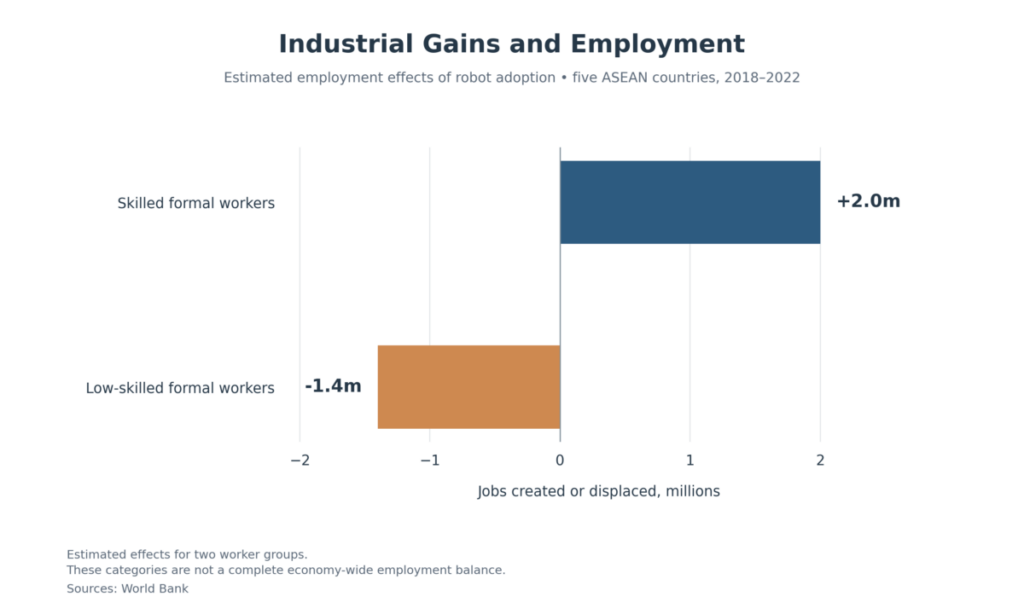
Between 1994 and 2014, manufacturing employment losses associated with robotics in Germany were offset by gains elsewhere, although earnings outcomes differed across workers. In East Asian manufacturing economies, production expanded alongside displacement of less-skilled formal workers as robotic adoption increased. Training tied to actual vacancies offers a firmer route into expanding activities than assurances about future occupations. Access to integration expertise serves a related purpose for smaller firms: it improves their chance of participating as customers modernize, rather than watching new business concentrate among established industrial leaders.
| Worker Group | Estimated Employment Effect | Share of Corresponding Group |
|---|---|---|
| Skilled formal workers | 2.0 million jobs created | 4.3% |
| Low-skilled formal workers | 1.4 million jobs displaced | 3.3% |
Sources: World Bank
The Signs of a Deepening Robotic Economy
A country entering the second phase should see proven applications reaching firms that previously lacked the resources to attempt them. Shorter commissioning would indicate that experience is becoming reusable, while improved delivery would give customers grounds to reconsider inventory commitments.
Although broad adoption and maturity remain uneven prospects across industries, shared testing and local support offer practical ways to avoid repeating expensive mistakes during the present transition. The strongest test is whether those capabilities improve commercial decisions: a supplier accepting a smaller order profitably, for example, allows its customer to commit less money before demand is certain. When such improvements become available beyond leading factories, robotic integration begins changing who can compete and how much capital an economy needs to meet its customers’ demand.
| Indicator | Definition | Unit |
|---|---|---|
| Adoption breadth | Robot-using plants ÷ manufacturing plants | % |
| Commissioning time | Median time from equipment arrival to accepted production | Weeks |
| Delivery reliability | Orders delivered on time ÷ orders due | % |
| Inventory commitment | Average inventory ÷ average daily cost of goods sold | Days |
| Labor productivity | Real value added ÷ hours worked | Constant-price currency/hour |
| Worker transition | Displaced workers re-employed within a fixed follow-up period | % |
Sources: Institute of Internet Economics, U.S. Census Bureau, National Institute of Standards and Technology, World Bank
TL;DR Summary
- China provides evidence of both robotic adoption and an expanding domestic equipment industry.
- Stage 2 spreads proven applications beyond the firms that pioneered them.
- Engineering expertise helps determine which manufacturers can participate.
- Lower changeover costs improve the economics of smaller production runs.
- Dependable replenishment can reduce inventory commitments where delivery performance supports it.
- JIT methods still require buffers around vulnerable inputs.
- Integration returns depend on commissioning costs, suitable workloads, and continuing support.
- Productivity spillovers differ from growth achieved by taking competitors’ market share.
- Released working capital contributes to expansion when it finances additional productive activity.
- Wider prosperity depends on consumer benefits and opportunities for displaced workers and smaller firms.
Sources
- World Economic Forum; Huafon Chongqing Spandex — Productivity; – Link
- International Federation of Robotics; Flexible Welding Cells Help to Produce Large Pressure Vessels in Half the Time; – Link
- London School of Economics, Centre for Economic Performance; Robots at Work — Discussion Paper 1335; – Link
What the Early Movers Reveal
- International Federation of Robotics; World Robotics 2026 — Industrial Robots, Executive Summary; – Link
- International Federation of Robotics; Robot Density Surges in Europe, Asia, and Americas; – Link
- International Federation of Robotics; China Tops World Record of 2 Million Factory Robots; – Link
What Changes Next in Production and Supply
- International Federation of Robotics; How to Increase Your Robotic Cell Utilization; – Link
- International Federation of Robotics; Made-to-Order Production with an Advanced Fleet of Mobile Robots; – Link
- World Economic Forum; Michelin Shenyang Tire — Productivity; – Link
How Businesses and Industrial Networks Respond
- CEPR; Robots and Firms; – Link
- Innovative Manufacturers Center; IMC Helps Metal Integrity Implement Advanced Robotics and Automation Technology; – Link
- FANUC America; High-Mix, Low-Volume Prototype Shop Achieves Lights-Out Manufacturing with Robotic Automation; – Link
When Industrial Gains Become Wider Prosperity
- Rutgers University; Unleashing the Power of Industrial Robotics on Firm Productivity: Evidence from China; – Link
- World Bank; Future Jobs: Robots, Artificial Intelligence, and Digital Platforms in East Asia and Pacific; – Link
- Federal Reserve Bank of Minneapolis; Adjusting to Robots: Worker-Level Evidence; – Link
The Signs of a Deepening Robotic Economy
- Brynjolfsson and Coauthors; The Characteristics and Geographic Distribution of Robot Hubs in U.S. Manufacturing Establishments; – Link
- National Institute of Standards and Technology; Best Practices for the Integration of Collaborative Robots into Workcells Within Small and Medium-Sized Manufacturing Operations; – Link
- ARM Institute; Learn About Our Process and Services; – Link