
The next phase of the web is not being driven by new destinations or faster infrastructure. It is being driven by a visible breakdown in how humans cope with digital complexity. Across consumer and enterprise environments, people now spend more time navigating interfaces, interpreting data, and managing tools than completing the tasks they came online to do. Artificial intelligence, analytics, and adaptive design are being applied not to add capability, but to remove this burden.
The scale of the problem is measurable. The Baymard Institute estimates that more than 70 percent of online shopping carts are abandoned globally, often after users have already decided to buy. In the workplace, Microsoft’s Work Trend Index shows that knowledge workers lose a large share of their day to switching between applications, searching for information, and responding to interruptions rather than doing focused work. These losses are not edge cases. They are structural outcomes of systems that ask humans to manage too many decisions at once.
For much of the web’s history, value came from exposure. Pages were documents, dashboards were control panels, and users were expected to browse, compare, configure, and decide. Behavioral economics explains why this model now works against itself. As choice expands and data accumulates, decision quality drops and follow-through collapses. What looks like empowerment at the interface level becomes friction in practice.
Legacy Interaction vs Intent-First Interaction
| Dimension | Legacy Web / Dashboard Model | Intent-First / Delegated Model |
|---|---|---|
| Primary Interaction | Navigation and configuration | Goal expression and confirmation |
| Number of Steps | High and variable | Collapsed into minimal actions |
| Decisions per Task | Many low-stakes micro-decisions | Fewer, higher-value decisions |
| User Role | Operator and monitor | Supervisor and reviewer |
| Cognitive Load | High and continuous | Reduced and episodic |
| Failure Mode | Abandonment or misconfiguration | Constraint-bounded, reversible errors |
Source: Nielsen Norman Group; Baymard Institute
AI alters this equation by allowing systems to learn from use rather than demand constant instruction. Machine learning models trained on interaction data infer intent, predict next actions, and identify hesitation. Analytics systems track outcomes such as completion time, error rates, and abandonment. Orchestration layers turn those signals into action, adjusting interfaces and execution paths automatically. Intent detection, decision logic, and execution are no longer fused into static screens. They are separated, adaptive, and continuously refined.
Cloud platforms magnify both the problem and the response. Global public cloud spending is forecast by Gartner to exceed $723 billion in 2025. At that scale, even small inefficiencies become material. Manual configuration does not scale. Platforms increasingly accept high-level intent – performance targets, budgets, reliability thresholds – and use learned responses to manage trade-offs autonomously.
These shifts challenge a long-standing assumption: that humans should manage complexity directly. As systems grow more powerful, the binding constraint on value creation is no longer technology, but attention.
Why the Old Web Model No Longer Works
The legacy web and cloud model externalizes complexity and treats human interpretation as the control mechanism. Pages expose menus and filters. Enterprise software exposes dashboards and alerts. Cloud platforms expose thousands of configuration options. At contemporary scale, this approach fails.
Usability research from Nielsen Norman Group shows that as visible options and data points increase, users slow down, make more errors, and abandon tasks more often. “Paralysis by analysis” is not a metaphor. It is a predictable behavioral response to overload.
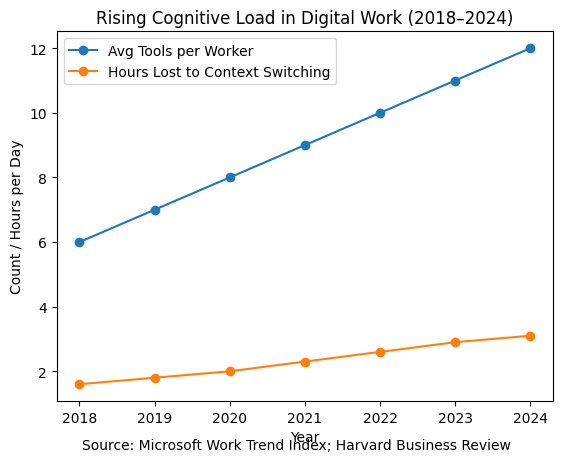
Consumer workflows make this concrete. Baymard Institute research shows that many checkout and onboarding flows contain far more steps and decisions than users expect. Each additional field or choice introduces measurable drop-off. Systems optimized for completeness consistently underperform systems optimized for completion.
Cloud environments exhibit the same failure in operational form. Modern stacks involve thousands of interdependent settings across compute, storage, networking, and security. Google’s Site Reliability Engineering research identifies operational toil – repetitive, manual work – as a primary scalability constraint. As toil increases, reliability declines and judgment degrades. Manual control becomes a liability rather than a safeguard.
The response is not automation alone, but a reassignment of responsibility. Intent-first systems infer goals from behavior and context. Machine learning models assess likely intent and risk. Analytics evaluate outcomes continuously. Orchestration layers act on those signals, sequencing actions and adjusting execution without constant human input.
The shift in workflow is tangible. Where legacy systems require navigating menus and interpreting dashboards, intent-first systems collapse effort into a single directive followed by review. On the web, pages reorganize around context and familiarity. In the cloud, platforms manage scaling and optimization within defined limits. As spend rises, delegation becomes less a feature and more a necessity.
What Changes for Humans and Organizations
For users, the most immediate impact is time and cognitive relief. Tasks that once required scanning dashboards and comparing options are increasingly completed through a single expressed goal followed by confirmation. Baymard Institute research shows that simplifying flows can improve completion rates by more than 35 percent, revealing how much effort is lost to avoidable friction.
A central driver is the reduction of data overload and decision fatigue. Behavioral economics shows that more information does not produce better decisions. Nielsen Norman Group research finds that users complete tasks faster and with fewer errors when information is prioritized and staged. Adaptive interfaces guide visual movement through a page, reducing hesitation and backtracking. The experience feels guided rather than demanding.
In practice, this shift already produces measurable gains. Microsoft’s internal deployment of Copilot across productivity workflows provides a concrete example. Prior to Copilot, tasks such as drafting summaries, extracting action items from meetings, or preparing first-pass documents required switching between multiple applications and manual synthesis. Microsoft reports that Copilot users complete these tasks 20–30 percent faster on average, with fewer context switches and reduced rework. What previously required navigating documents, notes, and dashboards becomes a single expression of intent followed by review and refinement.
Cloud platforms amplify this effect. When systems absorb optimization and scaling, teams move from watching dashboards to reviewing outcomes. Google’s Site Reliability Engineering research links reduced toil to improved reliability and team well-being, showing that delegation aligned with human limits benefits both systems and people.
The impact is uneven across regions and cultures. In mobile-first and lower-bandwidth environments, reduced navigation and data load disproportionately improve access. Cultural norms shape adoption as well. Societies with higher institutional trust adopt delegated systems more readily, while others demand stronger explainability and override mechanisms. Systems that adapt to these differences scale more effectively.
As systems take on more responsibility, trust becomes the next constraint.
Trust Is the New Interface
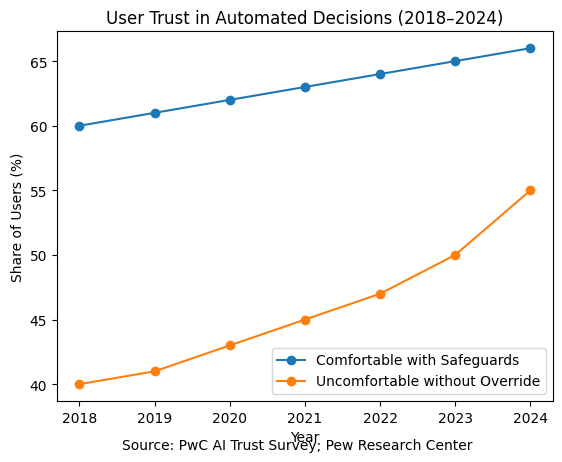
Trust is the binding condition for delegated systems, and it is measurable. Surveys summarized by PwC show that more than 55 percent of users are uncomfortable with automated systems making high-impact decisions without human override, even when accuracy is higher. The concern is not automation itself, but unbounded autonomy.
Enterprise data reinforces this pattern. Flexera reports that roughly 30 percent of cloud spend is wasted annually due to misconfiguration and poorly governed automation. In response, organizations impose budget caps, approval gates, and policy controls. These are not technical constraints. They are trust mechanisms.
Trust Thresholds and Governance Mechanisms
| Governance Dimension | Low-Risk Actions | High-Risk Actions |
|---|---|---|
| Automation Acceptance | High tolerance | Conditional acceptance |
| User Expectation | Silent execution | Explicit confirmation |
| Preferred Safeguards | Background monitoring | Hard limits and approval gates |
| Explainability Need | Optional or summary-level | Mandatory, plain-language rationale |
| Override Expectation | Rarely used | Always available |
Source: PwC AI Trust Survey; Pew Research Center; European Commission AI Governance Research
Behavioral economics explains why guardrails work. Humans are loss-averse. A single unexpected failure outweighs many successful automated actions. High-risk actions require friction – confirmation, delay, explanation – while low-risk actions proceed automatically. This mirrors everyday delegation.
Explainability strengthens trust without reintroducing overload. European Commission research shows that users report higher trust when automated decisions are accompanied by plain-language explanations, even when outcomes are unchanged. Knowing why something happened reduces anxiety.
Everyday systems already set expectations. Navigation apps reroute automatically but explain why. Email filters act silently but allow correction. Financial apps flag anomalies rather than require constant monitoring. Delegated systems succeed when autonomy is paired with interruption rights.
Identity and memory add tension. Pew Research Center surveys show that a majority of users worry about how long automated systems retain personal data. Platforms increasingly respond by treating identity as contextual, remembering what is needed for a task and nothing more.
Governance choices determine whether adaptive systems become trusted infrastructure or contested risk.
The Near Future of a Calmer Web
What began as a response to overload is now reshaping how the web is built and used. The near future is defined by fewer decisions, fewer steps, and less time spent operating software. Intent replaces navigation as the primary interface.
Market signals make this tangible. Global cloud and AI spending continues to rise, yet organizations struggle to extract value because human overhead has not fallen. Roughly one-third of cloud spend is wasted annually. Agentic browsers, copilots, and task-oriented assistants are moving from experiments to products, reframing interaction around delegated execution.
At the same time, analysts warn that many agentic AI initiatives will stall due to governance and trust failures. The winners will not be systems that automate everything, but those that automate selectively. Bounded autonomy, explainability, and reversibility are becoming competitive advantages.
The decisive questions ahead are practical. Where should systems act on behalf of users. What limits bind that action. When should humans be interrupted. How much memory is helpful without becoming intrusive. Platforms that answer these well will define the next phase of the internet.
The future web does not succeed by asking humans to do more. It succeeds by quietly removing the work they no longer have time, attention, or tolerance to perform.
Key Takeaways
-
The next phase of the web is driven by human cognitive limits, not technical constraints – value now comes from reducing decisions, steps, and attention demands rather than adding features.
-
Behavioral economics explains the shift: as data and choice expand, decision quality and task completion fall, making intent-first design economically and behaviorally necessary.
-
AI, analytics, and orchestration enable a structural separation between intent, decision-making, and execution, allowing systems to adapt continuously without constant human input.
-
The legacy model of dashboards, menus, and manual configuration no longer scales, particularly in cloud environments where complexity and cost compound rapidly.
-
Intent-first systems measurably improve outcomes by collapsing multi-step workflows into single directives, reducing context switching, and cutting task completion time by double digits in real deployments.
-
Adaptive interfaces reduce data overload and decision fatigue by staging information and guiding attention, creating calmer and faster user experiences.
-
Delegation shifts humans from operators to supervisors, focusing attention on outcomes and exceptions rather than continuous monitoring.
-
Trust is the primary constraint on adoption; users accept automation when autonomy is bounded, reversible, and explainable.
-
Guardrails, not granular controls, are the dominant governance mechanism, aligning system behavior with human loss aversion and risk tolerance.
-
Regional, cultural, and infrastructural differences shape adoption, favoring systems that adapt to context rather than assuming a universal user.
-
The competitive advantage of the future web lies in burden reduction: platforms that quietly remove cognitive and operational work will define the next phase of digital interaction.
Sources
- Baymard Institute; Cart Abandonment Rate Statistics; – Link
- Baymard Institute; Checkout Usability Research; – Link
- Microsoft; Work Trend Index Annual Report; – Link
- Microsoft; Copilot and Productivity Research; – Link
- Nielsen Norman Group; Decision Making and Cognitive Load in UX; – Link
- Nielsen Norman Group; Information Overload and Visual Hierarchy; – Link
- Gartner; Forecast: Public Cloud End-User Spending Worldwide 2025; – Link
- Flexera; State of the Cloud Report; – Link
- Google; Site Reliability Engineering Research and Publications; – Link
- PwC; Trust in Artificial Intelligence Survey; – Link
- Pew Research Center; How Americans Feel About Data Privacy; – Link
- European Commission; Ethics Guidelines for Trustworthy AI; – Link