

For much of the digital era, connectivity has been treated as a geographically contingent outcome. Digital services expanded where infrastructure could be economically deployed, while areas defined by low population density, difficult terrain, or unfavorable cost structures absorbed disconnection as a structural condition rather than a temporary failure. This assumption shaped telecommunications planning and, more broadly, economic geography, influencing firm location decisions, labor deployment, and the design of public services.
That assumption is now increasingly misaligned with economic reality. Direct to device satellite connectivity does not represent a breakthrough in bandwidth, nor does it displace terrestrial networks. Its significance lies in altering a more basic premise: that connectivity must disappear beyond the edge of physical infrastructure. When standard consumer devices can maintain even limited communication outside cellular footprints, coverage begins to function as a baseline condition rather than a competitive outcome, even where service quality remains constrained.
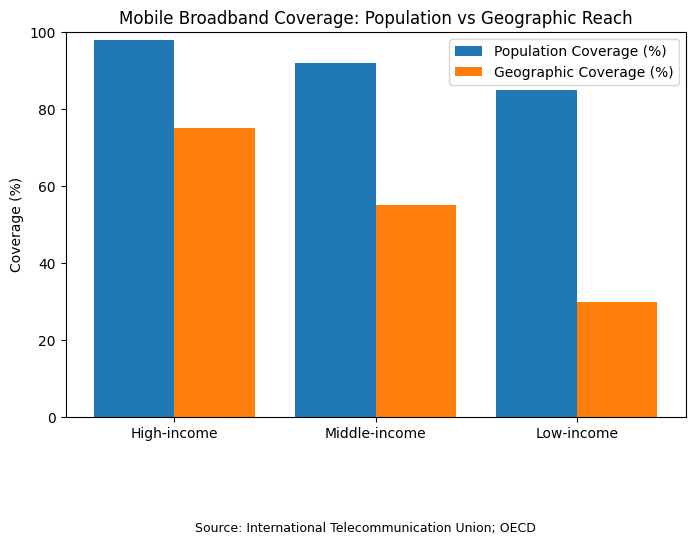
The persistence of coverage gaps explains why this shift carries material economic weight. International Telecommunication Union data indicate that more than 95 percent of the global population lives within reach of a mobile broadband network, yet roughly one third of the world’s population remains offline, and hundreds of millions more experience unreliable or intermittent service. In advanced economies, population coverage often exceeds 98 percent, but large geographic areas remain functionally unserved because extending terrestrial infrastructure into low-density regions fails basic economic thresholds.
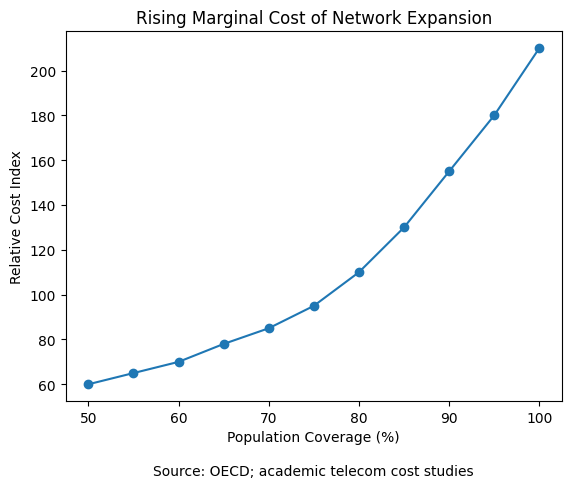
Cost has consistently been the binding constraint. Academic and regulatory research shows that the final segment of population coverage absorbs a disproportionate share of total network investment. In Europe and North America, estimates suggest that the last five percent of population coverage can account for 20 to 30 percent of total deployment costs, even before operating expenses are considered. The result is a durable equilibrium in which remoteness and mobility impose an embedded economic penalty, visible in higher operating costs, lower service reliability, and greater exposure to disruption.
Repricing Disconnection Risk and the Expansion of Economic Spillovers
Direct to device satellite connectivity alters this equilibrium by addressing the most expensive marginal coverage problem through a different cost structure. Rather than extending terrestrial infrastructure into every geography, it introduces a continuity layer that activates where terrestrial economics break down. This does not eliminate outages or replicate broadband performance, but it materially changes the expected cost of being disconnected.
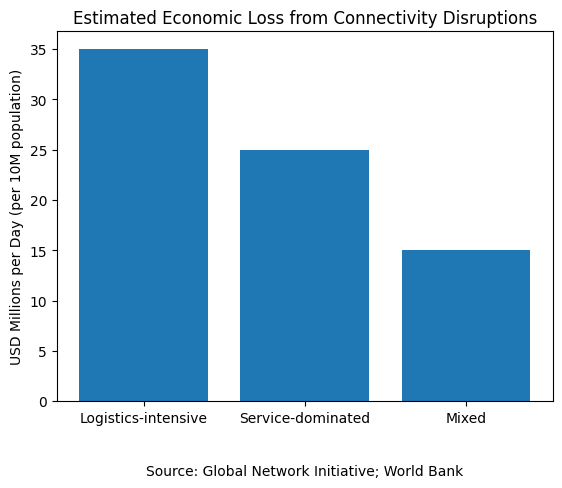
The central economic effect is a repricing of disconnection risk. Connectivity failures impose costs through delayed coordination, missed transactions, safety incidents, and operational blind spots. Research on the economic impact of internet disruptions shows that even localized outages can generate losses equivalent to tens of millions of dollars per day per 10 million inhabitants in highly digitized economies, particularly in logistics-intensive and service-oriented regions.
| Connectivity Function by Network Layer | ||
| Dimension | Terrestrial Networks | Satellite Continuity Layer |
|---|---|---|
| Primary economic role | High-capacity data delivery | Baseline availability and continuity |
| Typical use case | Urban and suburban coverage | Remote, mobile, marginal coverage |
| Bandwidth profile | High to very high | Low to moderate |
| Latency sensitivity | Low tolerance | Moderate tolerance |
| Failure mode | Localized outages | Capacity constraints |
| Policy relevance | Infrastructure expansion, competition | Universal service, resilience |
| Source: OECD; International Telecommunication Union | ||
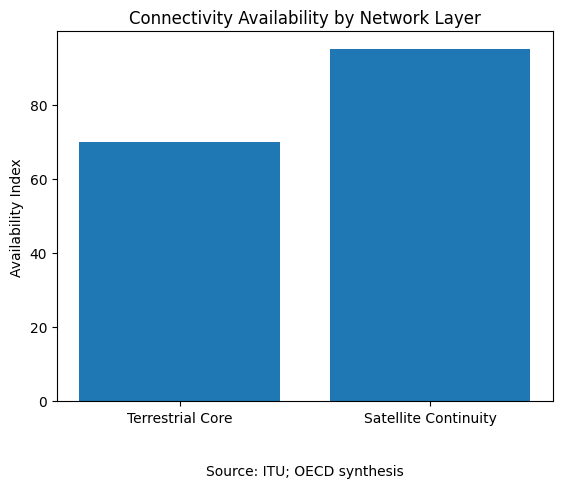
The value of satellite-to-device connectivity lies in preserving minimal communication during these gaps. Low-bandwidth messaging, signaling, and location data can reduce the severity and duration of disruption by sustaining coordination and enabling emergency response while terrestrial networks recover. Economically, this lowers the expected cost of disconnection events rather than increasing average network performance, which explains why even constrained capacity can deliver outsized systemic value.
Once disconnection risk is repriced, spillovers extend well beyond communications markets. Logistics and transport operations benefit from persistent signaling across long-haul corridors and remote depots, enabling dispatchers to track assets and respond to delays without deploying private networks. Energy and utilities operators gain more consistent visibility into distributed infrastructure, supporting predictive maintenance and faster fault detection. Public safety systems benefit from maintained coordination during disasters and infrastructure failures, reducing secondary economic losses that OECD analysis suggests can reach 0.1 to 0.3 percent of annual regional GDP following major disruptions.
Over time, these effects influence how risk itself is priced. Faster incident verification and improved situational awareness reduce response timelines and claim severity, shaping underwriting assumptions for remote operations, infrastructure projects, and mobile industries. What begins as a marginal connectivity layer becomes embedded in broader systems of economic risk management.
Micro-Level Effects on Firms, Workers, and Quality of Life
At the level of households and firms, the effects of baseline connectivity are incremental but cumulative. For individuals, continuity improves safety, navigation, and access to information in areas previously characterized by dead zones. Emergency satellite messaging embedded in mainstream smartphones allows stranded motorists, outdoor workers, and rural residents to request assistance or share location data when cellular networks are unavailable, reducing reliance on delayed rescue or chance encounters.
For firms, the implications are more structural. When managers can assume that workers and assets will remain intermittently reachable across wider geographies, workflows can shift away from rigid check-in schedules toward continuous status awareness. Field service providers, infrastructure operators, and logistics firms can confirm task completion or equipment status without waiting for crews to return to coverage, reducing idle time and improving asset utilization.
Labor market effects emerge more gradually. World Bank research links reliable digital access to higher labor participation, improved income stability, and greater access to remote and flexible work arrangements. In practice, baseline connectivity enables professionals to operate across wider geographies without losing contact with employers and allows mobile or seasonal workers to coordinate employment and services without persistent communication gaps.
Quality-of-life effects follow similar patterns. Connectivity continuity supports access to digital financial services, healthcare coordination, education resources, and social networks. In rural and underserved communities, where device penetration may be relatively high but service reliability low, these improvements translate into fewer missed appointments, faster access to emergency care, and more consistent participation in digital markets.
| Marginal Cost Dynamics of Network Expansion | ||||
| Coverage Segment | Typical Geography | Capital Intensity | ROI Profile | Policy Intervention |
|---|---|---|---|---|
| 0–80% | Dense urban corridors | Low | High | Minimal |
| 80–95% | Suburban and peri-urban | Moderate | Declining | Targeted subsidies |
| 95–100% | Rural and remote terrain | Very high | Low or negative | Heavy public support or alternatives |
| Source: OECD; academic telecommunications cost studies | ||||
Regional Variation, Structural Constraints, and the Pace of Change
While the underlying economic mechanism is consistent, outcomes vary sharply by region. In high-income economies, where internet adoption exceeds 90 percent, the primary benefit of satellite integration is resilience rather than access. Hybrid networks reduce the economic cost of natural disasters, infrastructure failures, and extreme weather by preserving coordination capacity, allowing emergency services, utilities, and businesses to maintain basic operations when terrestrial networks are impaired.
In emerging and developing markets, the stakes are higher and more complex. Satellite connectivity can reach regions that terrestrial networks may not serve for decades, accelerating access to digital services for remote schools, clinics, and small enterprises. At the same time, affordability constraints remain significant. Device compatibility, pricing structures, and subscription costs risk concentrating benefits among higher-income users and firms unless addressed through targeted policy measures.
Dependence on foreign-owned satellite infrastructure introduces additional considerations related to sovereignty, regulatory oversight, and long-term sustainability. If satellite layers substitute for rather than complement terrestrial investment, countries risk entrenching a two-tier connectivity model in which urban centers receive high-capacity networks while rural regions rely indefinitely on limited continuity services. Capacity constraints, jurisdictional complexity, and platform-level control over satellite access will all shape the pace and distribution of benefits.
| Regional Integration Outcomes | ||||
| Region Type | Primary Benefit | Main Constraint | Policy Risk | Likely Outcome |
|---|---|---|---|---|
| High-income economies | Resilience | Regulatory complexity | Overregulation | Hybrid network optimization |
| Upper-middle-income | Expanded access | Affordability | Uneven adoption | Partial integration |
| Low-density regions | First-time continuity | Device access | Dependency risk | Satellite-led access layer |
| Source: International Telecommunication Union; World Bank; OECD | ||||
Implications of Integration for Policy, Infrastructure, and Governance
The long-term impact of direct to device satellite connectivity will depend less on technological capability than on institutional design. Policymakers face the challenge of integrating satellite layers into universal service strategies without undermining incentives for terrestrial investment. Infrastructure planning must treat satellite connectivity as complementary, addressing marginal coverage gaps while preserving incentives to expand ground networks where density supports it.
Regulatory frameworks will need to adapt to hybrid systems that cross borders and traditional network categories. Spectrum allocation, competition policy, consumer protection, and data governance all require reassessment in a context where connectivity is layered rather than territorially bounded. Public–private coordination will be particularly important for emergency services and disaster response, where continuity can generate public value that exceeds direct commercial returns.
Absent deliberate alignment, continuity benefits may accrue primarily to higher-income users and firms, limiting broader inclusion gains. Policy design will therefore play a decisive role in determining whether satellite connectivity reinforces or mitigates existing economic divides.
| Policy and Governance Implications of Satellite Integration | ||
| Policy Area | Existing Framework | Impact of Satellite Integration |
|---|---|---|
| Universal service | Tower-based obligations | Redefinition of coverage metrics |
| Spectrum management | Terrestrial-focused licensing | Cross-border coordination |
| Competition policy | Operator-centric | Platform and device power |
| Emergency response | Terrestrial priority | Hybrid continuity planning |
| Infrastructure incentives | Capex subsidies | Complementarity enforcement |
| Source: OECD; national regulatory synthesis | ||
A Layered Future for Connectivity and Economic Participation
Direct to device satellite connectivity will not replace terrestrial networks. Its significance lies in redefining baseline assumptions about availability. When minimal communication becomes feasible across most geographies, the economic cost of distance declines, and participation becomes less contingent on infrastructure density.
The result is a more layered connectivity environment, where performance varies but disconnection becomes less common. This supports greater resilience, wider geographic participation, and new forms of economic organization. Satellites will ultimately be judged not by speed or capacity, but by their contribution to continuity, inclusion, and economic stability.
The broader transformation is structural rather than technological. Connectivity is evolving from a location-dependent outcome into a foundational economic input, reshaping how societies organize work, manage risk, and extend participation across geography.
Key Takeaways
- Satellite-to-device connectivity primarily reprices disconnection risk rather than increasing bandwidth.
- Even low-bandwidth continuity delivers outsized economic value by reducing disruption costs.
- Spillovers extend across logistics, infrastructure, labor markets, insurance, and public safety.
- Regional outcomes depend on affordability, regulation, and complementarity with terrestrial investment.
- Connectivity is becoming a layered economic input that reduces the structural cost of distance.