

Connected living is no longer an emerging phenomenon in parts of the world where digital infrastructure, affordability, and adoption have converged. Middle-class households in suburban areas of the United States and Western Europe provide a useful baseline for understanding this maturity. They do not represent a global norm, but they illustrate what everyday life looks like once connected systems become routine rather than exceptional.
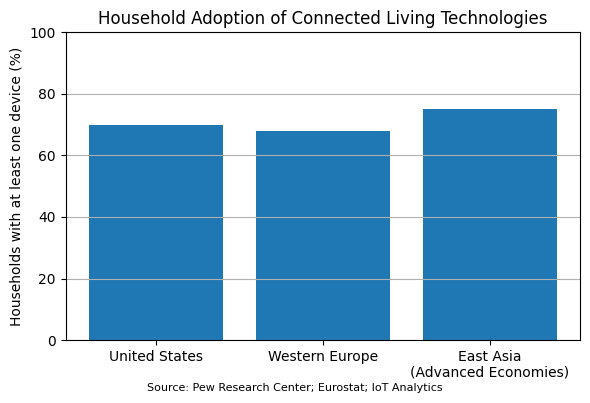
Across OECD economies, fixed broadband penetration now exceeds 85 percent and approaches 90 percent in much of Western Europe and the United States. Survey data indicate that between 65 and 75 percent of households in these regions own at least one smart home device, with average device counts per household continuing to rise. Importantly, many of these technologies are not adopted through deliberate experimentation, but arrive through bundled services, building standards, employer benefits, or infrastructure upgrades that make connectivity a default condition rather than a discretionary choice.
At this baseline, connectivity is embedded across both domestic and personal environments. Voice-enabled assistants such as Alexa and Google Assistant coordinate household routines, manage calendars, and act as control hubs for other connected devices. Smart thermostats, lighting systems, and energy monitors automate comfort and efficiency, while connected security cameras and doorbells enable continuous, app-based surveillance. These systems increasingly operate as integrated environments rather than isolated tools.
Connected living also extends into the personal sphere through wearable and health-related technologies. Smartwatches, fitness trackers, and connected health devices collect continuous streams of biometric data related to sleep, activity, heart rate, and movement. These data flows integrate personal improvement into everyday decision-making, linking health awareness, productivity, and lifestyle management into persistent feedback loops that subtly shape behavior over time.
Beyond the household, connected living is reinforced by broader urban and digital infrastructure. Smart grids dynamically balance electricity supply and demand, and in Great Britain smart meters are now installed in approximately 70 percent of homes and small businesses, enabling near real-time feedback and demand-side participation. In the United States, utilities increasingly integrate smart thermostats into demand response programs, with participation rates in some regions exceeding 40 percent of eligible households. Sensor-enabled infrastructure supports predictive maintenance of roads, lighting, and utilities, while connected transportation systems manage traffic flow and public transit in real time.
These layers are increasingly coordinated through integrated cloud platforms. Large technology ecosystems link devices, services, and data across home, work, mobility, and public space, often through a single digital identity. Credentials, preferences, and behavioral data move seamlessly across environments, allowing connected living to function as a continuous system rather than a collection of discrete products.
Taken together, these conditions define a mature phase of connected living in which technology is no longer encountered as a discrete product, but as an ambient environment. Middle-class households in the United States and Western Europe illustrate what it means to inhabit such a system, where automation, data, and connectivity quietly shape routines, expectations, and interactions. This baseline frames the analysis that follows and provides a reference point for understanding how connected living is experienced, contested, and adapted across different regions, cultures, and generations.
Efficiency Visibility and Control in Everyday Life
The principal value of connected living lies in efficiency generated through continuous data visibility and coordination across systems. In mature environments, automation reduces the volume of routine decisions households must make while increasing awareness of outcomes. The result is not acceleration, but smoother daily operation and lower cognitive overhead.
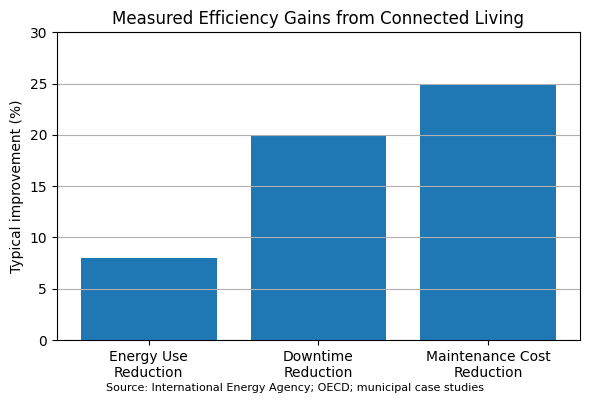
Energy management remains the clearest example. Smart meters and connected thermostats allow households to observe consumption patterns in near real time and respond automatically to price signals. Studies across Europe and North America associate real-time feedback with electricity reductions of 5 to 10 percent, particularly where time-of-use pricing is implemented. Over time, energy use becomes a managed behavior rather than a passive expense, reinforcing efficiency through habit rather than enforcement.
Beyond energy, similar dynamics apply to home security, appliance management, and climate control. Connected systems reduce the need for manual checks and repetitive actions by shifting oversight to dashboards and alerts. For many households, this translates into fewer interruptions and greater predictability rather than constant engagement.
Connected living also expands temporal and spatial flexibility. Remote access to climate, lighting, and security systems allows households to manage environments independently of physical presence. This capability became especially relevant as remote and hybrid work expanded across the United States and Europe, now encompassing roughly 40 percent of professional employment. Homes increasingly adapt to human schedules rather than enforcing them, enabling more fluid coordination between work, caregiving, and leisure.
Reliability is a quieter but equally consequential benefit. Sensor-based monitoring enables earlier fault detection and preventative maintenance across infrastructure and appliances. Municipal deployments show reductions of 10 to 30 percent in unplanned outages and maintenance costs. For residents, these gains register as fewer disruptions rather than visible innovation, reinforcing trust through consistency rather than novelty.
________________________________________________________________
Friction Between Automation and Human Behavior
Despite efficiency gains, connected living introduces frictions rooted in human behavior rather than technical limitation. Automation reduces manual effort but increases cognitive demand. Alerts, notifications, and dashboards compete for attention, and their cumulative effect varies widely. Roughly one quarter of smart home users report notification fatigue or stress associated with constant system feedback.
Configuration and maintenance remain persistent challenges. Even in digitally fluent households, setup, updates, and troubleshooting often fall to a single household member, reinforcing existing divisions of domestic labor. Learning curves and compatibility issues can undermine perceived value, particularly when benefits are incremental rather than transformative.
Efficiency itself can become a source of tension. Smart energy systems may optimize for cost or grid efficiency at the expense of comfort or routine. Between 20 and 30 percent of households disengage from advanced automation features over time, reverting to manual control when systems feel intrusive or misaligned with lived experience. In these cases, automation is not rejected outright but selectively constrained.
Trust magnifies these frictions. Connected living generates detailed behavioral data that reveals routines, presence, and habits. While adoption remains high, 60 to 80 percent of users express concern about how data is collected and used. Resistance emerges most clearly during forced transitions, such as mandatory infrastructure upgrades, or after high-profile data breaches. The friction is not opposition to technology, but concern over agency, consent, and long-term control.
Benefits and Friction Points in Connected Living
| Domain | Typical Benefits | Common Frictions |
|---|---|---|
| Energy Management | 5–10% reduction in household energy consumption | Comfort trade-offs, automation overrides |
| Home Security | Remote monitoring and access | False alerts, data exposure concerns |
| Infrastructure Reliability | 10–30% reduction in outages and maintenance costs | Dependence on system uptime |
| Daily Routines | Reduced cognitive load | Alert fatigue, learning curves |
Source: International Energy Agency; IoT Analytics; municipal case studies
Living Within Connected Systems
As connected living matures, the next phase is defined less by device proliferation and more by integration and autonomy. Edge computing, interoperability standards, and AI-driven automation are designed to reduce latency and coordination costs while minimizing user intervention. Forecasts point to continued low double-digit growth in device deployment in advanced economies, but marginal value increasingly comes from system coherence rather than scale.
This shift changes the nature of trust. As systems operate more autonomously, residents move from managing devices to accepting environments that make decisions on their behalf. Reliability, transparency, and accountability therefore become more important than feature richness, particularly as failure in automated systems carries higher social and economic cost.
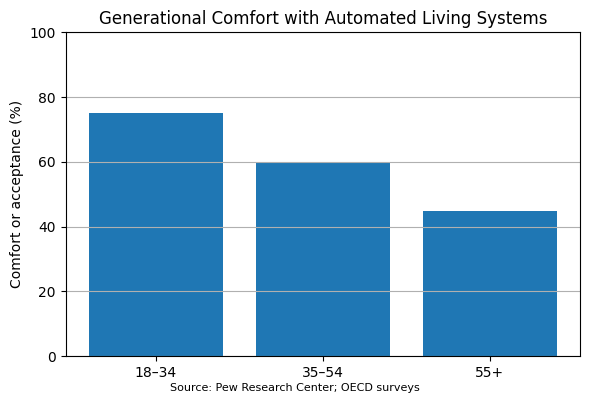
Generational differences shape this transition. Younger cohorts, having grown up with connectivity as a default condition, show significantly higher acceptance of autonomous systems. Surveys indicate a 15 to 25 percentage point gap in comfort with automation between younger and older users. Younger users are also less likely to frame issues of digital citizenship, data sovereignty, and privacy as immediate personal concerns, instead treating them as abstract or institutional matters. Older cohorts tend to evaluate these systems through the lens of rights, control, and exposure.
Generational Attitudes Toward Connected Living and Civic Implications
| Age Group | Comfort With Automation | View of Data and Privacy | Primary Orientation |
|---|---|---|---|
| 18–34 | High | Abstract or institutional concern | Convenience, seamless experience |
| 35–54 | Moderate | Balanced concern | Efficiency with oversight |
| 55+ | Lower | Personal and rights-based concern | Control, reliability, clarity |
Source: Pew Research Center; OECD digital society surveys
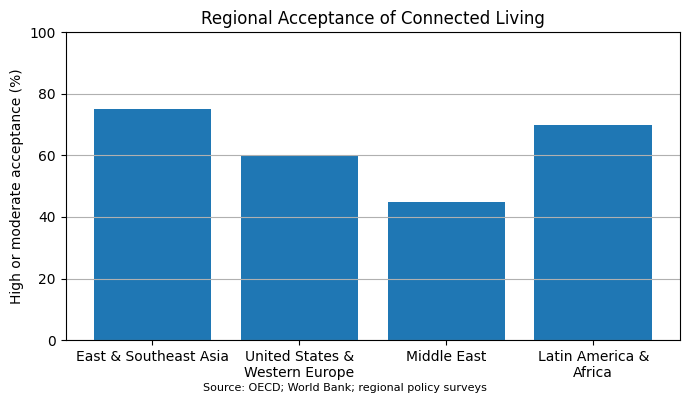
Regional patterns further complicate adaptation. In much of East and Southeast Asia, higher institutional trust, dense urban environments, and system-oriented cultural norms have produced broader acceptance of ambient sensing and automated environments. Parts of the Middle East exhibit greater caution, shaped by social norms, religious considerations, and sensitivities around surveillance and data governance. Europe and the United States present a paradoxical case: technologically advanced yet increasingly skeptical, with public debate strongly focused on privacy, data rights, and individual agency.
In Latin America and parts of Africa, connected living is often met with comparatively high openness. Lower legacy infrastructure, fewer entrenched systems, and strong incentives to leapfrog inefficiencies contribute to acceptance. In these contexts, connectivity is frequently framed as opportunity rather than intrusion, even as governance frameworks lag behind adoption. These regional differences suggest that acceptance of connected living is shaped as much by cultural and institutional context as by technical readiness.
––––––––––––––––––––––––––––––––––––
Connected Living as a Long Term Human Settlement
Connected living has crossed a structural threshold in advanced economies. Using US and Western European suburbia as a baseline reveals what happens when connectivity becomes ordinary rather than exceptional. Daily life becomes more predictable and responsive, while dependence on systems operating largely out of sight increases.
The central insight is that connected living is not simply about efficiency. It reshapes how people relate to their homes, routines, and sense of autonomy. Data and automation can reduce effort and uncertainty, but only when systems align with human behavior, cultural expectation, and tolerance for abstraction. When alignment fails, efficiency becomes friction.
As connected living expands globally, early adopters provide both a template and a warning. Technological capability alone does not determine success. Long-term value depends on whether connected environments integrate smoothly into everyday life, preserve agency, and adapt to regional and generational realities. Connected living is becoming a durable human settlement. Its success will be measured not by visibility, but by whether it quietly improves life without demanding constant negotiation.
Regional Patterns of Connected Living Adoption and Acceptance
| Region | Adoption Level | Primary Drivers | Key Societal Concerns |
|---|---|---|---|
| United States & Western Europe | High | Mature infrastructure, service bundling, utility and insurance incentives | Privacy, data rights, individual agency |
| East & Southeast Asia | High | Institutional trust, system-oriented culture, urban density | Governance transparency, state and corporate data use |
| Middle East | Moderate | State-led smart city investment, infrastructure modernization | Cultural norms, religious considerations, surveillance sensitivity |
| Latin America | Moderate to High | Leapfrogging legacy systems, mobile-first adoption | Cost, access equity, governance maturity |
| Africa | Moderate | Infrastructure gaps driving innovation, mobile connectivity | Affordability, reliability, institutional trust |
Source: OECD; World Bank; regional technology and policy adoption studies
––––––––––––––––––––––––––––––––––––
Key Takeaways
• Connected living in advanced economies now functions as infrastructure rather than innovation.
• Efficiency gains are real, but behavioral friction and trust concerns remain persistent.
• Younger generations show higher acceptance of automation and lower concern for civic implications such as data sovereignty.
• Regional acceptance varies widely based on cultural, institutional, and economic context.
• Long-term success depends on alignment between technology, human behavior, and governance norms.
––––––––––––––––––––––––––––––––––––
- Sources
IoT Analytics; Number of connected IoT devices growing 13% to 18.8 billion; – Link - UK Department for Energy Security and Net Zero; Smart meters in Great Britain quarterly update; – Link
- International Energy Agency; Digitalisation and Energy; – Link
- Organisation for Economic Co-operation and Development; Smart Cities and Inclusive Growth; – Link
- Pew Research Center; Americans’ Use of Mobile Technology and Home Broadband; – Link
- Harvard Kennedy School Data-Smart City Solutions; How Smart City Barcelona Brought the Internet of Things to Life; – Link
- Institute of Internet Economics; Connected Living and Human-Centered Infrastructure in the IoT Era; – Link