
Europe enters the second half of 2026 as a highly connected, regulation-led internet economy whose challenge has shifted from access to absorption. Overall the region is fully connected. Digital systems now shape how firms operate, governments deliver services, households participate in markets, and cross-border activity is coordinated. The question is whether Europe can turn digital capacity into productivity and market coordination fast enough to strengthen competitiveness.
Europe’s model rests on a distinctive bargain. The region often imports the technological frontier without carrying the full development burden, but adoption integrates through the dual umbrella of the individual sovereign state and in alignment with EU rules. On the individual country level full integration faces hurdles with local business practices, uneven talent pools, and established institutions. Regulation protects trust and gives Europe credibility in making digital markets governable, but it also slows expansion and puts tough environments for capital to be profitable. The result is a modern internet surge filtered through Europe’s political economy: stable and trusted, but slower and more negotiated.
Europe’s internet economy is now a regional issue due to the high number of small states that are interconnected as a network and inter-reliant as a digital infrastructure. EU and non-EU economies share digital supply chains, financial systems, infrastructure dependencies, and commercial standards that do not stop at international boundaries.
By mid-2026, Europe is in a coordination phase. ICT is near saturation, cloud infrastructure is mainstream, AI is accelerating, and connected production systems are beginning to reshape industry. Digital systems now sit within the fabric of ordinary economic life. Public trust has become part of the infrastructure that allows digital markets to function.
The region is connected, but not uniformly. As each country is sovereign, internet rollout has been through the expansion of commercial services – especially mobile – across the region. Each country is small in size, and grown irrespective of the others. Networks are a kludge collection of hardware and public (but privately owned) networks. As phone services and internet align with utilities, each country has a unique footprint and network. This imbalance makes it poorly equipped for the data-heavy, AI-enabled economy it is trying to build.
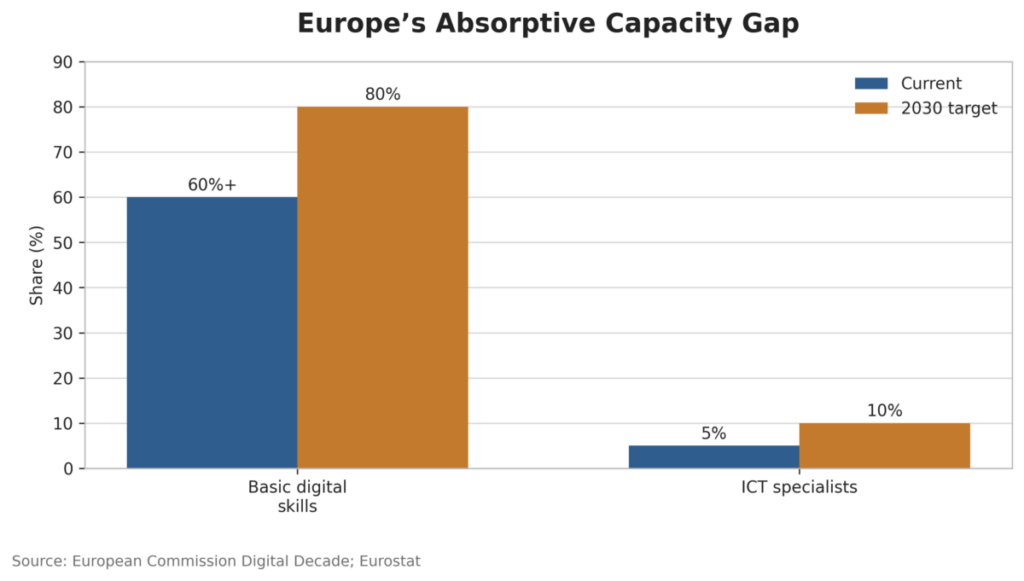
In 2026, 46.7% of EU enterprises use cloud computing, 39.9% use data analytics, and nearly one-fifth deploy AI. More than 60% of Europeans have at least basic digital skills, while ICT specialists account for only 5% of employment. Basic 5G reaches 96.8% of EU households, yet only 17.29% of EU enterprises with fixed internet connections operate above 1 Gb/s. Access is broad, but the ability to redesign work around digital systems remains uneven.
In addition, Europe is not a single-speed digital economy. Technology follows industrial structure, capital depth, and institutional capacity. Northern and Western Europe generally move faster through deeper capital markets and stronger public infrastructure; while Eastern Europe advances through established manufacturing, smaller firms, and local market constraints. Europe’s competitive question is no longer whether it is modernizing. It is whether modernization can compound across borders quickly enough to lift regional productivity rather than remain a set of aligned national cases.
From Digital Access Into Economic Absorption
| Name | 2025 | 2026 (est)* | % Growth | Source |
|---|---|---|---|---|
| EU enterprises using cloud computing | 46.7% | 49.0%* | 4.9% | European Commission Digital Decade |
| EU enterprises using data analytics | 39.9% | 41.0%* | 2.8% | European Commission Digital Decade |
| EU enterprises using AI technologies | 19.95% | 22.0%* | 10.3% | Eurostat |
| Basic 5G household coverage | 96.8% | 97.5%* | 0.7% | European Commission Digital Decade |
Regional Scope and Market Structure
A Fragmented but Highly Coordinated Digital Region
Connectivity now rests among Europe’s economic foundations. A firm operating across national borders may face different institutions, but it still depends on a uniform digital marketplace, trusted data systems, and well established digital rules.
Europe’s access problem no longer rests on the notion of basic connection.Basic 5G reaches 96.8% of EU households, and in 2025, 95.01% of EU enterprises with at least 10 employees used fixed broadband.
The deeper issue is connection quality. Only 17.29% of those enterprises had fixed internet connections above 1 Gb/s, limiting their ability to use cloud systems, adopt AI tools, secure transactions, and compete across borders at modern speed. Being online is not the same as being digitally equipped.
An individual citizen’s digital identity has been established and managed through regulation. It stands a foundational block with, connectivity and trust infrastructure. EU Digital Identity Wallets are set to launch at the end of 2026, turning identity into a uniform standard. Much like an id card, it is an unique digital identity that enables digital markets and becomes a tool rather than a background administrative system. The economic gain comes when identity can provide authenticity and move securely through digital systems. This method creates immediate efficiencies as validity and credibility are nearly instant. Modern standards reduce delay and processing times without adding privacy risk or institutional complexity.
Europe’s true test is whether connection becomes participation, productivity, and cross-border scale. Europe’s digital economy gains strength only when these systems interoperate rather than develop as isolated national cases.
Region Specifics
| Name | 2025 | 2026 (est)* | % Growth | Source |
|---|---|---|---|---|
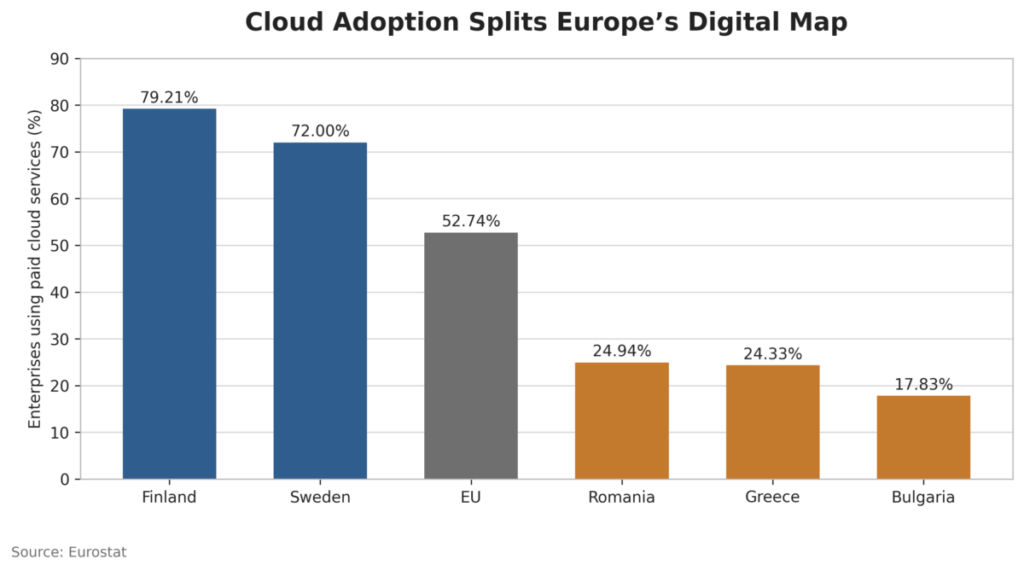
| Finland enterprise cloud adoption | 79.21% | 81.0%* | 2.3% | Eurostat |
| Sweden enterprise cloud adoption | 72.00% | 74.0%* | 2.8% | Eurostat |
| Bulgaria enterprise cloud adoption | 17.83% | 19.0%* | 6.6% | Eurostat |
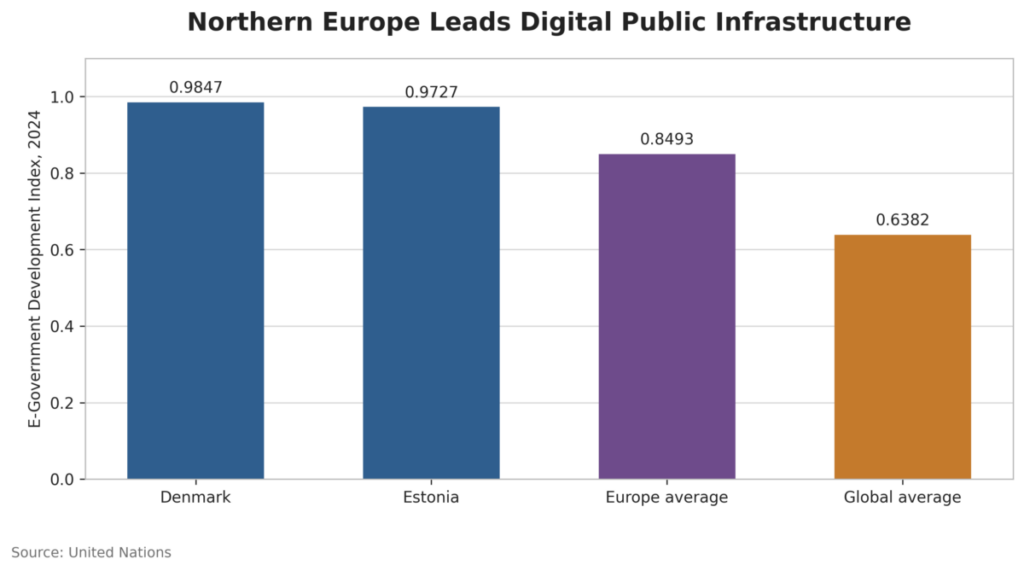
| Europe average e-government index | 0.8493 | 0.850* | 0.1% | United Nations |
Connectivity and Market Access
Basic Access Is Strong, but Productive Capacity Remains Uneven
The region’s infrastructure position is strong at the access layer but weakens where digital quality becomes economic capacity. In 2025, 95.01% of EU enterprises with at least 10 employees used fixed broadband, but only 17.29% had fixed internet connections above 1 Gb/s.
That gap matters because modern participation depends on more than a basic connection. Firms need enough speed, security, cloud access, and institutional reliability to use data-intensive tools and compete across borders.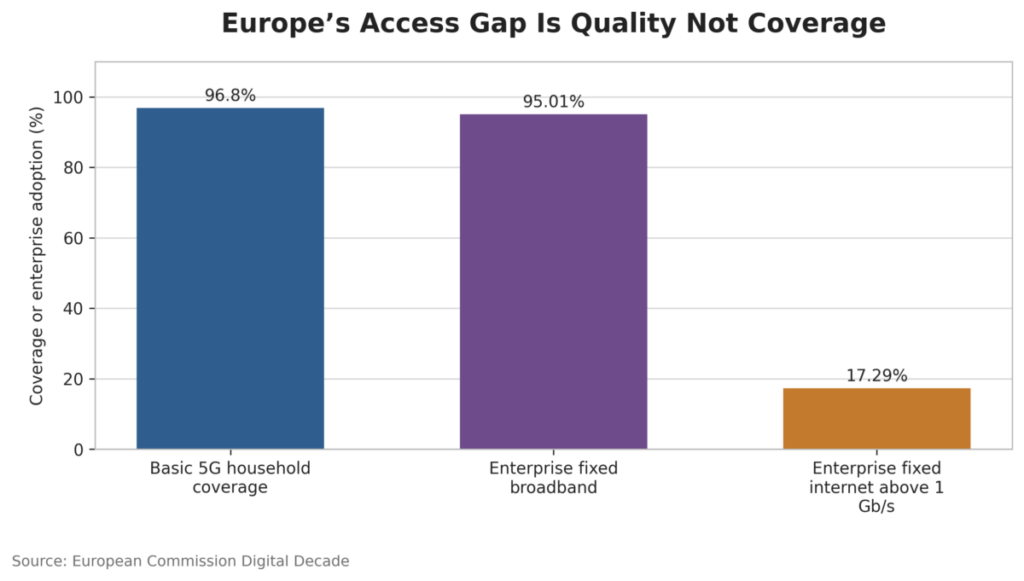
The AI Act also moves toward full applicability in 2026, making Europe a test case for regulated AI adoption as an operating condition, not only a legal framework. Together, broadband quality, trusted identity, and AI governance show how Europe’s access challenge has changed. The region is broadly connected, but productive capacity now depends on whether digital systems are fast, secure, trusted, and usable enough to support modern economic activity.
AI, Cloud, and Productivity
Enterprise Adoption Is Rising Faster Than Organizational Absorption
Enterprise digitization shows that Europe’s internet economy has moved from connectivity into operational redesign. Digital tools now shape how work is organized, how decisions are made, how risk is assessed, and how firms reach markets. The practical shift is that the internet is has grown beyond being a communications layer for business. It is becoming part of the operating core that determines how firms plan, manage, and respond to disruption.
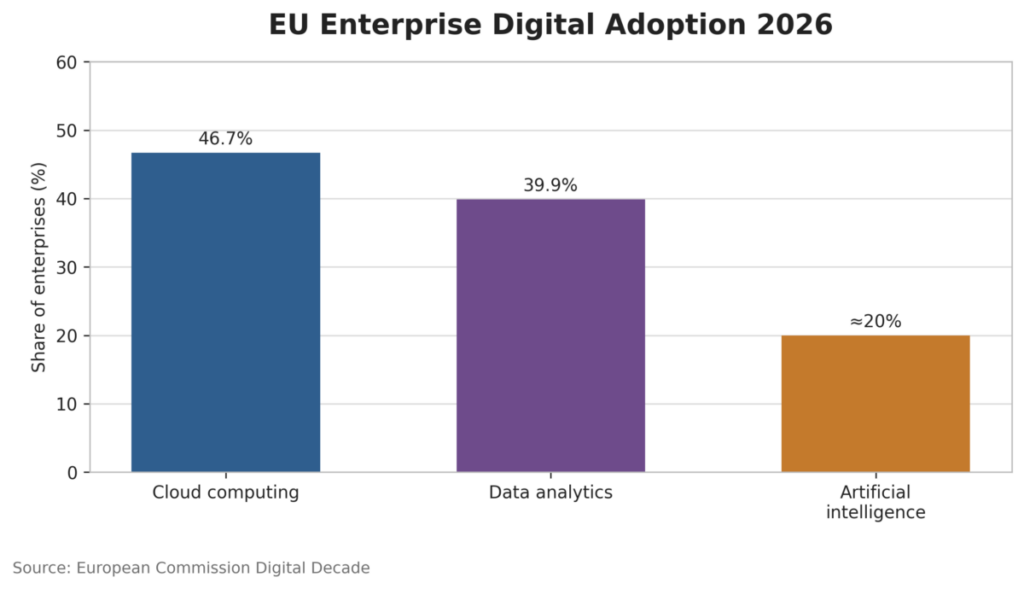
Cloud platforms have crossed into mainstream enterprise infrastructure. EU enterprise cloud use reached 52.74% in 2025, while 46.7% of enterprises use cloud computing in the 2026 Digital Decade reporting frame. The difference between use and productivity now depends on depth of integration. A firm can use cloud services for basic storage or communication and still remain far from a digitally redesigned business model.
Data analytics and AI mark the next stage of the shift. In 2026, 39.9% of enterprises use data analytics, and nearly one-fifth deploy AI. The meaningful change is not the technology label but the operational effect: shorter delays, clearer records, fewer failures, faster settlement, and better-timed decisions. These tools become economically important when they change how people work rather than simply add another software layer.
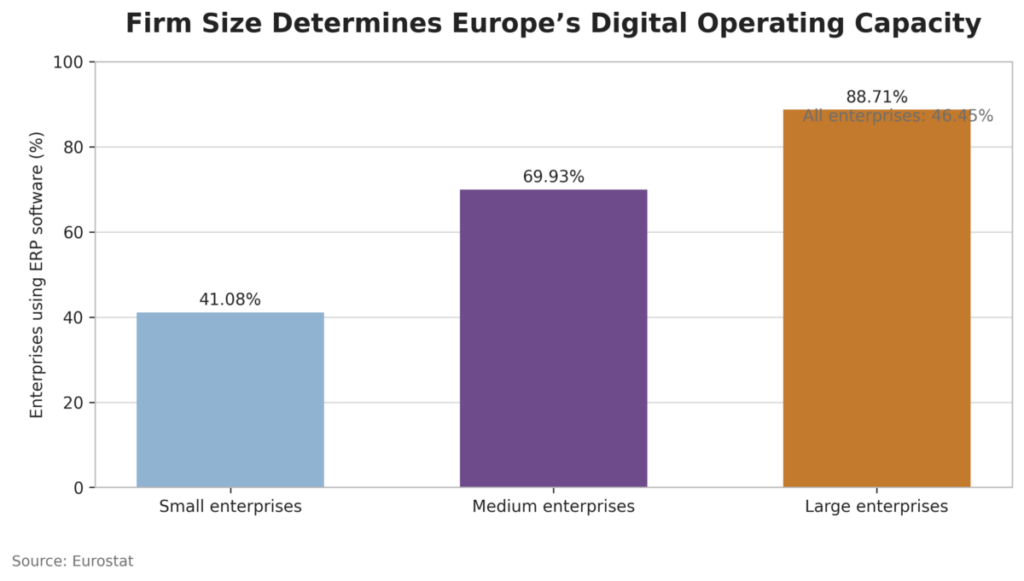
ERP adoption shows how deeply digital systems are entering firm management. In 2025, 46.45% of EU enterprises used enterprise resource planning software. Large firms are embedding digital systems into their operating core, while smaller firms adopt more cautiously because staff capacity is thinner and implementation risk is harder to absorb. This firm-size divide is central to Europe’s productivity challenge: adoption is rising, but organizational absorption remains uneven.
Productive Capacity Remains Uneven
| Name | 2025 | 2026 (est)* | % Growth | Source |
|---|---|---|---|---|
| Basic 5G household coverage | 96.8% | 97.5%* | 0.7% | European Commission Digital Decade |
| Enterprise fixed broadband use | 95.01% | 95.5%* | 0.5% | Eurostat |
| Enterprise fixed internet above 1 Gb/s | 17.29% | 18.3%* | 5.8% | Eurostat |
| EU Digital Identity Wallet rollout | Build-out | Launch planned | n/m | European Commission |
Sectors, Commerce, and Industrial Systems
Digital Coordination Is Reshaping Europe’s Production Base
Europe’s strongest sectoral gains appear where internet technologies enter the operating core of production, finance, public services, and infrastructure. The focus is not simply that more sectors are digitizing; it is that digital systems are lowering the coordination costs that have long shaped performance.
Emerging technologies are evolutionary and disruptive. Competitive advantages can be had through first market movers or and disruptive to established companies that have acquired a large amount of technical debt. A manufacturer using connected systems can keep output steadier and respond earlier to equipment problems. A bank using digital identity and fraud analytics can reduce settlement risk. A public agency using online credentials can make services faster without weakening accountability. These examples point to the same economic shift: digital tools create value when they change how institutions coordinate work.
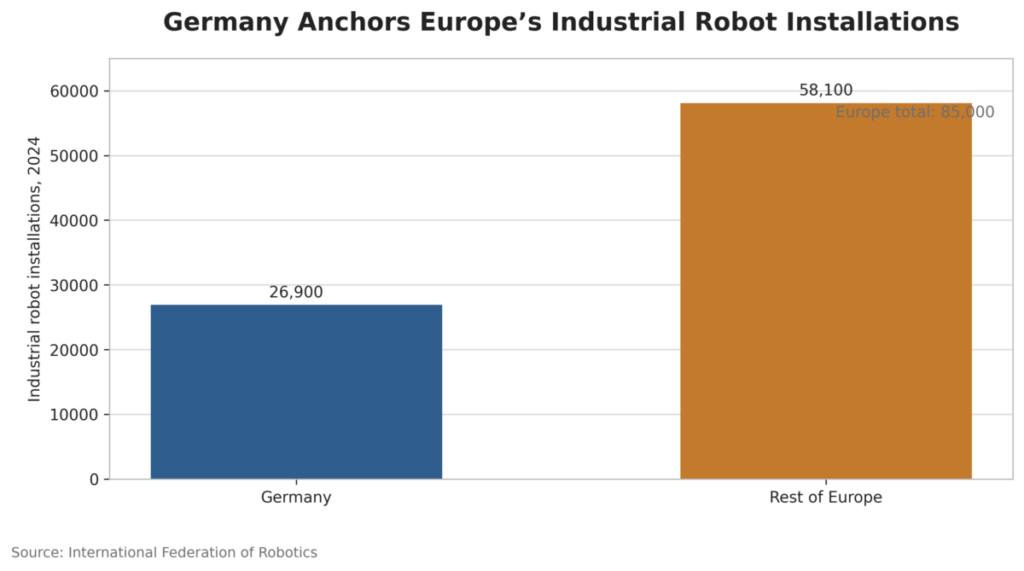
Industrial digitization remains one of Europe’s strongest positions. Industrial robot installations in Europe reached 85,000 units in 2024, the second-highest level recorded, with Germany remaining the region’s main automation anchor. The production story is therefore not only about software adoption. It is about the deeper integration of data, machinery, labor, and management into more responsive industrial systems.
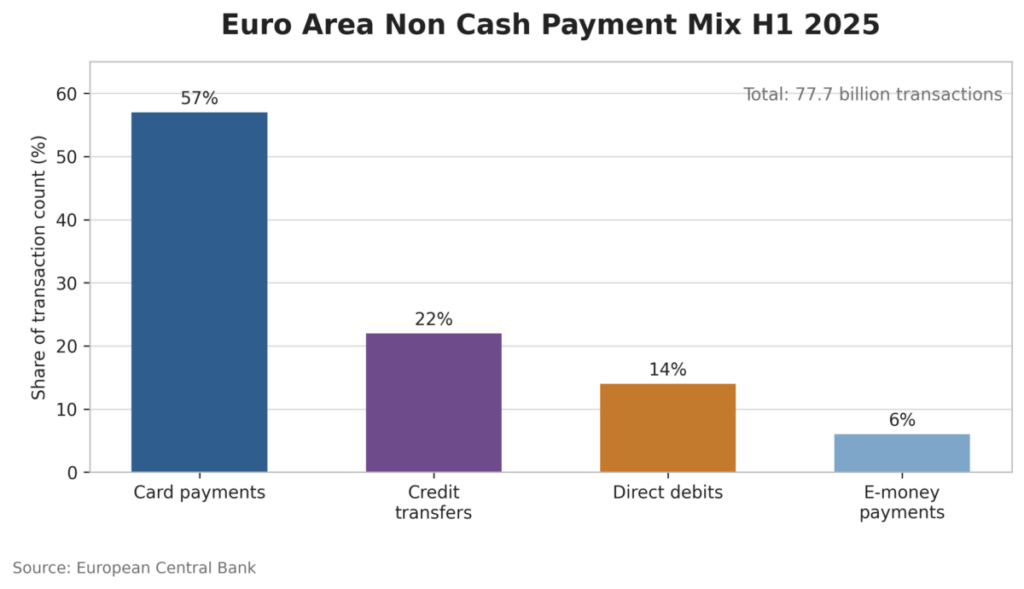
Commerce and finance moved early because transactions depend heavily on information and trust. In the first half of 2025, euro-area non-cash payments reached 77.7 billion transactions, up 7.7% from a year earlier, with card payments accounting for 57% of transactions. Digital finance is now part of ordinary market plumbing, shaping how households spend, merchants settle, and firms measure demand.
The digital euro belongs in the same sovereignty conversation as cloud, identity, and platform regulation. Parliamentary backing in June 2026 moved the project closer to formal negotiations, with a pilot expected in 2027 and a full rollout targeted for 2029. Its importance is not only monetary. It reflects Europe’s attempt to reduce dependence on foreign-dominated payment networks while preserving regulated payment channels.
Reshaping Europe’s Production Base
| Name | 2025 | 2026 (est)* | % Growth | Source |
|---|---|---|---|---|
| European industrial robot installations | 86,000* | 88,000* | 2.3% | International Federation of Robotics |
| Germany industrial robot installations | 27,500* | 28,200* | 2.5% | International Federation of Robotics |
| Euro-area non-cash payments | 155.4B* | 167.4B* | 7.7% | European Central Bank |
| Card share of euro-area payments | 57% | 57%+* | n/m | European Central Bank |
Labour, Skills, and Public Services
Human Capacity Now Determines the Value of Digital Infrastructure
Europe’s internet economy faces a looming human-capacity constraint that may eclipse its infrastructure constraint. More than 60% of Europeans have at least basic digital skills, yet ICT specialists account for only 5% of employment. A lot of this is attributed to the rapid technological adaptation that is at odds with the small firm and localized mom-and-pop commerce system entrenched into many of the countries of Europe. The gap shows that digital maturity depends not only on adoption, but on whether workers, firms, schools, and public institutions can absorb new tools into ordinary economic life.
This constraint becomes more important as digital systems move from optional services into the operating layer of daily life. A firm can buy cloud software and still fail to redesign workflows. A school can connect classrooms and still lack the training to use digital systems well. A health provider can install remote-monitoring tools and still struggle if staff, patient, and record systems do not work together.
Europe’s productivity problem is therefore partly a skills problem, but it is also an organizational one.
Digital systems widen opportunity when they lower access costs and give people more practical agency. They widen inequality when benefits depend on income, geography, or institutional access. An older patient using remote monitoring in Sweden or a migrant navigating digital public services in Germany experiences the internet economy not as technology, but as either access or exclusion. The same system that improves efficiency for confident users can become a barrier for people who lack skills, documentation, language support, or reliable devices.
Public trust has become part of the economic infrastructure. The 2026 Digital Decade package reports that 79% of Europeans consider digital policy a key EU priority, 85% support investment in EU-developed digital infrastructure, and 82% favour reducing dependence on non-EU suppliers. Sovereignty is therefore not only a policy preference. It is a public expectation about who controls the systems through which daily economic and civic life now runs.
Human Capacity
| Name | 2025 | 2026 (est)* | % Growth | Source |
|---|---|---|---|---|
| People with at least basic digital skills | 60%+ | 61.5%* | n/m | Eurostat |
| ICT specialists share of employment | 5.0% | 5.1%* | 2.0% | European Commission Digital Decade |
| Digital policy as key EU priority | n/a | 79% | n/m | European Commission Digital Decade |
| Support for EU-developed digital infrastructure | n/a | 85% | n/m | European Commission Digital Decade |
| Support for reducing non-EU supplier dependence | n/a | 82% | n/m | European Commission Digital Decade |
Governance and Digital Sovereignty
Regulation Has Become Part of Europe’s Operating Model
Governance is now an operating condition of Europe’s internet economy. Firms and public-service systems work inside overreaching EU rules that determine whether digital tools can be trusted, scaled, and accepted across borders. Europe has chosen to compete not only through market size, but through a rule-based model that makes digital markets more governable and consumer friendly. That gives the region a defensible position, even as it narrows the space for rapid corporate experimentation.
The AI Act makes this model concrete in 2026. Its full applicability on August 2 turns Europe’s AI posture from framework into operating condition, requiring firms and public agencies to treat model risk, transparency, oversight, and deployment context as part of ordinary digital management. NIS2 extends the same logic into cybersecurity by turning resilience across critical sectors into a regional economic requirement rather than a specialist compliance file.
The Digital Decade investment base gives governance economic weight. Member-state roadmaps include 1,934 measures worth €289.3 billion, with €205.9 billion from public budgets. Digital investments under the Recovery and Resilience Facility are estimated to generate €1.50 in EU output and €2.00 globally for every €1 invested by the end of the Digital Decade. Europe’s internet economy is therefore being built through public coordination as much as private adoption.
Regulation
| Name | 2025 | 2026 (est)* | % Growth | Source |
|---|---|---|---|---|
| AI Act applicability | Partial rules | Full applicability | n/m | European Commission |
| NIS2 critical sectors covered | 18 sectors | 18 sectors | 0.0% | European Commission |
| Digital Decade roadmap measures | 1,934 | 1,934* | 0.0% | European Commission Digital Decade |
| Digital Decade roadmap value | €289.3B | €289.3B* | 0.0% | European Commission Digital Decade |
| Digital Decade public budgets | €205.9B | €205.9B* | 0.0% | European Commission Digital Decade |
| RRF digital investment EU output multiplier | €1.50 per €1 | €1.50 per €1* | 0.0% | European Commission Digital Decade |
Risk, Resilience, and Strategic Infrastructure
The Region Is More Digitally Capable and More Exposed
Europe’s risk profile has moved from adoption risk to structural economic exposure. The main vulnerabilities now sit inside the systems that make digital life possible. Cybersecurity has become an ordinary condition for business and public administration, not a specialist concern.
Cloud and AI infrastructure are strategic because Europe seeks sovereignty while still relying heavily on foreign providers. The EU accounts for only 9% of the global semiconductor market, far below its 2030 target of 20%. Compute capacity now sits beside chips and cloud as a sovereignty constraint. Europe’s Cloud and AI Development Act aims to at least triple EU data-centre capacity within five to seven years, showing that sovereignty depends on physical capacity as much as regulation.
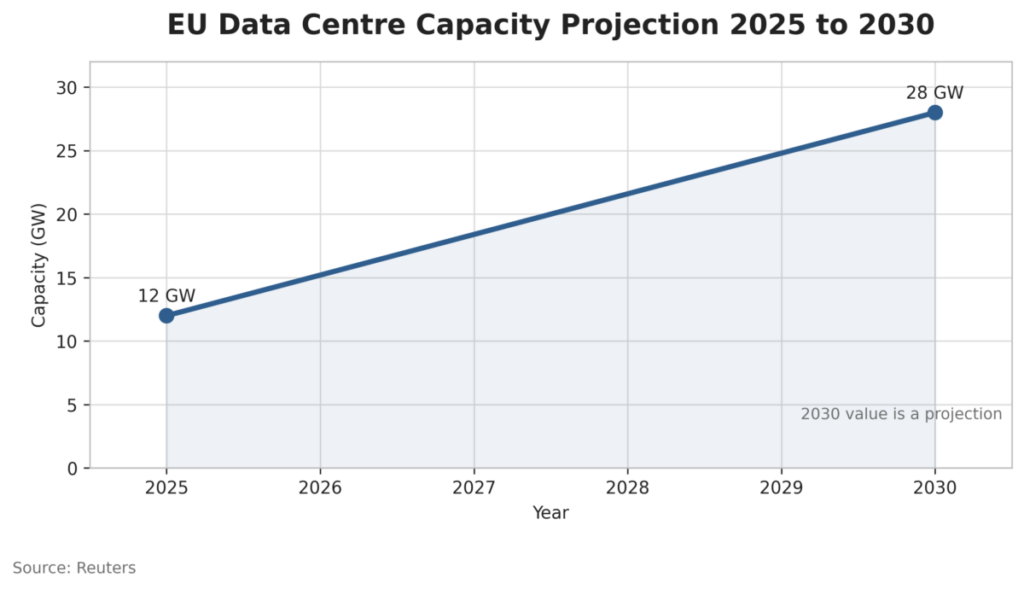
Energy is now part of the internet economy outlook. EU data-centre capacity is projected to rise from 12 GW in 2025 to 28 GW by 2030, pushing data centres beyond their current 2.5% share of EU electricity use. More domestic compute, more AI capacity, and less dependence on foreign providers require energy systems, financing, permitting, and public legitimacy to move together.
Digitally Capable and More Exposed
| Name | 2025 | 2026 (est)* | % Growth | Source |
|---|---|---|---|---|
| ENISA incidents analysed | 4,875 | 4,875* | 0.0% | ENISA |
| Public administration share of cyber incidents | 38.2% | 38.2%* | 0.0 pp | ENISA |
| EU semiconductor market share | 9% | 9%+* | n/m | European Commission Digital Decade |
| EU data-centre capacity | 12 GW | 14.2 GW* | 18.3% | Reuters |
| EU data-centre electricity-use share | 2.5% | 2.8%* | 12.0% | Reuters |
Outlook
Europe’s 2030 Test Is Absorption Without Fragmentation
The second half of 2026 will test whether Europe can turn digital capacity into economic absorption. AI adoption will continue to rise, cloud use will deepen, digital identity will move closer to practical launch, cybersecurity obligations will become more embedded, and data-centre policy will move further into economic strategy. These developments will strengthen Europe’s internet economy only if they reduce friction for firms and citizens rather than adding another layer of complexity.
Europe’s 2030 trajectory depends on whether its governance model becomes a productivity model. If regulation reduces uncertainty, strengthens trust, and supports cross-border scale, Europe’s slower path can still produce durable digital competitiveness. If regulation adds friction without accelerating implementation, the region risks becoming a sophisticated rule-maker whose firms remain dependent on foreign compute, foreign platforms, and slower domestic adoption.
The central mid-year judgment is clear. Europe’s internet economy is mature in access, advancing in enterprise adoption, strong in governance, uneven in skills, constrained in infrastructure depth, and exposed in strategic digital inputs. Its next test is not whether digital systems will spread. They already have. The test is whether Europe can absorb them into productivity, resilience, sovereignty, and cross-border economic coordination before fragmentation weakens the return on its digital investment.
Absorption Without Fragmentation
| Name | 2025 | 2026 (est)* | % Growth | Source |
|---|---|---|---|---|
| EU data-centre 2030 capacity projection | 28 GW target | 28 GW target | 0.0% | Reuters |
| Cloud and AI Development Act capacity goal | Baseline | 3x goal | n/m | European Commission |
| Basic digital skills target | 80% target | 80% target | 0.0 pp | Eurostat |
| ICT specialists target | 10% target | 10% target | 0.0 pp | European Commission Digital Decade |
| EU semiconductor 2030 target | 20% target | 20% target | 0.0 pp | European Commission Digital Decade |
Sources
- European Commission Digital Strategy; 2026 State of the Digital Decade package; – Link
- Eurostat; Towards Digital Decade targets for Europe; – Link
- Institute of Internet Economics; E-Commerce – 2026 Stats and Summary Mid-Year; – Link
Connectivity and Market Access
- European Commission; EU Digital Identity Wallet Home; – Link
- Eurostat; Cloud computing statistics on the use by enterprises; – Link
AI, Cloud, and Productivity
- Eurostat; Digital economy and society statistics enterprises; – Link
- European Commission Digital Strategy; Regulatory framework on artificial intelligence; – Link
Sectors, Commerce, and Industrial Systems
- European Central Bank; Payments statistics first half of 2025; – Link
- Reuters; Digital euro clears key hurdle as EU seeks to break free from U.S. credit cards; – Link
- International Federation of Robotics; World Robotics 2025 report industrial robots; – Link
Labour, Skills, and Public Services
- United Nations; E-Government Development Index Data Center; – Link
- Eurostat; Digital skills statistics; – Link
Governance and Digital Sovereignty
- European Commission Digital Strategy; NIS2 Directive securing network and information systems; – Link
- European Commission Digital Strategy; 2026 State of the Digital Decade package; – Link
Risk, Resilience, and Strategic Infrastructure
- ENISA; ENISA Threat Landscape 2025; – Link
- Reuters; EU plans energy standards for data centres amid concerns over soaring power use; – Link
Outlook
- Reuters; EU plans energy standards for data centres amid concerns over soaring power use; – Link
- European Commission Digital Strategy; 2026 State of the Digital Decade package; – Link
Keywords: Internet Economy, Digital Infrastructure, Cloud Computing, Artificial Intelligence, Digital Sovereignty, Cross-Border Digital Coordination, Infrastructure Resilience
Country List: Albania, Andorra, Austria, Belarus, Belgium, Bosnia And Herzegovina, Bulgaria, Croatia, Cyprus, Czechia, Denmark, Estonia, Finland, France, Germany, Greece, Hungary, Iceland, Ireland, Italy, Kosovo, Latvia, Liechtenstein, Lithuania, Luxembourg, Malta, Moldova, Monaco, Montenegro, Netherlands, North Macedonia, Norway, Poland, Portugal, Romania, Russia, San Marino, Serbia, Slovakia, Slovenia, Spain, Sweden, Switzerland, Ukraine, United Kingdom, Vatican City