

Digitalization and Regional Structure Become One Growth Model
MENA and its associated regions enter mid-2026 with enough digital scale to shape economic outcomes, but not enough institutional depth to make those gains uniform. The region is not one internet economy moving at a single speed. It is a set of digital systems converting connectivity into growth, public capacity, and market access at very different levels of effectiveness.
Mobile remains the practical backbone across households, firms, and public systems. This region had an estimated 318.7 million mobile internet users in 2025, rising to 329.8 million in 2026. The shift from 4G toward 5G is turning the regional question from basic access into network capacity, reliability, and institutional use.
The four regional models define how digital value is absorbed.
The Gulf Middle East is the high-income digital-state economy, where cloud systems, digital identity, AI, payments, and government platforms support diversification beyond hydrocarbons. North Africa is the scale-and-affordability economy, where large populations and young labor markets make digital adoption powerful only if devices, data, and services remain usable. The Levant is the small-country modern economy, where digital capability sits close to institutional strain and geopolitical shock. The Low-Capacity Middle East is the constrained internet economy, where networks often preserve basic coordination before they can generate higher-value growth. In many respects, these markets face the same barriers seen in other low-development countries.
Israel is an important anomaly. It sits in the highest tier of internet integration and aligns more closely with advanced digital economies in the United States and Western Europe than with most regional peers. It faces few connectivity constraints and stands among the region’s most advanced markets for AI, compute, and digital infrastructure needs.
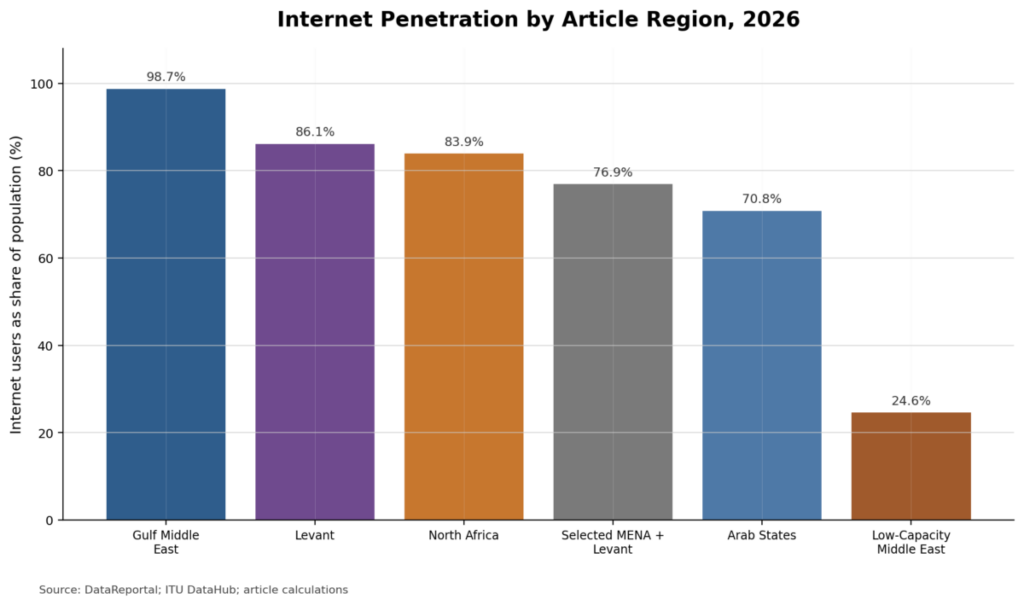
Population-weighted penetration rates show that the regional spread is wider than single-country examples suggest. Across the selected MENA and Levant country set, internet penetration reaches 76.9% in 2026. The Gulf Middle East sits near saturation at 98.7%, while North Africa reaches 83.9%. The Levant rises to 86.1%, and the Low-Capacity Middle East remains far lower at 24.6%.
The broader Arab States benchmark reaches 70.8% in 2026, while the latest official global benchmark is 73.6%.
The mid-year test is structural. MENA has the connectivity base to support growth, payments, services, and public coordination, but each subregion must convert that base through different institutional conditions. The Gulf must turn advanced infrastructure into diversification. North Africa must turn scale into affordable participation. The Levant must turn digital systems into continuity under strain. Low-capacity markets must use networks to preserve coordination before higher-value growth can follow.
| Digitalization and Regional Structure | ||||
|---|---|---|---|---|
| Name | 2025 | 2026 (est)* | % Growth | Source |
| Gulf Middle East internet penetration | 98.7% | 98.7% | 0.0 pp | DataReportal; calculated |
| North Africa internet penetration | 83.0% | 83.9% | +0.9 pp | DataReportal; calculated |
| Levant internet penetration | 84.7% | 86.1% | +1.4 pp | DataReportal; calculated |
| Low-Capacity Middle East internet penetration | 24.6% | 24.6% | 0.0 pp | DataReportal; calculated |
| Selected MENA + Levant internet penetration | 76.3% | 76.9% | +0.6 pp | DataReportal; calculated |
| Arab States internet use | 69.5% | 70.8% | +1.3 pp | ITU DataHub |
| Total mobile internet users | 318.7M | 329.8M | 3.5% | GSMA; calculated |
| Total mobile economic contribution | $367.6B | $386.0B | 5.0% | GSMA; calculated |
| Total mobile share of GDP | 5.7% | 5.8% | +0.1 pp | GSMA; article estimate |
Connective Capacity
Access, Affordability, and Recognition Decide Participation
The region’s hardest gap now sits around the connection, not only inside the network. Internet use in the Arab States reached 69.5% in 2025, compared with 73.6% globally and 94.2% in high-income economies. Gulf markets operate near universal access, while lower-capacity and lower-income markets still face gaps in device ownership, affordability, network quality, and institutional reach.
Mobile is the main access layer. In MENA, 308 million people were connected to the mobile internet in 2024, and that number is expected to reach 378 million by 2030. The mobile sector’s economic contribution is expected to rise from $350 billion in 2024 to $470 billion by 2030. The scale is already large enough to move the economic base, but the benefits depend on whether access becomes usable participation rather than network presence.
Capacity is the next divide. In 2025, 4G accounted for 67% of MENA mobile connections, while 5G is moving from early adoption toward the region’s next capacity layer. Its share of mobile connections is expected to rise from 7% in 2024 to 48% by 2030. Modern internet use increasingly depends on whether 5G and high-quality 4G networks can handle data-intensive activity at scale. Payments, cloud tools, AI-enabled services, remote work, digital health, logistics, and public-service platforms now depend on reliability and bandwidth as much as coverage.
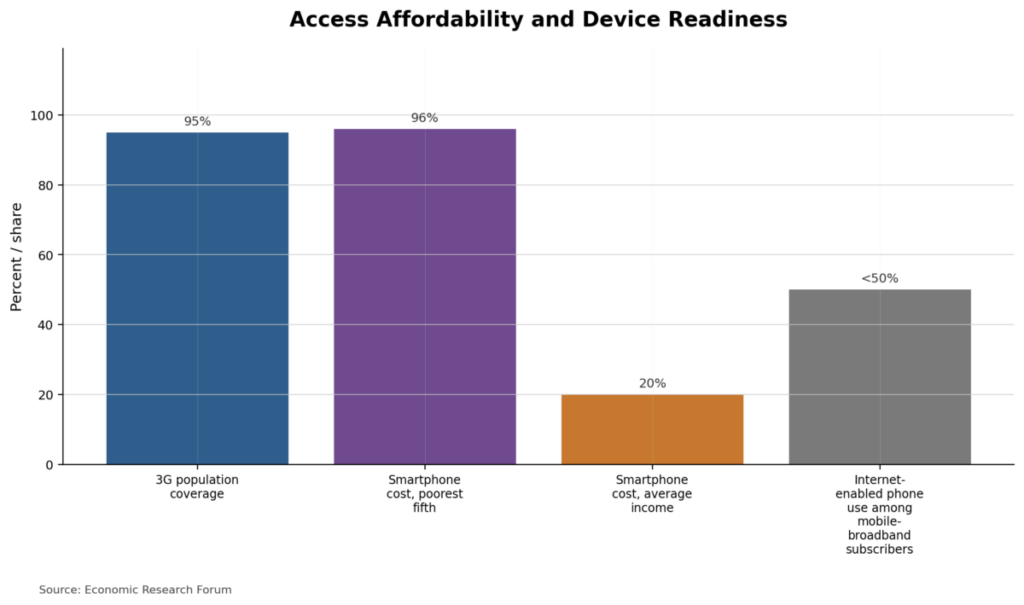
Affordability is one of the major hurdles. A smartphone costs close to 20% of average monthly income in MENA and 96% for the poorest fifth. Even where 3G networks cover 95% of the population, fewer than half of mobile-broadband subscribers own or use an internet-enabled phone. Beyond connectivity, capacity remains a major barrier. The gap is between technical coverage and usable access.
Recognition is the deeper filter. The state remains the authority behind legal identity, public support, formal permission, and economic standing. Saudi Arabia’s 2024 EGDI score of 0.9602 and the UAE’s score of 0.9533 show what digital recognition looks like at the high-capacity end of the region. The harder question is whether comparable systems can reach lower-income users, displaced populations, small firms, and people outside the Gulf’s institutional depth.
MENA’s mid-year question is therefore not whether the region is connected. It is whether connection becomes economic power. The answer depends on affordable devices, reliable 5G capacity, and institutional trust.
| Access, Affordability, and Recognition | ||||
|---|---|---|---|---|
| Name | 2025 | 2026 (est)* | % Growth | Source |
| 4G share of mobile connections | 67% | 66% | -1.0 pp | GSMA |
| 5G share of mobile connections | 12% | 17% | +5.0 pp | GSMA |
| 5G share of mobile connections, 2030 outlook | 48% by 2030 | 48% by 2030 | n/m | GSMA |
| Smartphone affordability, average income | 20% of monthly income | 20% of monthly income | 0.0% | Economic Research Forum |
| Smartphone affordability, poorest fifth | 96% of monthly income | 96% of monthly income | 0.0% | Economic Research Forum |
| 3G population coverage | 95% | 95% | 0.0% | Economic Research Forum |
| Internet-enabled phone use among mobile-broadband subscribers | <50% | <50% | n/m | Economic Research Forum |
Platforms, Commerce, and Finance
Payments Turn Trust Into Portable Infrastructure
Payments are where the coordination phase becomes visible in daily life. Digital finance gives households and firms a portable record of activity. A merchant who once lived only in cash can become legible to suppliers, lenders, and the state. A worker paid through a traceable channel carries a financial memory that informal economies rarely provide. The transaction may be small, but the institutional shift is large.
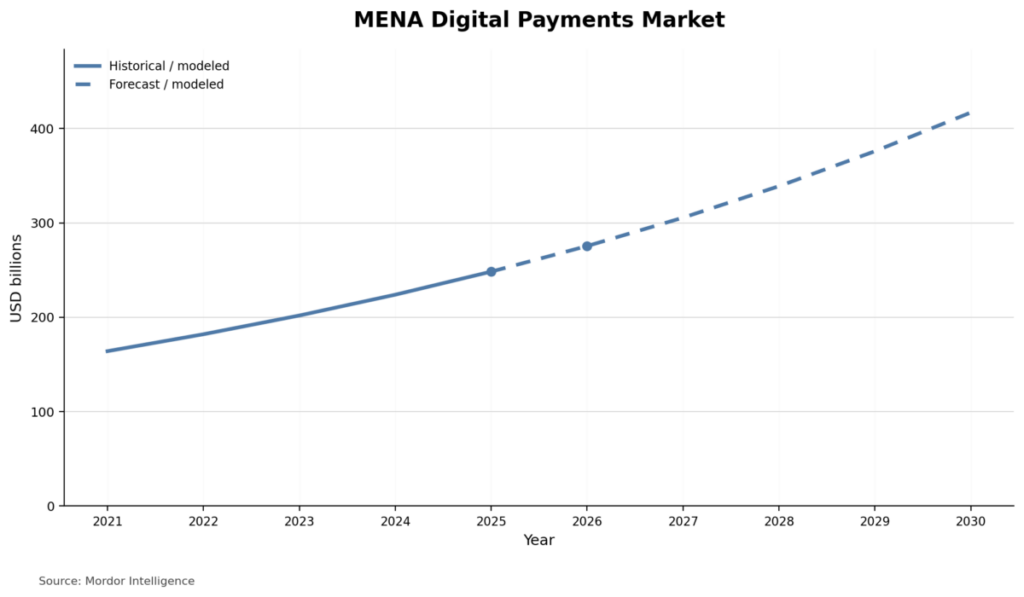
This region’s digital payments market stood at $248.35 billion in 2025 and is expected to reach $275.47 billion in 2026. Emerging payment methods are already widely used, with 85% of people in MENA reporting use of at least one such method. The e-commerce layer is expanding alongside payments: the regional market rises from $155.16 billion in 2025 to $176.68 billion in 2026. Payments are no longer a narrow financial service. They are becoming the layer through which economic life becomes visible.
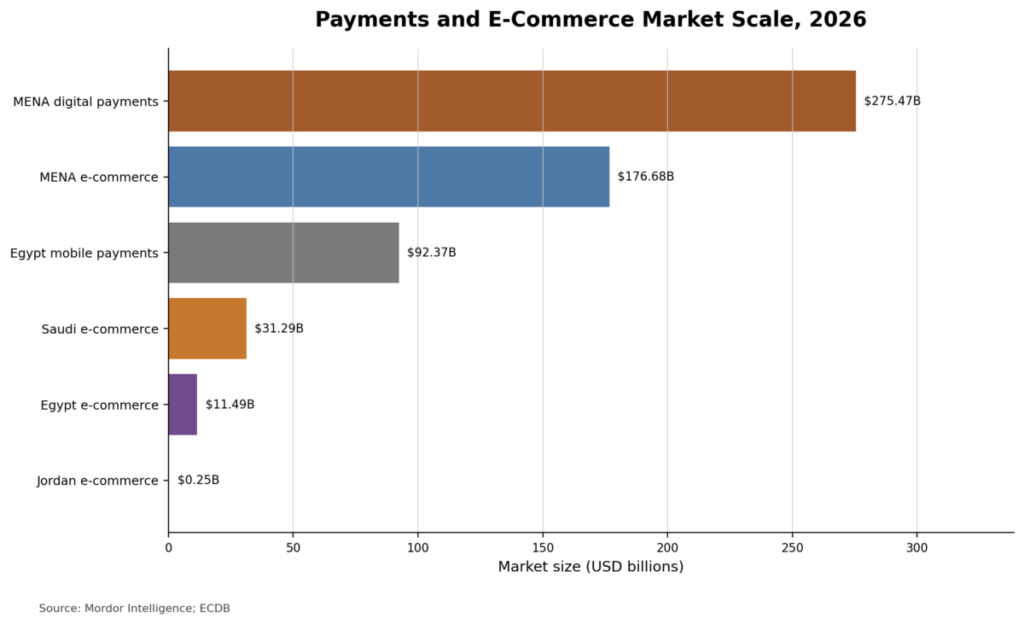
Institutional capacity determines what that visibility means. The Gulf uses payments to reinforce regulated modernization and service convenience. Saudi Arabia shows this clearly, with e-payments reaching 79% of retail transactions and e-commerce rising from $27.96 billion in 2025 to $31.29 billion in 2026. North Africa uses payments to pull households and small merchants toward formal markets where cash and trust have long limited scale. Egypt’s mobile payments market rises from $84.93 billion to $92.37 billion, while its e-commerce market grows from $10.39 billion to $11.49 billion.
The Levant uses digital commerce and payments for continuity when financial systems are strained. Jordan shows a smaller but active base, with online shopping penetration at 38% and e-commerce rising from $229 million in 2025 to an estimated $240 million to $252 million in 2026. The Low-Capacity Middle East remains more constrained, where payments and commerce are less about convenience and more about keeping money and basic exchange moving when ordinary channels fail.
The same channel also exposes vulnerability. When payment systems work, they create records, access, and trust. When they fragment, households and firms are pushed back toward cash, informal transfer channels, or survival mechanisms. The Levant’s digital economy is therefore not only a story of modern services. It is also a story of identity, money, and survival moving through the same infrastructure.
| Payments, Fintech, and Household Trust | ||||
|---|---|---|---|---|
| Name | 2025 | 2026 (est)* | % Growth | Source |
| MENA digital payments market | $248.35B | $275.47B | 10.9% | Mordor Intelligence |
| MENA emerging payment method usage | 85% | 85% | 0.0 pp | Mastercard |
| Saudi Arabia e-payments share of retail transactions | 79% | 79% | 0.0 pp | Saudi Central Bank |
| MENA e-commerce market | $155.16B | $176.68B | 13.9% | Mordor Intelligence |
| Saudi Arabia e-commerce market | $27.96B | $31.29B | 11.9% | Mordor Intelligence |
| Egypt mobile payments market | $84.93B | $92.37B | 8.8% | Mordor Intelligence |
| Egypt e-commerce market | $10.39B | $11.49B | 10.6% | Mordor Intelligence |
| Jordan online shopping penetration | 38% | 38% | 0.0 pp | Middle East Commerce |
| Jordan e-commerce market | $229M | $240M–$252M | 5%–10% | ECDB |
AI, Cloud, and Productivity
Compute and AI Are Becoming the Region’s Industrial Base
Cloud and AI have moved from headline technologies into the operating core of firms and states. Cloud carries institutional memory, while AI becomes economically meaningful when it improves decisions that already allocate value. The test is not whether institutions run pilots. It is whether machine intelligence shortens delay, reduces error, widens reach, and allows action earlier.
The Gulf Middle East is the region’s compute-capital center, with digital infrastructure embedded in diversification strategy. Saudi Arabia shows the clearest version of this model, with data-center load growing on a 29% annual path. North Africa sits on the absorption side of the system, where cloud and AI must raise firm productivity, public-service reach, and labor-market efficiency at scale.
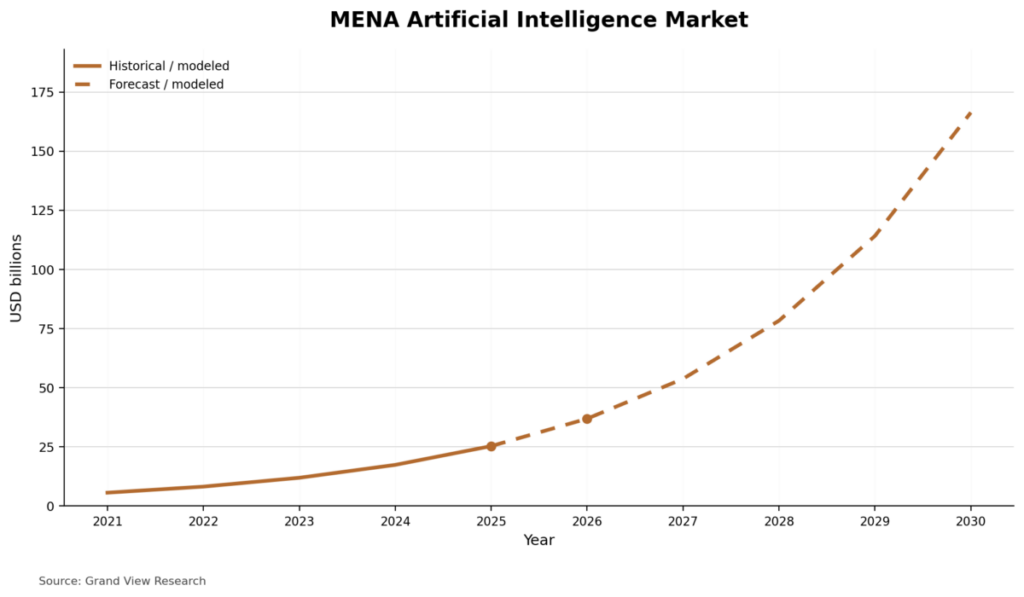
The Levant is split. Israel is an advanced compute and AI outlier, with its data-center market estimated at $0.63 billion in 2026 and installed capacity moving toward 532.9 MW by 2030. It faces few connectivity constraints and aligns more closely with advanced digital economies in the United States and Western Europe than with most regional peers. The rest of the Levant carries digital capability inside smaller and more exposed markets, where cloud systems are more often tied to continuity, records, payments, services, and remote work under strain.
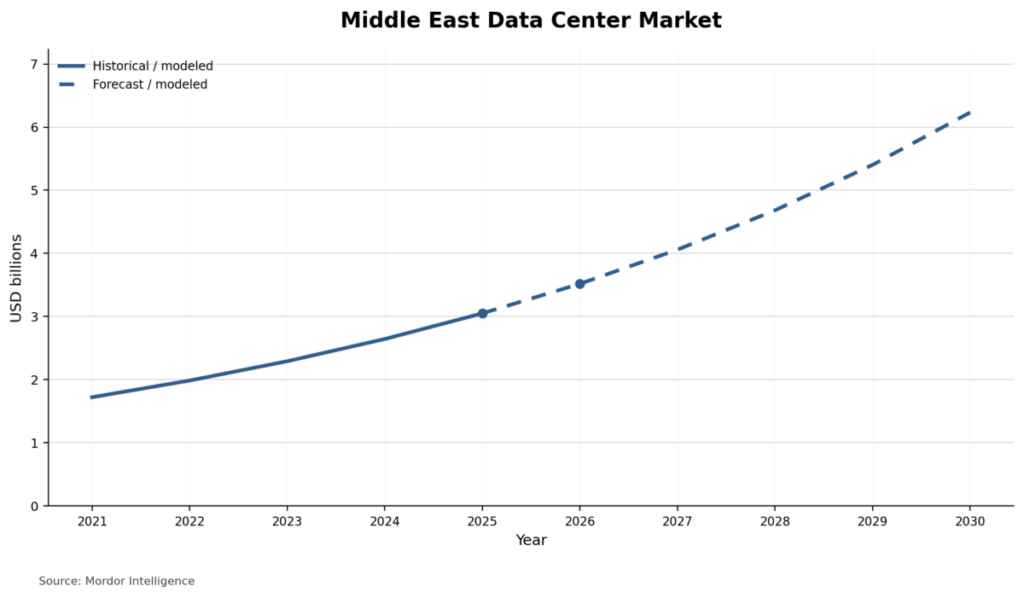
Across the Middle East, the data-center market is expected to reach $3.52 billion in 2026, while installed capacity rises to 1.99 thousand MW. Compute has therefore become physical infrastructure. It consumes power, requires cooling, demands capital, creates cyber exposure, and shifts bargaining power toward those who control domestic capacity.
The regional divide is not only who uses cloud and AI, but who controls the compute layer beneath them. The Gulf is building capacity as a strategic asset. Israel shows how concentrated innovation and compute depth can make a small market strategically important. North Africa needs affordable access and skills absorption. The rest of the Levant needs resilient systems that preserve continuity under pressure. Low-capacity markets need basic infrastructure before AI can become more than a narrow imported tool.
| Compute, Cloud, and AI Capacity | ||||
|---|---|---|---|---|
| Name | 2025 | 2026 (est)* | % Growth | Source |
| Middle East data-center market | $3.05B | $3.52B | 15.4% | Mordor Intelligence |
| Installed data-center capacity | 1.82k MW | 1.99k MW | 9.2% | Mordor Intelligence |
| Saudi data-center load growth | 29% annual growth path | 29% annual growth path | 0.0% | S&P Global |
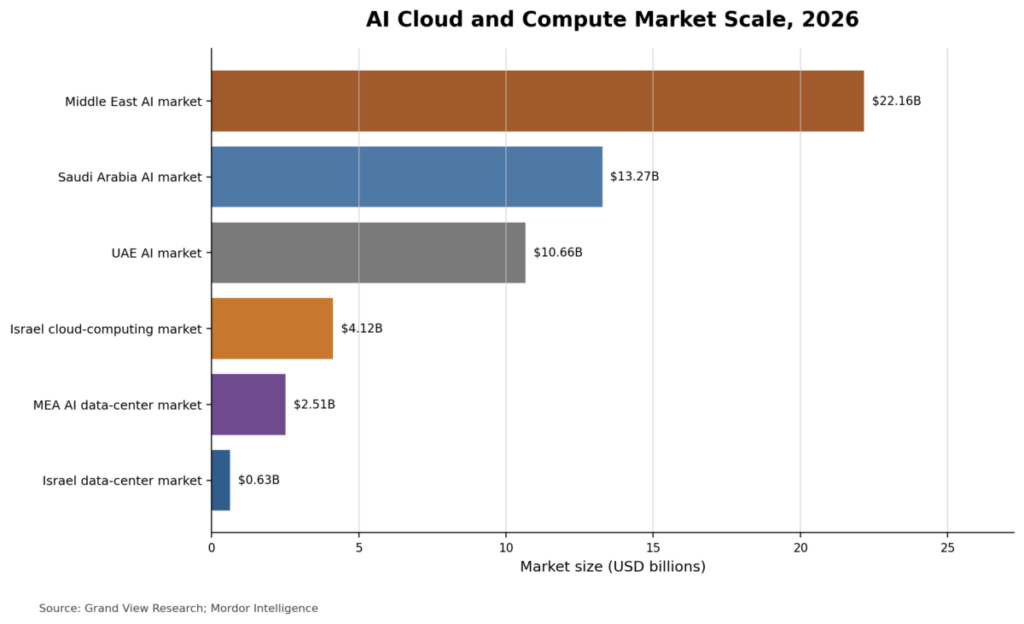
| Israel data-center market | $0.58B | $0.63B | 8.6% | Mordor Intelligence |
| Israel installed data-center capacity | 378.8 MW | 409.6 MW | 8.1% | Mordor Intelligence; calculated |
| Israel cloud-computing market | $3.67B | $4.12B | 12.3% | Mordor Intelligence; calculated |
Sectors, Commerce, and Industrial Systems
Data Centers, Energy, and Logistics
The industrial implication is immediate. Digital systems lower friction in the movement of goods, the use of infrastructure, and the coordination of cities. The internet economy is therefore not only visible in apps, payments, or cloud services. It also appears in warehouses, ports, roads, cooling systems, power grids, and water demand.
Data centers make that shift physical. Regional data-center construction rises from $2.87 billion in 2025 to an estimated $3.61 billion in 2026, while water consumption rises from 119.34 billion liters to 153.25 billion liters. By 2031, construction is expected to reach $11.39 billion, and water consumption is forecast to reach 535.71 billion liters. In a region where heat already tests infrastructure, AI and cloud are also questions of power, water, land, cooling, and resilience.
Logistics is the other side of the same system. Faster digital coordination protects inventory, reduces delay, and turns transport networks into productivity infrastructure. The Gulf has the strongest platform for this model because ports, airports, free zones, data centers, and digital government systems are increasingly connected. North Africa’s challenge is to use digital systems to reduce friction across larger consumer and labor markets. The Levant needs logistics and digital infrastructure that can preserve continuity under strain. Low-capacity markets face the harder task of keeping basic movement, records, and services functioning where infrastructure is weak.
The mid-year test is whether the region can scale compute without weakening the physical systems that support it. Digital growth now depends on energy planning, water management, cooling efficiency, cybersecurity, land use, and logistics resilience as much as software adoption.
| Urban Infrastructure, Resource Pressure, and Logistics | ||||
|---|---|---|---|---|
| Name | 2025 | 2026 (est)* | % Growth | Source |
| Regional data-center construction | $2.87B | $3.61B | 25.8% | Arizton |
| Regional data-center water consumption | 119.34B liters | 153.25B liters | 28.4% | Mordor Intelligence |
Digital Health and Public Services
Human Capability Is the Test of Digital Development
Digital capacity becomes development only when people can actually use the services they depend on. Health is the clearest test because it turns identity, records, access, trust, and continuity into a measure of state performance. A health system that can reach patients remotely, maintain records, and allocate scarce resources earlier turns connectivity into human capability. A weak system that only moves forms online does not.
The key issue is penetration, not spending alone. Digital health grows when remote care, e-health records, patient portals, digital prescriptions, and connected public-service platforms reach ordinary households and work cohesively. Telehealth is especially important because it can extend medical access beyond major cities and reduce the cost of distance, waiting, and specialist shortages.
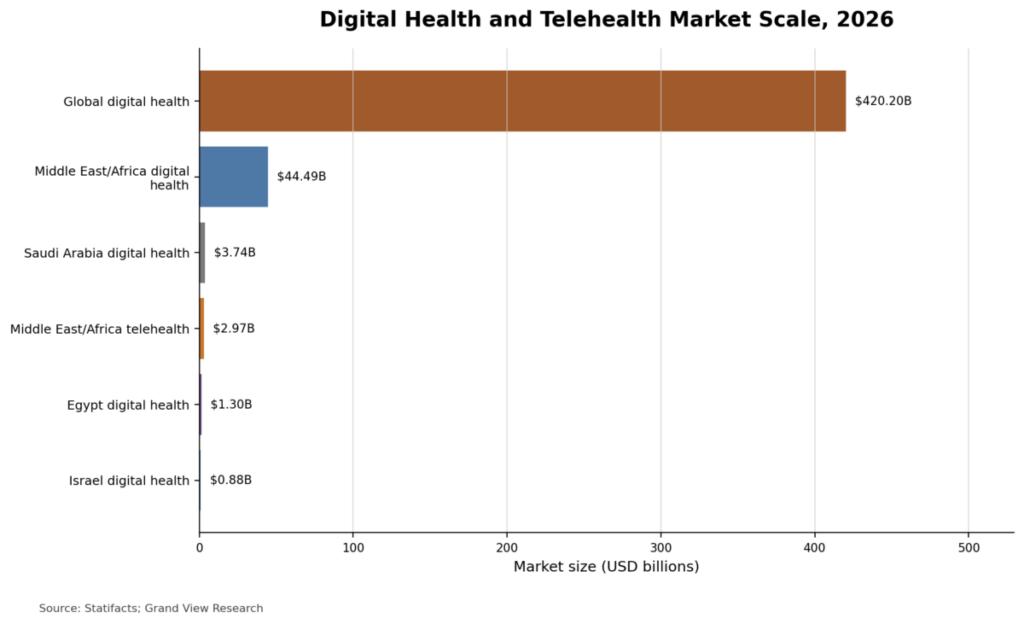
Spending shows that the service layer is expanding. The Middle East/Africa digital health market is expected to reach $44.49 billion in 2026, up 22.0% from 2025, while the telehealth market reaches $2.97 billion, up 14.4%. Country examples point in the same direction: Saudi Arabia’s digital health market reaches $3.74 billion in 2026, Egypt’s reaches $1.30 billion, and Israel’s reaches $0.88 billion. The numbers matter because they show where penetration can deepen, not because spending alone proves development.
The regional divide follows the same pattern as the broader internet economy. Gulf markets are best placed to integrate digital health with identity, insurance, hospitals, and government platforms. North Africa’s challenge is scale: using digital tools to reach large populations at lower cost. Israel reflects the high-capability end of the Levant, where health technology fits into a deeper innovation base. Lower-capacity markets remain uneven, but they also show why leapfrogging matters.
| Human Capability and Development Outcomes | ||||
|---|---|---|---|---|
| Name | 2025 | 2026 (est)* | % Growth | Source |
| Middle East/Africa digital health market | $36.47B | $44.49B | 22.0% | Statifacts |
| Saudi Arabia digital health market | $3.14B | $3.74B | 19.1% | Grand View Research |
| Egypt digital health market | $1.09B | $1.30B | 19.3% | Grand View Research |
| Israel digital health market | $0.74B | $0.88B | 18.9% | Grand View Research |
| Low-capacity health digitization conditions | Limited / uneven | Limited / uneven | n/m | |
| Middle East/Africa telehealth market | $2.60B | $2.97B | 14.4% | Grand View Research |
| Global digital health market | $347.4B | $420.2B | 21.0% | Grand View Research |
Labour, Skills, and Public Services
Youth Connectivity and Labor Absorption
Labor transformation is the next layer of inclusion. The region’s young people are already connected, but not securely absorbed into work: 86% of people aged 15 to 24 in the Arab States used the internet in 2024, while Arab States youth unemployment remained the highest in the world at 28.0% in 2023. Women face an even deeper constraint. Female labor-force participation in MENA remains around 19%, far below the global average near 48%.
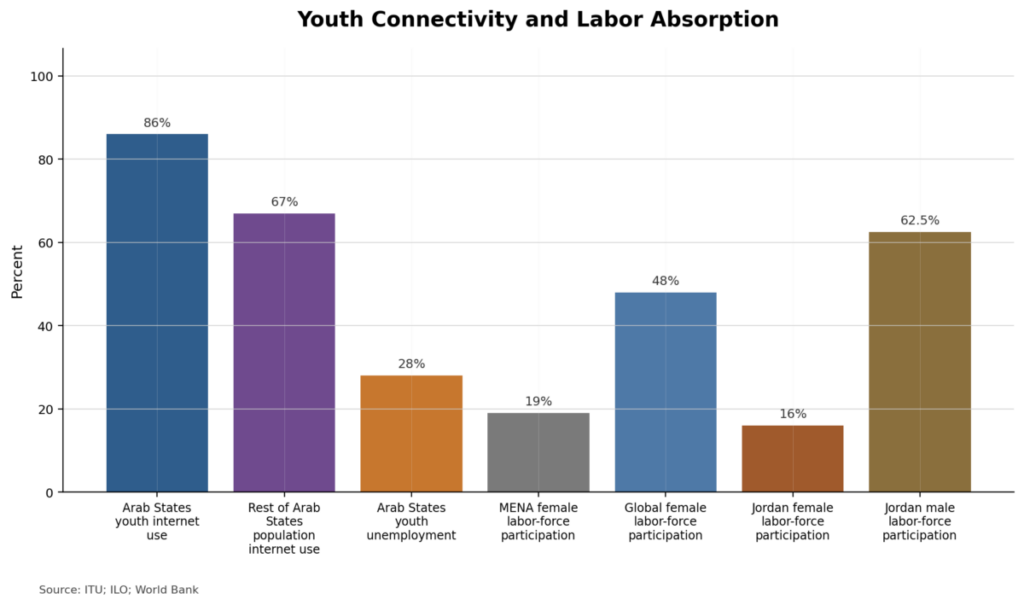
The country pattern is uneven. Saudi Arabia shows how reform, digital platforms, and formal freelance systems can widen participation, with more than 2.25 million registrants on its national freelance platform. Egypt shows the North African absorption problem, where women’s education has not translated into equivalent labor-market participation and female unemployment remains far above male unemployment. Jordan shows the Levant’s structural gap, with female labor-force participation at 16% in 2025 compared with 62.5% for men.
| Labor Transformation, Gig Work, and Faster Money | ||||
|---|---|---|---|---|
| Name | 2025 | 2026 (est)* | % Growth | Source |
| Region female labor-force participation | 19% | 19% | 0.0 pp | World Bank |
| Global female labor-force participation benchmark | 48% | 48% | 0.0 pp | World Bank |
| Arab States youth internet use, ages 15–24 | 86% | 86% | 0.0 pp | ITU |
| Rest of Arab States population internet use | 67% | 67% | 0.0 pp | ITU |
| Arab States youth unemployment | 28.0% | 28.0% | 0.0 pp | ILO |
| Saudi freelance-platform registrants | 2.25M+ | 2.25M+ | 0.0% | IOE / Saudi Press Agency |
| Egypt female unemployment | 18% | 18% | 0.0 pp | OECD |
| Egypt male unemployment | 5% | 5% | 0.0 pp | OECD |
| Jordan female labor-force participation | 16% | 16% | 0.0 pp | World Bank Gender Data Portal |
| Jordan male labor-force participation | 62.5% | 62.5% | 0.0 pp | World Bank Gender Data Portal |
| Gig workers in cross-border payments | ~1 in 10 users | ~1 in 10 users | n/m | Mastercard |
| Global mobile-money transactions | $2.0T | $2.0T | 0.0% | GSMA |
| Global mobile-money merchant payments | $155B | $155B | 0.0% | GSMA |
| Mobile-money remittance cost advantage | 44% lower than global average | 44% lower than global average | n/m | GSMA |
Governance and Regulation
Governance Now Defines Digital Power
Governance Now Defines Digital Power
The coordination phase makes governance more important, not less. Once payments, cloud services, public administration, and identity systems move online, the rules around data, recognition, and access become economic infrastructure. A market cannot become fully digital if people cannot trust how they are identified, how their information is used, or whether online systems will treat them as legitimate participants.
The Gulf Middle East has the clearest state-capacity advantage. Digital government supports diversification by linking service delivery, sovereign data strategy, and administrative speed, though concentration creates dependence. North Africa must serve large populations without letting bureaucracy reproduce itself through digital interfaces. The Levant’s burden is trust under pressure, where records and digital identity matter because institutional continuity is less assured. In the Low-Capacity Middle East, sanctions, weak administration, and unreliable infrastructure make sovereignty a practical constraint.
Regulation decides who benefits from fintech, AI, and cloud growth. Payments can formalize economic life, but they can also expose vulnerable users to surveillance, exclusion, or sudden account dependency. AI can improve allocation, but it can also harden bias inside systems people cannot challenge. Cloud can lower costs, but foreign dependency can reduce bargaining power over the region’s operating stack.
Cybersecurity and resilience now sit at the center of economic credibility. Middle East cybersecurity spending is projected to reach $18.56 billion in 2026 and $29.39 billion by 2031, reflecting the cost of defending more connected value. Red Sea cable cuts in September 2025 showed that the physical internet is also exposed. The region’s cloud, payments, public services, and AI strategies depend on software protection, repair capacity, backup routes, and the physical geography of connection.
Conflict widens the test. Continued escalation may cost Arab States economies 3.7% to 6.0% of collective GDP, or $120 billion to $194 billion. Under pressure, the internet becomes the way economies keep records intact, money moving, services reachable, and public trust from collapsing.
| Cybersecurity and Public Services Spending | ||||
|---|---|---|---|---|
| Name | 2025 | 2026 (est)* | % Growth | Source |
| Middle East cybersecurity market | $20.55B | $23.54B | 14.5% | Mordor Intelligence |
| UAE cybersecurity market | $0.82B | $0.91B | 11.0% | Mordor Intelligence |
| Egypt cybersecurity market | $230.01M | $257.43M | 11.9% | Mordor Intelligence |
| Israel cybersecurity market | $1.00B | $1.08B | 8.0% | Mordor Intelligence |
| Saudi government ICT spending | $8.5B | n/a | n/m | Saudi Digital Government Authority |
| Abu Dhabi digital government strategy | $3.54B total, 2025–2027 | $3.54B total, 2025–2027 | n/m | Abu Dhabi DGE |
| Middle East digital transformation market | $59.47B | $71.64B | 20.5% | Mordor Intelligence |
| GCC digital transformation market | $18.19B | $20.38B | 12.0% | MarkNtel Advisors |
Outlook
The Second Half of 2026 Rewards Absorption Over Announcement
The second half of 2026 separates digital ambition from digital absorption. This region already has strategies, portals, pilots, and high-profile technology announcements. The harder test is conversion. Digital systems must now lower costs, speed up services, widen participation, and keep infrastructure resilient under pressure.
The mobile base will keep expanding. This region’s mobile internet users are projected to rise from 308 million in 2024 to 378 million by 2030, while the mobile sector’s economic contribution is expected to move from $350 billion toward $470 billion over the same period. The next return will not come from connection alone. It will come from converting a larger connected base into productive use, trusted transactions, durable services, and institutional resilience.
The four internet economies will not converge through one path. The Gulf Middle East must show that digital investment produces productivity beyond megaprojects and state platforms. North Africa must convert scale and youth connectivity into affordable participation and firm absorption. The Levant must keep modern digital capability functioning under shock without losing trust. The Low-Capacity Middle East must use the internet to preserve coordination before it can reliably capture higher-value gains.
The central fact of mid-2026 is not that this region is adopting technology. It is that the internet has become an operating condition for economic power, public recognition, and social inclusion. The region’s winners will not be the systems that announce the most advanced tools. They will be the systems that make digital capacity ordinary enough to lower costs, resilient enough to survive disruption, and trusted enough to carry economic life.
| AI and Digital Transformation | ||||
|---|---|---|---|---|
| Name | 2025 | 2026 (est)* | % Growth | Source |
| Middle East AI market | $15.63B | $22.16B | 41.8% | Grand View Research |
| GCC AI market | $6.22B | $7.15B | 14.9% | IMARC; calculated |
| Saudi Arabia AI market | $9.26B | $13.27B | 43.3% | Grand View Research |
| UAE AI market | $7.82B | $10.66B | 36.3% | Grand View Research; calculated |
| MEA AI data-center market | $1.98B | $2.51B | 26.8% | Mordor Intelligence |
| Middle East digital transformation market | $59.47B | $71.64B | 20.5% | Mordor Intelligence |
| GCC digital transformation market | $18.19B | $20.38B | 12.0% | MarkNtel Advisors |
| Saudi Arabia digital transformation market | $13.4B | $16.37B | 22.2% | IMARC; calculated |
| Morocco digital transformation strategy | $1.2B total, 2024–2026 | $1.2B total, 2024–2026 | n/m | Reuters |
| Jordan digital transformation strategy | 2026–2028 plan | 2026–2028 plan | n/m | Jordan MODEE |
| * Estimate. “n/m” means not meaningful. Calculated rows are modeled from reported market size and CAGR or endpoint data. Country rows are examples and do not add up to regional totals. | ||||
Sources
- DataReportal; Digital 2025 and Digital 2026 country reports; – Link
- International Telecommunication Union; ITU DataHub, Individuals Using the Internet; – Link
- GSMA; The Mobile Economy Middle East and North Africa 2025; – Link
Connectivity and Market Access
- Economic Research Forum; Broadband: Is MENA Ready?; – Link
- United Nations E-Government Knowledgebase; E-Government Development Index Data Center; – Link
Platforms, Commerce, and Finance
- Mordor Intelligence; Middle East and North Africa Digital Payments Market; – Link
AI, Cloud, Productivity, and Industrial Systems
- Mordor Intelligence; Middle East Data Center Market; – Link
- Mordor Intelligence; Middle East and Africa Data Center Water Consumption Market; – Link
Digital Health and Public Services
- Statifacts; Middle East and Africa Digital Health Market; – Link
- Grand View Research; Middle East and Africa Telehealth Market; – Link
Labor, Skills, and Public Services
- World Bank; The Upside of Digital for the Middle East and North Africa; – Link
- International Labour Organization; Global Employment Trends for Youth 2024: Middle East and North Africa Brief; – Link
Governance, Regulation, and Resilience
- Mordor Intelligence; Middle East Cybersecurity Market; – Link
- Saudi Digital Government Authority; Government ICT Spending Report, Saudi Arabia 2025; – Link
Outlook: AI and Digital Transformation
- Abu Dhabi Department of Government Enablement; Abu Dhabi Government Digital Strategy 2025–2027; – Link
- Jordan Ministry of Digital Economy and Entrepreneurship; Jordan Digital Transformation Strategy and Implementation Plan 2026–2028; – Link
Keywords: Internet Economy, MENA Digital Transformation, Middle East Digital Infrastructure, Digital Governance, Fintech, Data Centers, Digital Inclusion, Economic Resilience
Gulf Middle East: Qatar, Saudi Arabia, United Arab Emirates
North Africa: Algeria, Egypt, Libya, Morocco, Tunisia
Levant: Israel, Jordan, Lebanon, Palestine, Syria
Low-Capacity Middle East: Iran, Iraq, Oman, Yemen