

Asia’s internet economy, excluding China, has reached digital scale before becoming a single digital economy. By mid-2026, the region is no longer defined by whether people and firms are online. It is defined by what connectivity becomes once it enters institutions, factories, public rails, consumer markets, and the everyday systems that turn access into economic life.
Mobile connectivity is now widespread across the region. In major cities, internet access functions almost like a utility: constant, expected, and embedded in commerce, mobility, communication, work, and public services. Outside those centers, the signal is often present but less useful. Rural and interior markets face weaker network quality, affordability limits, data restrictions, distance, and thinner service systems.
Scale has not produced integration. Connectivity still follows national telecom systems, domestic regulation, public infrastructure, and country-specific economic interests. Geography, rural service depth, industrial structure, and institutional capacity shape what the internet can become in each market. The overall Asian region is not one uniform digital economy; it is a set of national and subregional conversion systems moving at different speeds.
The numbers already carry macroeconomic weight.
Asia-Pacific’s mobile-sector contribution is estimated to rise from $1.01 trillion in 2025 to $1.08 trillion in 2026, adding roughly $70 billion in annual output. Its share of regional GDP edges up only slightly, from 5.8% to 5.9%, which shows how large the base has become.
Southeast Asia’s digital economy is projected to grow from $300 billion to $345 billion in gross merchandise value, while India’s UPI transaction volume is projected to rise from 185.9 billion to 241.6 billion.
| Name | 2025 | 2026 (est)* | % Growth | Source |
|---|---|---|---|---|
| Asia-Pacific mobile-sector contribution | $1.01T | $1.08T | 6.9% | GSMA |
| Asia-Pacific mobile share of GDP | 5.8% | 5.9% | +0.1 pp | GSMA |
| Southeast Asia digital economy GMV | $300B | $345B | 15.0% | Bain; Google; Temasek |
| India UPI transaction volume | 185.9B | 241.6B | 30.0% | NPCI; PIB |
| India UPI transaction value | ₹260.4 lakh crore | ₹314.0 lakh crore | 20.6% | NPCI; PIB |
Connectivity
The Hardest Gap Is Around the Signal
The region’s access problem has shifted. The decisive question is no longer simply whether the signal exists, but whether the system around it is strong enough to make digital participation useful. A connection becomes productive only when it is supported by trusted and credible systems: settlement, verified identity, reliable public services, affordable data, logistics, finance, skills, and firm participation.
This is the hardest gap across constrained-access markets in northern, interior, and South Asia. These markets are not defined by the absence of digital demand. They are defined by the thinness of the institutions and services around the connection. Millions of users can be online without the surrounding systems needed to turn access into income, care, innovation or business resilience.
Mongolia shows how penetration can overstate readiness. Its 83.0% internet penetration at the end of 2025 sits beside sparse settlement and high service-delivery costs. Nepal shows a different version of the same problem, where terrain and infrastructure depth widen the gap between connection and usable public service.
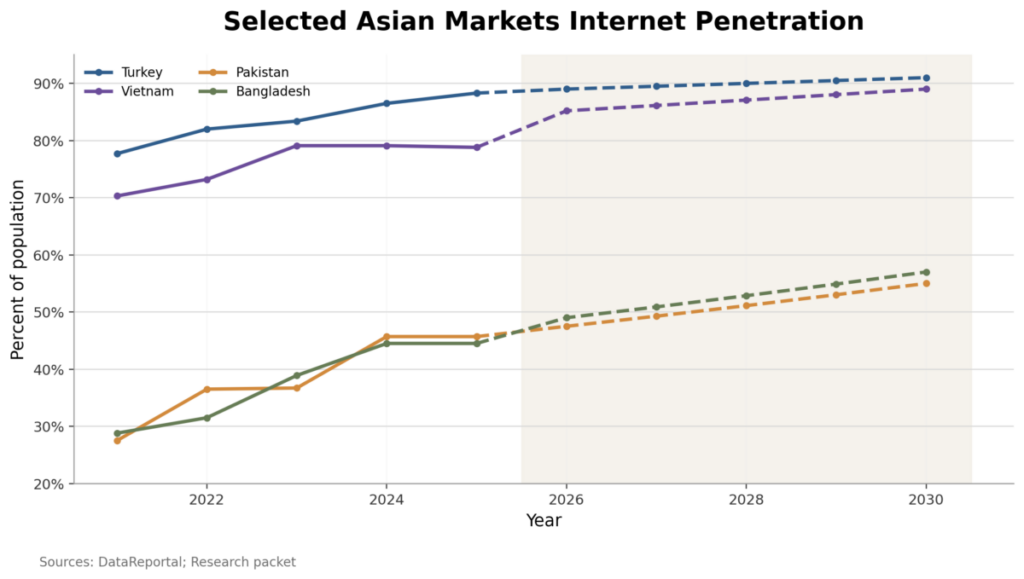
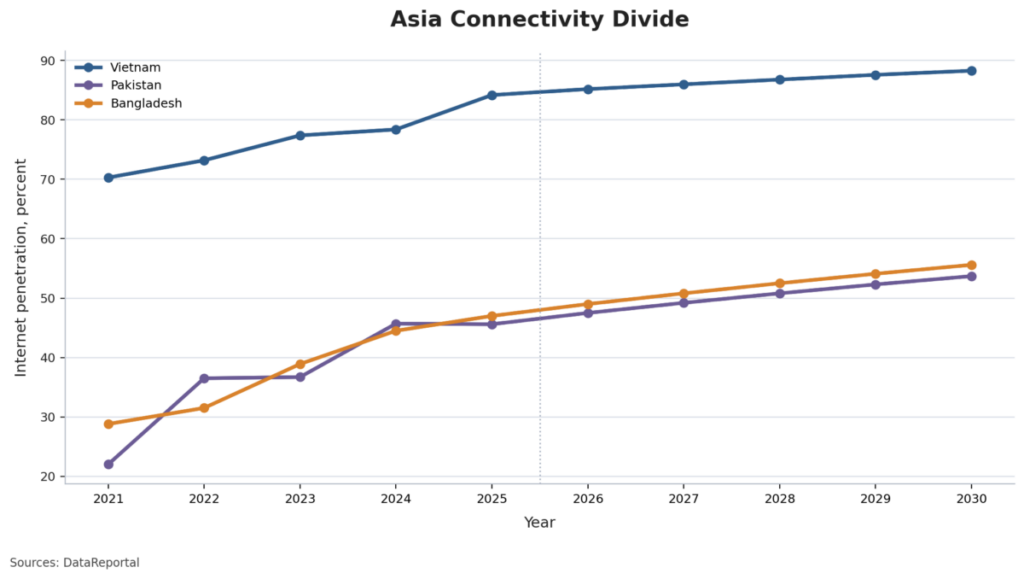
Pakistan and Bangladesh show the population-scale version: large digital societies with penetration still below half the population. Their economic conversion depends on affordability, service quality, institutional reach, and the ability of ordinary people and small firms to rely on digital systems.
Central Asia belongs in this frame where distance and institutional capacity shape digital use. Kazakhstan and Uzbekistan may show stronger capacity than some neighbors, but the broader interior-Asia question remains whether connectivity is surrounded by enough finance, public administration, logistics, and skills to become productive use.
| Name | 2025 | 2026 (est)* | % Growth | Source |
|---|---|---|---|---|
| Mongolia internet penetration | 83.0% | 84.0% | +1.0 pp | DataReportal |
| Nepal internet penetration | 56.0% | 58.0% | +2.0 pp | DataReportal |
| Pakistan internet penetration | 45.6% | 47.5% | +1.9 pp | DataReportal |
| Bangladesh internet penetration | 47.0% | 49.0% | +2.0 pp | DataReportal |
| Pakistan internet users | 117.0M | 123.0M | 5.1% | DataReportal |
Efficiency
Different Absorption Models
The same digital expansion is producing very different economic outcomes across Asia excluding China. The divide is no longer simply between connected and unconnected markets. It is between markets that can absorb connectivity into production, public infrastructure, platform commerce, industrial upgrading, or basic service reach.
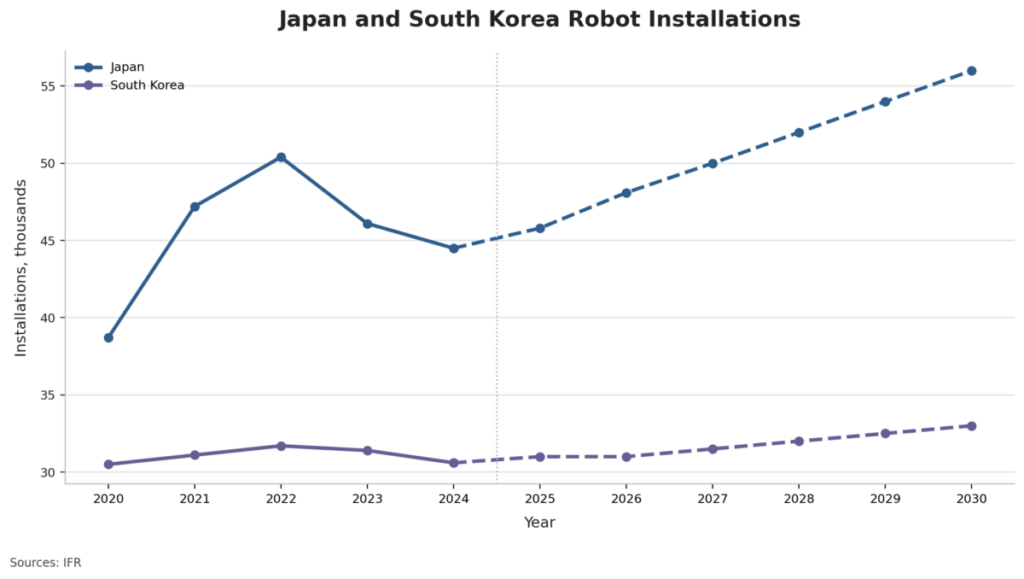
At the frontier, Japan, South Korea, and Taiwan show the industrial version of the internet economy. Digital systems are embedded in factory automation, semiconductors, advanced components, and the hardware base beneath AI. Japan and South Korea remain major automation markets, while Taiwan’s foundry position places it at the center of AI hardware supply.
India represents a different model: public-rail scale. UPI is not only a payments platform; it is becoming a daily operating layer for commerce. In May 2026, UPI processed 23.2 billion transactions worth ₹29.9 lakh crore. Volume growth remains stronger than value growth, which points to deeper use in smaller, routine transactions rather than only large-value digital payments.
Southeast Asia sits in the platform-discipline phase. Its digital economy is expected to exceed $300 billion in GMV, after a decade in which GMV expanded 7.4 times and revenue expanded 11.2 times. The next test is no longer user acquisition alone. It is whether platforms can sustain growth and AI-enabled operating efficiency.
Vietnam and Turkey occupy the industrial-middle tier. Both have broad connectivity, but their strategic question is conversion: whether internet access can deepen manufacturing capability, export competitiveness, and firm-level adoption. Vietnam’s 84.2% internet penetration gives it a strong base for manufacturing upgrade, while Turkey’s 88.3% penetration places it beyond the basic access problem and closer to the challenge of converting digital use into industrial and trade performance.
These differences make a single regional frame misleading. Japan, South Korea, and Taiwan sit near the industrial frontier. India shows how public infrastructure can become behavior at population scale. Southeast Asia has entered the platform-discipline phase after a long user-growth cycle. Vietnam and Turkey show the middle-income challenge of turning connectivity into firm capability. Access-constrained markets face the separate problem of turning a signal into institutional reach.
Asia’s second-half test is whether these absorption models can become productivity before infrastructure pressure, weak trust, affordability limits, or institutional gaps slow the gains. The region has scale, but scale is no longer the scarce asset. The scarce asset is the ability to turn access into productive, trusted, and repeatable economic life.
| Name | Latest | Change / Scale | Absorption Model | Source |
|---|---|---|---|---|
| Asia industrial robot installations | 401.7K in 2024 | 74% of global deployments | Industrial automation | IFR |
| Japan industrial robot installations | 44.5K in 2024 | World’s 2nd-largest market | Frontier production | IFR |
| South Korea industrial robot installations | 30.6K in 2024 | World’s 4th-largest market | Automated industry | IFR |
| TSMC global foundry share | 70.4% in Q4 2025 | AI and advanced-node concentration | AI hardware base | TrendForce |
| India UPI transaction volume | 23.2B in May 2026 | ₹29.9 lakh crore value | Public digital rails | NPCI |
| Southeast Asia digital economy GMV | $300B+ in 2025 | 7.4x GMV growth over decade | Platform discipline | Google; Temasek; Bain |
| Vietnam internet penetration | 84.2% in 2025 | 85.6M users | Industrial middle conversion | DataReportal |
| Turkey internet penetration | 88.3% in 2025 | 77.5M users | Services and trade conversion | DataReportal |
Platforms, Commerce, and Finance
The Consumer Internet Has Become an Infrastructure Problem
Southeast Asia has moved beyond the first phase of mobile internet expansion. Its platform economy is now large enough that growth must be judged by durability rather than adoption. ASEAN’s digital economy is set to surpass $300 billion in GMV in 2025, after a decade in which both transaction scale and revenue multiplied rapidly.
The constraint has shifted from attracting users to sustaining the commercial system beneath them. Platforms must prove that merchants can remain active, delivery quality can hold, payments can maintain trust, and repeat use can survive without subsidy-driven expansion. Indonesia gives the model scale, while Singapore and Malaysia show how platform growth increasingly depends on infrastructure depth. Less-developed markets remain more exposed to institutional and access constraints, but the central story has shifted toward operating discipline.
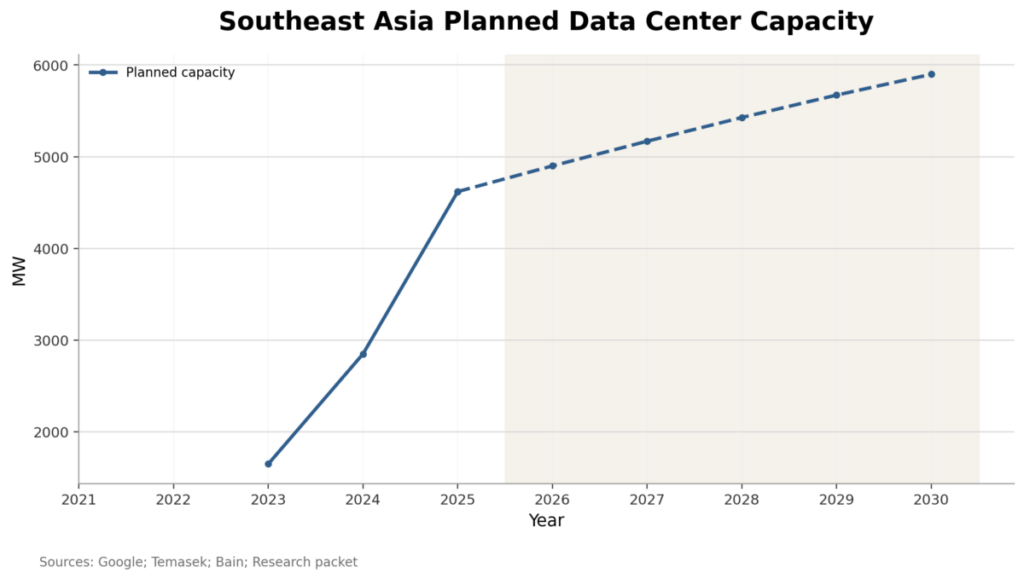
Southeast Asia also shows why the internet economy is becoming physical. More than 4,600 MW of new data-center capacity is planned, and regional capacity is set to grow by 180%, faster than the projected pace for the rest of Asia Pacific. Platform growth now depends on the physical systems that support computation, storage, delivery, and trust. The consumer internet is becoming an infrastructure economy.
The regional test is whether mobile-first scale can mature into durable market capacity. Southeast Asia has enough digital commerce to matter. Its next phase depends on whether the systems beneath that commerce can support margins, compute demand, merchant confidence, and small-business participation.
| Name | 2025 | 2026 (est)* | % Growth | Source |
|---|---|---|---|---|
| Southeast Asia digital economy GMV | $300B | $345B | 15.0% | Bain; Google; Temasek |
| Southeast Asia private digital funding | $7.7B | $8.5B | 10.4% | Bain; Google; Temasek |
| Southeast Asia planned data-center capacity | 4,620 MW | 4,900 MW | 6.1% | Bain; Google; Temasek |
| Malaysia planned data-center capacity | 2,415 MW | 2,560 MW | 6.0% | Bain; Google; Temasek |
Digital Health and Public Services
Public Rails Are Turning Infrastructure Into Behavior
India is a key model for how the internet can become an institutional-level system for public service. Its fintech system and payment infrastructure, led by a Unified Payments Interface (UPI), are exemplary because they show how digital settlement can move from private adoption into daily economic operation.
In May 2026, UPI processed 23.2 billion transactions worth ₹29.9 lakh crore, with volume up 24% and value up 19% year over year. The deeper point is frequency. UPI is not simply a payment tool; it is a settlement layer for ordinary commerce, where the rhythm of daily payment becomes part of the operating system of economic life.
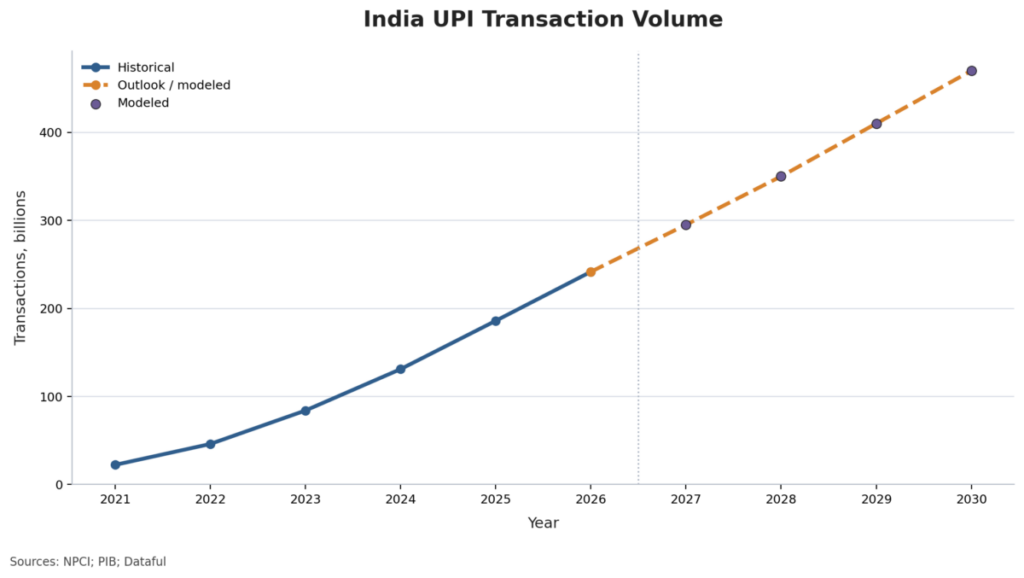
That changes India’s position in Asia’s regional map. India is not only a large mobile market or a fintech market. It is a country where public rails are turning payments, accounts, and records into a connected architecture for participation. The value is not only transaction volume. It is the reduction of friction between households, merchants, platforms, and public systems.
The model now extends beyond payment. Ayushman Bharat Digital Mission crossed 90 crore ABHA accounts in 2026, up from 14.7 crore in 2021. Payment infrastructure gives India a settlement layer; health-account infrastructure gives it a recognition layer. Together, they show how public digital systems can begin to change the cost of being paid, identified, treated, and served.
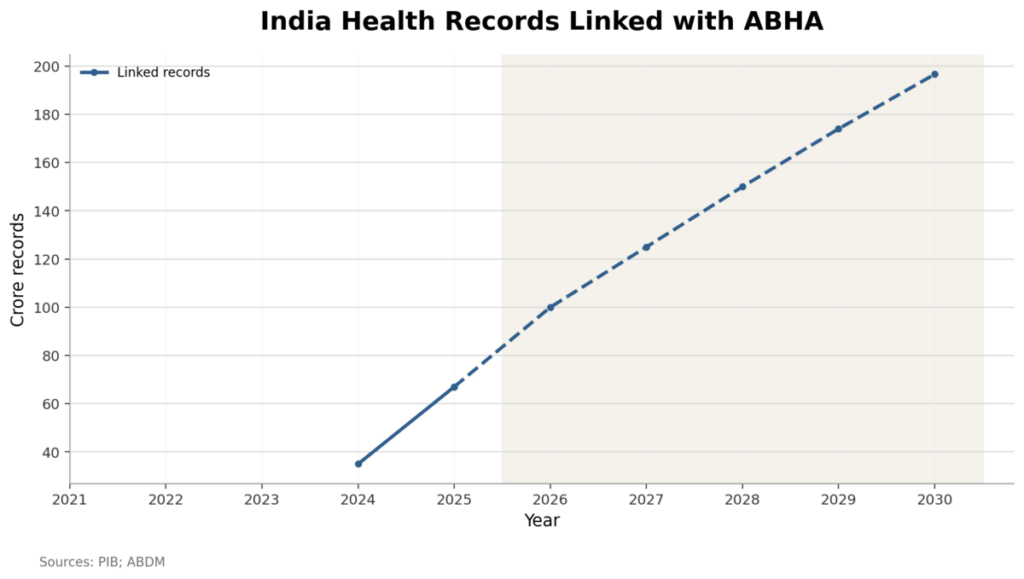
India’s mid-year constraint is execution. Population-scale rails are visible, but consistent service quality remains harder than account creation or payment volume. The next stage depends on whether public digital infrastructure can work reliably across rural areas, income groups, small firms, and public agencies. India proves that infrastructure can become behavior; it now has to prove that behavior can become service quality.
| Name | 2025 | 2026 (est)* | % Growth | Source |
|---|---|---|---|---|
| UPI transaction volume | 185.9B | 241.6B | 30.0% | NPCI; PIB |
| UPI transaction value | ₹260.4 lakh crore | ₹314.0 lakh crore | 20.6% | NPCI; PIB |
| UPI share of domestic digital payments | 85.0% | 85.0% | 0.0 pp | PIB |
| UPI merchant-payment share of volume | 63.0% | 64.0% | +1.0 pp | NPCI |
| ABHA digital health accounts | 80.0 crore | 90.0 crore | 12.5% | PIB; ABDM |
AI, Cloud, and Productivity
The Industrial Frontier Is the Physical Base of AI
Japan, South Korea, and Taiwan absorb digital systems through production rather than first-time platform access. Their role in Asia’s internet economy is not defined by how many people come online. It is defined by how deeply digital systems enter the industrial base.
Japan and South Korea carry the automation side of the frontier. Industrial robotics places digital capacity directly inside production, where software raises precision, sustains output, and helps manage demographic pressure. The economic question is no longer whether these economies are digital. It is whether digital production systems can keep lifting productivity as labor, energy, and supply-chain pressure intensify.
Taiwan anchors the hardware foundation beneath the same transformation. Taiwan accounts for more than 60% of global foundry revenue and more than 90% of leading-edge chip manufacturing. Its semiconductor industry generated more than $165 billion in revenue in 2024, equal to about 20.7% of GDP. That makes Taiwan central to the internet economy without turning it into a consumer-platform story.
Together, these economies define the physical edge of AI and cloud growth. Automation raises the productivity frontier, while chips supply the compute foundation that digital systems elsewhere depend on. Their risk is not poor access. It is whether industrial systems, AI infrastructure, and energy capacity can remain resilient under geopolitical strain.
| Name | 2025 | 2026 (est)* | % Growth | Source |
|---|---|---|---|---|
| Asia-Pacific whole-cloud spending | $258B | $315B | 22.2% | IDC |
| Asia-Pacific AI and GenAI spending | $101B | $140B | 38.4% | IDC |
| Taiwan semiconductor revenue | $165B | $175B | 6.1% | U.S. ITA |
| Taiwan global foundry revenue share | >60% | >60% | 0.0 pp | U.S. ITA |
| Taiwan leading-edge chip manufacturing share | >90% | >90% | 0.0 pp | U.S. ITA |
Sectors, Commerce, and Industrial Systems
The Industrial Middle Must Turn Connectivity Into Firm Capability
Vietnam and Turkey occupy the industrial middle of Asia’s internet economy. They are not low-access markets, and they are not the frontier producers of the region’s most advanced digital infrastructure. Their importance lies in whether broad connectivity can raise firm capability.
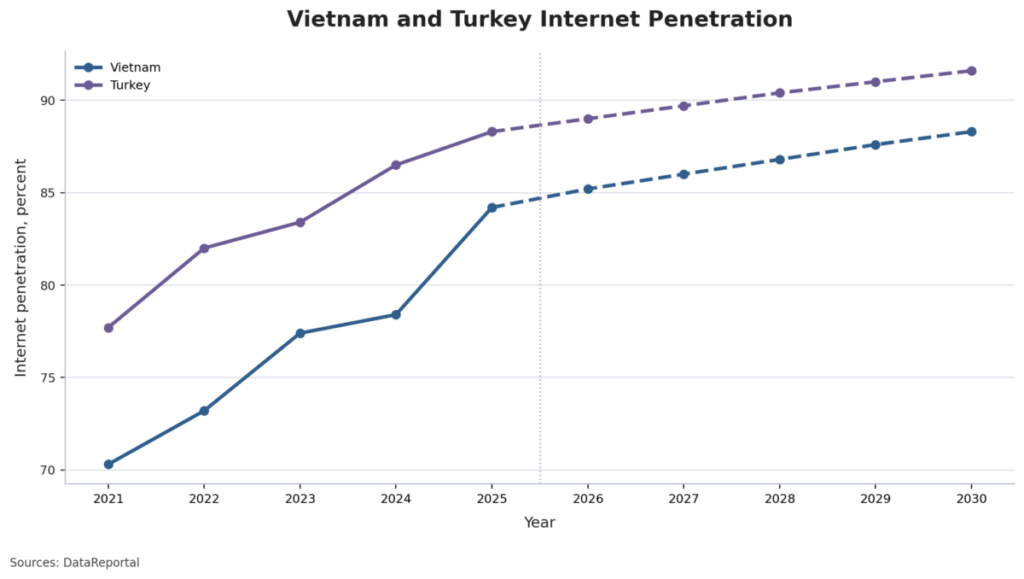
Vietnam’s digital base is strong enough to shift the question from access to use inside firms. With 85.6 million internet users at the end of 2025 and 84.2% penetration, the country has the connectivity base needed for industrial upgrading. The next step is deeper firm use, where digital tools improve production reliability, supplier coordination, workforce capability, and trade performance.
Turkey belongs in the same middle lane through a different economic route. With 77.5 million internet users and 88.3% penetration at the end of 2025, its internet economy is already broad. The constraint is whether digital use deepens its role as a manufacturing, services, and trade bridge rather than remaining concentrated in consumer activity.
The industrial middle prevents Asia’s digital development from being reduced to a ladder with only two ends. Between low-access markets and advanced automation economies sits a large zone of connected industrial economies where the decisive question is whether firms can use digital systems deeply enough to raise productivity.
| Name | 2025 | 2026 (est)* | % Growth | Source |
|---|---|---|---|---|
| Vietnam internet users | 85.6M | 86.8M | 1.4% | DataReportal |
| Vietnam internet penetration | 84.2% | 85.2% | +1.0 pp | DataReportal |
| Turkey internet users | 77.5M | 78.5M | 1.3% | DataReportal |
| Turkey internet penetration | 88.3% | 89.0% | +0.7 pp | DataReportal |
Human Impact, SDGs, and STI
Inclusion Is an Institutional Test
The human impact of Asia’s internet economy depends on whether digital systems reduce the distance between people and institutions. Connectivity matters most when it changes the cost of being paid, recognized, treated, educated, or served.
Financial inclusion provides the baseline. Global adult account ownership reached 79% in 2025, while mobile-phone ownership reached 86%. Those figures show the foundation for digital participation, but the outcome depends on what institutions can do with that access. An account becomes meaningful when income can arrive safely, payments can be made cheaply, and a household can interact with formal systems without repeated friction.
India gives the clearest regional example because payments and health recognition are moving together. UPI’s May 2026 transaction scale shows daily settlement at population level. ABHA’s 90 crore accounts show administrative recognition moving into health. Together, they turn inclusion from a connectivity question into a service-delivery question.
The development relevance is larger than India. Digital public systems can support health access, administrative identity, economic participation, and resilience when they are trusted and usable. In advanced production economies, the human test is whether technology supports older societies without excluding workers. In platform economies, it is whether small merchants gain durable market access. In the industrial middle, it is whether skills attach to higher-value production. In constrained markets, it is whether access becomes reliable enough to matter in daily life.
| Name | 2025 | 2026 (est)* | % Growth | Source |
|---|---|---|---|---|
| Global adult account ownership | 79.0% | 80.0% | +1.0 pp | World Bank |
| Adults owning mobile phones | 86.0% | 87.0% | +1.0 pp | World Bank |
| India UPI transaction volume | 185.9B | 241.6B | 30.0% | NPCI; PIB |
| ABHA digital health accounts | 80.0 crore | 90.0 crore | 12.5% | PIB; ABDM |
Governance, Regulation, and Digital Sovereignty
Trust Has Become Infrastructure
Governance has become part of the economic structure of the internet. It decides whether digital scale remains usable as transactions, records, platforms, industrial systems, and cloud infrastructure become more central to everyday activity.
The cloud layer makes that governance problem more physical and more strategic. Asia-Pacific whole-cloud spending is moving toward $471.2 billion by 2028 at a 22.2% compound annual rate. AI and GenAI spending is moving faster, toward $175 billion by 2028. The region is entering a compute-intensive phase in which cloud access, data-centre capacity, energy reliability, and sovereign control increasingly belong to the same economic problem.
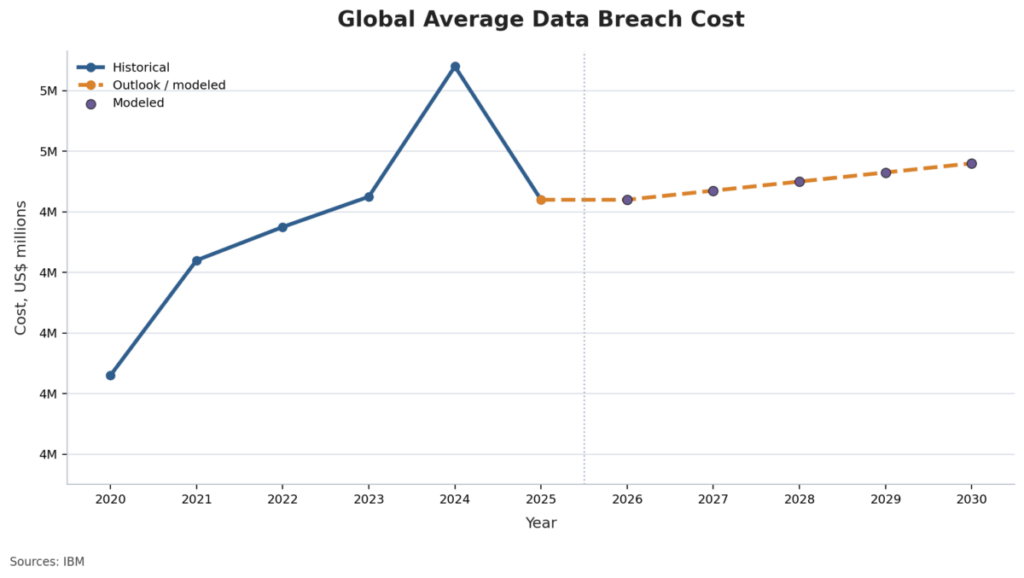
Cyber risk turns trust into an operating requirement. The global average cost of a data breach stood at $4.44 million in 2025, down from $4.88 million in 2024 but still large enough to make digital failure an economic-continuity problem. As firms, public agencies, and platforms depend more heavily on digital systems, cyber resilience becomes part of productivity.
Asia will not converge around one regulatory model because it does not have one internet economy. India needs trust in public rails and records. Frontier producers need resilience inside industrial and hardware systems. Southeast Asia needs platform discipline and infrastructure governance. Vietnam and Turkey need rules that support firm upgrading. Access-constrained markets need institutions strong enough to make first-use digital systems reliable.
Governance is therefore trust infrastructure. Without it, scale can grow while confidence weakens. With it, digital systems can become durable economic capacity.
| Name | 2025 | 2026 (est)* | % Growth | Source |
|---|---|---|---|---|
| Asia-Pacific whole-cloud spending | $258B | $315B | 22.2% | IDC |
| Asia-Pacific AI and GenAI spending | $101B | $140B | 38.4% | IDC |
| Average cost of a data breach | $4.44M | $4.44M | 0.0% | IBM |
| ADB energy and digital infrastructure programme | $70B | $70B | 0.0% | ADB |
Outlook
Adoption Is No Longer the Test
Asia’s second-half 2026 outlook is positive but constrained. The region has digital scale, but the decisive question is whether that scale can be converted into productivity, resilience, inclusion, and public value.
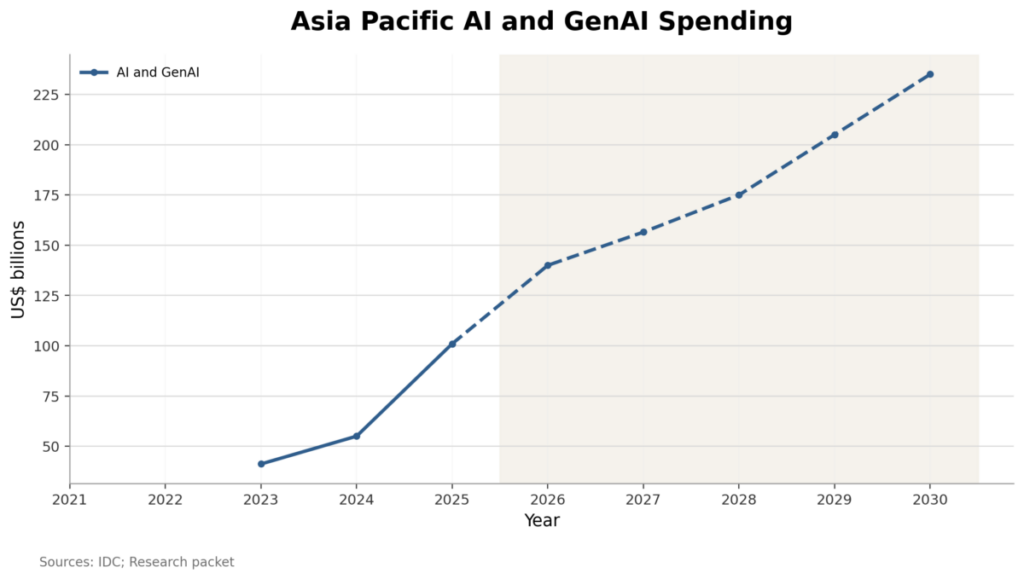
AI and cloud demand raise the stakes. Asia-Pacific whole-cloud spending is moving toward $471.2 billion by 2028, while AI and GenAI spending is moving toward $175 billion. The internet economy is becoming more compute-intensive, and that changes the meaning of infrastructure. Broadband, cloud, data centers, AI systems, and electricity now form one development constraint.
The infrastructure response is already taking shape. A $70 billion program through 2035 is aimed at strengthening energy and digital infrastructure across Asia Pacific, including the power systems needed to support a more cloud- and AI-dependent economy. Digital growth can no longer be separated from grids, land, resilience, and regional coordination.
Each part of Asia now faces a different version of the same second-half test. The industrial frontier must keep advanced production productive under demographic, energy, and geopolitical pressure. India must turn public-digital scale into consistent service quality. Southeast Asia must convert platform scale into durable commercial discipline. Vietnam and Turkey must deepen firm capability. Access-constrained markets must make connectivity reliable enough to change ordinary economic life.
Asia’s internet economy is not moving at one speed because it is not one economy. It is a set of systems absorbing the same technological wave through different institutions, industries, and geographies. Adoption is now the weaker measure. The real measure is whether digital growth becomes productive capacity before the limits around it harden.
| Name | 2025 | 2026 (est)* | % Growth | Source |
|---|---|---|---|---|
| Asia-Pacific mobile-sector contribution | $1.01T | $1.08T | 6.9% | GSMA |
| Asia-Pacific whole-cloud spending | $258B | $315B | 22.2% | IDC |
| Asia-Pacific AI and GenAI spending | $101B | $140B | 38.4% | IDC |
| Southeast Asia planned data-center capacity | 4,620 MW | 4,900 MW | 6.1% | Bain; Google; Temasek |
| ADB energy and digital infrastructure programme | $70B | $70B | 0.0% | ADB |
Sources
- GSMA; The Mobile Economy Asia Pacific 2025; – Link
- Google, Temasek, Bain; e-Conomy SEA 2025 Report; – Link
Internet Integration and Regional Digital Position
- International Federation of Robotics; World Robotics 2025 Report — Industrial Robots; – Link
- DataReportal; Digital 2026 Global Overview Report; – Link
Connectivity and Market Access
- DataReportal; Digital 2026: Vietnam; – Link
- DataReportal; Digital 2026 Mid-Year Global Update Report; – Link
Digital Health and Public Services
- NPCI; UPI Product Statistics; – Link
- Press Information Bureau, Government of India; Ayushman Bharat Digital Mission Crosses Landmark Milestone of 90 Crore ABHA Accounts; – Link
AI, Cloud, and Productivity
- U.S. International Trade Administration; Taiwan — Semiconductors, Including Chip Design and AI; – Link
- IDC; Asia/Pacific AI and GenAI Spending to Reach $175 Billion by 2028; – Link
Platforms, Commerce, and Finance
- Bain & Company; e-Conomy SEA 2025 — ASEAN’s Digital Economy Poised to Surpass $300 Billion; – Link
Governance, Regulation, and Digital Sovereignty
- IDC; Asia/Pacific Whole Cloud Spending Forecast, 2025–2028; – Link
- IBM; Cost of a Data Breach Report 2025; – Link
Human Impact, SDGs, and STI
- World Bank; The Global Findex Database 2025; – Link
Outlook
- Asian Development Bank; ADB Launches $70 Billion Push to Connect Asia Power Grids and Digital Networks; – Link
Keywords: Internet Economy, Digital Infrastructure, Asia-Pacific, Public Digital Infrastructure, AI Infrastructure, Cloud Computing, Digital Payments, Digital Inclusion
Access-Constrained Northern, Interior, and South Asian Markets: Bangladesh, Kazakhstan, Mongolia, Nepal, Pakistan, Uzbekistan
Frontier Production: Japan, South Korea, Taiwan
Manufacturing-Middle Economies: Turkey, Vietnam
Mobile-First Platform Scale: Cambodia, Indonesia, Laos, Malaysia, Myanmar, Singapore, Timor-Leste
Public Digital Infrastructure: India