
Sub-Saharan Africa enters the second half of 2026 as a mobile-first internet economy whose strongest gains come from coordination rather than frontier compute. Digital systems already shape how money moves, how households reach services, how small firms find demand, and how public agencies coordinate across distance. The central test is no longer first access. It is whether access can harden into dependable infrastructure.
The region is not moving as one digital economy. It is separating by how well connectivity becomes usable participation. Advanced city corridors show the deepest digital absorption, with dense markets and stronger institutions turning access into daily economic function. Kenya and South Africa sit closest to advanced national models, though through different paths: Kenya through mobile finance and public-service reach, South Africa through enterprise infrastructure and deeper institutional systems.
Advanced-country status does not erase rural exclusion. It means the state has stronger capacity to scale digital systems, not that the benefits arrive evenly. Rural districts inside stronger countries still face the reliability and affordability barriers that decide whether coverage becomes use. National averages can make these communities look more included than they are.
Lower-capacity states face the harder version of the same problem at national scale. Digital systems may arrive before electricity, regulatory depth, public-sector capacity, local technical skill, and institutional trust are strong enough to maintain them. The issue is not only rural exclusion. It is weak integration across the country as a whole.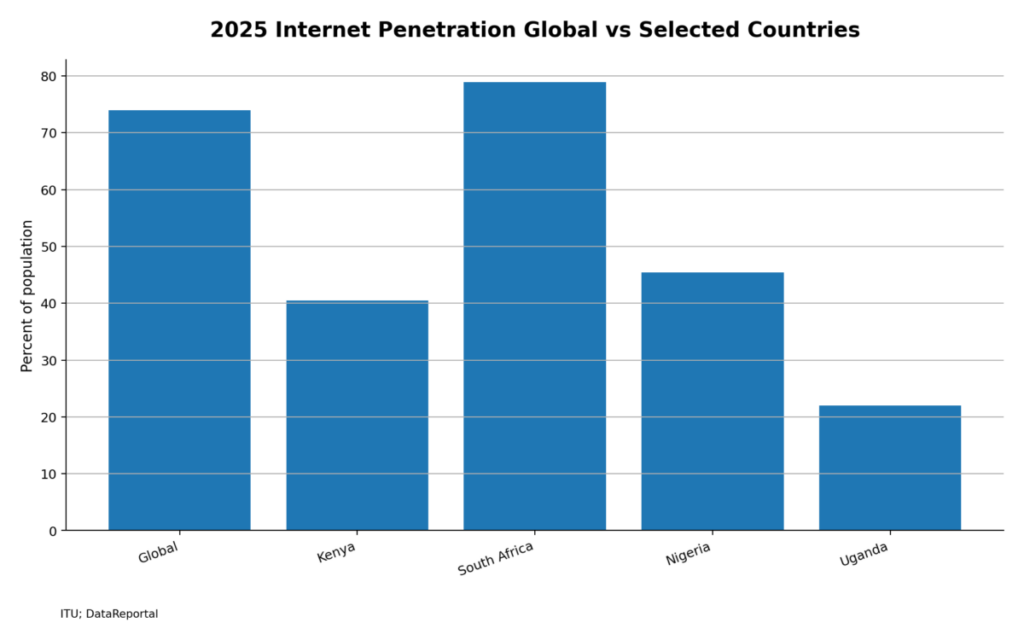
Global internet use reached about 6 billion people in 2025 and is estimated at 6.18 billion in 2026. Global penetration moved from 74% toward an estimated 76%, while the offline population fell from about 2.2 billion to an estimated 2.1 billion. The benchmark has moved from first connection toward meaningful use. In Sub-Saharan Africa, that shift is sharper as mobile networks expand faster than the conditions that turn coverage into participation.
Country penetration figures show the same split inside the region. South Africa’s internet penetration stood near 78.9% in 2025 and is estimated at 79.6% in 2026, while Nigeria remained near 45.5%, Kenya near 40.5%, and Uganda around 22%. The numbers do not simply rank markets. They show why the region’s digital story has to be read through absorption rather than averages.
Offline status now carries human cost. A person without reliable access is farther from payment systems, public identity, care pathways, learning channels, and the daily transactions that increasingly assume a working connection. Slow access creates a quieter exclusion. People may be counted as connected while still unable to complete the actions that now define participation.
The mid-year judgment is regional but not averaged. Sub-Saharan Africa is advancing through mobile coordination, but durable value depends on whether advanced cities, stronger national systems, rural districts, and low-integration states move closer together rather than farther apart.
| Name | 2025 | 2026 (est)* | % Growth | Source |
|---|---|---|---|---|
| Global internet users | 6.0B | 6.18B | 3.0% | ITU |
| Offline population | 2.2B | 2.1B | -4.5% | ITU |
| Global internet penetration | 74% | 76% | +2.0 pp | ITU |
| Kenya internet penetration | 40.5% | 40.5% | 0.0% | DataReportal |
| South Africa internet penetration | 78.9% | 79.6% | 0.9% | DataReportal |
| Uganda internet penetration | 22.0% | 22.0% | 0.0% | DataReportal |
| Nigeria internet penetration | 45.4% | 45.5% | 0.2% | DataReportal |
| Advanced-city digital absorption | High | High | n/m | IoIE |
Connectivity and Market Access
From Coverage to Absorption
Connectivity now works as market access. A household, clinic, school, farm, port, or small firm may be technically connected and still remain economically constrained when power fails, service quality drops, or devices remain unaffordable.
Mobile technologies and services generated $240 billion in economic value across Africa in 2025, equal to 7.8% of regional GDP. The figure is estimated at $249 billion in 2026. Mobile-sector employment moved from 13 million supported jobs toward an estimated 13.4 million, while public revenues rose from $45 billion to an estimated $46.7 billion. Mobile is already one of the region’s economic foundations. Its next gains depend on whether use becomes routine enough to support work, trade, administration, and service delivery.
Coverage is not participation. Advanced cities show how connectivity deepens when markets and institutions make digital systems useful faster. Advanced countries show how those systems begin to scale through national capacity. Rural districts inside stronger markets expose the limits of averages, where signal can exist without dependable participation. In low-integration states, mobile access often carries too much of the digital economy on a weak physical and institutional base.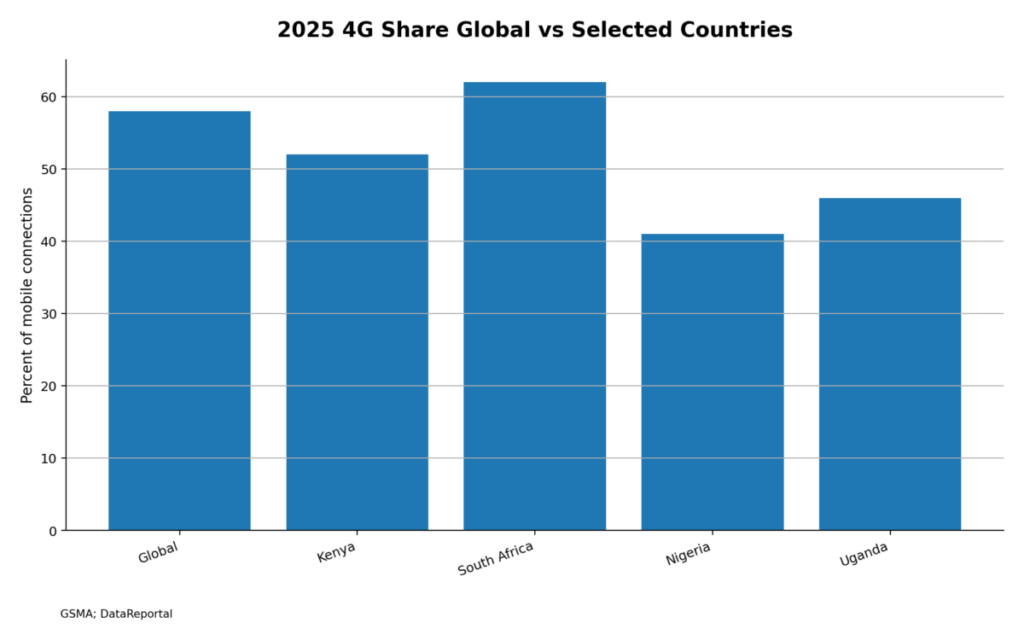
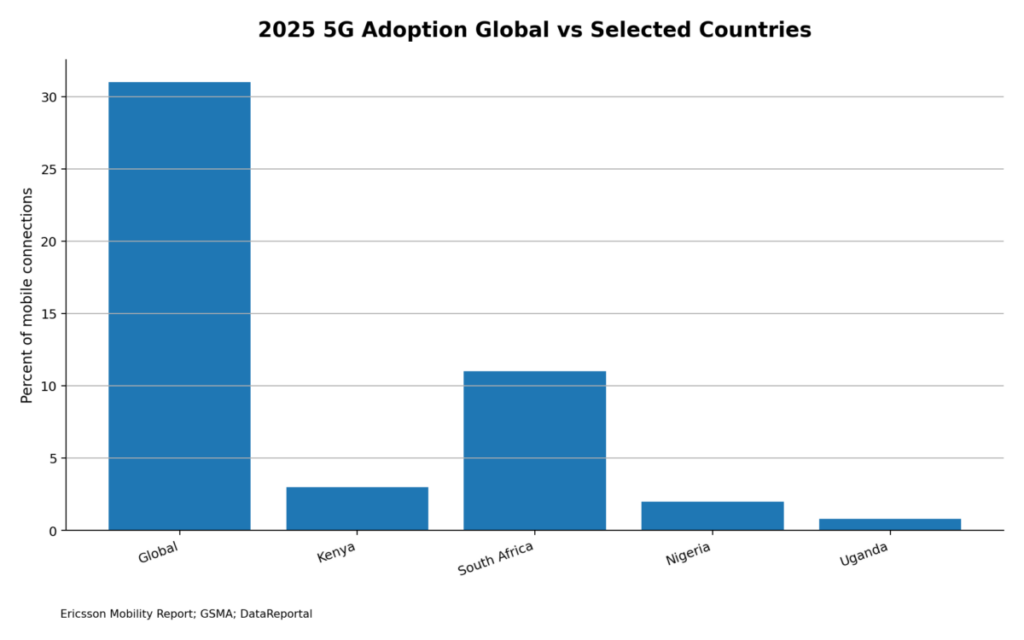
The connectivity layer is improving, but its distribution tells a harder story. Global 5G population coverage rose from 55% in 2025 toward an estimated 60% in 2026, while low-income coverage moved only from 4% to 5%. Uganda’s 4G population coverage reached 96%, yet its internet penetration remained around 22%. South Africa’s broadband-capable mobile connections approached 98.7%, while mobile connection density in Nigeria rose from 64% to an estimated 69.2%. The region’s access problem is not only whether networks exist. It is whether people can convert network reach into stable use.
Electricity is the hard floor. Around 600 million people in Sub-Saharan Africa, or 47% of the population, lacked access to electricity in 2024. Annual electricity-access investment needs stand near $15 billion, while Mission 300 aims to connect 300 million people by 2030 with a financing target of $90 billion. Digital participation cannot become institutional uptime while the power system remains fragile.
Affordability sets the other practical boundary. A $40 smartphone could bring mobile internet within reach for an additional 20 million people in Sub-Saharan Africa, while a $30 handset could open access for as many as 50 million more. The device has become part of the infrastructure story. Coverage can reach a place before a household can afford to use it.
The access problem is shifting into an absorption problem. Coverage can make participation imaginable, but absorption depends on whether the connection is regular, affordable, secure, and useful enough to support essential economic and public-service activity. A person can be counted as connected while still excluded from the higher-value systems that now define participation.
Slow internet produces partial citizenship in digital life. A weak connection may be enough to appear online but not enough to complete a payment, verify identity, use a public-service portal, or keep a small business visible. In rural districts, nominal coverage becomes a middle condition between inclusion and exclusion. In low-integration states, the same gap can become a national development condition.
Device quality and trust belong inside market access. A shared phone, a basic handset, an unaffordable smartphone, or an insecure device can decide whether a person can receive money, complete schoolwork, verify identity, use a health portal, or make a public claim. Mobile coverage does not become digital participation when the usable device is missing or the channel cannot be trusted.
Continuity now belongs inside economic stability. When networks fail or are restricted, the loss no longer stays inside communications. Payments slow, clinics lose reach, public-service channels narrow, and household income systems become less reliable.
| Name | 2025 | 2026 (est)* | % Growth | Source |
|---|---|---|---|---|
| Africa mobile economic contribution | $240B | $249B | 3.8% | GSMA Intelligence |
| Africa mobile sector jobs supported | 13M | 13.4M | 3.1% | GSMA Intelligence |
| Africa public revenues from mobile | $45B | $46.7B | 3.8% | GSMA Intelligence |
| 3G exposure employment effect | 3–8 pp | Established finding | n/m | World Bank / IZA |
| Global 5G population coverage | 55% | 60% | +5.0 pp | ITU |
| Low-income 5G coverage | 4% | 5% | +1.0 pp | ITU |
| Uganda 4G population coverage | 96% | 96% | 0.0% | GSMA |
| South Africa broadband-capable mobile connections | 97.5% | 98.7% | +1.2 pp | DataReportal |
| South Africa mobile connection density | 193.0% | 196.0% | 1.6% | DataReportal |
| Nigeria mobile connection density | 64.0% | 69.2% | 8.1% | DataReportal |
| Mission 300 electricity target | 300M by 2030 | 300M by 2030 | 0.0% | World Bank |
| Mission 300 finance target | $90B | $90B | 0.0% | World Bank |
| Annual electricity-access investment need | $15B | $15B | 0.0% | IEA |
| Affordable smartphone threshold | $40 | $40 | 0.0% | GSMA |
| Affordable smartphone access unlock | 20M people | 20M people | 0.0% | GSMA |
Technologies With the Greatest Economic Influence
Coordination Before Frontier Compute
The most influential technologies in Sub-Saharan Africa are not the most advanced in a frontier sense. They are the systems that reduce the cost of trust and settlement across distance.
Mobile money remains the clearest expression of that shift. Services processed more than $2 trillion in transactions in 2025 and are estimated to reach $2.4 trillion in 2026. Merchant payments rose from $155 billion toward an estimated $210 billion, making commerce the most telling mobile-money use case. Scale has moved into deepening. Mobile finance has moved beyond household transfer into the transaction layer of everyday commerce.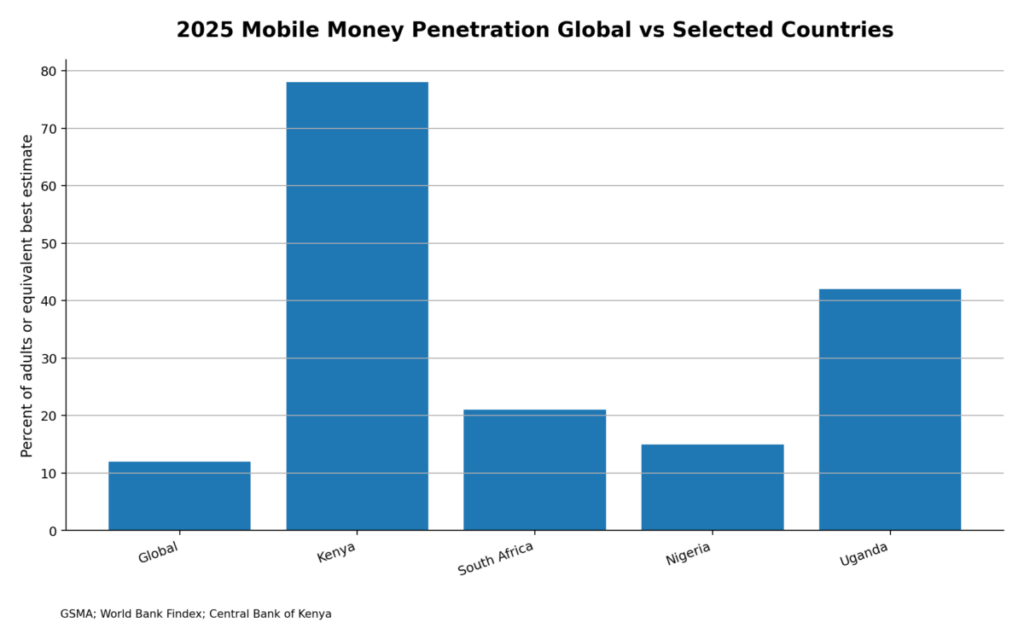
Kenya sits at the higher-capacity edge of mobile-first coordination. Mobile-money accounts rose from 89.46 million in 2025 to an estimated 94.09 million in 2026, while cash-in and cash-out value held near KSh8.1 trillion. Payment behavior has become part of the economy’s operating system even where formal banking has not reached everyone equally.
Uganda shows the same coordination logic in a lower-income setting. Mobile-money transaction value rose from $27.2 billion in 2025 toward an estimated $29.9 billion in 2026, showing how settlement systems can deepen even where broader internet participation remains limited. South Africa represents the heavier edge of the same shift, where enterprise demand and local hosting needs push the internet economy toward deeper infrastructure.
Country contrast matters. South Africa’s internet penetration reached 78.9% in 2025 and is estimated at 79.6% in 2026, while Nigeria remained near 45.5%. Uganda’s 4G population coverage reached 96%, yet internet penetration remained around 22%. The gap between network reach and actual use shows why absorption is the region’s defining digital problem.
Advanced cities absorb these technologies first as dense markets make digital services useful faster. Advanced countries matter when those tools move beyond the city and become national operating systems. Rural districts reveal whether national systems can reach lower-density communities without losing reliability. Low-integration states reveal whether imported platforms can become domestic capability or remain external operating layers.
Technology transfer matters only when it becomes local capacity. A country that imports systems but cannot repair, audit, adapt, procure, or govern them remains dependent even when adoption figures improve.
AI belongs in the regional story with restraint. Its near-term value is strongest where it improves institutional workflows rather than imitates frontier economies. In public services and applied sectors, AI can strengthen capacity only when data systems, electricity, and accountability are strong enough to carry it. Advanced cities will test applied AI first. Advanced countries will determine whether it becomes institutional capacity. Rural and low-integration settings will show where the base remains too thin.
Coordination Before Frontier Compute
| Name | 2025 | 2026 (est)* | % Growth | Source |
|---|---|---|---|---|
| Mobile money transaction value | $2.0T | $2.4T | 20.0% | GSMA |
| Mobile money merchant payments | $155B | $210B | 35.5% | GSMA |
| Kenya mobile-money accounts | 89.46M | 94.09M | 5.2% | Central Bank of Kenya |
| Kenya mobile-money cash-in / cash-out | KSh8.14T | KSh8.13T | -0.1% | Central Bank of Kenya |
| Uganda mobile-money transaction value | $27.2B | $29.9B | 9.9% | IMF; FRED |
Strongest Sectors and Business Models
Where Digital Systems Reduce Friction
Digital systems produce the strongest sector gains where distance, informality, weak records, and high transaction costs have historically limited participation. Their value appears when people can find work, receive money, reach customers, and manage risk with less friction.
Mobile broadband has measurable labor effects. In rural Tanzania, 3G exposure produced a 3–8 percentage point increase in wage employment and non-farm self-employment. The network matters most when it changes the information environment around work, selling, and household income.
Mobile finance has shown the same household force. Access to M-PESA lifted 194,000 Kenyan households, about 2% of households, out of extreme poverty. The economic meaning goes beyond payment convenience. Mobile finance became a resilience system by improving how households store value, receive support, and move money during stress.
Business models scale first where income density and trust are already stronger. Advanced cities can support merchant digitization and platform-enabled commerce sooner than lower-density markets. Advanced countries can extend those models when national institutions are strong enough to carry them.
Rural communities often benefit most from reduced distance, but they face the highest adoption friction. Lower-technology and weakly integrated countries face the deeper problem: the market itself may be too fragmented for digital business models to scale without parallel investment in physical infrastructure and public trust.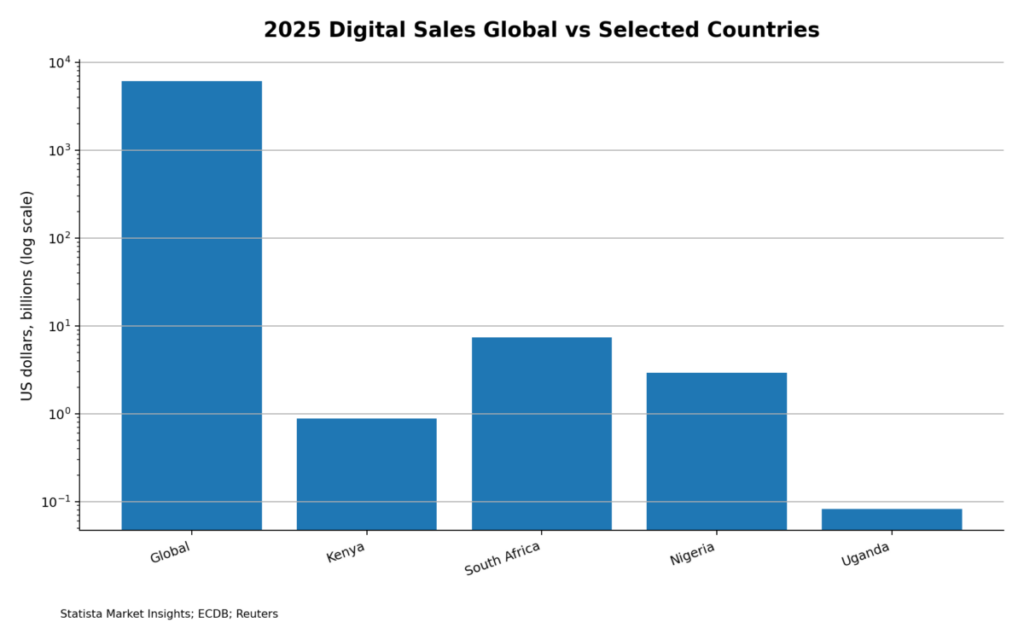
Commerce digitization in the region is less a clean shift into platform retail than the modernization of informal trade. Kenya’s e-commerce revenue is estimated to rise from $886 million in 2025 to $997 million in 2026, while Nigeria’s moves from $2.92 billion to $3.29 billion. South Africa’s larger market is estimated to rise from $7.42 billion to $8.34 billion, while Uganda moves from $82 million to $92 million. The larger shift is not platform retail alone. Digital payments and ordering systems make small trade more visible, less cash-bound, and less dependent on travel.
| Name | 2025 | 2026 (est)* | % Growth | Source |
|---|---|---|---|---|
| Kenya e-commerce revenue | $886M | $997M | 12.5% | ECDB |
| South Africa e-commerce revenue | $7.42B | $8.34B | 12.4% | Reuters |
| Uganda e-commerce revenue | $82M | $92M | 12.2% | ECDB |
| Nigeria e-commerce revenue | $2.92B | $3.29B | 12.7% | ECDB |
| 3G exposure labor effect | 3–8 pp | Established finding | n/m | World Bank / IZA |
| M-PESA poverty reduction effect | 194,000 households | Established finding | n/m | Science |
| M-PESA poverty reduction share | ~2% of households | Established finding | n/m | Science |
Human Impact, SDGs, and STI
Recognition, Capability, and Everyday Participation
The human impact of digital transformation depends on who can enter formal digital life. Identity, institutional capability, and applied innovation determine whether digital systems widen opportunity or deepen exclusion.
Adult ID coverage in Sub-Saharan Africa reached 81% in 2025 and is estimated at 82% in 2026. About 800 million people globally still lack official identification, and at least 2.8 billion lack government-recognized digital identity for secure online transactions. Identity is now an economic threshold rather than an administrative detail.
The region’s uneven digital systems are especially visible in recognition. Advanced cities face questions of quality and trust as platforms become more complex. Advanced countries face the task of making national systems dependable beyond metropolitan cores. Rural districts face basic usability barriers. Low-integration states face the deeper challenge of keeping identity, health, education, and public-service systems stable enough to become trusted.
Digital access has human force where older systems never fully reached everyone. Connectivity can become the first practical route into care, records, payments, warnings, learning, and claims. The developmental value is not the device itself. It is the shortened distance between a household and the institutions that shape survival, income, and recognition.
For Sub-Saharan Africa, science, technology, and innovation are not frontier slogans. They are the practical capacity to turn connection into learning, care, income, resilience, and public trust. Digital systems support development when they make services reachable, widen market access, bring excluded households into formal systems, and turn technology transfer into local capability rather than permanent dependence.
Digital health belongs inside the absorption test. Care delivery is one of the clearest places where distance becomes economic and human cost. South Africa’s MomConnect has reached more than 4.7 million mothers, showing how a public-health channel can extend state capacity between physical visits. In lower-capacity countries, similar systems remain more fragile when continuity depends on institutions that are still thin.
Maternal health shows the same boundary. Uganda’s maternal mortality ratio remained near 189 per 100,000, while Nigeria reported a 17% maternal-death reduction claim against its baseline. Digital channels can help close missed links in fragile systems, but they cannot substitute for the public-health foundations that make care continuous.
Digital health does not replace hospitals, clinicians, medicine, clean water, or transport. It extends scarce capacity when public-health channels can reach people between physical visits. The human impact comes from earlier contact and fewer missed links in fragile systems.
Identity is only one part of recognition. In rural economies, digital records and trusted public workflows can make people and assets more visible to institutions. The human value is not the technology itself. It is the shift from informal existence toward recognized participation.
Gendered access sharpens the human-impact frame. More than 810 million women remained unconnected globally in 2025, with an estimated decline to 790 million in 2026. Mobile ownership and smartphone ownership gaps remained 7% and 13%, making access a question of agency inside households and communities.
Education sharpens the same divide across generations. School-age children without home internet fell from 1.30 billion in 2025 toward an estimated 1.24 billion in 2026, but the remaining gap still marks a vast capability boundary. Digital exclusion is not only a present-tense constraint. It shapes who can learn, search, apply, and participate later.
Youth capability will shape whether digital adoption becomes domestic learning. Young people often adapt mobile tools to local needs first, but that energy remains informal when training, finance, procurement access, and institutional trust are too thin. The region’s demographic advantage becomes an internet-economy advantage only when local skill becomes local capacity.
Science, technology, and innovation capacity decides whether countries merely consume digital tools or adapt them to local constraints. Advanced cities generate much of the visible innovation. Advanced countries decide whether that innovation can become institutional capacity. Rural spaces test whether innovation reaches lower-density communities. Low-technology countries test whether digital transformation becomes local learning or permanent dependence.
| Name | 2025 | 2026 (est)* | % Growth | Source |
|---|---|---|---|---|
| Sub-Saharan Africa adult ID coverage | 81% | 82% | +1.0 pp | World Bank ID4D |
| School-age children without home internet | 1.30B | 1.24B | -4.6% | UNICEF; ITU |
| Women not using mobile internet | 810M | 790M | -2.5% | GSMA |
| South Africa MomConnect reach | 4.7M users | 4.7M+ users | n/m | MomConnect; Ada |
| Uganda maternal mortality ratio | 189 / 100k | 189 / 100k | 0.0% | WHO AFRO |
| Nigeria maternal-death reduction claim | Baseline | -17% | n/m | Nigeria Health Ministry |
Regulation and Governance
Trust as the Operating Condition
Governance determines whether mobile-first growth can scale without fraud, exclusion, or institutional overload. The regulatory challenge is not only to permit digital markets. It is to keep trust ahead of adoption.
Cybercrime accounts for more than 30% of reported crime in Western and Eastern Africa. Around 90% of African countries need significant improvement in cyber law-enforcement or prosecution capacity. Cybersecurity has become part of ordinary economic coordination as more value moves through digital channels.
Governance capacity remains uneven. Advanced cities often move faster than national rules as digital markets concentrate there first. Advanced countries have deeper policy ecosystems, but enforcement gaps still widen outside metropolitan cores. Rural districts often encounter digital systems through weaker local institutions. Low-technology countries face the deepest mismatch, where adoption can outrun prosecution, audit, procurement, data protection, and public-sector technical capability.
Network transition is also a governance test. South Africa’s 2G and 3G shutdown path points toward a 2027 deadline, a shift that can improve spectrum efficiency while creating new inclusion risks for users still dependent on older devices. Regulation has to manage modernization without turning infrastructure upgrades into another form of exclusion.
Trust has to arrive early. In mature digital economies, cybersecurity often appears after adoption as a risk-management problem. In mobile-first and lower-capacity settings, trust is part of the baseline. A weakly protected device can turn the same channel that expands access into a source of fraud, exclusion, or institutional doubt.
Digital regulation works when it makes trust usable. Payment systems, identity systems, cloud services, and public platforms all depend on credible enforcement. Without that capacity, adoption can rise while confidence weakens.
Public-service digitization also needs appeal paths. When a digital identity record, device failure, payment error, or missing document blocks access to a benefit or service, the system needs a way to correct the error. A digital system that cannot be challenged becomes a gate. A system that can correct errors and preserve human recourse becomes a bridge.
Economic coordination improves when access, trust, cloud infrastructure, and energy planning are treated as one operating environment. Fragmented governance leaves institutions solving connected problems in isolation.
| Name | 2025 | 2026 (est)* | % Growth | Source |
|---|---|---|---|---|
| Cybercrime share of reported crime | 30%+ | 30%+ | n/m | INTERPOL |
| Cyber law-enforcement capacity gap | 90% of countries | 90% of countries | n/m | INTERPOL |
| South Africa 2G / 3G shutdown deadline | Policy path | 2027 deadline | n/m | Government of South Africa |
Risks and Distributional Effects
Scarcity, Dependency, and Uneven Absorption
Sub-Saharan Africa is becoming more digitally active while remaining thin in the infrastructure that supports advanced digital capacity. That imbalance turns adoption into exposure.
Africa holds less than 1% of global data-center capacity, while mobile data use on the continent is rising by about 40% annually. Local compute capacity is estimated to rise from 307 MW in 2025 to 400 MW in 2026, and the African data-center market from $1.94 billion to $2.22 billion. Growth is real, but the base remains small. The region is consuming more digital services without yet controlling much of the infrastructure that stores, processes, and secures them.
Global cloud and data-center demand is moving in the opposite direction of African infrastructure scarcity. Public cloud end-user spending rose from $723 billion in 2025 toward an estimated $850 billion in 2026, while data-center electricity demand climbed from 503 TWh to an estimated 592 TWh. Digital growth is becoming more power-intensive at the same moment African digital participation is becoming more mobile-dependent.
IFC’s $100 million financing for Raxio shows that local hosting is becoming a practical infrastructure priority, but the gap remains severe. Nigeria’s AI-ready data-center project points to a heavier compute future. Kenya’s delayed $1 billion AI data-center proposal shows how difficult that future becomes when power, capital, and political legitimacy have to align.
Digital growth is separating into four speeds. Dense urban markets absorb advanced services earliest. Stronger national systems extend some of that capacity beyond metropolitan cores. Rural districts inside stronger countries gain connection but remain fragile. Low-technology and weakly integrated states face the greatest exposure as adoption rests on limited public-sector capacity and foreign-platform dependence.
Cloud infrastructure is the missing middle between mobile adoption and advanced digital capacity. The region can expand mobile use without owning much compute, but it cannot build durable sovereignty, low-latency services, or high-trust public systems if most processing remains offshore.
Compute expansion carries an environmental balance sheet. Data centers need power, cooling, land, and political legitimacy, making digital growth inseparable from the region’s energy transition. The risk is not only exclusion. It is dependency.
Leapfrogging can shorten the path to capability, but it cannot skip the foundations that make capability durable. Without reliable power, technical skill, institutional trust, governance depth, and local absorption, countries may adopt current-generation tools while remaining dependent on external platforms, offshore compute, imported maintenance, and rules written elsewhere.
| Name | 2025 | 2026 (est)* | % Growth | Source |
|---|---|---|---|---|
| Africa data-center capacity share | <1% | ~1% | n/m | Reuters; IFC |
| Public cloud end-user spending | $723B | $850B | 17.6% | Gartner |
| Data-center electricity demand | 503 TWh | 592 TWh | 17.7% | IEA |
| Africa local compute capacity | 307 MW | 400 MW | 30.3% | ADCA; Xalam Analytics |
| Africa data-center market | $1.94B | $2.22B | 14.4% | Mordor Intelligence |
| IFC Raxio financing | $100M | $100M | 0.0% | IFC; Reuters |
Outlook
Coordination Becomes Capability
Energy and compute now belong in the same infrastructure stack. The systems that carry money, care, public identity, education, AI, and state coordination cannot become dependable while the infrastructure beneath them remains externally controlled or physically fragile.
The second half of 2026 is an absorption test. Mobile coordination is strengthening, but the systems around it still decide whether connection produces domestic capability or deeper dependence.
The next compute phase is already uneven. Kenya’s data-center market is estimated to rise from $266 million in 2025 to $306 million in 2026. South Africa’s moves from $0.58 billion to $0.67 billion, while Nigeria’s rises from $322.65 million to $374.05 million. Uganda’s market remains far smaller, moving from $6 million to $6.9 million. AI-ready infrastructure will not arrive as a regional wave. It will concentrate where power, capital, regulation, and technical depth are already strongest.
Advanced cities will continue to move first. Stronger national markets will matter where institutions can extend that capacity beyond metropolitan cores. Rural districts will remain the measure of whether national averages become practical participation. Low-integration states will face the hardest version of the problem as digital tools strain against weak infrastructure.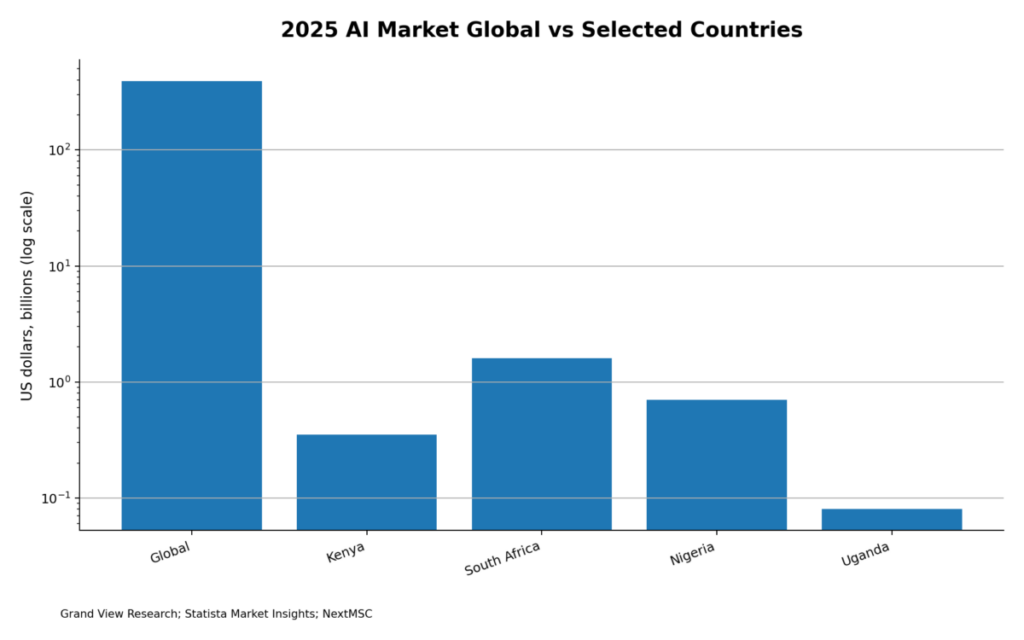
Nigeria’s AI-ready data-center project points to the next version of the region’s infrastructure race. Kenya’s delayed $1 billion AI data-center proposal shows the constraint. Ambition does not create compute capacity on its own. Power, hosting, regulation, and local technical depth have to hold together.
The mid-year conclusion is clear. Sub-Saharan Africa’s digital economy is advancing, but not by becoming a smaller version of frontier compute economies. Its strongest gains come from coordination. Its largest risk is that coordination becomes dependent before it becomes domestic capability. Coverage opened the door. Participation depends on whether power, trust, institutions, devices, and local infrastructure can keep it open.
| Name | 2025 | 2026 (est)* | % Growth | Source |
|---|---|---|---|---|
| Kenya data-center market | $266M | $306M | 15.0% | Mordor Intelligence |
| South Africa data-center market | $0.58B | $0.67B | 15.5% | Mordor Intelligence |
| Uganda data-center revenue | $6M | $6.9M | 15.0% | D4D Hub |
| Nigeria data-center market | $322.65M | $374.05M | 15.9% | Mordor Intelligence |
| Nigeria AI-ready data-center project | Announced | 38 MW | n/m | Airtel; AEC |
| Kenya proposed AI data-center project | $1B proposal | Delayed | n/m | Reuters |
| Mission 300 electricity connections | 300M target | 300M target | 0.0% | World Bank |
| Africa mobile contribution outlook | $240B | $249B | 3.8% | GSMA Intelligence |
Sources
- GSMA Intelligence; The Mobile Economy Africa 2026; – Link
- GSMA; Mobile Technologies Contributed $240 Billion to Africa’s Economy in 2025 as the Continent Enters a New Phase of Digital Transformation; – Link
- International Telecommunication Union; Facts and Figures 2025; – Link
- DataReportal; Digital 2026: Kenya; – Link
- DataReportal; Digital 2026: South Africa; – Link
- DataReportal; Digital 2026: Uganda; – Link
- DataReportal; Digital 2026: Nigeria; – Link
Connectivity and Market Access — From Coverage to Absorption
- International Energy Agency; Financing Electricity Access in Africa; – Link
- International Energy Agency; Financing Electricity Access in Africa — Executive Summary; – Link
- GSMA; Affordable 4G Smartphone Requirements for Africa; – Link
- GSMA; Pioneering Affordable Access in Africa; – Link
- GSMA; Digital Policy Reforms Could Add UGX 14.6 Trillion to Uganda’s GDP and Connect 4 Million More Citizens by 2030; – Link
Technologies With the Greatest Economic Influence — Coordination Before Frontier Compute
- GSMA; The State of the Industry Report on Mobile Money 2026; – Link
- GSMA; Mobile Money Accounted for $2 Trillion in Transactions in 2025, Doubling Since 2021; – Link
- Central Bank of Kenya; Mobile Payments Statistics; – Link
- Federal Reserve Bank of St. Louis; Mobile Money Transactions, Value for Uganda; – Link
- FinDev Gateway; Pocket Banks: Nigeria’s Mobile Money Journey to Financial Inclusion; – Link
Strongest Sectors and Business Models — Where Digital Systems Reduce Friction
- Institute of Labor Economics; Mobile Broadband Internet, Poverty and Labor Outcomes in Tanzania; – Link
- World Bank Open Knowledge Repository; Mobile Broadband Internet, Poverty and Labor Outcomes in Tanzania; – Link
- Science; The Long-Run Poverty and Gender Impacts of Mobile Money; – Link
- MIT News; Mobile-Money Services Lift Kenyans Out of Poverty; – Link
- Reuters; South Africa’s Online Retail Sales to Exceed $7.42 Billion This Year, Study Forecasts; – Link
- ECDB; E-Commerce Market Data by Country; – Link
Human Impact, SDGs, and STI — Recognition, Capability, and Everyday Participation
- World Bank; Global Progress in Identification — 3 Findings from the Latest Data; – Link
- World Bank ID4D; Identification for Development Global Dataset; – Link
- GSMA; The Mobile Gender Gap Report 2026; – Link
- GSMA; 810 Million Women Still Not Using Mobile Internet in Low- and Middle-Income Countries; – Link
- Institute of Internet Economics; United Nations Goals: Science, Technology, and Innovation as Economic Infrastructure; – Link
- UNICEF; ITU; How Many Children and Young People Have Internet Access at Home?; – Link
Digital Health and Health-Outcome Linkages
- Ada Health; SafeMom: AI Symptom Assessment for MomConnect in South Africa; – Link
- BMJ Global Health; MomConnect: An Exemplar Implementation of the Health Normative Standards Framework in South Africa; – Link
- SAGE Digital Health; FamilyConnect and Maternal-Child Health Messaging in Uganda; – Link
- WHO Regional Office for Africa; Health of Mothers and Babies Is the Foundation of Healthy Families and Communities; – Link
- Federal Ministry of Health and Social Welfare Nigeria; 2025 Joint Annual Review Reports Health Sector Reform Gains; – Link
Regulation and Governance — Trust as the Operating Condition
- INTERPOL; New INTERPOL Report Warns of Sharp Rise in Cybercrime in Africa; – Link
- INTERPOL; Africa Cyberthreat Assessment Report 2025; – Link
- Government of South Africa; Next Generation Radio Frequency Spectrum Policy for Economic Development; – Link
- South African Government News Agency; SA to Switch Off 2G and 3G Networks by End of 2027; – Link
Risks and Distributional Effects — Scarcity, Dependency, and Uneven Absorption
- Reuters; World Bank Backs Africa Digital Data Push with $100 Million Raxio Deal; – Link
- International Finance Corporation; IFC Supports Raxio to Expand Data Centers Across Africa; – Link
- Mordor Intelligence; Kenya Data Center Market; – Link
- Mordor Intelligence; South Africa Data Center Market; – Link
- Mordor Intelligence; Nigeria Data Center Market; – Link
- D4D Hub; East Africa Data Center Markets Brief; – Link
- Wesgro; Overview of the Global and African Data Centre Landscape; – Link
AI, Cloud, IaaS, and ICT Outlook
- Gartner; Gartner Forecasts Worldwide Public Cloud End-User Spending to Total $723 Billion in 2025; – Link
- Gartner; Gartner Forecasts Worldwide Public Cloud End-User Spending to Total $850 Billion in 2026; – Link
- International Energy Agency; Data Centres and Data Transmission Networks; – Link
- International Trade Administration; Kenya — Information and Communications Technology; – Link
- International Trade Administration; South Africa — Digital Economy; – Link
- ICASA; The State of the ICT Sector Report of South Africa 2026; – Link
- Premium Times; Nigeria’s ICT Sector Contribution to GDP Increases in Q1 2025 — NBS; – Link
- Reuters; Microsoft to Train 1 Million South Africans in AI and Cybersecurity Skills; – Link
- Africa Energy Week; AI Data Centers Become Nigeria’s Next Major Gas Customer; – Link
- Institute of Internet Economics; The Transformative Impact of Mobile Internet on Employment Dynamics; – Link
Outlook — The Convergence Test for the Second Half of 2026
- World Bank; Mission 300 — Electricity to Power Africa and Its Economy; – Link
- World Bank; New Partnership Aims to Connect 300 Million to Electricity by 2030; – Link
- Reuters; African Nations Seek to Connect 300 Million People to Power by 2030; – Link
- Reuters; AIIB and IsDB Pledge Around $6 Billion for Africa Electrification Push; – Link
Keywords: Internet Economy, Mobile Money, Digital Infrastructure, Electricity Access, Digital Identity, Local Compute, Rural Connectivity, Cybersecurity, Digital Coordination, Human Impact, SDGs, STI, Advanced Cities, Advanced Countries, Rural Digital Divide, Low-Technology Countries, Digital Absorption, Leapfrogging, Technology Transfer, Digital Health, Trust Infrastructure
Country Association: Angola, Benin, Botswana, Burkina Faso, Burundi, Cabo Verde, Cameroon, Central African Republic, Chad, Comoros, Democratic Republic of the Congo, Republic of the Congo, Côte d’Ivoire, Equatorial Guinea, Eritrea, Eswatini, Ethiopia, Gabon, Gambia, Ghana, Guinea, Guinea-Bissau, Kenya, Lesotho, Liberia, Madagascar, Malawi, Mali, Mauritius, Mozambique, Namibia, Niger, Nigeria, Rwanda, São Tomé and Príncipe, Senegal, Seychelles, Sierra Leone, South Africa, South Sudan, Tanzania, Togo, Uganda, Zambia, Zimbabwe.