
When a country builds a robust digital health system, the first economic effect is not savings but investment. Governments and healthcare organizations must finance new systems while existing services continue, creating a transition period in which conventional processes and digital infrastructure often operate side by side.
Beyond software purchases, national systems require implementation capacity: reliable connectivity, secure information exchange, integration with existing clinical systems, and continuing technical support. These demands consume capital and skilled labor that could otherwise finance care, so the economic question is not simply what technology costs but what additional capacity those resources eventually produce.
Experience with large health technology programs shows why implementation quality matters. The UK National Audit Office’s 2020 assessment of NHS digital transformation described earlier national efforts constrained by governance, legacy systems, technical capability, and interoperability. Technology creates little value when institutions cannot integrate it into clinical and administrative work.
Operating costs also persist after deployment. Systems require maintenance, staff support, and protection against disruption. Cyberattacks can interrupt records and clinical services, making resilience part of maintaining healthcare capacity rather than a peripheral technology expense.
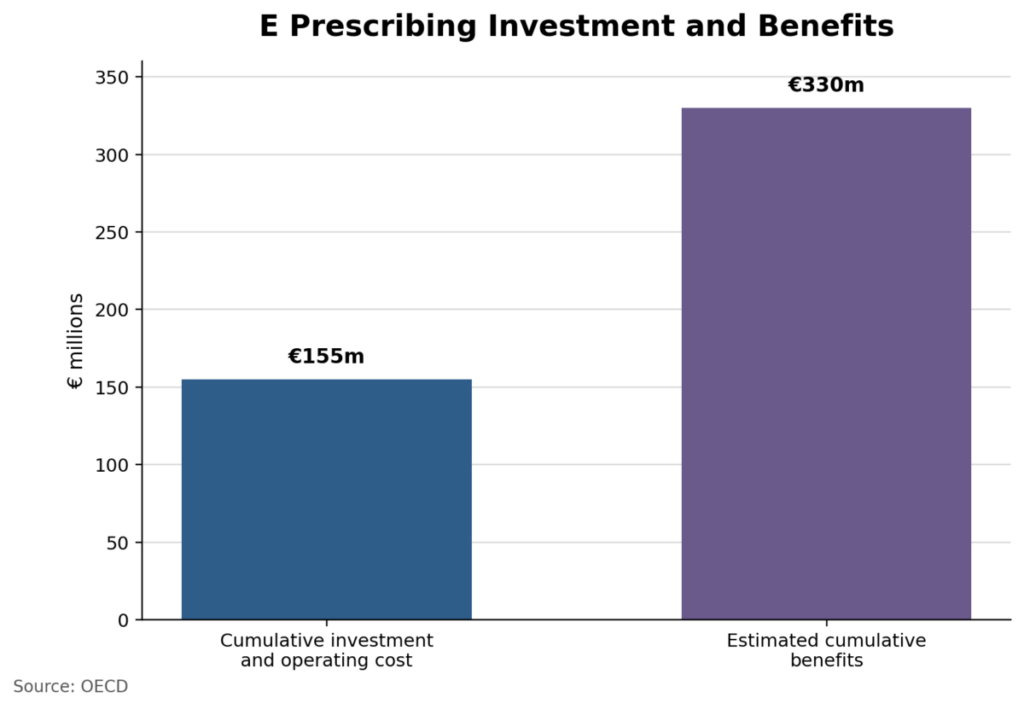
Returns can take years to appear. OECD analysis of electronic prescribing found that Sweden had accumulated about €155 million in investment and operating expenditure by 2008 against estimated cumulative benefits of €330 million. Across 11 interoperable record and prescribing systems, positive annual socioeconomic returns took four to nine years to emerge, with cumulative net benefits taking six to 11 years. These historical estimates are system-specific, but they show why national infrastructure cannot be judged on a single budget cycle.
A national assessment must therefore separate initial investment, continuing expenditure, and economic return. Benefits may appear as greater capacity, better allocation, or stronger household protection even when total healthcare spending does not fall.
| Implementation Benchmark | Measured Figure | System Context |
|---|---|---|
| Planned digital transformation cost | £8.1 billion | NHS estimate |
| National transformation budget | £4.7 billion | 2016–17 to 2020–21 |
| Trust spending on technology | Less than 2% | Recommended level: 5% |
| Staff able to rely on digital records | 54% | NHS trusts, 2017 |
| Systems mostly compliant with SNOMED CT | 15% | NHS trusts, 2017 |
Sources: UK National Audit Office, OECD
Easier Access Changes Costs and Reveals Demand
For a patient who previously traveled to a clinic for a suitable follow-up appointment, remote care can remove a journey and reduce time away from work while still requiring clinician labor. The household can gain even when provider expenditure changes little.
Across a population, however, reducing the cost and inconvenience of access can reveal demand that distance or scheduling previously suppressed. A 2017 direct-to-consumer telehealth study found that 88 percent of respiratory visits represented additional utilization rather than replacement of another encounter. A 2026 study covering more than three million US adults found no statistically significant association between greater regional telemedicine adoption and overall ambulatory visits or medical spending. Different services and populations can therefore produce very different utilization effects.
As access expands, the constraint can move downstream. India’s eSanjeevani program widened consultation access, yet research found differences in medicine availability and diagnostic follow-through, while national program data could not establish whether patients completed subsequent treatment. Digital consultation can identify need faster than the rest of the care system can respond.
What happens after access improves determines the economic result. Additional spending may represent useful care that was previously unavailable, while connected information can expose where treatment pathways fail or capacity remains underused. Data become productive only when institutions act on them.
| Telemedicine Measure | Result | Study Scale |
|---|---|---|
| Patients observed | 3.04 million | US adults |
| Ambulatory visits | 120 million | 2019–2023 |
| Medical spending represented | $178.4 billion | Study cohort |
| Telemedicine share of all visits | 9.8% | Full observation period |
| Visits in high-adoption areas | −2.4% | Not statistically significant |
| Spending in high-adoption areas | −0.5% | Not statistically significant |
Sources: JAMA Network Open
Continuous Care Changes Labor and Capacity
Although connected monitoring can identify deterioration between appointments and focus professional attention on higher-risk patients, it does not eliminate clinical work. Information must be interpreted and acted upon. Financing measurement without financing the response can generate data without producing better care.
Evidence from chronic disease programs shows the tradeoff. The Peterson Health Technology Institute found limited incremental improvement across many diabetes monitoring and behavior-change products, with modeled savings insufficient to cover product costs in most categories. Hypertension programs performed better when monitoring was combined with medication management, although spending rose initially and longer-term savings remained projected rather than observed.
Rather than simply replacing workers, digital health can change the composition of healthcare labor. Administrative or travel requirements may decline while monitoring and coordination expand. Productivity improves only when scarce clinical time moves toward higher-value activity.
Hospital at home provides a clearer example of how digital support can change both labor and capital use. A 2020 randomized trial found adjusted direct episode costs 38 percent lower for selected home-hospital patients, but its 91-patient sample and high refusal rate limit generalization. A later rural US and Canadian trial found no statistically significant cost difference, with relatively late transfers limiting the hospital activity displaced.
Released capacity does not automatically become cash savings because buildings and salaried staff remain in place. A freed bed may instead serve another patient, increasing output before expenditure declines. Sustained changes could eventually improve facility productivity or reduce future construction needs, but those capital effects require separate evidence.
| Care Model | Economic Measure | Result |
|---|---|---|
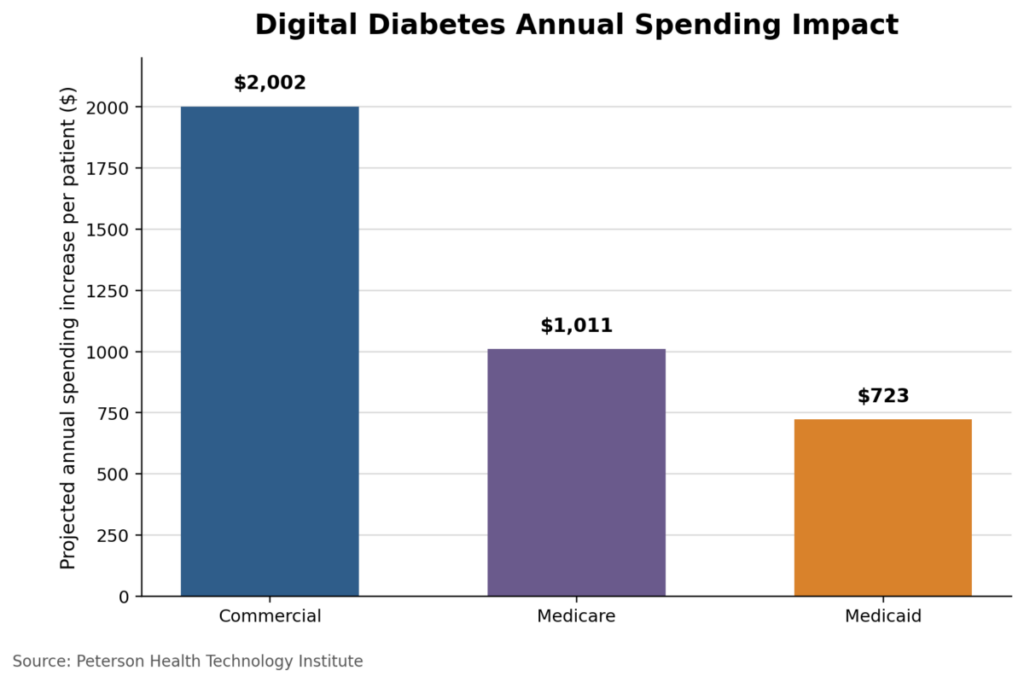
| Diabetes remote monitoring | Annual spending change, commercial insurance | +$2,002 per patient |
| Diabetes remote monitoring | Annual spending change, Medicare | +$1,011 per patient |
| Diabetes remote monitoring | Annual spending change, Medicaid | +$723 per patient |
| Behavior and lifestyle programs | Annual spending change | +$484–$574 per patient |
| Rural hospital at home | Adjusted acute-episode cost | +14.2%, not significant |
| Rural hospital at home | Daily patient activity | +714 steps |
Sources: Peterson Health Technology Institute, JAMA Network Open
Payment and Administration Determine Who Captures the Value
Even when a delivery model uses fewer resources, system-level value does not guarantee financial gains for the organization providing it. The Safer@Home evaluation found favorable hospital financial outcomes for Medicaid-funded and uninsured patients but losses for Medicare and commercially insured patients when dedicated program reimbursement was absent. Payment rules can therefore determine whether a resource-efficient model remains financially viable.
Reimbursed digital activity also cannot be treated as evidence of useful care by itself. US investigators have identified remote-monitoring billing patterns warranting scrutiny, reinforcing the need to evaluate expenditure against outcomes rather than activity alone.
While reimbursement shapes incentives, administrative infrastructure determines how benefits and information move through the system. Estonia paired medicine-benefit reform with an electronic prescription system that tracked patient co-payments and automatically applied additional financial protection. The policy created the benefit; technology made that protection easier to administer and receive.
At national scale, connected administration can reduce duplication and make resource use more visible. WHO reports that digitalized benefit processes can save time for patients and purchasing agencies, while OECD analysis of Estonia associates extensive healthcare digitalization with lower administrative workload and costs. Economic returns therefore appear not only in clinical spending but also in staff time and more reliable benefit delivery.
| Economic Signal | Measured Result | Context |
|---|---|---|
| Purchasers surveyed | 332 | Health plans, employers, health systems |
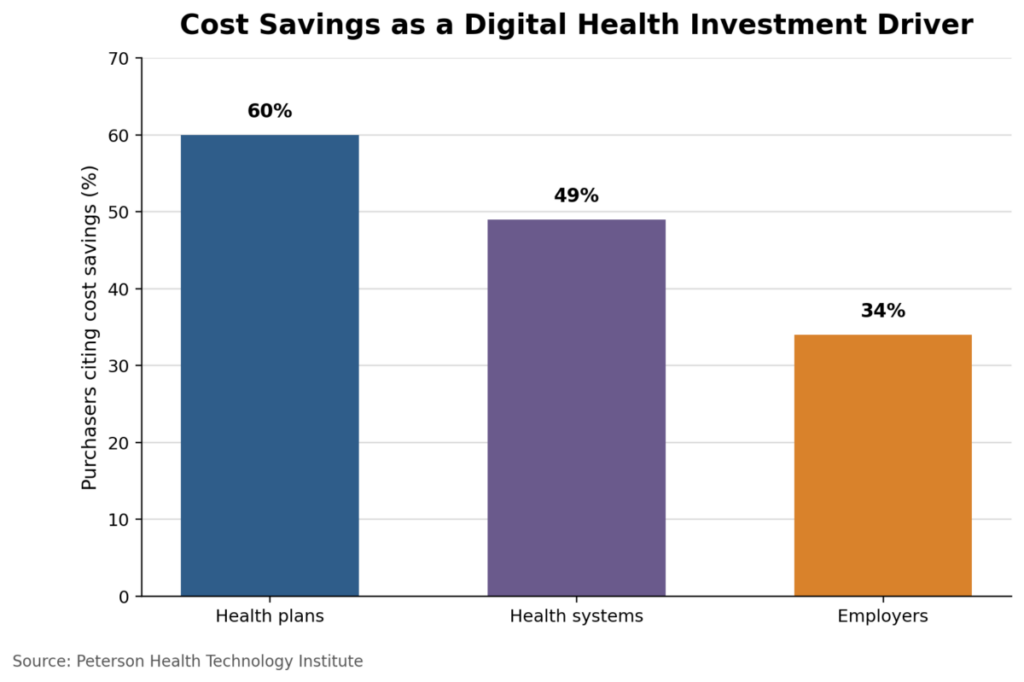
| Cost savings cited by health plans | 60% | Reason for increased digital investment |
| Cost savings cited by health systems | 49% | Reason for increased digital investment |
| Cost savings cited by employers | 34% | Reason for increased digital investment |
| Estonia e-prescribing implementation | About €500,000 | Direct implementation cost |
| Printing savings after digitization | About €100,000 | Estonia, 2010 |
Sources: Peterson Health Technology Institute, OECD, World Health Organization
The Economic Return Extends Beyond Healthcare
Through changes in travel, working time, financial protection, and caregiving, households experience digital health as an economic system as well as a medical one. Remote care can reduce journeys and hours lost reaching services, while home-based care may shift coordination or assistance onto families. Cochrane has found limited evidence on caregiver effects, making those transfers important to measure rather than assume.
These household effects also show why expenditure and economic burden are not identical. Higher public spending can improve financial protection, while a cheaper provider episode can transfer costs elsewhere. Without assisted access and continuing physical services, apparent efficiency may also concentrate among people with suitable housing, connectivity, and digital skills.
Broader labor effects remain plausible but conditional. Time no longer spent traveling to appointments may support paid work or other productive activity, while better-managed illness may improve employment participation. Saved time does not automatically become additional output, and greater unpaid caregiving can reduce another household member’s availability for work.
Over a longer horizon, capital effects emerge as providers use existing facilities differently or reconsider future expansion. National digital systems simultaneously create continuing claims on capital through modernization and security. Their economic performance must therefore be compared with the resources and outcomes of the healthcare system that would otherwise exist.
As digital health becomes national infrastructure, governance becomes part of its economics. Shared clinical information requires workable rules for interoperability, data access, security, and accountability, while reimbursement and evidence standards influence which services scale. Weak standards can preserve duplication and switching costs, while poorly calibrated restrictions can constrain legitimate data use and competition.
The European Health Data Space shows how regulation can evolve once digital systems operate at scale. Entering into force in March 2025, the regulation combines patient access rights with interoperability requirements, rules for secondary health-data use, secure processing, and compliance obligations for electronic health-record systems. Major provisions begin applying from 2029, with further categories following in 2031. The European approach is not a universal model, but it demonstrates how the economic benefits of connected data create corresponding regulatory demands.
Ultimately, a robust digital health system changes the relationship between healthcare inputs and healthcare output. Its national return depends on whether investment produces useful care, protects households, improves scarce-labor productivity, uses capital more effectively, and directs resources toward needs that were previously hidden or poorly served. As dependence on digital infrastructure grows, those gains become increasingly connected to the rules governing access, interoperability, security, evidence, and accountability.
| Economic Channel | Primary Measure | Useful Unit |
|---|---|---|
| Household burden | Out-of-pocket cost and travel avoided | Currency and hours per patient |
| Healthcare labor | Clinical and administrative time released | Staff hours per episode |
| System capacity | Additional completed care | Episodes per fixed resource |
| Capital use | Facility utilization or expansion deferred | Bed use and capital expenditure |
| Administrative efficiency | Processing burden and benefit uptake | Time, cost, completion rate |
| Digital governance | Interoperable exchange and secure reuse | Coverage and compliance rate |
Sources: OECD, World Health Organization, European Commission
TL;DR Summary
- National digital health requires substantial initial and continuing investment before economic returns emerge.
- Infrastructure returns can take years to materialize, making short budget cycles a weak measure of value.
- Lower patient access costs do not necessarily reduce healthcare expenditure because easier access can uncover unmet demand.
- Additional spending can represent useful care that was previously inaccessible rather than economic failure.
- Digital access can move bottlenecks deeper into the healthcare system.
- Monitoring can improve care while creating new clinical work.
- Productivity depends on whether digital systems redirect scarce labor toward higher-value activity.
- Greater hospital capacity, lower episode costs, and lower total expenditure are distinct outcomes.
- Payment determines whether providers can sustain new models, while administration affects how benefits are distributed.
- Household time and caregiving connect digital health to the wider economy.
- National adoption increases the importance of interoperability, cybersecurity, evidence standards, data governance, and accountability.
- Digital health creates durable economic value only when institutions convert connectivity and information into effective care and allocation.
Sources
Investment Comes Before the Return
- UK National Audit Office; Digital transformation in the NHS; – Link
- World Health Organization; Digital Implementation Investment Guide: Integrating Digital Interventions into Health Programmes; – Link
- World Health Organization; Cyber-attacks on critical health infrastructure; – Link
Easier Access Changes Patient Costs—and Demand
- Health Affairs; Direct-To-Consumer Telehealth May Increase Access To Care But Does Not Decrease Spending; – Link
- JAMA Network Open; Telemedicine Adoption, US Ambulatory Visits, and Total Medical Spending, 2019–2023; – Link
- JAMA Network Open; Estimated Indirect Cost Savings of Using Telehealth Among Nonelderly Patients With Cancer; – Link
Better Access Can Move the Treatment Bottleneck
- National Health Systems Resource Centre, India; Utilization of Telemedicine eSanjeevani in the Public Health Facilities of India; – Link
- Oxford Open Digital Health; Adoption and utilization of India’s eSanjeevani national telemedicine service; – Link
- World Health Organization; The Online Referral System in the state health insurance scheme of Karnataka, India: a digital tool to contribute to strategic purchasing; – Link
Continuous Care Adds Capacity and New Work
- Peterson Health Technology Institute; Digital Diabetes Management Solutions; – Link
- Peterson Health Technology Institute; Digital Hypertension Management Solutions; – Link
- OECD; Digital and AI skills in health occupations: What do we know about new demand?; – Link
Hospital at Home Changes Resource Use
- Annals of Internal Medicine; Hospital-Level Care at Home for Acutely Ill Adults: A Randomized Controlled Trial; – Link
- JAMA Network Open; Hospital-Level Care at Home for Adults Living in Rural Settings: A Randomized Clinical Trial; – Link
- Centers for Medicare & Medicaid Services; Acute Hospital Care at Home Data Release Fact Sheet; – Link
Payment Determines Whether Changes Can Spread
- JAMA Network Open; Health Economic Analysis of an All-Virtual, At-Home Acute Care Model; – Link
- US Department of Health and Human Services, Office of Inspector General; Billing for Remote Patient Monitoring in Medicare; – Link
- Centers for Medicare & Medicaid Services; ACCESS (Advancing Chronic Care with Effective, Scalable Solutions) Model; – Link
Household Costs Change in Several Ways
- World Health Organization; Using digital technologies to make access to medicines and dental care more affordable: a case study from Estonia; – Link
- Cochrane Database of Systematic Reviews; Admission avoidance hospital at home; – Link
- OECD; Building people-centred digital health systems: Lessons from PaRIS; – Link
The Effects Reach Beyond Healthcare
- World Bank; Digital-in-Health: Unlocking the Value for Everyone; – Link
- OECD; The COVID-19 Pandemic and the Future of Telemedicine; – Link
- World Health Organization; Digital technologies in health financing; – Link
Keywords: E-Health, Digital Health, Healthcare Economics, Health Infrastructure, Clinical Productivity, Health Data Governance, Health System Transformation