
Artificial intelligence regulation is moving beyond individual models and into the economic system required to produce them. Rules increasingly shape access to the data, computing capacity, and infrastructure behind AI. The result is not a unified global regime but different policies whose economic effects increasingly converge on the cost and availability of AI capacity.
Jurisdictions approach that system with different objectives. U.S. federal policy emphasizes infrastructure expansion and national security, while domestic AI regulation remains largely sectoral or state based. The European Union has adopted a broader framework centered on risk and accountability. China combines information controls with state-directed industrial policy, while Singapore relies more heavily on targeted governance frameworks, including its 2026 guidance for agentic AI. These approaches reflect different judgments about what regulation should accomplish, not simply different levels of restriction.
Under the EU AI Act, providers of general-purpose AI models face documentation and transparency requirements covering copyright and training content. Models presenting systemic risk face stricter oversight, including additional evaluation and security requirements. These rules began applying on August 2, 2025, with full Commission enforcement powers taking effect on August 2, 2026. Certain free and open-source models receive different treatment, although systemic-risk requirements can still apply.
Compliance has an economic as well as a legal structure. Required testing and oversight create fixed costs that larger developers can spread across greater revenue, while smaller firms may face higher barriers to entry. Regulation also creates demand for compliance services, shifting some economic value rather than simply adding cost.
The United States follows a different path because AI used in regulated activities can fall under existing sectoral law without a comprehensive federal statute. Standards can also acquire economic force when institutions make compliance a condition of doing business. Regulation therefore operates through both law and institutional requirements, while AI capability still depends on what information developers can legally and economically use.
Data Rights Become Production Economics
Data has always been an input into machine learning, but generative AI has made its legal status economically consequential at far greater scale. Privacy rules shape how personal information can be used in development, while copyright governs protected works. Cross-border rules can also affect where data is processed.
In December 2024, the European Data Protection Board adopted Opinion 28/2024 to guide authorities on the use of personal data in AI development and deployment. The opinion considers when models may qualify as anonymous, when legitimate interest can support processing, and how prior unlawful use can affect later deployment. It requires case-by-case assessment rather than treating model training as categorically permitted or prohibited.
Those requirements move privacy law directly into production economics. Developers may need to establish a lawful basis and adjust how data is obtained or used. The question is not simply whether personal data can enter training, but what makes it a legally usable production input.
Copyright introduces a different pricing mechanism. The U.S. Copyright Office’s continuing AI study documents an emerging licensing market for generative AI training material while noting disagreement over whether voluntary licensing can operate at the scale modern models require. Its May 2025 Part 3 report remains a pre-publication version, with the Office stating that the final version is not expected to change its analysis or conclusions.
If valuable content acquires an explicit price, rights holders gain potential revenue while developers face another cost. Proprietary datasets can create bargaining advantages, while other data may carry different legal and economic constraints. The competitive effect depends largely on available substitutes and how licensing costs are distributed.
The same mechanism affects individuals. Data protection rules shape how personal information enters commercial systems, while copyright policy affects whether creators and publishers share economically when protected material contributes to model development. Regulation therefore influences both the cost of training material and how value is distributed. Even legally accessible information has little economic value for advanced AI without sufficient computation.
| Regulatory Measure | Threshold or Date | Scope |
|---|---|---|
| GPAI model threshold | More than 1023 FLOP | General-purpose AI obligations |
| Systemic-risk presumption | More than 1025 FLOP | Additional safety and security duties |
| GPAI obligations apply | August 2, 2025 | New models placed on EU market |
| Full Commission enforcement | August 2, 2026 | Compliance enforcement and fines |
| Maximum GPAI fine | €15 million or 3% of global turnover | Whichever is higher |
Sources: European Commission, EUR-Lex
Compute Controls Turn Semiconductors Into Strategic Capacity
Advanced AI requires specialized computing capacity, making semiconductor policy one of the clearest points at which regulation affects productive capability rather than merely product behavior. U.S. policy combines domestic infrastructure expansion with national-security restrictions governing specified advanced computing products and related activities.
Bureau of Industry and Security policy states that exports, reexports, transfers, and some forms of support involving advanced computing products can trigger licensing requirements when parties know the equipment will be used to train specified AI models for restricted end users or uses. The guidance explicitly addresses infrastructure-as-a-service providers, showing how export-control policy can reach computing access rather than only the shipment of processors.
That distinction matters because compute is increasingly purchased as a service. A developer unable to acquire certain processors directly may seek remote capacity instead, forcing regulators to consider where hardware is located, who controls it, and what training occurs on it. Regulation is consequently moving toward effective access to computing capability, although the legal mechanisms remain fragmented across export controls, licensing, and end-use restrictions.
Semiconductor procurement, cloud contracting, and export compliance impose costs that larger firms are better positioned to manage. Smaller developers can avoid some capital requirements by renting cloud infrastructure, but that substitutes dependence on major providers for direct ownership. The result can reinforce scale advantages without any rule being designed to favor incumbents.
Countries with strong research communities may likewise remain dependent on foreign processors or capital-intensive computing facilities. Access to compute increasingly functions as part of national productive capacity, making infrastructure availability an element of technological competitiveness rather than merely an engineering concern. Processors become economically useful only when assembled into facilities with reliable networks, cooling, and power.
| Indicator | Measured Evidence | Market Signal |
|---|---|---|
| Copyright Office AI inquiry | 10,000+ public comments | Large rights-holder and developer policy record |
| Wiley AI licensing revenue | $23 million in FY2024 | Commercial market already established |
| Wiley AI licensing revenue | $40 million in FY2025 | Training rights gaining measurable value |
| Large technology counterparties | At least 3 for Wiley by FY2025 | Licensing extends beyond one experimental deal |
Sources: U.S. Copyright Office, Wiley
Data Centers Create a Conflict Between Investment and Externalities
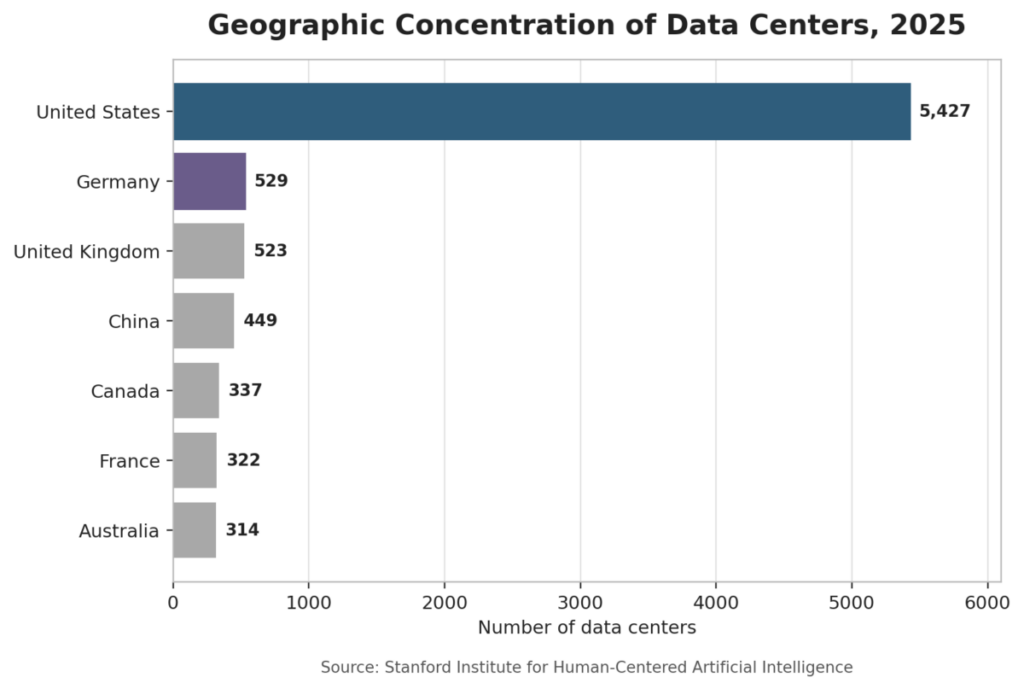
The physical character of AI becomes unavoidable at the data-center level, where hyperscale facilities require substantial land, power infrastructure, cooling, and capital. Their economic logic increasingly resembles industrial development rather than conventional commercial real estate.
Governments consequently face two objectives at once. They want data centers because the projects can bring investment, tax revenue, digital infrastructure, and participation in the AI economy, yet they must also manage resource demand and infrastructure costs that may fall on communities or utility customers.
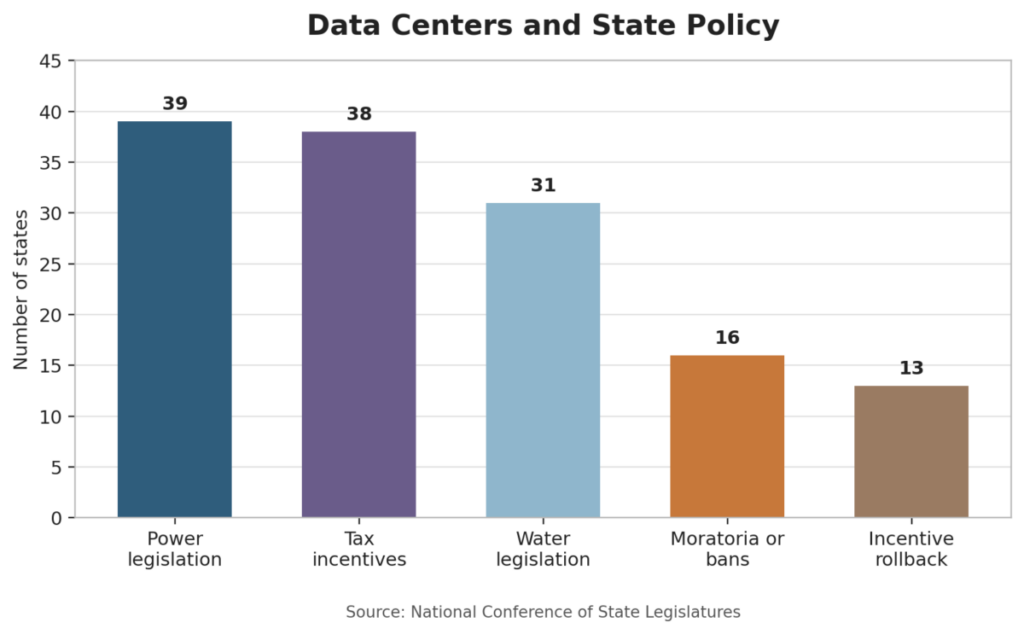
As of April 2026, 38 U.S. states offered dedicated tax incentives for data centers, including sales, use, and property-tax relief. The same policy environment has produced reassessment as infrastructure pressures rise, with some states attaching conditions, reconsidering incentives, or debating restrictions.
A state can therefore provide tax relief to attract a facility while requiring developers to finance infrastructure or meet environmental conditions, then constrain additional development if local resources become scarce. The objective is not necessarily inconsistent: governments are trying to capture investment while deciding how much of its external cost should remain with developers and how much should be borne by utilities, taxpayers, or residents.
Europe applies a different mechanism through sustainability reporting and resource-efficiency requirements. Such rules do not prevent development, but they make environmental and infrastructure performance more visible to policymakers and markets, allowing measurement to become a form of governance when it informs permitting or planning decisions.
Data-center development can support construction, engineering, transmission investment, and ongoing operations, but whether those gains outweigh local costs depends on tax structures, labor participation, and infrastructure financing. The relevant question is which benefits remain local and which costs are socialized. Once a facility has land, processors, and network connections, its binding constraint can shift to electricity.
| State Policy Area | States Involved | Policy Direction |
|---|---|---|
| Data-center power legislation | 39 states | Grid and electricity oversight |
| Water-use legislation | 31 states | Resource-use controls |
| Moratoria or bans considered | 16 states | Development constraints |
| Incentive rollback considered | At least 13 states | Reassessment of subsidies |
| Electricity-tax exemption | 14 incentive states | Operating-cost support |
| Property-tax abatement | 11 incentive states | Capital-cost support |
Sources: National Conference of State Legislatures
Electricity Regulation Becomes AI Industrial Policy
AI infrastructure develops on a different timetable from the power system that serves it. Computing capacity can be financed and installed more quickly than major generation projects, transmission lines, and substations can be completed, pushing data-center expansion directly into electricity regulation.
In June 2026, the Federal Energy Regulatory Commission issued separate show-cause orders to all six regional grid operators under its jurisdiction, directing them to justify or reform rules governing how data centers and other large loads connect to the transmission system. FERC framed the proceedings around reliability, affordability, transparency, and the infrastructure needed to accommodate rapidly growing demand.
Cost allocation is the central economic issue because large loads can require substantial grid investment. If infrastructure is constructed for a project that is later delayed or abandoned, the cost remains. FERC’s 2026 proceedings introduced cost-recovery mechanisms intended to prevent residential customers from absorbing infrastructure costs created for large loads that fail to materialize as planned.
The human impact is direct. Decisions that appear to concern AI infrastructure can affect electricity affordability and reliability for households and businesses that never purchase an AI service. Rules governing financial commitments and infrastructure upgrades determine whether project risk remains with the new industrial customer or spreads across the broader rate base.
Energy availability can also become a geographic advantage. Regions able to add reliable generation and grid capacity may attract projects that constrained regions cannot accommodate despite favorable taxes or labor markets, giving technology companies stronger incentives to secure long-term power arrangements.
Institutional structure shapes those outcomes. European policy places comparatively greater emphasis on resource efficiency and environmental measurement, while the United States distributes authority among utilities, states, regional grid organizations, and federal regulators. Where computing is constrained by power, decisions about grid investment, reliability, and cost allocation determine where additional AI production can economically occur.
| Measure | Value | Regulatory Context |
|---|---|---|
| Global data-center electricity use | 485 TWh in 2025 | Starting demand base |
| Projected electricity use | About 950 TWh in 2030 | Roughly double 2025 demand |
| AI-focused data-center demand | Projected to triple by 2030 | Fastest-growing load segment |
| FERC regional grid proceedings | 6 RTO/ISOs | All regional operators under FERC jurisdiction |
| Tariff response deadline | 60 days | Justify or reform large-load rules |
| Resource-adequacy report | 30 days | Generation plans for new large loads |
Sources: International Energy Agency, Federal Energy Regulatory Commission
Competition Geography and the Next Five Years
The cumulative effect of model rules, data rights, compute controls, facility policy, and electricity regulation exceeds that of any individual regime. A jurisdiction can maintain permissive model rules but lack sufficient power, while another can offer abundant electricity but limited access to advanced processors. Firms therefore respond to combinations of institutional and infrastructure constraints rather than to one measure of regulatory intensity.
Competition authorities are beginning to address one market through which those constraints converge. In June 2026, the European Commission reached the preliminary view that Amazon Web Services and Microsoft Azure should be designated as gatekeepers under the Digital Markets Act for cloud-computing services. It cited entrenched users, switching costs, ecosystem effects, and the growing role of AI in cloud procurement, while a broader investigation is examining interoperability and contractual practices.
Cloud providers increasingly mediate access to processors, development tools, and scalable inference. Rules affecting interoperability or gatekeeper obligations can therefore influence whether smaller firms can move workloads between providers or avoid infrastructure lock-in, affecting AI entry conditions even when the intervention is not formally described as AI regulation.
Public policy is also acting on supply. The European High Performance Computing Joint Undertaking is implementing 19 AI Factories and, after an expanded mandate under Council Regulation (EU) 2026/150, launched a July 2026 tender for AI Gigafactories. The program is designed to expand large-scale computing capacity and access for public and private users, including smaller companies and researchers.
These measures reveal two approaches to concentration. Competition regulation can target switching barriers and gatekeeper power, while industrial policy can expand computing supply for firms unable to finance frontier-scale infrastructure. Neither approach guarantees greater competition, but both recognize that control over compute and cloud infrastructure shapes participation in AI markets.
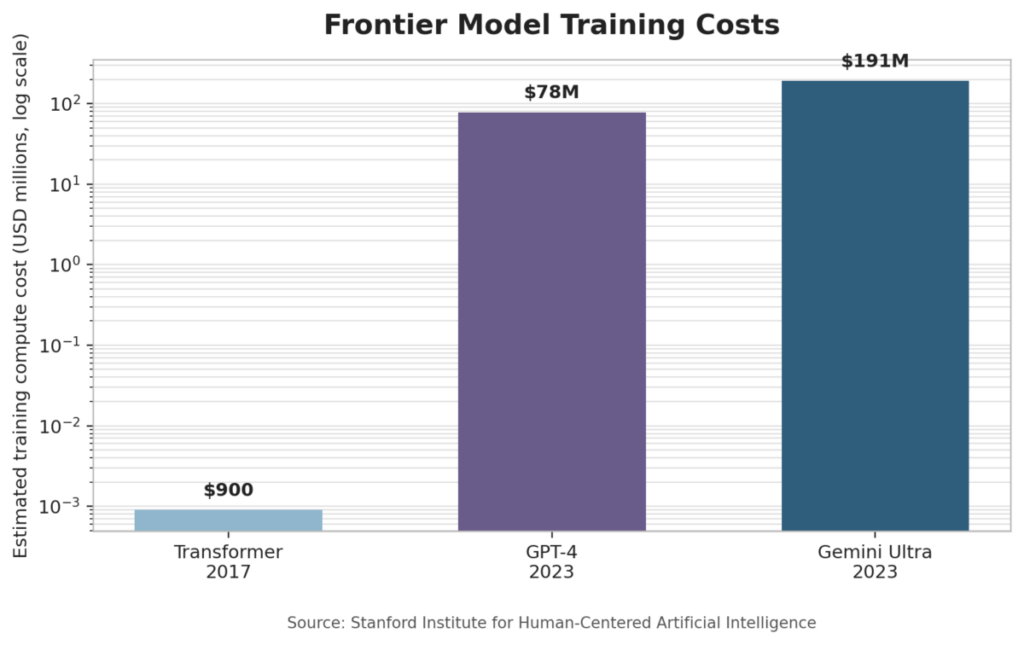
Scale still matters across the production system. Large firms are better positioned to manage supply, infrastructure, and compliance, while smaller developers often depend on shared infrastructure to avoid major capital commitments. Production can also fragment geographically, making national AI capacity dependent on physical resources and market institutions as well as research talent.
For many emerging economies, the constraint appears earlier. The central challenge may be affordable access to connectivity, electricity, cloud services, and advanced computation rather than frontier-model regulation. AI geography therefore reflects both regulatory choices and access to productive resources.
Over the next five years, these systems are unlikely to consolidate into one global regime. Rules governing models, data, compute, infrastructure, and energy arise from different institutions, but their economic effects increasingly intersect.
Model rules influence deployment costs. Data rules affect the price of information. Semiconductor and cloud controls shape compute access, while electricity policy affects where capacity can operate and who finances it.
Each mechanism also reallocates value. Copyright policy can create licensing revenue, assurance requirements can support security services, and infrastructure rules can shift costs or bargaining power across firms and consumers.
The useful distinction is no longer simply between jurisdictions that regulate AI heavily and those that regulate it lightly. More important questions concern what a rule is designed to solve, who exercises authority, who bears the cost, and how market behavior changes.
AI regulation remains fragmented across laws and institutions, but its economic consequences increasingly converge on four questions: how much AI costs to produce, who can produce it, where production occurs, and who captures the resulting value.
That convergence is turning a substantial part of AI regulation into economic infrastructure policy.
| Capacity Indicator | Current Measure | Market Dimension |
|---|---|---|
| Global cloud infrastructure spending | $143 billion in Q2 2026 | Scale of infrastructure market |
| Amazon cloud share | 28% | Largest global provider |
| Microsoft cloud share | 20% | Second-largest provider |
| Google cloud share | 15% | Third-largest provider |
| EU AI Gigafactories planned | Up to 7 | Public-backed compute expansion |
| Expected private investment | More than €20 billion | European sovereign compute buildout |
| Gigafactory processor scale | At least 3–4× current leading EU AI factories | Frontier-compute capacity |
Sources: Synergy Research Group, European High Performance Computing Joint Undertaking
TL;DR Summary
- AI regulation is extending beyond model behavior into data, computing capacity, data centers, and electricity infrastructure.
- The emerging system remains fragmented rather than forming one coherent global regulatory regime.
- EU model obligations create direct operating and compliance costs.
- Privacy and copyright rules increasingly influence the legal availability and price of training material.
- Semiconductor controls increasingly concern effective access to computing capacity as well as the movement of physical chips.
- Cumulative compliance and infrastructure costs can strengthen scale advantages without being designed to favor incumbents.
- Governments use both incentives and restrictions to manage data-center investment and externalities.
- Electricity regulation has become central because large AI loads can require costly grid investment.
- Competition authorities are beginning to address cloud market structure and infrastructure access.
- Public compute investment is emerging as another tool for widening access to AI infrastructure.
- Emerging economies face additional constraints in connectivity, electricity, capital, and compute.
- Separate regulatory systems increasingly converge economically on production cost, market access, geography, and ownership of AI capacity.
Sources
- European Commission; General-purpose AI obligations under the AI Act; – Link
- EUR-Lex; Regulation (EU) 2024/1689 Artificial Intelligence Act; – Link
- National Institute of Standards and Technology; AI Risk Management Framework; – Link
- Infocomm Media Development Authority; Updated Model AI Governance Framework for Agentic AI; – Link
Data Rights Become Production Economics
- European Data Protection Board; Opinion 28/2024 on Certain Data Protection Aspects Related to AI Models; – Link
- U.S. Copyright Office; Copyright and Artificial Intelligence Part 3 Generative AI Training; – Link
- John Wiley & Sons; Research Growth AI Licensing and Cost Reduction Drive Wiley’s Fiscal 2025 Results; – Link
Compute Controls Turn Semiconductors Into Strategic Capacity
- U.S. Bureau of Industry and Security; Policy Statement on Controls That May Apply to Advanced Computing Integrated Circuits and Other Commodities Used to Train AI Models; – Link
- U.S. Bureau of Industry and Security; Export Administration Regulations Part 740 License Exceptions; – Link
- Stanford Institute for Human-Centered Artificial Intelligence; 2025 AI Index Research and Development; – Link
Data Centers Create a Conflict Between Investment and Externalities
- National Conference of State Legislatures; Subsidizing Servers How States Are Competing to Attract Data Centers; – Link
- National Conference of State Legislatures; As Data Centers Surge States Weigh Jobs Power and Local Control; – Link
- EUR-Lex; Commission Delegated Regulation (EU) 2024/1364 on Data Centre Sustainability Reporting; – Link
- Stanford Institute for Human-Centered Artificial Intelligence; 2026 AI Index Report; – Link
Electricity Regulation Becomes AI Industrial Policy
- Federal Energy Regulatory Commission; FERC Launches Aggressive Targeted Action to Speed Large Load Integration; – Link
- Lawrence Berkeley National Laboratory; United States Data Center Energy Usage Report 2025 Update; – Link
- International Energy Agency; Energy and AI Energy Demand from AI; – Link
Competition Geography and the Next Five Years
- European Commission; Preliminary Position on Amazon Web Services and Microsoft Azure Under the Digital Markets Act; – Link
- European High Performance Computing Joint Undertaking; The EuroHPC Joint Undertaking Launches the AI Gigafactories Call; – Link
- Synergy Research Group; Q2 Cloud Market Passes $143 Billion Highest Growth Rate in Eight Years; – Link
- Stanford Institute for Human-Centered Artificial Intelligence; 2026 AI Index Economy; – Link