
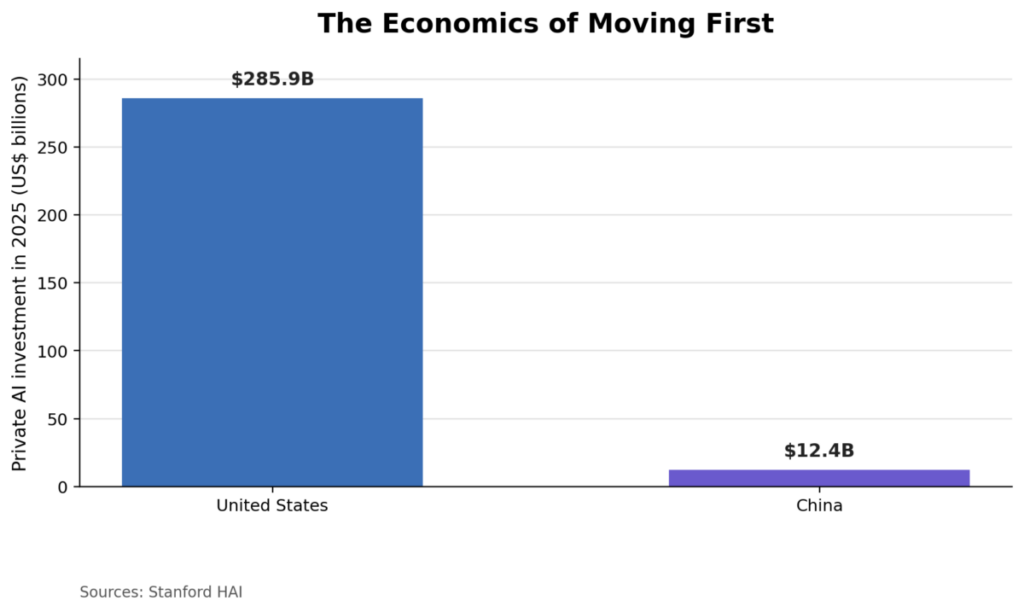
The United States and China are competing to expand the computing capacity and industrial systems behind advanced artificial intelligence. Their companies pursue commercial opportunities while governments seek technological capability and economic security. Stanford’s 2026 AI Index places advanced model production heavily in these two countries, even as national AI ambitions expand elsewhere. Private investment captures only part of the contest because public financing and industrial policy also shape the resources committed to it.
The economic consequences begin long before any system reaches superintelligence because strategic competition changes the value of waiting. Under ordinary uncertainty, firms can postpone difficult-to-reverse investments until demand and expected returns become clearer. In a race, delay carries its own cost. A competitor that secures scarce computing resources or supplier relationships earlier may gain advantages that are harder to reproduce later, pulling investment forward even when eventual returns remain uncertain.
That mechanism separates the current cycle from a simple response to rising AI demand. The International Energy Agency reports that the largest technology companies’ capital expenditure exceeded $400 billion in 2025. The figure includes spending beyond AI and does not measure the incremental effect of US–China rivalry, but it shows the scale of the infrastructure cycle surrounding advanced computing. Data centers create demand across construction and supporting infrastructure before productivity gains are known, spreading activity through the economy without guaranteeing adequate returns.
The opportunity cost of acceleration is equally important. Capital and skilled labor directed toward AI cannot simultaneously finance every alternative use. The harder economic question is therefore not whether large projects create activity, but whether the resulting capacity generates enough value to justify resources committed earlier because strategic delay appeared more costly than commercial uncertainty.
| Measure | 2025 | Comparison |
|---|---|---|
| US private AI investment | $285.9B | 23.1× China |
| China private AI investment | $12.4B | Second globally |
| Global corporate AI investment | $581.7B | +130% |
| Global private AI investment | $344.7B | +127.5% |
| Newly funded US AI companies | 1,953 | 10×+ next country |
Sources: Stanford HAI
When Investment Becomes a Contest
Competition can strengthen innovation by rewarding advances that deliver greater capability at lower cost. Stanford’s 2025 AI Index documents steep declines in inference prices for specified benchmark performance and continued improvement in open-weight models. Falling operating costs expand the range of viable applications and give countries outside frontier development more ways to participate, provided they have the infrastructure and expertise to use them.
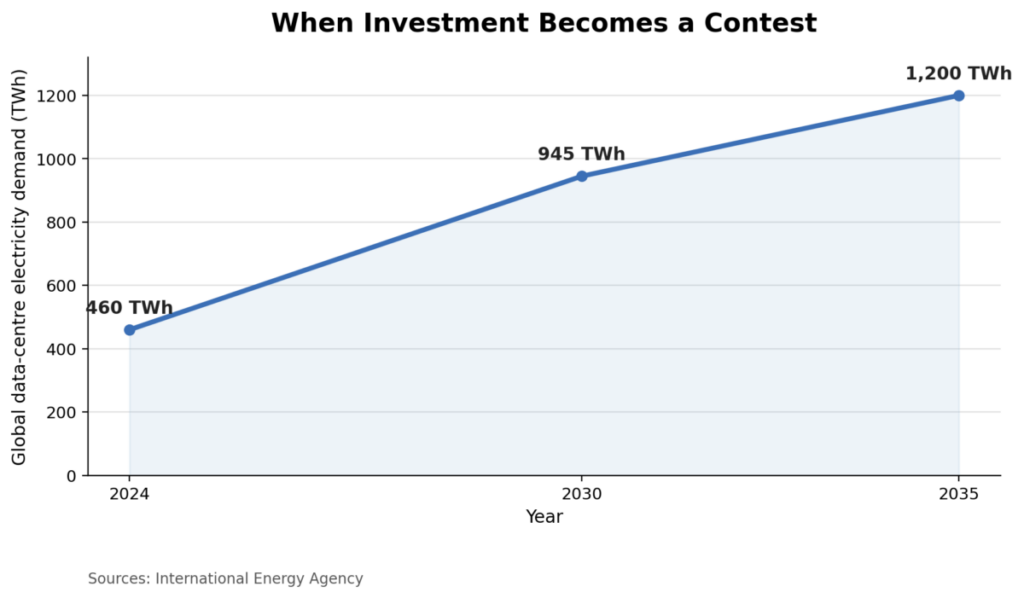
Greater efficiency does not necessarily reduce aggregate resource demand. The IEA’s central forecast puts global data-center electricity consumption at roughly 950 terawatt-hours in 2030, about twice the 2025 level, with AI contributing substantially to the increase. Lower energy use per task can make applications cheaper while encouraging greater use, allowing efficiency and total demand to rise together.
As competitive pressure accelerates deployment, infrastructure scarcity becomes a distributional problem. Power systems and industrial capacity operate on different timelines from software development. In July 2025, Ohio regulators ordered a data-center-specific tariff intended to protect other customers from the risk of underused transmission investments while allowing additional connections. The case shows how financing rules and regulation determine who bears the cost when computing projects arrive faster than supporting infrastructure.
The same urgency can weaken incentives for financial restraint. A project with uncertain standalone returns may proceed because losing strategic position appears more costly than accepting investment risk. A July 2026 Bank for International Settlements working paper models how firms pursuing dominant positions can overcommit capital and transmit losses through interconnected financing. Separate BIS research describes greater reliance on debt and private credit, extending exposure beyond AI developers. Useful technological progress can therefore coexist with commercially unsuccessful projects and unrecovered capital.
| Indicator | Level | Signal |
|---|---|---|
| AI-related private credit outstanding | $200B+ | Rapid credit expansion |
| Share of private credit loans | Nearly 8% | Up from below 1% |
| Projected AI private credit by 2030 | $300B–$600B | Greater external financing |
| Modeled overinvestment | ~50% | Above efficient baseline |
| Hyperscaler bond issuance | $100B+ | 2025 gross issuance |
Sources: Bank for International Settlements
Capacity Is Not Productivity
Once capacity is built, the economic question shifts from how quickly investment occurs to how effectively it is used. Companies need organizational complements such as redesigned workflows, worker training, and verification. Economies need the broader absorptive capacity that allows productivity gains to spread beyond frontier firms.
This distinction between installation and productive use is central to the race because competitive pressure can bring new systems forward faster than organizations can adapt to them. Research on the productivity J-curve helps explain why complementary investment can precede gains visible in measured output. Faster technological cycles can compress the adjustment period further, forcing firms to absorb new systems before earlier investments have fully matured.
Evidence from individual workplaces demonstrates the potential without establishing an economy-wide outcome. A published study by Erik Brynjolfsson, Danielle Li, and Lindsey Raymond found that generative AI assistance increased customer-support productivity by 15 percent on average, measured through issues resolved per hour, with substantial differences among workers. The broader economic effect depends on whether similar gains survive implementation costs and spread across firms and sectors.
Integration and absorption determine that transition. Integration occurs when organizations successfully incorporate AI into production; absorption is broader, reflecting whether firms and institutions can adapt without imposing disproportionate costs on workers or regions. Research by Benjamin Jones adds another constraint: innovation gains depend on the range of research tasks AI can perform and the bottlenecks that remain elsewhere. Greater intelligence alone does not guarantee proportionate economic growth.
| Measure | Finding |
|---|---|
| Study population | 5,172 agents |
| Lower-skill worker gain | ~30% more issues resolved per hour |
| Experience acceleration | 2-month AI users matched untreated workers with 6+ months |
| Higher-skill workers | Little productivity gain |
| Manager-escalation requests | ~25% decline |
Sources: Quarterly Journal of Economics
Control, Supply, Adoption and Dependence
The international consequences are best understood through economic position rather than a simple divide between participants and nonparticipants. Some economies control important technologies, others supply indispensable inputs, some adopt advanced systems productively, and others remain dependent on technologies they have limited capacity to shape or absorb.
Control creates one source of economic rents. The United States and China seek capabilities that can generate income, strengthen industrial capacity, and reduce technological dependence. Economies hosting major developers can capture profits and skilled employment, extending the value of frontier capability beyond the immediate revenues of AI companies.
Supply creates another route to benefit. Taiwan remains central to advanced semiconductor fabrication, while South Korea and the Netherlands occupy important positions in memory and manufacturing equipment. SK hynix attributed its record 2025 performance partly to AI memory, while ASML linked sales growth to expanding AI demand. These results show how accelerated investment can transmit gains through international supply chains even as suppliers remain exposed to investment corrections and policy changes.
Access rules influence both control and supply. In January 2026, US authorities announced conditional, case-by-case licensing review for H200 and similar semiconductor exports to China. Such rules can alter supplier opportunities and investment decisions, making commercial access another channel through which strategic competition reshapes markets.
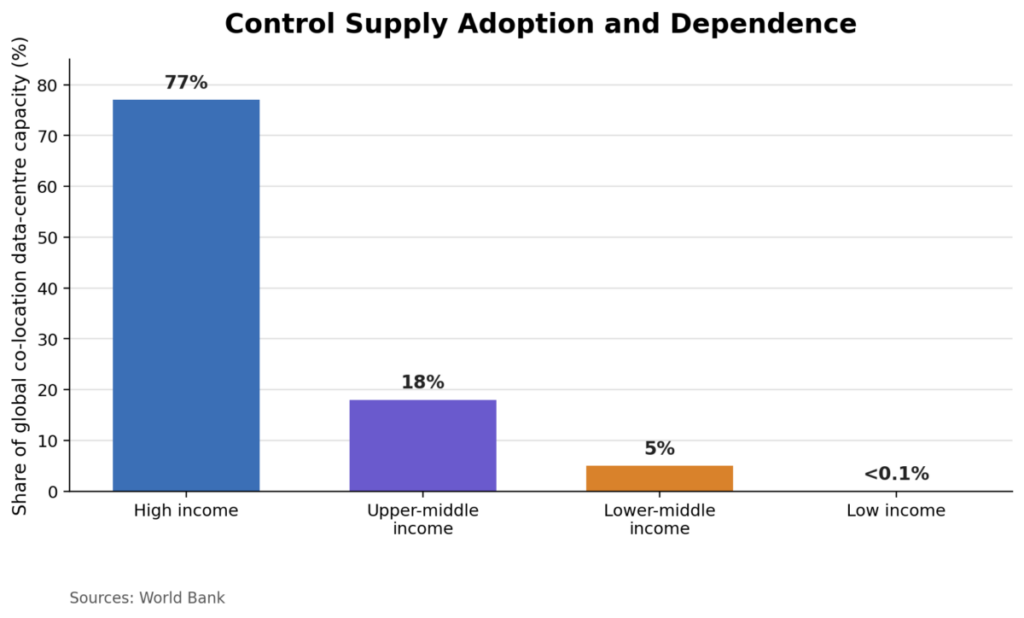
Adoption offers countries outside the frontier race a different advantage. They can use increasingly capable systems without financing frontier model training or the full infrastructure required to compete at the technological edge. Falling inference costs allow firms to import capability while concentrating investment on complementary strengths. Where absorptive capacity is sufficient, economies can raise productivity without assuming the full capital risk of frontier development.
Dependence appears where that capacity remains weak. Countries may buy technology on external terms while capturing a smaller share of the gains. World Bank research showing strong Indian technology-service exports alongside weaker job-posting and wage indicators in parts of South Asia illustrates how export growth and labor-market improvement can diverge. The global distribution of AI gains therefore turns on control, supply, adoption, and the ability to absorb imported technology.
| Measure | High Income | Lower Middle Income | Low Income |
|---|---|---|---|
| Global data-center capacity | 77% | 5% | <0.1% |
| Internet use | 93% | 54% | 27% |
| Basic digital skills | 66% | — | <5% |
| Notable AI models | 87% | — | Marginal share |
| Top-500 HPC capacity | 97% | — | Minimal |
Sources: World Bank
The Economics After the Buildout
The emerging economic picture is more complicated than either an AI boom or an AI bubble. Strategic competition can accelerate investment that creates useful infrastructure and eventual productivity gains. The same acceleration can create shortages, financial exposure, premature commitments, and adjustment periods shorter than firms or institutions would otherwise choose.
Macroeconomic effects can also differ across stages. IMF modeling finds that AI-related investment can affect output, inflation, and interest rates differently depending on whether the technology primarily complements labor or substitutes for tasks. Large investment programs can create near-term demand and financing pressures even when later productivity gains reduce production costs.
Successful diffusion would broaden productivity gains and make more of the buildout economically useful. Fragmentation could instead produce rival technological ecosystems and restricted access. A financing correction could damage exposed firms while leaving productive capacity behind, while a major capability breakthrough could accelerate both opportunity and adjustment. These paths can overlap.
The lasting economic effect of the superintelligence race will therefore depend less on the amount spent than on what accelerated spending becomes. Competitive urgency determines how rapidly capital moves; integration determines whether firms turn capacity into production; absorption determines whether the gains spread through economies. The race can enlarge the global economic frontier while widening the distance between economies able to convert advanced computing into durable productivity and those unable to do so.
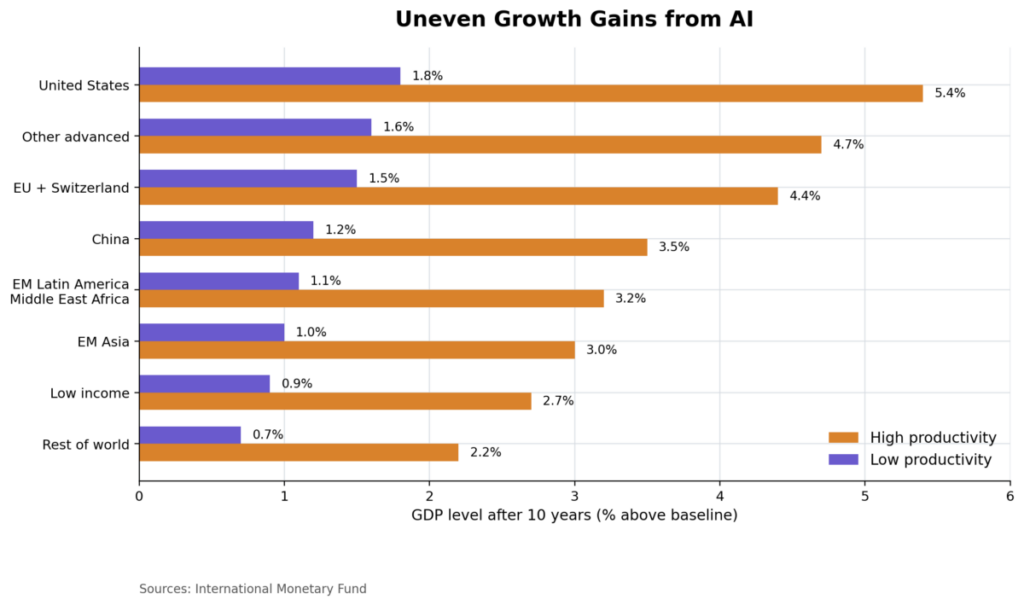
| Economic Test | Modeled Result | Interpretation |
|---|---|---|
| High productivity case | Nearly +4% global GDP | 10-year level effect |
| Low productivity case | +1.3% global GDP | 10-year level effect |
| Underlying productivity gain | 0.8%–2.4% | Modeled TFP range |
| Advanced vs low-income economies | Up to 2× income gain | Uneven distribution |
Sources: International Monetary Fund
TL;DR Summary
- US–China AI competition changes investment behavior before superintelligence exists.
- Strategic rivalry raises the cost of waiting and can pull capital commitments forward.
- Infrastructure spending creates current economic activity without guaranteeing adequate returns.
- Accelerated investment carries opportunity costs because scarce resources have alternative uses.
- Falling inference costs can broaden adoption even as aggregate computing demand rises.
- Infrastructure constraints determine where deployment creates shortages and how costs are allocated.
- Competitive pressure can encourage investment even when commercial returns remain uncertain.
- Computing capacity produces lasting gains only when organizations successfully integrate AI.
- Economic absorption determines whether productivity gains spread beyond frontier firms.
- Countries outside the race can benefit as suppliers or adopters without financing frontier development.
- Weak absorptive capacity can leave other economies more dependent and less able to capture the gains.
- The race’s lasting economic value depends on how much accelerated investment becomes productive capacity and how widely the gains spread.
Sources
- Stanford Institute for Human-Centered Artificial Intelligence; The 2026 AI Index Report; – Link
- International Energy Agency; Key Questions on Energy and AI: Executive Summary (2026); – Link
- Stanford Institute for Human-Centered Artificial Intelligence; The 2025 AI Index Report; – Link
Hypergrowth, Infrastructure Costs, and Financial Risks
- Public Utilities Commission of Ohio; PUCO Orders AEP Ohio to Create Data Center Specific Tariff (July 9, 2025); – Link
- Bank for International Settlements; The AI Investment Race (Working Paper 1367, July 2026); – Link
- Bank for International Settlements; Financing the AI Boom: From Cash Flows to Debt (Bulletin 120, January 2026); – Link
- Bank of England; Financial Policy Committee Record — September 2026; – Link
Integration, Absorption, Productivity, and Innovation
- American Economic Journal: Macroeconomics — Erik Brynjolfsson, Daniel Rock, and Chad Syverson; The Productivity J-Curve: How Intangibles Complement General Purpose Technologies (2021); – Link
- The Quarterly Journal of Economics — Erik Brynjolfsson, Danielle Li, and Lindsey Raymond; Generative AI at Work (2025, author-hosted published paper); – Link
- Benjamin F. Jones / National Bureau of Economic Research; Artificial Intelligence in Research and Development (September 22, 2025 version); – Link
Country Separation, Supplier Benefits, and Technology Access
- SK hynix; SK hynix Announces FY25 Financial Results (January 28, 2026); – Link
- ASML; 2025 Annual Report: Financials; – Link
- US Bureau of Industry and Security; Department of Commerce Revises License Review Policy for Semiconductors Exported to China (January 13, 2026); – Link
Global Cascades, Uneven Gains, and Economic Outcomes
- World Bank; Digital Progress and Trends Report 2025: Strengthening AI Foundations; – Link
- World Bank; South Asia Economic Update, April 2026 — Box 2.1: Where Firms Hire: AI and the Reshaping of Global Value Chains; – Link
- International Monetary Fund; The Global Impact of AI: Mind the Gap (April 2025); – Link
- International Monetary Fund; From Servers to Rates: AI, ICT Capital, and the Natural Rate (October 2025); – Link
Keywords: Artificial Intelligence, Economic Growth, Capital Investment, Technology Competition, Productivity Absorption, Global Supply Chains, Strategic Industrial Economics