
Artificial intelligence is usually described as a software revolution, but economically that is only half true. Before AI can raise productivity across firms, somebody has to build the physical system beneath it.
Power, connectivity, and computing infrastructure must all be built and maintained. The first wave of the AI economy is therefore construction, infrastructure, and skilled labor.
That labor extends beyond machine learning engineers to electricians, grid workers, and other technical trades. The Bureau of Labor Statistics identifies AI-driven data-center growth as one factor behind rising demand for electricians and grid workers, projecting electrician employment to grow 9 percent between 2025 and 2035, with about 72,700 openings a year.
The employment story is broader than the usual discussion of “AI jobs.” Demand is rising in occupations that predate large language models, much of it tied to building AI capacity. Counting only permanent workers inside a completed facility misses the wider employment chain created by the buildout itself.
The AI Economy Begins as Physical Infrastructure
| Growth Measure | Computing Infrastructure | U.S. Economy |
|---|---|---|
| Employment growth, 2025–2035 | 25.1% | 3.6% |
| Annual output growth, 2025–2035 | 4.2% | 2.0% |
| Projected employment gain | 120,400 jobs | — |
Sources: U.S. Bureau of Labor Statistics
Beyond the Permanent Head Count
Completed data centers are highly capital intensive and generally do not employ thousands once construction ends. Research comparing counties with large facilities against similar places where projects were canceled estimates roughly 100 to 200 additional local jobs from a first large data center. The same analysis found data-processing employment rising 56 percent over the first decade after a facility arrived and telecommunications employment rising 43 percent.
Construction employment is temporary, but construction capability can endure. A continuing stream of projects can sustain contractors, training, and technical services. Years of demand can justify permanent hiring, equipment investment, and expertise that remains after an individual project ends.
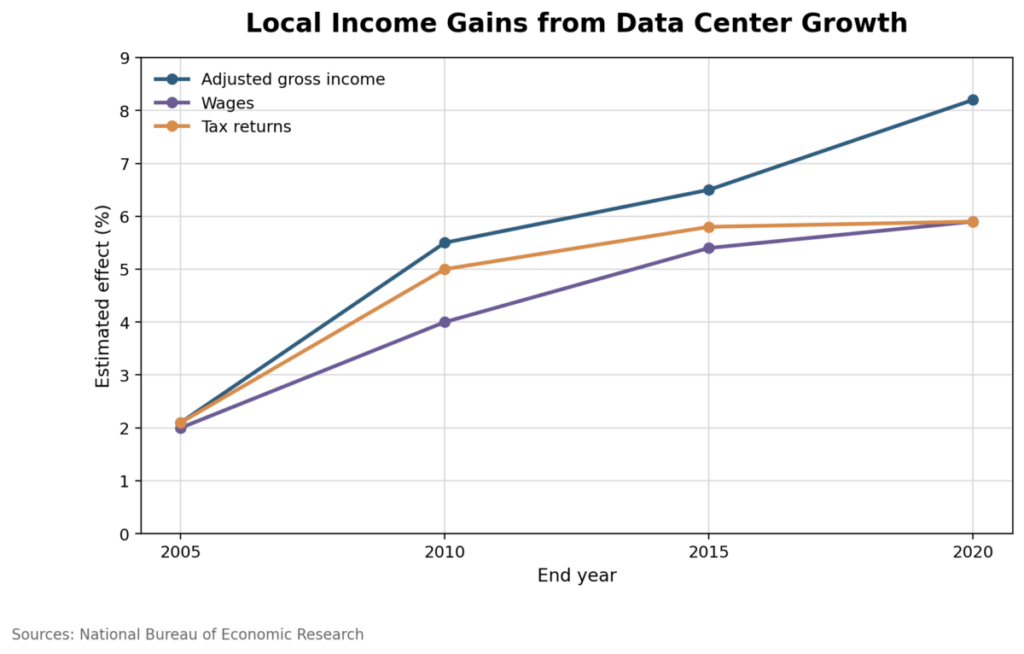
Repeated investment can turn a project into a market, but not automatically. Workers gain specialized experience, firms become better positioned for subsequent projects, and suppliers may find enough recurring demand to maintain local capacity. Recent causal work also finds persistent gains in local employment and establishments after data-center growth, while reinforcing that durable spillovers vary by place and facility type.
Beyond the Permanent Head Count
| Research Measure | Evidence |
|---|---|
| U.S. facilities studied | ~1,500 |
| Canceled projects used for comparison | 52 |
| Labor-market period studied | 2003–2024 |
| Hyperscale facilities | Data processing plus telecommunications gains |
| Colocation facilities | Data-processing gains without the same telecom effect |
Sources: Brookings Institution
When Infrastructure Becomes an Advantage
As those capabilities deepen, the economics of subsequent investment change. A company entering a market with experienced contractors, reliable power, and established technical capacity faces fewer unknowns than one assembling those capabilities from scratch. Previous investment can make the next project easier to execute.
Location economics have always reflected differences in productive inputs. Firms compare labor costs, energy, and infrastructure reliability before committing capital. As artificial intelligence becomes embedded in ordinary business activity, compute and connectivity increasingly enter that calculation.
The scale of the underlying sector is also expanding rapidly. Bureau of Labor Statistics projections put output from computing infrastructure, data processing, and related services at about $467 billion in 2025 and $707 billion by 2035, implying roughly 4.2 percent annual growth over the decade.
A 2025 Strategy Science study found that third-party data centers tend to favor urban markets and proximity to demand, while major cloud providers concentrate facilities where scale and supply economics can be more favorable. The pattern does not show that nearby data centers automatically make AI cheaper, but it does show that infrastructure conditions influence where computing capacity is built.
A company does not need a data center across the street to use AI. Cloud computing lets institutions rent capacity from facilities far away. The economic advantage of infrastructure is therefore not simple proximity, but the broader productive environment that develops around sustained investment.
Regions with strong digital and electrical capacity can develop deeper provider markets and workforces accustomed to compute-intensive systems. Those capabilities can make future projects easier to launch and give firms a stronger base for adopting AI-intensive processes.
The claim is not that every cloud workload becomes cheaper because a data center sits nearby. Regions that accumulate infrastructure and skilled labor can instead reduce some of the friction involved in AI-intensive activity. Those conditions can improve project economics, accelerate adoption, and strengthen a region’s appeal for future investment.
The emerging divide between AI “haves” and “have-nots” is therefore not a map of places with AI and places without it. Almost every connected business will be able to purchase AI services. The more important divide concerns where productive capability accumulates and where more of the surrounding economic activity takes root.
Regions that attract more of that investment can capture construction activity, technical experience, and supplier development. Over time, those gains can reinforce one another and create a stronger foundation for AI-intensive business formation.
When Infrastructure Becomes an Advantage
| Provider Model | Location Pattern | Economic Driver |
|---|---|---|
| Third-party data centers | More urban | Proximity to customer demand |
| Specialized providers | Urban bias | Service-market access |
| Major cloud providers | Fewer concentrated locations | Scale and supply economics |
Sources: INFORMS Strategy Science
Early Adoption and Cumulative Advantage
That accumulation matters while AI adoption remains uneven. Census Bureau research found that about 18 percent of U.S. firms were using AI in at least one business function during November 2025 through January 2026, while those firms accounted for 32 percent of employment. Adoption remains higher among larger businesses.
Lower implementation friction can influence how quickly firms learn to use that input. A company integrating AI is not merely buying software. It is redesigning processes and accumulating experience that competitors cannot purchase instantly. Across many firms, that know-how can begin to accumulate locally.
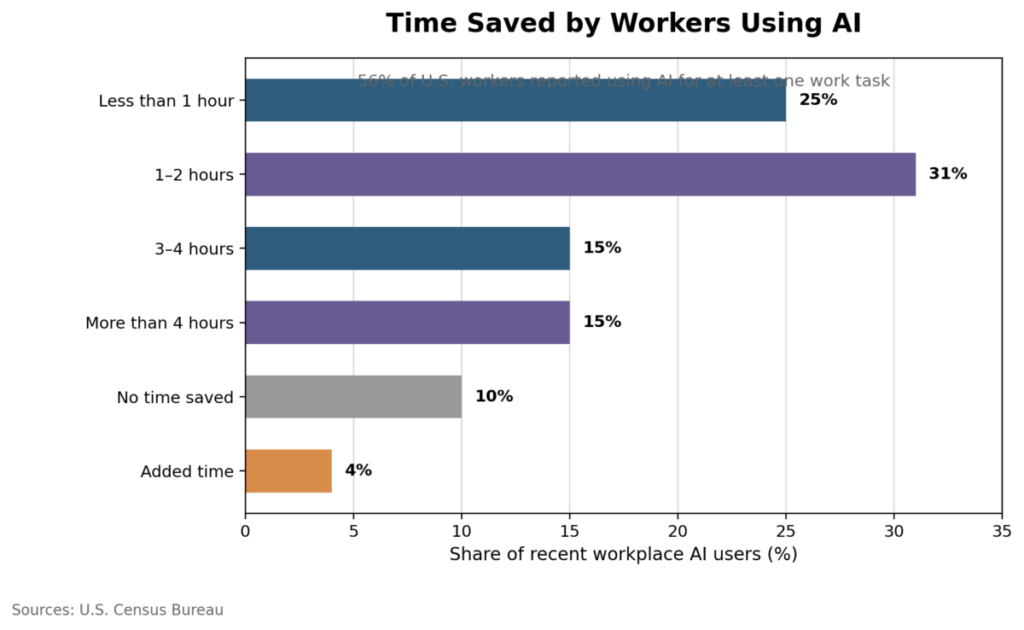
The potential productivity footprint extends far beyond the technology
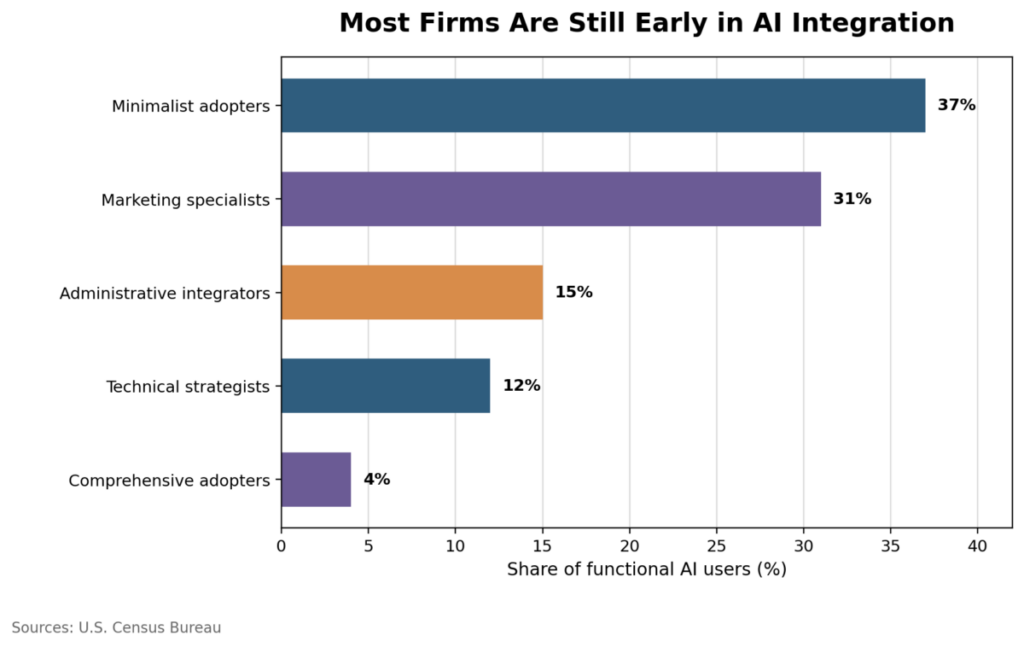
sector. Census data from March 2026 found that about 56 percent of U.S. workers had used AI for at least one work-related task, and 31 percent of recent users said it allowed them to finish work one to two hours faster. These are self-reported estimates rather than measured productivity gains, but they show the breadth of AI’s potential economic reach.
Infrastructure and prosperity connect through that wider labor market. Initial jobs come from building and servicing physical capacity, while the larger payoff emerges if AI raises productivity across the firms that use it. Infrastructure investment can therefore influence more employment and output than facility payroll alone.
Education and research respond to the same forces. The National Science Foundation’s 2026 State and Regional AI Infrastructure Hubs initiative, backed by up to $100 million, aims to expand compute access and strengthen regional technical workforces. Employer demand can encourage training, while better computing access can support research and partnerships that deepen local capability.
Early Adoption and Cumulative Advantage
| Adoption Measure | Share |
|---|---|
| Expected firm adoption within six months | 22% |
| Adopters using AI in 3 or fewer functions | 57% |
| Firms with worker task-level AI use | 23% |
| Employment-weighted worker task use | 41% |
| Users relying on AI only to augment tasks | 66% |
Sources: U.S. Census Bureau
How Regional Divergence Begins
Over time, these mechanisms can produce divergence among places that technically have access to the same technology. Consider two similar regions. One attracts infrastructure investment and develops the capacity needed to support AI-intensive activity, while the other purchases most of those capabilities externally. Both use AI, but only one accumulates more of the surrounding capital and know-how.
The divergence is already visible in adoption patterns. Census research finds AI use reaching roughly 50 to 60 percent among very large firms in leading knowledge-intensive sectors, while employment-weighted adoption in those firms reaches about 60 to 70 percent. That concentration matters because early adoption builds organizational experience before use becomes widespread.
The initial regional difference may still be modest. It becomes more consequential when the next investor finds that one market already possesses the productive capability needed to launch quickly, while the other requires more time and investment to assemble it. Economic geography often strengthens as previous investment makes later investment easier.
A technological difference can then become an investment advantage, and an investment advantage can become a competitiveness advantage. Companies in the better-equipped region may have more room to experiment, easier access to specialized talent, and a stronger base for expanding AI-intensive activity.
How Regional Divergence Begins
| Regional Capacity Measure | NSF Hub Structure |
|---|---|
| Program funding available | Approximately $100 million |
| Typical hub request | $4–12 million |
| Typical funding period | 5 years |
| Geographic award structure | One award per state or multi-state region |
| Capacity supported | Compute access, workforce development, faculty training |
Sources: U.S. National Science Foundation
The Opportunity Cost Is What Never Appears
The opportunity cost of declining infrastructure is difficult to observe because much of it is counterfactual. The building that is not constructed is visible, and lost construction work can be estimated. The contractor that never expands or the company that later chooses the deeper market leaves no comparable record.
The economic scale of what is being built is substantial. Bureau of Labor Statistics projections show employment in computing infrastructure, data processing, and related services rising from about 479,900 jobs in 2025 to 600,300 in 2035. That is an increase of roughly 120,400 jobs, or 25.1 percent.
Not every proposed data center is automatically a good economic-development project. A facility can be poorly located, a subsidy can be a bad bargain, and a community can reasonably reject a particular proposal. The larger economic question is what regions gain when infrastructure investment becomes the foundation for subsequent employment, skills, and business formation.
The most consequential gain may therefore be neither the building nor its permanent payroll. It may be the chain of investment and capability that follows infrastructure and gradually makes a region more attractive to future projects.
The phrase “AI race” usually evokes frontier models, semiconductor restrictions, and competition between countries. Beneath it is another contest over where capital is built, workers gain experience, and subsequent investment becomes easier.
The most important distinction may therefore be between access and participation. Nearly every region will be able to access artificial intelligence, but not every one will capture the employment, expertise, and productivity gains surrounding the physical system that supports it.
AI may be delivered through the cloud, but its economic advantages are not weightless. They attach to workers, infrastructure, and accumulated know-how, all of which develop geographically over time. Regions that participate in the buildout have the opportunity to capture more of that productive base and more of the prosperity that can develop around it.
The Opportunity Cost Is What Never Appears
| Prosperity Measure | Causal Evidence After Data-Center Growth |
|---|---|
| Total employment | Positive effect |
| Construction employment | Positive effect |
| Business establishments | Positive effect |
| Adjusted gross income | Positive effect |
| Wages | Positive effect |
| Employment and establishments | Persistent gains |
Sources: National Bureau of Economic Research, Becker Friedman Institute
TL;DR Summary
- AI prosperity depends on physical infrastructure as well as software.
- Data-center construction creates employment before facilities become operational.
- Permanent payroll captures only part of the local labor effect.
- Repeated investment can create durable regional capability.
- Computing-infrastructure output is projected to rise from about $467 billion in 2025 to $707 billion in 2035.
- Cloud access does not place every region in the same economic position.
- Regions that accumulate productive capability may capture more employment and business formation.
- Uneven AI adoption gives early users time to accumulate organizational knowledge.
- Worker AI use creates a plausible productivity channel, although self-reported time savings are not measured productivity growth.
- Large-firm AI adoption is already substantially higher than the economy-wide average.
- Computing-infrastructure employment is projected to grow 25.1 percent from 2025 to 2035.
- Participation in the buildout can shape where future prosperity, skills, and productive capacity accumulate.
Sources
The AI Economy Begins as Physical Infrastructure
- U.S. Bureau of Labor Statistics; Electricians, Occupational Outlook Handbook; – Link
- U.S. Bureau of Labor Statistics; Electrical Power-Line Installers and Repairers, Occupational Outlook Handbook; – Link
- U.S. Bureau of Labor Statistics; Heating, Air Conditioning, and Refrigeration Mechanics and Installers, Occupational Outlook Handbook; – Link
- U.S. Bureau of Labor Statistics; Industries with the Fastest Growing Output; – Link
Beyond the Permanent Head Count
- Brookings Institution; New Evidence on Data Center Employment Effects; – Link
- Greg C. Wright and Dany Bahar; The Local Economic Impact of Data Centers; – Link
- Daniel Yue and Yiyang Zeng; The Local Economic Effects of Data Center Entry; – Link
When Infrastructure Becomes an Advantage
- INFORMS Strategy Science; Where the Cloud Rests: The Economic Geography of Data Centers; – Link
- CBRE; 2026 North American Data Center Investor Intentions Survey; – Link
- JLL; 2026 Global Data Center Market Outlook; – Link
- McKinsey & Company; The $7 Trillion Data Center Build-Out: How Industrials Can Capture Their Share; – Link
Early Adoption and Cumulative Advantage
- U.S. Census Bureau; The Microstructure of AI Diffusion: Evidence from Firms, Business Functions, and Worker Tasks; – Link
- U.S. Census Bureau; About a Third of Workers Who Used AI in the Last Week Said They Completed Tasks One to Two Hours Faster; – Link
- Stanford Graduate School of Business; The Adoption of Industrial AI in America; – Link
- Stanford Institute for Economic Policy Research; Firm Data on AI; – Link
How Regional Divergence Begins
- U.S. National Science Foundation; New NSF State and Regional AI Infrastructure Hubs Will Power AI-Enabled Scientific Research Across the Country; – Link
- U.S. Economic Development Administration; Regional Technology and Innovation Hubs; – Link
- McKinsey & Company; The Data Center Balance: How U.S. States Can Navigate the Opportunities and Challenges; – Link
The Opportunity Cost Is What Never Appears
- National Bureau of Economic Research; Data Centers and Local Economies in the Age of AI: A Shift-Share Approach; – Link
- U.S. Bureau of Labor Statistics; Industries with the Fastest Growing Wage and Salary Employment; – Link
- McKinsey & Company; The Data Center Dividend; – Link
Keywords: Artificial Intelligence, Data Centers, Regional Economics, Infrastructure Investment, AI Productivity, Economic Geography, Regional Competitiveness
Ai Adoption Is Concentrated In Larger Firms