
An advertiser may be working from a prediction about your health, your relationships, or the community you belong to. You never supplied that description. Perhaps you searched for information about a parent’s illness and were classified as someone who might need treatment. An ordinary act of care can become the starting point for a commercial identity that changes what reaches you online.
Most people never inspect that account. In a 2018 survey of U.S. Facebook users, 74% did not know the platform maintained classifications for advertising until researchers directed them to their profiles. Discovering those classifications could mean encountering an interpretation of themselves they had never supplied. Machine learning gives that interpretation a statistical foundation. Models learn associations in existing data, then use similarities to estimate another person’s circumstances or likely responses. Among the Facebook users surveyed, 88% found information generated for their advertising preferences. That historical snapshot reveals how routinely participation can produce classification without the participant understanding the process.
A presumed illness can shape an offer around vulnerability; a household classification can suggest responsibilities the recipient does not have. Cultural or political assumptions reach into belonging and belief. Each gives a business a different reason to approach someone, with consequences that extend beyond whether the advertisement earns a click.
| User Assessment of Profile | Uncomfortable With Profiling |
|---|---|
| Very or somewhat accurate | 48% |
| Not very or not at all accurate | 78% |
Sources: Pew Research Center
What Marketers Think Is Happening to Your Health
When a visit to a medical facility becomes an advertising signal, the interpretation can reach further than the observation. The FTC alleged that Mobilewalla used visits to pregnancy centers to construct audiences targeting pregnant women. Its complaint described more than 500 million advertising identifiers paired with precise location information collected between January 2018 and June 2020. An individual can have multiple device identifiers; the total measures tracking infrastructure, not half a billion patients.
The medical meaning comes later, when a location becomes evidence of a condition or need. Someone accompanying a relative can leave a trace resembling that of a patient, while researching treatment says little about who would receive it. A model can find a meaningful association across many visits without resolving the circumstances of this particular one. The FTC finalized restrictions on Mobilewalla’s sensitive location sales in January 2025. Once assembled, health-related information has buyers. A 2023 Duke investigation found that 11 of 37 contacted brokers were willing and able to sell the requested mental health data. The investigation established commercial availability; it did not clinically validate the attributes being offered.
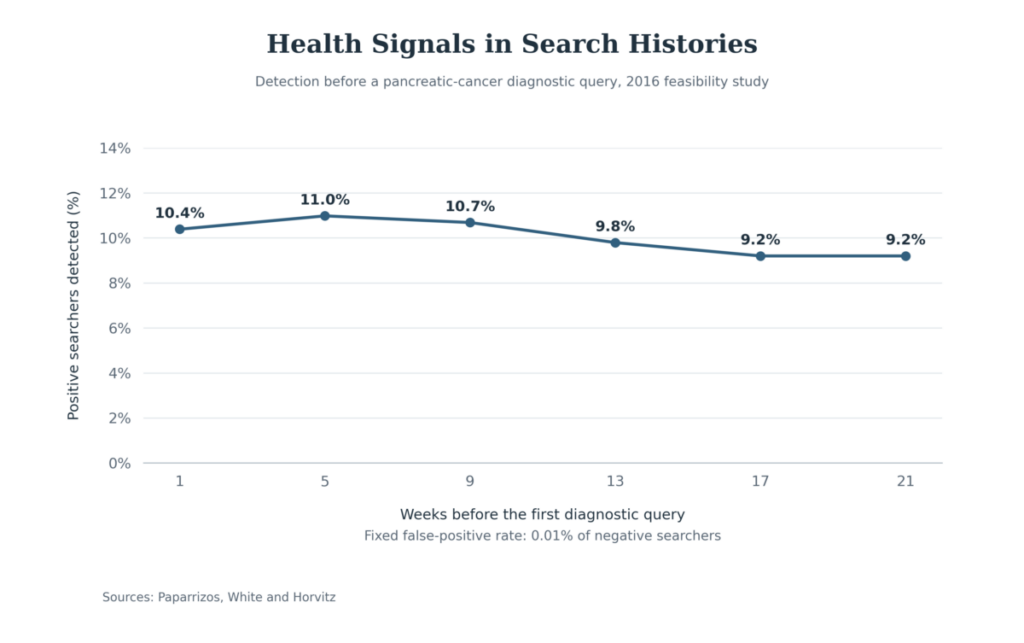
Healthcare marketing company Swoop also advertises prediction of future medical milestones, including provider visits and treatment changes. Timing is part of the product: reach someone before an anticipated decision, when an advertisement might influence the next step. Useful information may arrive through that process, but so may messages addressing an illness the recipient does not have. When the inference is correct, its unexpected appearance can disclose how much private activity has become commercially legible.
| Market Measure | Reported Result |
|---|---|
| Brokers responding to inquiries | 26 of 37 contacted |
| Aggregated mental-health counts | $275 for 5,000 counts |
| Annual data-access prices | $75,000+ or $100,000+ |
Sources: Duke University
The Relationships and Social Life Assigned to You
Home is another source of commercial interpretation. Experian advertises a Mosaic database covering 126 million U.S. households, allowing businesses to associate customer records with a wider account of how households live. For a retailer, that can fill gaps between purchases. For the person receiving an offer, it means that expectations about family circumstances may arrive before any direct conversation about them.
The system organizes households into 70 types. Its audience documentation includes single parents and empty nesters, and suggests approaching young families with food delivery messages about convenience. Here the classification supplies a persuasive setting as well as a customer: the offer assumes something about the recipient’s responsibilities and what would make daily life easier.
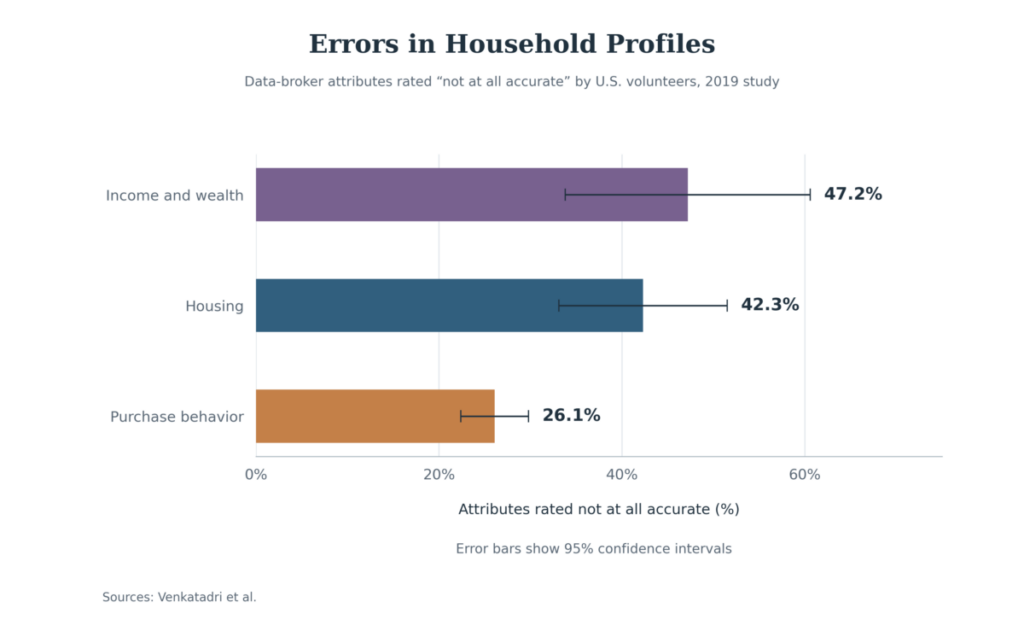
Such detail should not be mistaken for personal understanding. In a study published in 2019, 183 U.S. volunteers assessed broker attributes exposed through controlled Facebook advertisements; at least 40% were rated not at all accurate. That finding describes the tested attributes and participants, but gives a concrete reason to question the apparent certainty of a detailed profile. People sharing an address may have separate finances, while a purchase associated with parenthood may be a gift. Relationships also change, leaving a once-plausible classification attached to someone whose life has moved on. An offer framed around family life can then address responsibilities the recipient no longer has, or presume a relationship that has ended. Changing those circumstances does not automatically correct the commercial record.
| Previously Accurate? | Broker Attributes 833 assessments |
Facebook Attributes 1,596 assessments |
|---|---|---|
| Yes or probably yes | 24.0% | 32.3% |
| No or probably not | 76.0% | 67.7% |
Sources: Venkatadri et al.
Your Culture and Politics Through a Marketing Lens
An interest in a culture need not establish membership of it, just as attention to politics does not establish allegiance. Marketers nevertheless have reasons to use both. An association that helps predict response can remain commercially useful even when the person assigned to it would choose a different description of themselves.
Pew’s Facebook research found that 27% of users assigned a political category considered it not very or not at all accurate. For those recipients, the platform’s interpretation and their own account of their politics diverged. A campaign acting on that classification could therefore begin with the wrong premise about the person it hoped to persuade.
Physical movements can also become evidence of religious affiliation. The Mobilewalla complaint included marketing segments based on religious characteristics, connecting physical movements with the audiences available to advertisers. Visiting a place of worship may express faith, family obligation, or curiosity. Treating the visit as affiliation gives one interpretation an economic consequence: it changes who is considered appropriate for a message.
Cultural classifications have their own uncertainties. Among Pew respondents assigned a multicultural affinity, 37% reported no strong affinity with the designated group. Affinity and membership are different judgments, and neither automatically establishes belief. Relevant cultural communication can help a business reach an underserved audience, but a repeated misclassification can make the reader’s online environment feel as though it has settled an identity question on their behalf. The stakes differ from an irrelevant product recommendation because the message can presume belonging, inviting the recipient into a commercial conversation conducted in the language of a community they never claimed.
| Classification | Share Assigned | Assessment Among Assigned Users |
|---|---|---|
| Political category | 51% | 73% rated it accurate |
| Multicultural affinity | 21% | 60% reported strong affinity |
Sources: Pew Research Center
How Predictions Become Your Online Experience
When a marketer buys access to a named audience, its label becomes a purchasing decision. The recipient is selected because the system places them inside that category. In one field test reported in a 2019 consumer-profiling study, the advertisement reached the requested demographic segment 59% of the time. That measures the targeting delivered in the test, including the processes between audience classification and display; it is not a stand-alone error rate for predicting identity.
The prediction can also concern what you will spend, using something as ordinary as your device. Orbitz described using Mac-versus-PC differences to personalize hotel recommendations, including more expensive options. A technical signal became evidence of a spending preference. This includes airlines using browser and device information to adjust prices and recommendations, with Opera or Apple users frequently seeing higher-priced options than Windows PC users. The economic connection is between the signal a shopper supplies and the spending preference a business assigns to it.
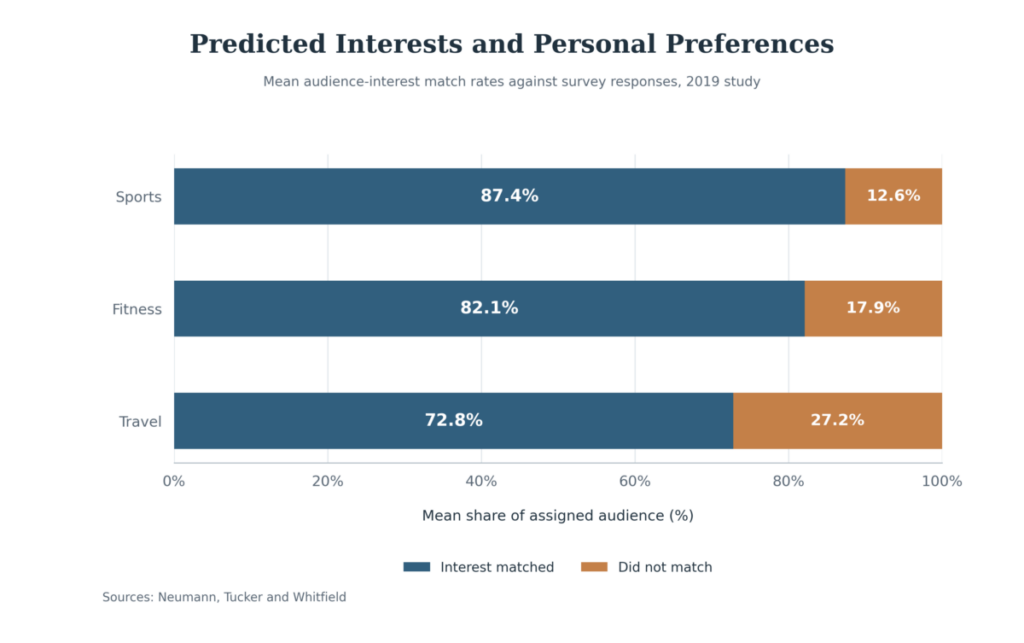
Precision also has a price. The consumer-profiling study estimated average additional display-advertising costs of approximately 151% when purchased audience data was used. Advertisers must earn back that premium, creating pressure to find audiences sufficiently responsive and sufficiently large. A very narrow classification may be accurate yet leave too few prospective customers to justify the campaign.
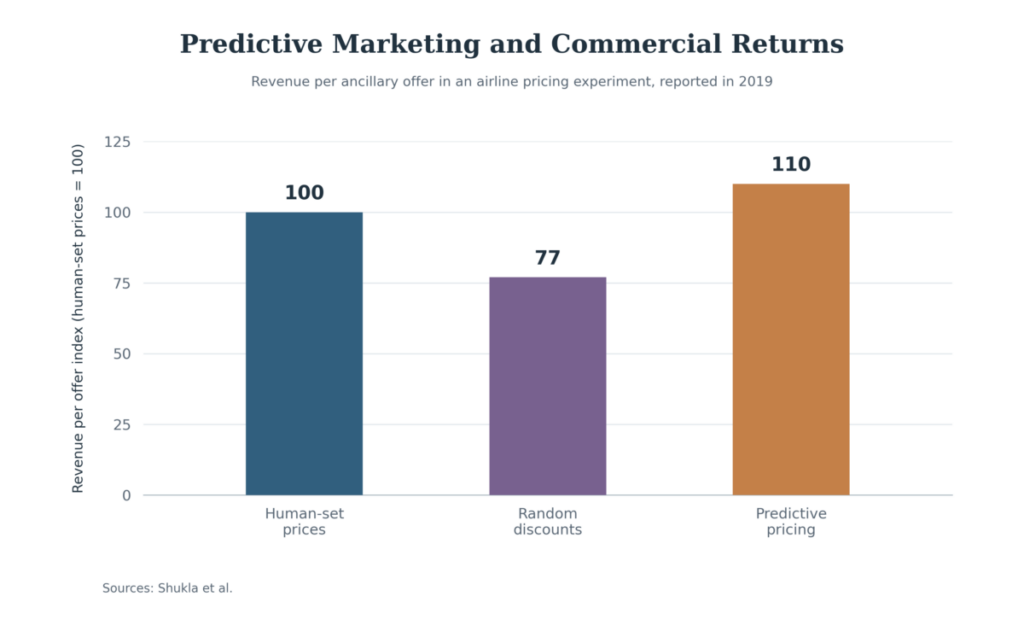
The value of anticipating a response is visible in an airline study that reported a 10% increase in revenue per offer during an online test of customer-context pricing for ancillary products. The model estimated purchase probability at different prices, allowing the offer to be adjusted around expected demand. Here prediction changed the transaction directly, rather than merely deciding which advertisement to display.
That feedback explains why profitable targeting can coexist with mistaken identities. Suppose someone clicks a health advertisement because its wording causes concern. The business records attention, but the response cannot by itself distinguish an existing medical need from anxiety prompted by the message. If the audience generates enough purchases, the campaign can pay despite such ambiguity. The commercial incentive is to retain a useful predictor, while investigating the personal explanation behind each response would impose additional work. For the reader, the assumption can therefore survive the very interaction that made it feel intrusive.
| Predicted Interest | Average Accuracy | Provider Range |
|---|---|---|
| Sports | 87.4% | 82.1–91.0% |
| Fitness | 82.1% | 78.6–85.9% |
| Travel | 72.8% | 62.4–87.8% |
Sources: Neumann, Tucker and Whitfield
Living With Someone Else’s Prediction
The person receiving an advertisement usually sees the message, not the classification that selected them. Even recognizing a mistake may reveal little about where it originated or which businesses continue to use it. California’s DROP allows eligible residents to send a deletion request to more than 600 registered brokers, reducing the work of finding each company separately. For someone repeatedly approached through an unwanted profile, that is a practical route to limiting its circulation.
The request must also outlast the record it removes. Starting in August 2026, brokers were required to access DROP at least every 45 days to begin processing requests. New collection can otherwise rebuild an earlier classification. California advises that status updates may take up to 90 days; during that interval, a consumer waiting for confirmation may have little basis for interpreting the advertisements that continue to appear.
UK guidance addresses interpretation itself, treating intentional sensitive inference as protected processing regardless of confidence in its accuracy; that guidance is under review. The distinction matters to someone assigned an illness or affiliation they do not recognize: an inaccurate inference can still be sensitive in how it is used.
A marketer can learn that an audience responds well without learning which members were misclassified. Correcting an individual profile may therefore bring little immediate commercial reward, even when the error has become intrusive for that person. As information is refreshed and resold, meaningful consumer control has to follow the interpretation into its next use. Otherwise, the same uncertain identity can keep determining how businesses approach someone long after that person has tried to correct it.
| Measure | Calculation or Comparison |
|---|---|
| Profile error rate | Incorrect attributes as a percentage of attributes checked |
| Commercial lift | Revenue per offer compared with a control group |
| Correction completion | Confirmed corrections as a percentage of corrections requested |
| Error recurrence | Corrected errors that reappear as a percentage rechecked |
Sources: Venkatadri et al., Shukla et al., California Privacy Protection Agency
TL;DR
- Marketers infer medical, social, and cultural identities from incomplete behavioral signals.
- Machine learning recognizes associations without necessarily understanding an individual’s circumstances.
- A medical search or location visit can acquire a meaning the person never intended.
- Predictive healthcare marketing seeks to anticipate decisions as well as identify current needs.
- Household classifications help businesses frame offers around presumed relationships and responsibilities.
- Detailed profiles can contain substantial inaccuracies.
- Cultural interest, community membership, and religious belief require different interpretations.
- Political attention can be misclassified as political allegiance.
- Targeting has to generate enough additional revenue to recover its costs.
- Campaign success does not establish that the identities used for targeting were accurate.
- Consumer responses can improve advertising decisions without resolving the underlying identity question.
- Effective recourse must address profiles that are repeatedly refreshed, circulated, and rebuilt.
Sources
- Federal Trade Commission; Data Brokers: A Call for Transparency and Accountability; – Link
- Federal Trade Commission; A Look Behind the Screens: Examining the Data Practices of Social Media and Video Streaming Services; – Link
- CIMM, Go Addressable and Truthset; The Challenges of Using IP Address for Audience Identification and Measurement; – Link
What Marketers Think Is Happening to Your Health
- Duke University; Data Brokers and the Sale of Americans’ Mental Health Data: The Exchange of Our Most Sensitive Data and What It Means for Personal Privacy; – Link
- Paparrizos, White and Horvitz; Screening for Pancreatic Adenocarcinoma Using Signals from Web Search Logs: Feasibility Study and Results; – Link
- U.S. Department of Justice; Digital Healthcare Platform Ordered to Pay Civil Penalties and Take Corrective Action for Unauthorized Disclosure of Personal Health Information; – Link
The Relationships and Social Life Assigned to You
- Venkatadri et al., The Web Conference; Auditing Offline Data Brokers via Facebook’s Advertising Platform; – Link
- Kosinski, Stillwell and Graepel, PNAS; Private Traits and Attributes Are Predictable from Digital Records of Human Behavior; – Link
- Experian; Consumer View; – Link
Your Culture and Politics Through a Marketing Lens
- Pew Research Center; Facebook Algorithms and Personal Data; – Link
- Neumann, Tucker and Whitfield, Marketing Science; How Effective Is Third-Party Consumer Profiling and Audience Delivery? Evidence from Field Studies; – Link
- Federal Trade Commission; Mobilewalla, Inc., In the Matter of; – Link
How Predictions Become Your Online Experience
- Matz, Kosinski, Nave and Stillwell, PNAS; Psychological Targeting as an Effective Approach to Digital Mass Persuasion; – Link
- Shukla et al.; Dynamic Pricing for Airline Ancillaries with Customer Context; – Link
- Federal Trade Commission; FTC Surveillance Pricing 6(b) Study: Research Summaries; A Staff Perspective; – Link
Living With Someone Else’s Prediction
- He et al., Proceedings on Privacy Enhancing Technologies; Measuring the Accuracy and Effectiveness of PII Removal Services; – Link
- California Privacy Protection Agency; Delete Request and Opt-out Platform (DROP); – Link
- California Privacy Protection Agency; Rights Under the California Consumer Privacy Act; – Link
Keywords: Behavioral Economics, Digital Marketing, Consumer Privacy, Predictive Consumer Profiling, Algorithmic Identity Inference