

Neurodiversity and AI Assistants: A New Frontier in Workforce Satisfaction
The rise of artificial intelligence in the workplace is often framed as a matter of efficiency, automation, and scale, but a quieter and more profound transformation is taking place inside offices, creative studios, and back-office operations. A growing body of research suggests that neurodiverse employees—individuals with differences in cognitive processing such as ADHD, autism spectrum conditions, dyslexia, dyspraxia, and other related traits—are not only adapting well to AI assistants but are reporting significantly higher satisfaction with these tools compared to their neurotypical peers. For companies navigating the dual pressures of productivity and inclusivity, this shift is more than a technical curiosity; it is an opportunity to rethink how work is structured and who benefits from it.
AI assistants, from scheduling bots to generative writing tools, have become increasingly common across industries. They arrange meetings, prioritize tasks, surface reminders, and automate mundane routines. For many neurotypical workers, the results are mixed. Some find the tools intrusive, others ignore the prompts altogether. Yet for employees with ADHD and other cognitive differences, the experience is often transformative. Predictability, clarity, and relief from the constant effort of managing multiple threads of information are not conveniences but lifelines. Tasks that once drained energy can be streamlined, and the hidden costs of navigating workplace ambiguity are reduced.

A recent survey of employees across multiple sectors found that those with cognitive differences rated their satisfaction with AI scheduling assistants nearly 20 points higher than their neurotypical colleagues. One participant with ADHD described how the system’s automated nudges helped maintain focus during high-pressure weeks. Where he once missed deadlines because of overlapping assignments, the assistant reorganized tasks to prevent conflicts and provided alerts before bottlenecks appeared. What felt like a mild annoyance to his peers was, to him, a guardrail that made the difference between success and failure.
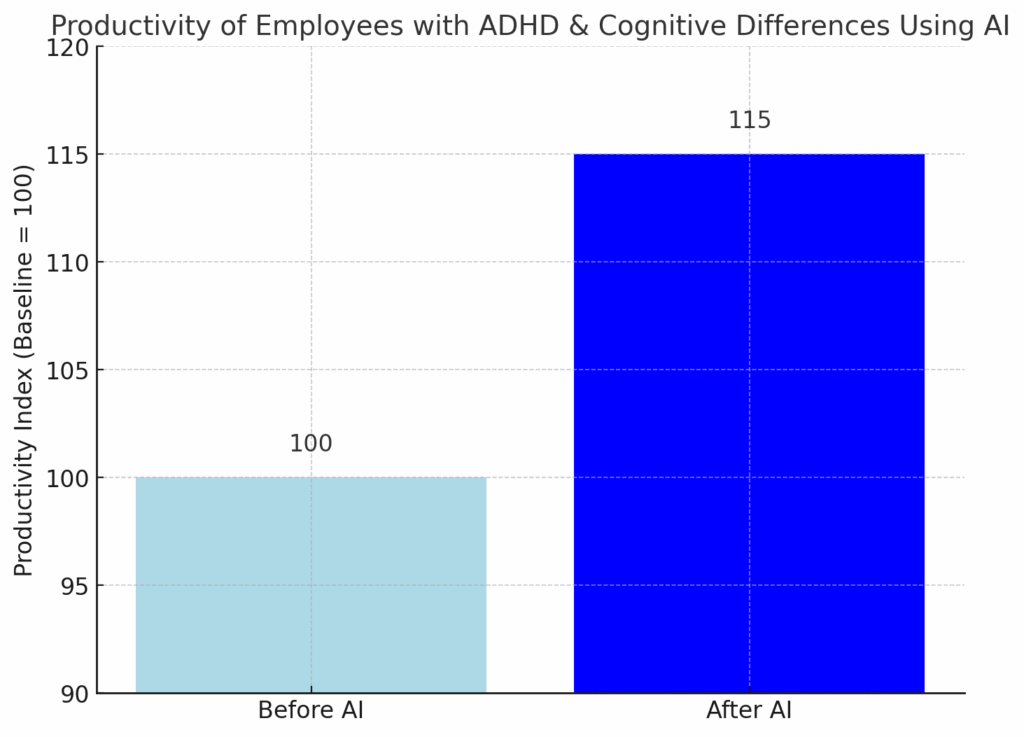
The pattern extends beyond scheduling. In a mid-sized software company in Seattle, developers using AI-driven code assistants reported not only higher productivity but fewer errors during sprints. The system handled repetitive checks, flagged dependencies, and suggested solutions, enabling developers to stay immersed in their flow rather than constantly shifting contexts. Metrics collected internally showed that developers with ADHD and similar conditions completed nearly 15 percent more sprint stories after six months of using the assistant. While overall satisfaction across the team was already high, satisfaction levels among employees with cognitive differences were strikingly higher, reinforcing the idea that these tools serve as amplifiers where they are needed most.
Financial services firms are witnessing similar dynamics. At one global bank, back-office employees with dyslexia faced particular challenges processing dense documents filled with figures and technical jargon. The bank piloted an AI system that read aloud key passages, flagged inconsistencies, and generated plain-language summaries. Employees who had once struggled with fatigue and slower throughput reported not only improved accuracy but reduced stress. Quality assurance metrics rose nearly 20 percent in the teams using the system, and staff turnover among those employees fell noticeably within a year. For managers grappling with both rising error rates and high attrition, the pilot underscored the dual benefit of inclusion and operational efficiency.
Even in the creative industries, where human imagination is at a premium, the same pattern emerges. A marketing agency testing generative AI for drafting campaign copy and visual storyboards found that employees with cognitive differences used the tools differently. For some designers, especially those on the autism spectrum, the blank page often produced paralysis. Having an AI-generated starting point turned that obstacle into momentum. Writers with ADHD reported that while they still rewrote much of the AI output, the simple fact of having raw material kept them engaged. Their productivity rose, but perhaps more importantly, their frustration fell. Job satisfaction surveys showed the widest increase among staff with cognitive differences, suggesting that the tools were not replacing creativity but unlocking it.
The reasons behind these results are not hard to discern. AI assistants are consistent, structured, and free of the social ambiguities that can complicate human interactions. They send reminders without judgment, break tasks into steps without condescension, and adjust routines without visible impatience. For workers with ADHD or other cognitive differences, this consistency is a relief. The invisible barriers that shape daily labor—the cognitive load of tracking deadlines, decoding instructions, or navigating interpersonal expectations—are lowered, leaving more energy for actual work. In effect, AI assistants act as a form of accommodation that is proactive rather than reactive.

For businesses, the implications extend beyond employee satisfaction. Companies that harness AI to empower cognitively diverse talent can see gains in retention, productivity, and quality. Lower turnover reduces recruiting and training costs in industries already struggling to fill specialized roles. Fewer errors and more consistent output save money directly. More broadly, tapping into a larger pool of skilled employees with cognitive differences can provide a competitive edge at a time when diversity is increasingly linked to innovation. An organization that designs its tools and workflows to support different cognitive styles does not only create a fairer workplace; it also creates a more resilient one.
Yet the story is not without risks. AI assistants that overwhelm users with notifications, that fail to adapt to different work styles, or that collect intrusive data can easily backfire. For employees sensitive to sensory overload, a poorly designed system can add stress rather than relieve it. There is also the danger of companies treating AI as a substitute for broader cultural inclusion, using technology as a way to tick boxes without addressing structural issues like training, management awareness, and team integration. Thoughtless deployment can turn a promising tool into a token gesture.
The companies that succeed in this space are those that treat cognitively diverse workers as co-designers rather than passive recipients. Customizable interfaces, adjustable notification levels, and transparent privacy policies are all part of inclusive AI adoption. Some firms have gone further, building feedback loops directly into their AI rollouts, ensuring that employees with ADHD and other cognitive differences shape the evolution of the tools they use. When done well, the technology supports human differences rather than flattening them.
The broader economic case for inclusive AI adoption is strong. A recent McKinsey analysis suggested that organizations investing in strategies for employees with cognitive differences could see up to 30 percent reductions in turnover costs and measurable improvements in productivity. Combined with the findings of academic studies showing higher satisfaction among these workers using AI assistants, the business rationale is clear. Inclusion is not merely an ethical commitment but a pathway to resilience in competitive markets.
The future of work will not be defined solely by which tasks machines can take over, but by how human beings—each with different strengths and challenges—interact with those machines. For employees with ADHD and other cognitive differences, AI assistants represent more than efficiency. They represent a form of equity, a rebalancing of workplace structures that historically demanded conformity at great personal cost. For companies, embracing that shift is both a responsibility and an opportunity. The satisfaction scores are only the beginning; the real story is about unleashing talent that was always there, waiting for the right tools to thrive.
Key Takeaways
- Employees with ADHD and other cognitive differences report higher satisfaction with AI assistants, especially in reducing cognitive load and providing structure.
- Case studies in software, finance, and creative industries show measurable improvements in productivity, error reduction, and employee retention.
- Inclusive AI adoption creates economic advantages by lowering turnover costs, boosting efficiency, and expanding access to skilled talent.
- Risks include over-automation, sensory overload, and tokenistic implementation, underscoring the need for thoughtful, user-driven design.
Sources
- Institute for Digital Economy study (2025)
- Internal case study, Seattle software firm
- Global bank back-office operations report (2025)
- Creative agency productivity survey (2025)
- McKinsey & Company analysis on workplace inclusion and performance