
Artificial intelligence (AI) is no longer a futuristic concept—it is a practical necessity driving fundamental change in how businesses operate, scale, and compete. As industries worldwide accelerate their digital transformations, AI is emerging not only as a tool for automation but as a strategic engine powering smarter decisions, leaner operations, and enhanced customer experiences.
In today’s competitive environment, companies are increasingly turning to AI to expand capacity without expanding headcount. This shift represents a profound transformation in operational strategy, with implications reaching across every department and business model.
Scaling Without Growing the Workforce
One of the most significant shifts enabled by AI is the ability for organizations to grow revenue and productivity without proportional increases in staff. By integrating machine learning, natural language processing, and predictive analytics into their operations, businesses are optimizing workflows, reducing manual intervention, and accelerating output.
Customer service teams are deploying AI chatbots capable of handling thousands of queries simultaneously, freeing up human agents for complex cases. In finance, AI is automating audits, identifying fraud patterns, and reconciling transactions at unprecedented speeds. These efficiencies mean companies can do more—with less.
This ability to scale smartly has become a strategic advantage, particularly for small and mid-sized firms seeking to compete with larger enterprises. With AI, they gain the power of enterprise-level insights and automation without the overhead.
The Surge in AI Adoption Across the Channel
Adoption rates of AI across solution providers have seen remarkable growth. Over the past two years, AI engagement among service providers increased by 33%, driven by the technology’s affordability, accessibility, and performance improvements.
As shown in the chart below, adoption rates jumped from 28% in 2023 to 57% in 2025—a doubling in just two years.

This surge reflects a growing recognition that AI is essential not just for efficiency but for survival in a rapidly changing economic landscape. Businesses that delay integration risk falling behind more agile competitors who are leveraging AI to move faster, reach more customers, and make better decisions.
Marketing and Sales: Leading the AI Transformation
The functions most immediately and dramatically impacted by AI are marketing and sales. Over the next 12 months, these departments are expected to see the greatest transformation through AI-driven tools.
AI enables marketing teams to personalize content at scale, predict customer behavior, optimize campaign performance, and automatically segment audiences. In sales, AI-enhanced CRMs identify promising leads, automate follow-ups, and provide insights into customer intent—all in real-time.
As shown below, marketing and sales lead all other departments in expected AI-driven gains.
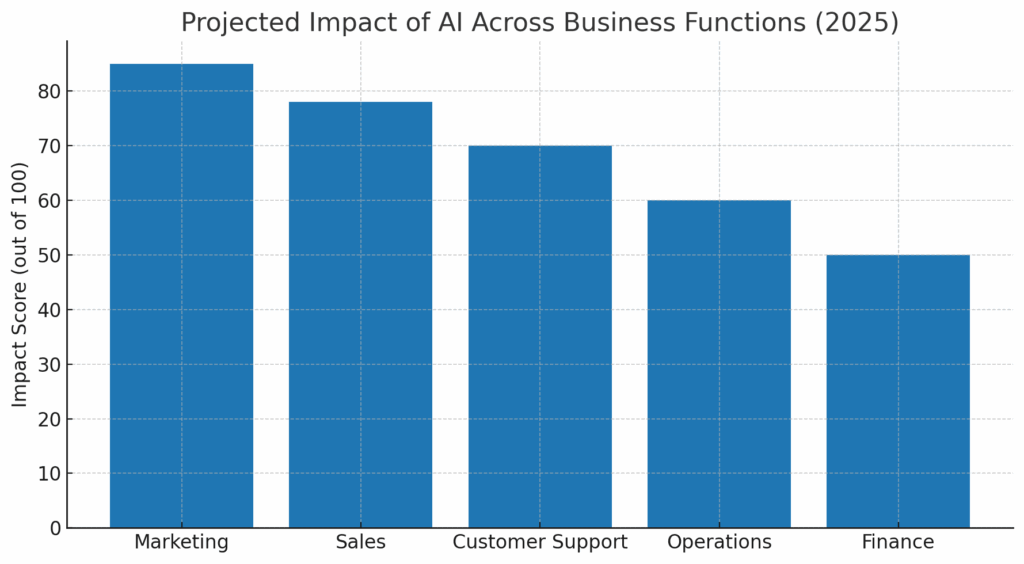
These tools empower teams to improve performance while reducing cost per acquisition, shortening sales cycles, and improving customer retention.
AI Positivity Is Growing, But So Are Concerns
While optimism surrounding AI is rising, businesses remain mindful of the associated risks. According to recent surveys, cybersecurity, legal uncertainties, and algorithmic bias are among the most pressing concerns.
Cybersecurity leads the list, as AI systems can become attack vectors or amplify security vulnerabilities if improperly managed. Legal risks—ranging from regulatory compliance to questions of AI-generated intellectual property—are also top of mind. Businesses are aware that irresponsible AI usage could bring significant reputational or financial harm.
The following chart illustrates the top concerns businesses face during AI integration:
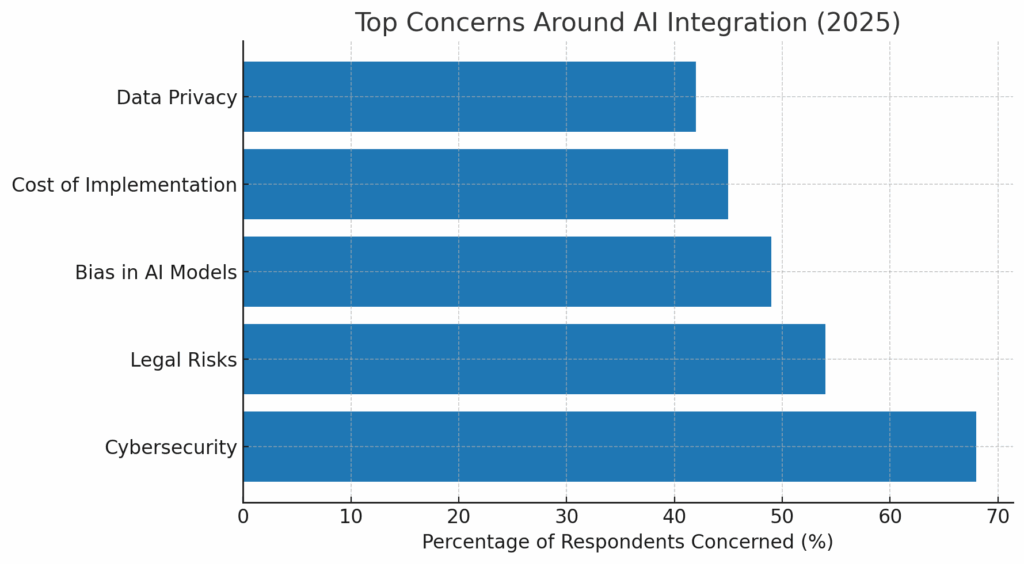
However, most experts agree that these challenges are manageable. With proper oversight, robust data governance policies, and ethical frameworks, organizations can mitigate risk while unlocking the full potential of AI.
The New Business Backbone: AI’s Expanding Role
Beyond operational improvements, AI is reshaping strategic planning. Decision-makers are using AI not only to optimize current functions but also to identify future growth opportunities, simulate business scenarios, and monitor market dynamics.
AI’s analytical capabilities allow executives to act faster with greater confidence, whether adjusting to supply chain disruptions, forecasting demand, or responding to customer trends. In effect, AI is becoming the analytical nervous system of the modern enterprise.
This transformation is creating ripple effects across business ecosystems. Companies that embed AI into their core processes are becoming more agile, data-driven, and customer-centric. They are outperforming their peers in speed, accuracy, and efficiency—and establishing new competitive benchmarks in the process.
What Comes Next? Preparing for Long-Term Integration
Looking ahead, AI will continue to evolve and integrate deeper into business infrastructures. Generative AI will enhance creative functions, large language models will serve as real-time advisors, and embedded AI chips will accelerate performance across devices and systems.
To prepare, businesses must invest in three critical areas:
- Talent Development – Training existing staff to work alongside AI systems, interpret outputs, and apply insights effectively.
- Ethical AI Governance – Establishing principles to ensure transparency, fairness, and accountability in AI applications.
- Technology Partnerships – Aligning with trusted providers to deploy secure, scalable AI solutions.
Organizations that approach AI integration with a balance of ambition and responsibility are best positioned to thrive.
Key Takeaways
- AI is enabling organizations to expand output and efficiency without increasing headcount, revolutionizing how businesses scale.
- Adoption has surged, with 33% more providers engaging in AI strategies than in prior years.
- Marketing and sales are poised to see the greatest gains from AI in the next 12 months.
- Cybersecurity and legal issues are the top challenges in AI integration, but they are addressable with governance and oversight.
Sources
- Global Technology Strategy Reports (2023–2025)
- Business Process AI Impact Surveys
- Enterprise AI Integration Benchmarks
- Emerging Tech Trends Publications
- Internal Adoption and Cybersecurity Survey Data