
For most people, the Internet still appears human. Someone opens an application, searches for information, watches a video, checks a bank balance, or buys something online. Beneath that visible activity, however, an increasing share of the web consists of machines communicating directly with other machines.
Machine-to-machine communication is not new. Servers have exchanged data since the Internet began. What is changing is the scale, persistence, and economic function of that traffic. Software increasingly monitors conditions, exchanges information, invokes AI models, reallocates computing resources, and initiates actions without waiting for human requests.
Global cloud infrastructure services revenue reached about $419 billion in 2025, including roughly $211.9 billion attributed to infrastructure as a service. That market developed largely around applications serving organizations and people. Its next phase increasingly involves infrastructure serving software that itself consumes computing resources and digital services.
The distinction changes the economics of the Internet because human attention is intermittent. People sleep, stop browsing, postpone decisions, and tolerate inefficiencies because checking again takes time. Machines do not face those same limits. A system can continuously monitor prices or network performance, track inventories and security conditions, or respond to changing energy availability.
For users, much of this activity will remain invisible. The website or application may still look familiar even as more of the work behind the interface occurs through machine-to-machine interactions.
Every minute of human attention replaced by automation becomes, in part, additional machine computation.
| Measure | Scale |
|---|---|
| Requests analyzed by Cloudflare | More than 1 trillion daily |
| Web behind Cloudflare | More than 20% |
| Most-visited sites using Cloudflare | 36% |
| Fortune 500 using Cloudflare | More than 40% |
| Turnstile verification events | Nearly 3 billion daily |
Sources: Cloudflare
When Machine Traffic Becomes Economic Traffic
Traffic volume alone does not explain the shift. Automated requests have always included indexing, security scanning, and routine synchronization. Their economic significance increases when machines use information to determine what happens next.
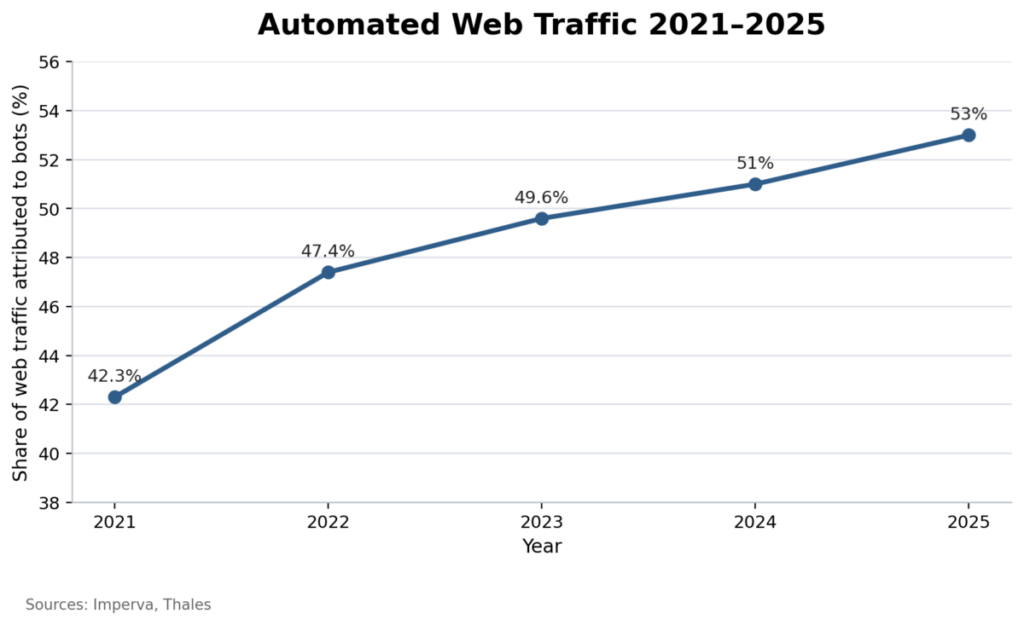
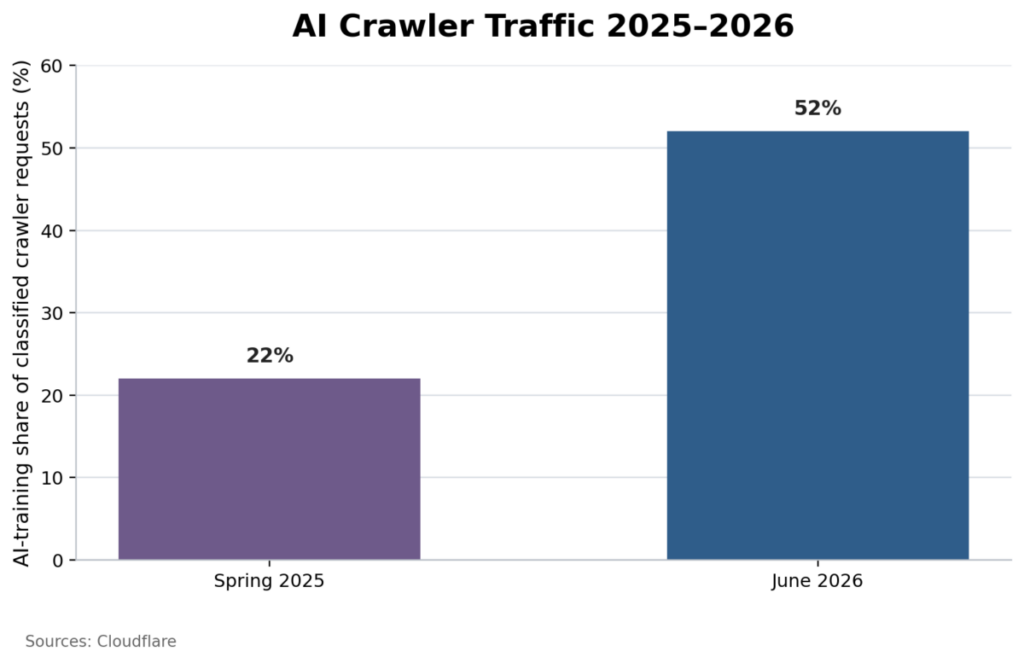
Cloudflare reported that 52 percent of classified crawler requests in June 2026 were associated with AI training, compared with 22 percent in spring 2025. Another 36 percent came from mixed-use crawlers combining search, training, and agent behavior. Measurements across large networks increasingly place automated activity around or above half of observed web requests, although these figures should not be interpreted as proof that most global Internet traffic is autonomous economic activity.
The important change is functional. A search crawler retrieves information so a human can discover it later. A machine system can instead retrieve information, evaluate conditions, and trigger subsequent actions across connected services.
That capability creates a different pattern of demand. Human-centered applications frequently operate around sessions and events. Machine systems can remain active indefinitely, responding as conditions change.
An industrial system might compare sensor readings with operational thresholds, while a software platform rebalances workloads as capacity changes. Logistics systems can update routes as inventory or transportation conditions shift, and cloud applications can choose computing services according to operational requirements.
The economics therefore extend well beyond autonomous purchasing. M2M systems reduce the cost of coordination itself. Tasks that once required people to observe conditions, communicate with another organization, evaluate alternatives, and authorize a response can increasingly occur between machines.
An action too small or frequent to justify manual intervention can become economical when software can repeat it thousands or millions of times.
| Measure | Earlier Measure | June 2026 |
|---|---|---|
| AI-training crawler share | 22% in spring 2025 | 52% |
| Change in share | Baseline | +30 percentage points |
| Mixed-use crawler activity | Not separately stated | More than 36% |
| Pure search crawling | Larger historical role | Small and declining share |
Sources: Cloudflare
IaaS Becomes Infrastructure for Persistent Demand
The apparent weightlessness of machine activity conceals a physical system underneath it. Every model inference or system interaction requires computing capacity somewhere. Machines may communicate through software, but physical infrastructure and electricity perform the work.
Cloud computing originally offered firms a way to rent capacity rather than own enough hardware for maximum expected demand. M2M activity deepens that model because the cloud increasingly hosts not only applications waiting for users, but systems that continuously interact with other systems.
AWS S3 now stores more than 500 trillion objects and handles more than 200 million requests per second. Those figures do not measure autonomous AI activity, but they show the scale of the machine environment onto which increasingly persistent workloads are being added.
Part of the economic difference lies in utilization. Human demand often arrives in bursts around daily activity. Machine demand can continue throughout the day, repeatedly checking conditions and consuming compute whenever a rule or model requires evaluation.
Persistent activity changes the economics of capacity planning. Infrastructure becomes more important when it must accommodate systems whose demand is generated by other systems rather than directly by people.
The same process can change how infrastructure itself is allocated. A cloud administrator will not manually reconsider workload placement every few minutes because operating conditions changed slightly. Software potentially can. What appears externally as M2M traffic can therefore become an internal mechanism for deciding where computing resources run.
Geography remains important. Regions with strong infrastructure can accommodate more of this activity directly. Areas without those resources may consume machine-mediated services while capturing less of the underlying infrastructure investment.
Cloud concentration creates an additional economic tension. Organizations may gain enormous flexibility through automated infrastructure while becoming more dependent on the relatively small number of firms supplying the computing capacity beneath it.
| AI-Optimized IaaS Measure | 2025 | 2026 Forecast |
|---|---|---|
| Total spending | $18.3B | $37.5B |
| Inference spending | $9.2B | $20.6B |
| Inference share | About half | 55% |
| Inference share outlook | Growing | More than 65% by 2029 |
Sources: Gartner
Lower Coordination Costs Change Markets
Traditional Internet economics has concentrated heavily on attention because human activity shaped commercial demand. Search platforms competed for intent, social networks for time, and marketplaces for transactions.
M2M activity changes another economic variable: the cost of coordination.
Economic research on AI agents supports the underlying mechanism. Machines can reduce transaction costs, making some forms of market activity practical at frequencies that would be irrational for people. They can also create new congestion and market power.
The effect reaches beyond commerce. A system can continuously compare services, evaluate resources, or monitor inputs. Software does not need a large potential saving to justify another comparison because the marginal cost of checking can be extremely low.
Markets can consequently become more responsive. Providers that historically benefited from slow customer comparison or infrequent organizational procurement may face systems capable of evaluating alternatives continuously.
Businesses may also have to become more legible to machines. Commercial and technical conditions increasingly need to be expressed in formats software can interpret reliably. A company can remain perfectly understandable to a human customer yet become difficult for automated systems to evaluate.
Agentic commerce illustrates the mechanism without defining it. A household might eventually authorize software to switch broadband when an equivalent plan becomes materially cheaper. The same economics apply when enterprise software reallocates digital resources.
The larger change is not machines becoming shoppers. It is machines becoming continuous participants in economic coordination.
| Evidence | Observed Result | Market Dimension |
|---|---|---|
| Online airline purchasing | About 11% lower fares | Search efficiency |
| Price dispersion | Persisted online | Incomplete friction removal |
| AI agent search | Lower search costs | Transaction costs |
| AI agent contracting | Lower communication and contracting costs | Coordination costs |
Sources: American Economic Association, NBER
The Human Impact of an Invisible Machine Web
For ordinary users, the consequences may appear first as reduced friction rather than visible technological change. A service responds faster, a subscription is optimized, a network experiences fewer disruptions, or an application adjusts capacity before congestion becomes noticeable. The machines conduct the underlying coordination while people experience the outcome.
That shift can return time to users and workers. People currently perform substantial routine economic administration. Machines capable of handling more of that activity reduce the human attention required to keep digital systems and personal services functioning.
Lower search costs can also improve bargaining power. A consumer who would not spend an hour saving $8 may still benefit if software performs the comparison automatically. Businesses can apply the same logic to many infrastructure and procurement decisions too small to justify continuous human review.
The gains are not guaranteed. Sellers can obscure pricing or restrict machine access, while platforms can limit which alternatives automated systems may evaluate. Greater automation can therefore reduce some forms of friction while creating new intermediaries.
Access may also become unequal. People and firms with effective machine representation could obtain better prices, lower operating costs, and faster responses than those relying on weaker systems. The digital divide could gradually expand from connectivity toward access to capable automated representation.
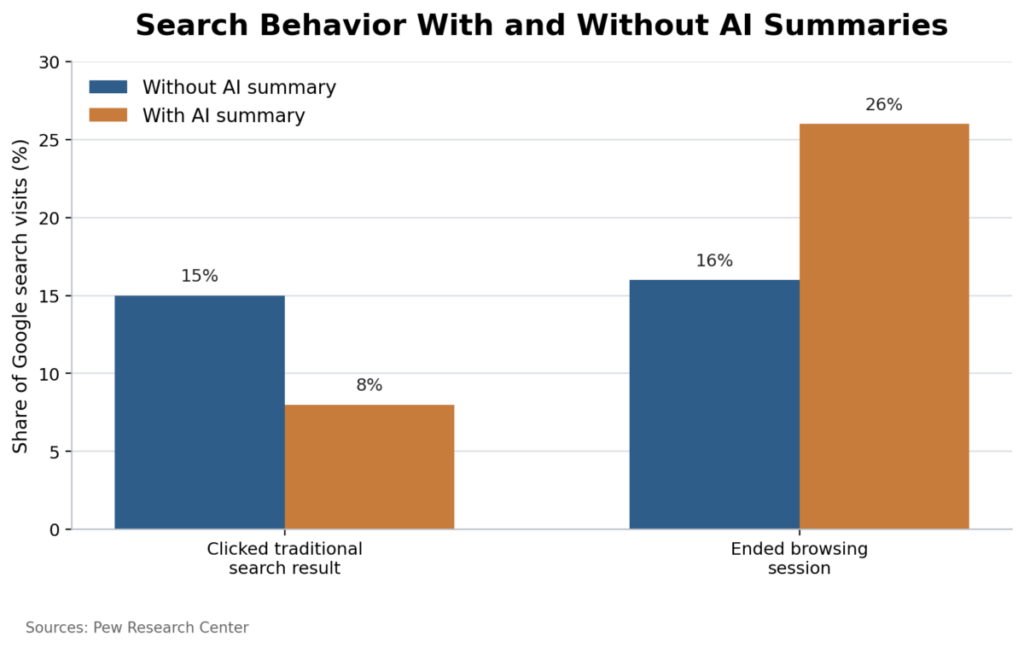
The same mediation can reduce direct exposure to the underlying web. Pew Research Center found that Google users clicked conventional search results on 8 percent of visits where an AI summary appeared, compared with 15 percent without one. Sessions ended after 26 percent of searches containing AI summaries, versus 16 percent without them. Those figures describe search behavior rather than M2M transactions, but they illustrate a broader pattern: software can increasingly mediate between human intent and the digital resources that satisfy it.
As machines retrieve and act on more information, the visible web may become a smaller portion of the economic Internet people actually depend on.
| Measure | Result |
|---|---|
| Consumers expecting regular agent use | About 1 in 3 |
| Would use agents to save time or money | Roughly two-thirds |
| Want transparency into agent decisions | Nearly 9 in 10 |
| Would stop use if control disappeared | About half |
| Discovery-stage substitution | 73% |
Sources: Visa
Who Controls the Machine Economy
An Internet built around persistent M2M interaction requires different forms of trust. Infrastructure must increasingly determine what kind of machine generated a request, whom it represents, and whether its actions should be accepted.
Machine identity therefore becomes infrastructure rather than a peripheral security feature. So do authorization and accountability.
Payments provide one visible example. Visa is developing infrastructure for authenticated agent-initiated transactions across a network already serving billions of credentials and hundreds of billions of annual transactions. The same issue applies to noncommercial M2M activity: systems need reliable ways to determine whether another machine is authorized to request data, change settings, or invoke services.
Once machines can be identified and authorized, their consumption can also be measured and priced. When automated systems continuously use digital resources, providers have stronger incentives to meter machine access rather than subsidize it through business models built primarily around human-facing traffic.
That shifts market power toward control points beneath the interface. Infrastructure providers can become increasingly important intermediaries because machines depend on them to communicate and act.
Competition policy consequently extends beyond the familiar question of which website or marketplace dominates human attention. The emerging question is which providers control the pathways through which machines discover resources, identify themselves, obtain permission, and execute decisions.
Scaling M2M economics will depend on more than capable software. Reliable infrastructure, transparent pricing, sufficient computing capacity, and clear responsibility for machine actions will determine how efficiently this new layer develops.
Humans remain the ultimate source of demand. Their goals, businesses, institutions, and consumption give machine activity its economic purpose. What changes is how much coordination between those goals and their outcomes occurs without direct human participation.
The Internet’s next economic transformation may therefore be less visible than the arrival of the web or smartphones. Instead of bringing another billion people online, it may connect billions of machines that continuously coordinate the digital economy on their behalf.
| Implementation | Machine Control Added | Current Scale or Status |
|---|---|---|
| Cloudflare Monetization Gateway | Usage pricing and access control | Built for machine-paid resources |
| x402 | Machine-native payment settlement | Coalition of 25+ industry leaders |
| Visa agent permissions | Spending and identity controls | Commercial infrastructure development |
| Machine-readable merchant data | Structured price and policy access | Identified as an agentic-commerce priority |
Sources: Cloudflare, Visa
TL;DR Summary
- M2M traffic is becoming economically significant because machines increasingly do more than transmit information.
- Cloudflare measured AI-training activity at 52 percent of classified crawler requests in June 2026.
- Persistent machine systems can monitor, compare, synchronize, allocate resources, and act without waiting for human sessions.
- M2M activity lowers coordination and transaction costs across digital markets and infrastructure.
- IaaS increasingly supports continuous machine demand rather than only applications responding to human activity.
- Machine workloads increase demand for processors, electricity, networking, storage, and data-center capacity.
- Automated resource allocation could make cloud infrastructure itself more responsive to price, latency, and capacity conditions.
- Businesses may need to make pricing, availability, services, and contractual conditions increasingly legible to machines.
- Agentic commerce is one example of the broader M2M shift rather than its central economic story.
- Users may gain lower friction, recovered time, and improved market comparison while becoming less directly involved in the underlying web.
- Unequal access to effective machine systems could create a new digital divide based on automated economic representation.
- Machine identity, authorization, pricing, infrastructure concentration, and accountability will increasingly shape Internet economics.
Keywords: Cloud Computing, Machine Traffic, M2M Communication, Internet Economics, Infrastructure Economics, Automated Coordination, Machine Demand