


Modern travel has become a paradox — smoother than ever yet strangely less personal, efficient yet often disorienting. As artificial intelligence (AI), mobile ecosystems, and global platforms redefine how people move through the world, travelers now live at the intersection of convenience and complexity. From algorithmic recommendations that promise to “know you better than you know yourself” to biometric borders and automated assistants, the digital scaffolding beneath travel has transformed both its beauty and its burdens. What was once a series of physical steps — booking, boarding, exploring — is now an invisible choreography of data, decisions, and code.
For travelers, technology has reimagined nearly every phase of the experience. Digital boarding passes, facial recognition at airports, AI-powered itineraries, and cloud-based hotel management systems have simplified logistics and improved efficiency. The World Travel & Tourism Council reported in 2024 that more than 70 percent of major airlines and hotel chains now deploy AI-driven systems to optimize pricing, staffing, and customer engagement. Yet, while these tools promise seamlessness, they have also created a dependency on algorithmic logic — systems that, for all their precision, are far from perfect.
A common frustration among frequent travelers today stems from poor AI recommendations. Personalized travel suggestions often rely on limited historical data or uncontextualized preferences. For instance, a traveler who once booked a budget weekend in Berlin might later find their AI assistant relentlessly promoting hostels and low-cost flights, ignoring that their budget and priorities have since evolved. A 2024 study from Cornell’s Center for Hospitality Research found that 38 percent of users described AI-generated travel suggestions as “irrelevant or repetitive,” while 22 percent said algorithms misinterpreted their intentions entirely. The same personalization engines that promise to anticipate needs can instead trap users in narrow behavioral patterns — a phenomenon known as “algorithmic narrowing.”
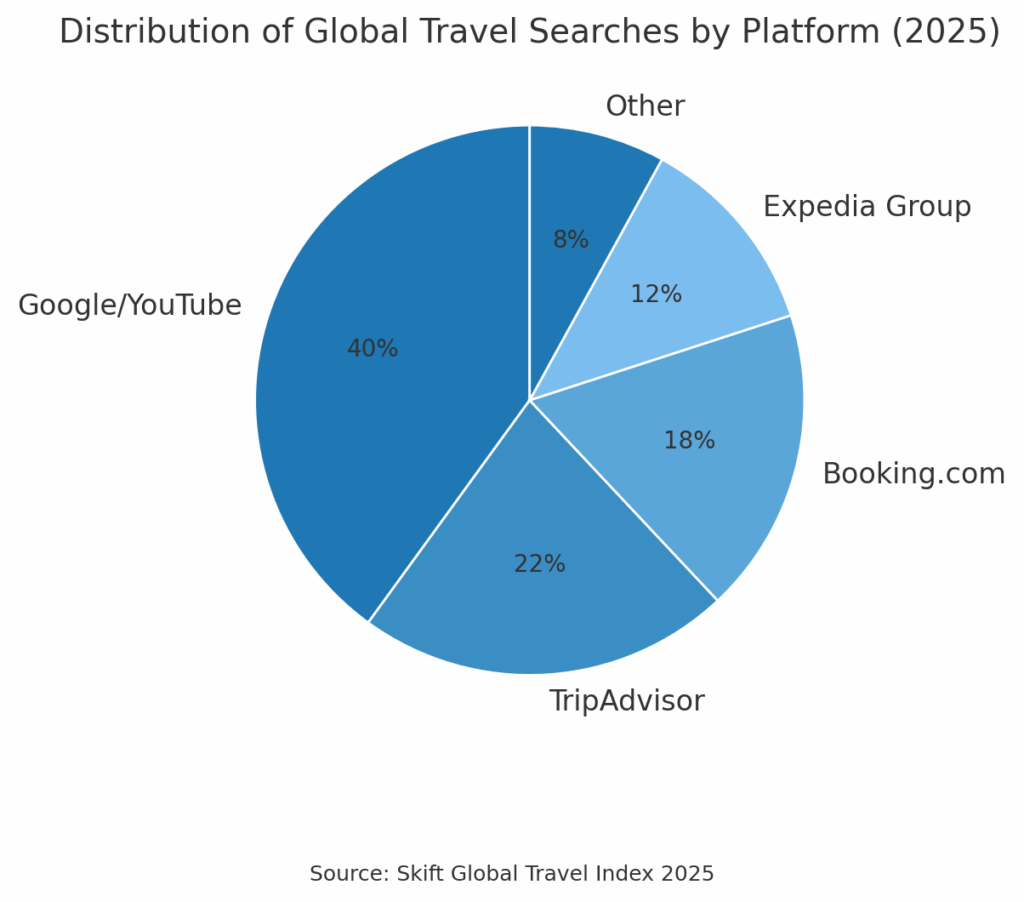
This misalignment becomes more consequential at scale. Entire tourism economies are being shaped by algorithmic visibility. Google Travel, TripAdvisor, and Booking.com collectively influence over 80 percent of global travel searches, according to Skift’s 2025 data index. When algorithms prioritize properties or destinations based on engagement metrics rather than quality or sustainability, the result is a feedback loop that amplifies over-tourism in popular sites while marginalizing smaller, local operators. In Venice, Bali, and Kyoto, local tourism boards have begun lobbying for algorithmic transparency after observing that AI-driven recommendation systems accelerated crowding during post-pandemic recovery periods. Technology that was meant to distribute opportunity has, in some cases, concentrated it.
Yet the benefits remain undeniable. Modern travel’s accessibility and efficiency have improved dramatically. McKinsey’s 2024 report on AI in travel found that predictive analytics and dynamic pricing have reduced operational waste in airlines by up to 15 percent, cutting delays and improving resource allocation. Similarly, ICT infrastructure has enabled real-time translation, biometric passport control, and intelligent routing, dramatically reducing friction across international travel. Cloud-based systems running on IaaS frameworks such as AWS and Google Cloud now underpin more than 60 percent of airline and hotel operations, according to Statista. The result is faster, more resilient travel infrastructure capable of handling disruptions from weather events, pandemics, or surges in demand.
The consumer-facing side of this transformation is equally visible. Apple’s integration of digital IDs and boarding passes within its Wallet ecosystem has streamlined security procedures, while Google Maps now offers multimodal navigation integrating walking, public transit, and ride-sharing in real time. AI concierges like Expedia’s ChatGPT plugin and Trip.com’s virtual assistant have replaced manual search fatigue with conversational trip planning. These tools are especially valuable for travelers exploring new regions or managing complex itineraries, offering adaptive solutions on the go.
However, this digitization comes at the cost of autonomy and transparency. As Big Tech platforms mediate travel discovery, the boundaries between convenience and manipulation blur. Academic research from the University of Surrey’s Digital Tourism Lab warns that “invisible intermediaries” — the algorithms that filter and rank options — can subtly shape traveler behavior toward commercial priorities. A user may believe they are exploring freely, while in reality, each click, hesitation, and keyword feeds into a feedback model optimized for platform profit rather than traveler benefit. The illusion of choice is one of modern travel’s quietest paradoxes.
Data privacy is another growing concern. A single international journey now generates thousands of digital interactions: biometric scans, transaction records, geolocation traces, hotel Wi-Fi logins, and online feedback. Each data point is stored, analyzed, and monetized. In 2025, the European Union’s General Data Protection Regulation (GDPR) audits found that nearly 40 percent of travel platforms were non-compliant with user consent standards, often burying data-sharing permissions deep within AI-enabled booking systems. For travelers, this means personal information — from passport scans to voice recordings — may circulate across global data centers with minimal oversight. The very systems that ensure safety and efficiency can simultaneously erode privacy.
Beyond data ethics, there is the problem of system dependency. Travelers today must rely on functioning digital networks — stable apps, mobile connectivity, QR-based ticketing — just to move. When these systems fail, disruption cascades. In July 2024, a global software outage linked to a routine cloud update temporarily grounded flights across multiple continents, stranding over 600,000 passengers. The incident, which originated from a major IaaS provider, revealed how interdependent global travel infrastructure has become. The same connectivity that enables agility also multiplies vulnerability.
Even at the experiential level, technology can distort authenticity. Over-personalization often sanitizes spontaneity. Predictive itinerary systems may optimize sightseeing routes to avoid crowds, but in doing so, they remove the element of unexpected discovery that defines genuine travel. Sociologists at the University of Amsterdam argue that algorithmic travel fosters “curated predictability,” producing experiences that feel efficient but emotionally flat. The traveler becomes both consumer and data source, guided not by curiosity but by code.
Nevertheless, examples of responsible innovation offer a more hopeful balance. In Japan, ANA Airlines’ AI-based sustainability platform now recommends carbon-efficient flight combinations, providing real-time offset tracking for passengers. In Singapore, Changi Airport’s biometric boarding gates cut processing time by 30 percent while maintaining rigorous data protection through encrypted verification. Start-ups in Kenya and Vietnam are using localized AI models to promote community-based tourism, connecting travelers with lesser-known rural destinations and distributing income more equitably. These initiatives show how AI and ICT can elevate both experience and ethics when implemented with transparency and purpose.
The challenge for the industry — and for travelers themselves — is to demand accountability without rejecting progress. Regulatory frameworks like the EU’s AI Act, data sovereignty policies in Asia, and global digital ID standards from IATA aim to establish clearer boundaries. Yet lasting change depends on cultural as much as technical awareness. Travelers can make informed choices by prioritizing platforms with transparent data practices, supporting local operators, and valuing experience over efficiency. Technology can enhance connection, but only if travelers remain conscious of the systems shaping their journeys.
For all its contradictions, the digital transformation of travel reflects humanity’s enduring desire to move, learn, and connect. The tools may evolve — from printed tickets to predictive analytics, from guidebooks to generative AI — but the essence remains: travel is still about exploration, perspective, and wonder. The goal of modern technology should not be to replace that human core, but to make it more accessible, sustainable, and resilient in a rapidly changing world. Whether the next generation of travel will serve the traveler or the algorithm depends on how consciously both industry and individuals navigate this new frontier.
Key Takeaways
- AI, ICT, and Big Tech have revolutionized travel efficiency and accessibility but risk over-centralizing control and eroding autonomy.
- Algorithmic recommendations can amplify over-tourism, bias, and misalignment with traveler intent.
- Cloud and IaaS systems improve resilience but increase systemic vulnerability and privacy risks.
- Ethical AI design, data transparency, and digital literacy are essential to preserving authentic, equitable travel.
- The future of travel depends on balancing optimization with human experience and maintaining curiosity amid automation.
Sources
Business Traveller — Tech’s Influence on Shaping Travel Is Having Untold and New Effects — Link
McKinsey — What AI Means for Travel — Now and in the Future — Link
World Travel & Tourism Council — AI and the Future of Seamless Journeys — Link
Cornell University — AI Personalization and Customer Experience in Hospitality — Link
University of Surrey — Digital Tourism and Algorithmic Influence — Link
Skift Research — Global Travel Index 2025 — Link
Statista — Cloud Infrastructure in the Global Travel Industry — Link
University of Amsterdam — Algorithmic Tourism and Experience Design — Link